
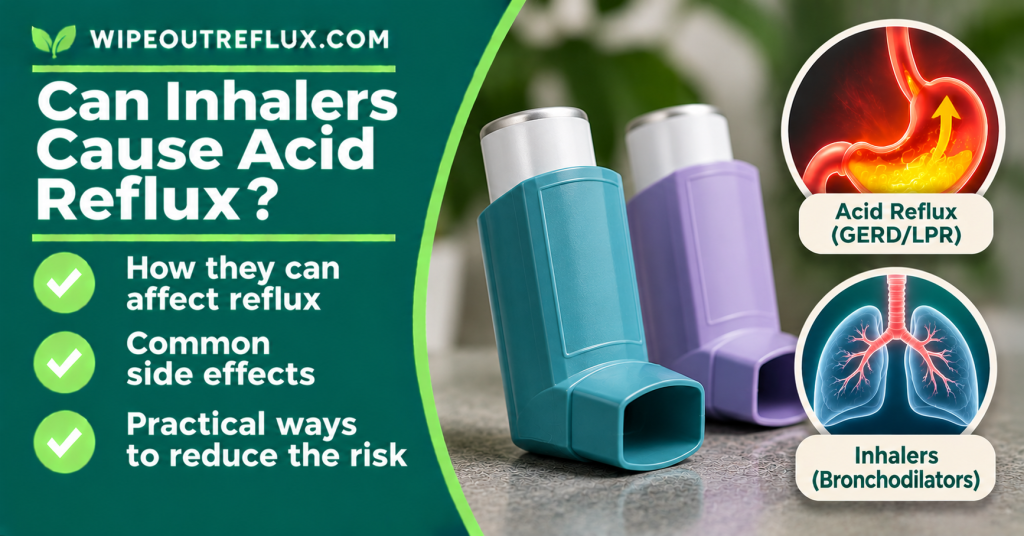
Some asthma and COPD inhalers can contribute to acid reflux, while others cause throat and esophageal symptoms that are easily mistaken for it. Reliever inhalers like albuterol (salbutamol) are beta-agonists, a class of drug that can relax the lower esophageal sphincter. One trial in people with asthma found nebulized albuterol lowered the sphincter’s pressure in a dose-dependent way. Ordinary inhaler puffs seem to have a much smaller effect, though, and a study in healthy volunteers found inhaled albuterol didn’t increase reflux.
Steroid (preventer) inhalers are a different story. They don’t cause reflux, but they commonly cause hoarseness, sore throat and thrush, and in one study, 37% of people using an inhaled steroid had a yeast infection in the esophagus. Those symptoms overlap heavily with silent reflux. The good news is that simple habits, like rinsing your mouth and using a spacer, prevent much of this, and you should never stop an inhaler because of reflux without speaking to your doctor.
Key Takeaways
- Beta-agonist relievers like albuterol can relax the lower esophageal sphincter, especially at higher, nebulized doses.
- In a study of healthy volunteers, standard inhaled albuterol didn’t lower LES pressure or increase reflux.
- Inhaled steroids increase the risk of oral thrush and hoarseness three- to five-fold, and the risk rises with dose.
- In one endoscopy study, 37% of people using inhaled fluticasone had esophageal thrush, compared with 0.3% of controls.
- Hoarseness, throat irritation and painful swallowing from steroid inhalers can mimic LPR or reflux esophagitis.
- Anticholinergic inhalers like tiotropium cause dry mouth, which reduces saliva’s natural acid protection.
- Rinsing and spitting after steroid inhalers, using a spacer, and treating reflux directly all help without compromising your breathing.
Asthma, COPD and Reflux: A Two-Way Street
Before looking at inhalers, it helps to know that asthma and reflux are tangled together anyway. Reflux symptoms are much more common in people with asthma, and reflux can trigger coughing and airway narrowing. Breathing hard during an asthma attack or a coughing fit also changes the pressures in your chest and abdomen in ways that can pull or push stomach contents upward.
So if you have asthma or COPD and reflux, the inhaler isn’t necessarily the cause. But it can be one piece of the puzzle. For the bigger picture, see asthma misdiagnosis and acid reflux and acid reflux and COPD.
Reliever Inhalers (Beta-Agonists)
Reliever inhalers like albuterol (salbutamol, Ventolin, ProAir) and long-acting versions like salmeterol and formoterol work by relaxing the smooth muscle around your airways. The problem is that the lower esophageal sphincter (LES) is also smooth muscle, and it has the same type of beta receptors.
The research is mixed and depends a lot on the dose:
- In a randomized, placebo-controlled trial in people with asthma, nebulized albuterol caused a dose-dependent drop in LES pressure, starting at doses as low as 2.5 mg. The researchers suggested reflux could follow bronchodilator treatment [Lacy et al., Digestive Diseases and Sciences, 2008].
- In a double-blind study in healthy volunteers, inhaled albuterol didn’t lower LES pressure or increase 24-hour acid reflux compared with placebo [Schindlbeck et al., JAMA, 1988].
A nebulizer usually delivers a much larger dose than a couple of puffs from a metered-dose inhaler, and more of it gets absorbed into the body. So the effect is most likely to matter if you use a nebulizer, use your reliever very frequently, or take oral beta-agonist tablets.
Beta-agonists also appear on lists of medications known to relax the LES. A large Swedish study found that long-term daily use of LES-relaxing drugs as a group was linked with more reflux and, over many years, a small increase in the risk of esophageal adenocarcinoma. The link almost disappeared after accounting for reflux symptoms, and the absolute risk was very low, with roughly 15,000 men needing to take such drugs daily for five years for one extra case [Lagergren et al., Annals of Internal Medicine, 2000]. The practical message isn’t to fear your inhaler, but to take any reflux it seems to trigger seriously and treat it.
If you’re using your reliever more than a few times a week, that’s also a sign your asthma isn’t well controlled, which is worth reviewing with your doctor for its own sake.
Steroid Inhalers (Preventers)
Inhaled corticosteroids, such as fluticasone (Flovent), budesonide (Pulmicort), beclomethasone and mometasone, and combination inhalers that contain them (like Advair and Symbicort), are the backbone of asthma control. They don’t relax the LES, but a good portion of each puff lands in your mouth and throat rather than your lungs, and some gets swallowed.
Throat irritation, hoarseness and thrush
A meta-analysis of 23 studies found that inhaled steroids increased the risk of oral thrush about three- to five-fold and hoarseness (dysphonia) to a similar degree, and doubled the risk of sore throat. Risk rose with higher doses. Using a dry-powder inhaler carried a somewhat lower risk than a metered-dose inhaler [Rachelefsky et al., Annals of Allergy, Asthma and Immunology, 2007].
Hoarseness, throat clearing, a raw throat and a feeling of irritation are also the classic symptoms of LPR. So someone using a steroid inhaler who develops these symptoms may be told they have silent reflux, or may assume it themselves, when the inhaler is actually the cause. Sometimes it’s both. I cover the reflux side in can acid reflux cause hoarseness and acid reflux and chronic laryngitis.
Thrush in the esophagus
This is the one most people have never heard of. A Japanese study performed endoscopies on 49 people using inhaled fluticasone and found esophageal candidiasis (yeast infection) in 37% of them, compared with just 0.3% of 700 control patients. It was particularly common in people with diabetes and those on higher doses. Reducing the steroid dose cleared the infection in four out of five patients [Kanda et al., The American Journal of Gastroenterology, 2003].
Esophageal thrush can cause pain or burning when swallowing, a feeling of food sticking, and chest discomfort, all of which are easily put down to reflux. It won’t respond to acid-reducing medication, so if your “reflux” isn’t improving on a PPI and you use a steroid inhaler, it’s worth mentioning to your doctor. A white coating in the mouth can be a clue, though esophageal thrush can be present without it. See white coating on tongue.
Steroid tablets like prednisone are a different matter and can cause heartburn more directly, which I cover in does prednisone cause heartburn.
Anticholinergic Inhalers
Inhalers like tiotropium (Spiriva), ipratropium (Atrovent), umeclidinium and glycopyrronium are mainly used for COPD. Dry mouth is their most common side effect: a meta-analysis of tiotropium trials in more than 8,000 patients found it was reported more often than with placebo [Barr et al., Thorax, 2006].
Saliva is one of your main defenses against reflux. It’s rich in bicarbonate, and each swallow washes acid back down and neutralizes it. A dry mouth means less of this protection, so acid and pepsin linger longer in the esophagus and throat. Anticholinergics as a class can also relax the LES when absorbed into the body, and they were the drug class most strongly linked to reflux-related problems in the Swedish study above [Lagergren et al., Annals of Internal Medicine, 2000]. Inhaled versions are absorbed much less than tablets, so the effect is likely smaller. See acid reflux and dry mouth.
Other Asthma Medications
- Theophylline (an oral tablet, not an inhaler) is well known to lower LES pressure and increase reflux, and is used less often today partly for this reason.
- Oral steroids like prednisone, used for flare-ups, can cause heartburn and stomach irritation.
- Montelukast doesn’t have a strong link with reflux.
How to Reduce Reflux and Throat Symptoms From Inhalers
Your inhalers keep your airways safe, so the goal is to reduce side effects, not stop treatment. Don’t change or stop any inhaler without talking to your doctor or asthma nurse.
- Rinse, gargle and spit after every steroid inhaler dose. This removes the steroid left in your mouth and throat. Spit the water out rather than swallowing it.
- Use a spacer with metered-dose inhalers. It means more medication reaches your lungs and less lands in your mouth and throat.
- Get your technique checked. Poor technique leaves more drug in the throat. Your pharmacist or asthma nurse can watch you use it.
- Ask about the lowest effective steroid dose once your asthma is controlled, since side effects rise with dose.
- Ask about a dry-powder device if you get frequent hoarseness or thrush on a metered-dose inhaler.
- Keep your asthma well controlled. Needing your reliever often means more beta-agonist exposure and more coughing, both of which can worsen reflux.
- Sip water through the day to counter dry mouth from anticholinergic inhalers.
- Treat the reflux itself. Avoid late meals, raise the head of your bed, cut back on trigger foods, and use an alginate after meals and at bedtime. See alginates for acid reflux.
Getting reflux under control may even help your breathing, because reflux can irritate the airways and trigger coughing. A structured diet makes that much easier, which is why I put together the Wipeout Diet Plan.
When to See a Doctor
See your doctor or asthma nurse if you have:
- Pain or burning when swallowing, or food sticking, especially if you use a steroid inhaler
- White patches in your mouth or throat
- Hoarseness lasting more than a few weeks
- Reflux that started or got worse after a new inhaler or a dose increase
- Needing your reliever inhaler more than usual
- A persistent cough that’s worse after meals or lying down (see reflux cough)
Seek urgent help for severe breathlessness, chest pain, or an asthma attack that isn’t responding to your reliever.
Conclusion
Inhalers can play a role in reflux, but in different ways depending on the type. Beta-agonist relievers like albuterol can relax the lower esophageal sphincter, mainly at higher, nebulized doses, while standard puffs seem to have little effect. Steroid preventers don’t cause reflux, but they commonly cause hoarseness, throat irritation and thrush, which can extend into the esophagus and closely mimic silent reflux or esophagitis. And anticholinergic inhalers dry the mouth, reducing saliva’s natural protection against acid.
The fixes are simple and don’t require giving up the medication that keeps you breathing: rinse and spit after steroid doses, use a spacer, get your technique checked, aim for the lowest effective dose, keep your asthma well controlled, and treat the reflux directly. If your symptoms aren’t responding to reflux treatment, ask whether thrush or another inhaler side effect could be the real cause.
For the reflux side, the Wipeout Diet Plan is my complete, in-depth guide to calming reflux through food choices, meal timing and daily habits. It was designed first and foremost for LPR, the throat-based form that causes hoarseness and throat clearing, but it works just as well for GERD and everyday heartburn because it targets the same root causes.
Frequently Asked Questions
Can albuterol cause acid reflux?
It can relax the lower esophageal sphincter, especially at higher nebulized doses. Standard inhaler puffs seem to have little effect on reflux in studies of healthy volunteers.
Can steroid inhalers cause heartburn?
They don’t usually cause reflux, but they can cause throat irritation, hoarseness and esophageal thrush, which can feel like burning, especially when swallowing.
Can Symbicort or Advair cause acid reflux?
These combine a steroid with a long-acting beta-agonist. The beta-agonist part can theoretically relax the LES, and the steroid part can irritate the throat. Rinsing and spitting after use helps.
Can inhalers cause silent reflux symptoms?
Steroid inhalers commonly cause hoarseness and throat irritation that closely mimic LPR. It’s worth considering the inhaler as a cause if throat symptoms started after beginning one.
Should I stop my inhaler if it gives me reflux?
No. Talk to your doctor or asthma nurse first. Changes to technique, device, dose or timing usually help without putting your breathing at risk.
Can Spiriva cause acid reflux?
Tiotropium commonly causes dry mouth, which reduces saliva’s protective effect against acid. Sipping water and sugar-free gum can help.
How do I know if I have esophageal thrush from my inhaler?
Pain or burning when swallowing, food sticking and white patches in the mouth are clues. It needs an endoscopy to confirm, and it won’t improve with acid medication.
Research & References
- [Lacy et al., Digestive Diseases and Sciences, 2008] — Randomized, placebo-controlled crossover trial in asthmatic patients showing nebulized albuterol caused a dose-dependent drop in LES basal pressure from 2.5 mg.
- [Schindlbeck et al., JAMA, 1988] — In ten healthy volunteers, inhaled albuterol didn’t reduce LES pressure or peristaltic amplitude, and 24-hour reflux was similar to placebo.
- [Lagergren et al., Annals of Internal Medicine, 2000] — Swedish case-control study linking long-term daily use of LES-relaxing drugs, including beta-agonists and anticholinergics, to esophageal adenocarcinoma via reflux, with a high number needed to harm.
- [Rachelefsky et al., Annals of Allergy, Asthma and Immunology, 2007] — Meta-analysis of 23 studies: inhaled steroids raised oral candidiasis (OR 3.2–5.4) and dysphonia (OR 3.7–5.7) risk dose-dependently, with about double the risk of pharyngitis.
- [Kanda et al., The American Journal of Gastroenterology, 2003] — Esophageal candidiasis found in 37% of 49 patients using inhaled fluticasone versus 0.3% of 700 controls; dose reduction cleared it in four of five.
- [Barr et al., Thorax, 2006] — Meta-analysis of nine tiotropium trials (8,002 COPD patients) showing reduced exacerbations and increased reports of dry mouth.

David Gray
12 years living with LPR · Consultant & researcher
I've lived with LPR for twelve years — the misdiagnoses, the PPI courses that did nothing, the slow work of figuring out what actually helps. Wipeout Reflux is where I translate the research into plain terms for people stuck in the same place. Every claim here is sourced to peer-reviewed work, and I consult one-to-one with LPR sufferers.