
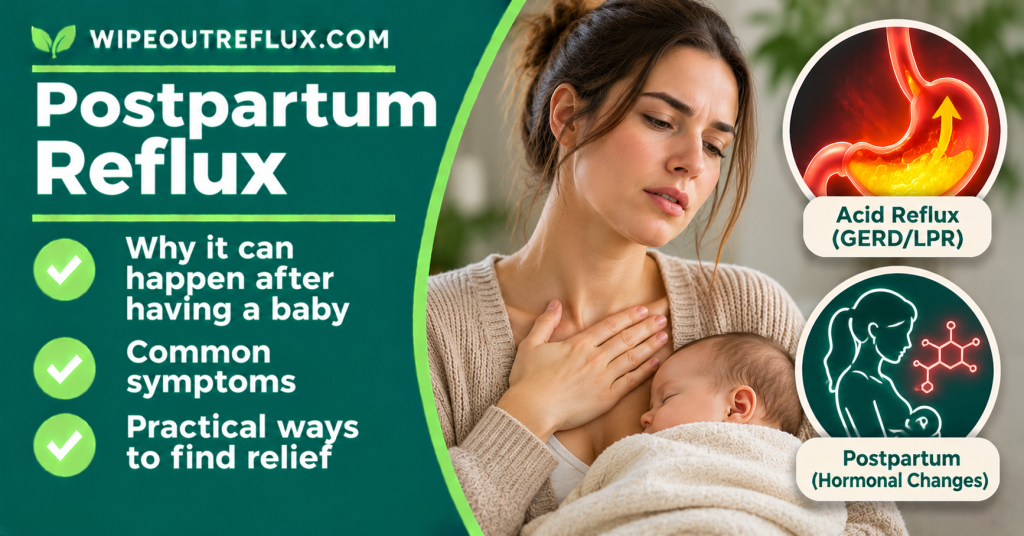
For most women, heartburn fades quickly after giving birth. The hormone progesterone, which relaxes the valve at the bottom of the esophagus during pregnancy, drops sharply after delivery, and in one classic study the valve pressure was back to normal within 1 to 4 weeks postpartum. The baby is no longer pushing up on your stomach either, so the two biggest drivers of pregnancy heartburn disappear.
But postpartum acid reflux doesn’t always go away on schedule. Extra weight that hasn’t come off yet, broken sleep, stress, a stretched and weaker core, rushed meals and some medications can all keep it going. In a longitudinal study, women who had been pregnant were more likely to have frequent reflux one year after delivery than women who hadn’t. The good news is that this kind of reflux usually responds well to simple changes, and there are treatments that are considered safe while breastfeeding.
Key Takeaways
- Pregnancy heartburn is driven mainly by progesterone relaxing the lower esophageal sphincter (LES) and the growing baby pressing on the stomach.
- LES pressure returned to normal within 1 to 4 weeks of delivery in a classic study, so most women improve within weeks.
- Reflux that lingers is usually kept going by retained weight, sleep deprivation, stress, irregular eating and a weakened core.
- Women who had been pregnant were more likely to have frequent reflux symptoms one year postpartum (4.7%) than women who hadn’t (1.3%).
- Sleep deprivation makes the esophagus more sensitive to acid, so the same reflux can feel worse when you are exhausted.
- Alginates like Gaviscon, famotidine and omeprazole are all generally considered compatible with breastfeeding, but check with your doctor or pharmacist first.
- Severe upper belly pain with headache, vision changes or swelling in the weeks after birth is not heartburn until proven otherwise. Get checked urgently.
Why You Get Heartburn During Pregnancy
To understand why postpartum acid reflux sometimes lingers, it helps to know what caused it in the first place. There are two main drivers.
The first is hormonal. Progesterone relaxes smooth muscle throughout the body, and that includes the lower esophageal sphincter, the ring of muscle that is supposed to keep stomach contents in the stomach. In a study that measured pregnant volunteers at 12, 24 and 36 weeks, LES pressure was reduced at every point in pregnancy and was lowest at 36 weeks. Stomach acid output did not change. The problem was the valve, not the acid [Van Thiel et al., Gastroenterology, 1977].
The second is mechanical. As the baby grows, the uterus pushes the stomach upward and raises the pressure inside the abdomen. That pressure squeezes the stomach and pushes against an already weakened valve. You can read more about this in my guide to acid reflux and pregnancy.
How Long Does Postpartum Acid Reflux Last?
For most women, not long. In the same study, LES pressure measured 1 to 4 weeks after delivery was back to normal [Van Thiel et al., Gastroenterology, 1977]. Researchers who studied Gaviscon in pregnancy describe pregnancy reflux as transient and mostly resolving after birth [Strugala et al., ISRN Obstetrics and Gynecology, 2012].
A rough timeline looks like this:
- First few days: heartburn often eases noticeably once the baby is no longer pressing on your stomach.
- First 2 to 6 weeks: hormones settle and the valve regains its strength. Many women are symptom-free by now.
- Beyond 6 to 8 weeks: if you are still getting regular heartburn, something else is likely keeping it going.
For a minority, it doesn’t fully settle. A Spanish study followed 263 women through pregnancy and for a year after delivery, with matched controls. At one year postpartum, frequent reflux symptoms were more common in the women who had been pregnant (4.7%) than in the controls (1.3%). Women who had occasional reflux before pregnancy, and those who gained more weight during pregnancy, were at higher risk of symptoms [Rey et al., American Journal of Gastroenterology, 2007].
So if your heartburn after pregnancy is still hanging around months later, you are not imagining it, and you are not alone.
Why Heartburn After Pregnancy Can Linger
1. Weight that hasn’t come off yet
Pregnancy weight usually takes months to lose, and extra weight around the middle raises abdominal pressure in the same way the baby did. In the Nurses’ Health Study of more than 10,000 women, reflux risk rose steadily with BMI. Even in women of normal weight, a BMI increase of more than 3.5 units was linked to almost three times the risk of frequent reflux symptoms [Jacobson et al., New England Journal of Medicine, 2006].
That is useful to know because it means even modest weight loss can help. You don’t need to rush it. Losing weight slowly and sensibly while you recover and, if you are breastfeeding, while you feed, is the right approach. See acid reflux and weight loss.
2. Sleep deprivation
Night feeds wreck sleep, and poor sleep makes reflux feel worse. In a crossover study, people with reflux disease who slept 3 hours or less felt acid in their esophagus faster and rated it as more intense than after nights of good sleep. Healthy people didn’t show this effect [Schey et al., Gastroenterology, 2007].
In other words, the same amount of reflux can hurt more when you are exhausted. This is one reason new mothers often describe heartburn that seems out of proportion to what they ate.
3. Stress and survival-mode eating
The newborn weeks are stressful, and stress makes the esophagus more sensitive too. On top of that, eating patterns go out of the window. Many new parents skip meals during the day, then eat one large meal late at night, or graze on whatever is quick: toast, biscuits, coffee, chocolate. Large late meals are one of the most reliable reflux triggers there is. I cover the stress link in can stress cause acid reflux.
4. A weaker core and abdominal wall
Pregnancy stretches the abdominal muscles, and some women develop a gap between the two sides of the six-pack muscles (diastasis recti). There isn’t good research directly linking this to reflux, but a weak core can make it harder to control pressure inside the abdomen when you lift, bend or strain. Constant lifting and bending to pick up a baby, a car seat and a changing bag is exactly that kind of strain. If you notice reflux mainly when lifting or bending, see heartburn when bending over.
5. Constipation
Constipation is very common after birth, especially after a cesarean, with iron supplements or with strong painkillers. Straining raises abdominal pressure, and a backed-up bowel slows stomach emptying. I explain the connection in constipation and acid reflux.
6. Hormonal contraception
Many women start a progestin-only pill, implant or hormonal IUD after birth, especially while breastfeeding. Progestins are synthetic relatives of progesterone, and some women notice their reflux returns or worsens after starting one. The evidence is limited, but it is worth thinking about if your symptoms came back around the time you started contraception. See birth control and acid reflux.
7. A hiatal hernia
Repeated pregnancies and raised abdominal pressure can contribute to a hiatal hernia, where part of the stomach slides up through the diaphragm. If your reflux is persistent, worse lying down and doesn’t respond well to simple changes, this is worth discussing with your doctor. See hiatal hernia symptoms in women.
Postpartum Reflux in the Throat
Not all reflux after pregnancy shows up as heartburn. Some women develop throat clearing, a hoarse voice, a lump-in-the-throat feeling or a nagging cough instead. This is laryngopharyngeal reflux (LPR), also called silent reflux, and it is easy to blame on a cold picked up from visitors or on tiredness.
In LPR, small amounts of refluxed material reach the throat, which has far less protection than the esophagus. The enzyme pepsin can stick to throat tissue and keep causing irritation long after the reflux event. If that sounds familiar, have a look at LPR symptoms.
Treatments Safe While Breastfeeding
Always check with your doctor, midwife or pharmacist before starting anything while breastfeeding, especially if your baby was premature or has health problems. That said, the main reflux treatments are generally considered compatible with breastfeeding.
Alginates (Gaviscon and similar)
Alginates form a foam raft on top of your stomach contents that physically blocks reflux. They work mostly in the stomach and very little is absorbed. Liquid Gaviscon was licensed for use in pregnancy, and in a study of 144 pregnant women it was rated a success in about 9 out of 10, with no safety concerns [Strugala et al., ISRN Obstetrics and Gynecology, 2012]. Taken after meals and at bedtime, an alginate is often the most useful first step. See alginates for acid reflux and my review of Gaviscon Advance.
Antacids
Calcium carbonate antacids like Tums are fine for occasional heartburn and are minimally absorbed into breast milk. They only neutralize acid for a short time, though, and calcium can be constipating. I cover the options in which antacids are safe in pregnancy, and the same principles apply after birth.
Famotidine
According to the NIH’s LactMed drug database, famotidine passes into breast milk in amounts lower than the doses given directly to newborns, and it isn’t expected to cause any adverse effects in breastfed infants [LactMed, National Library of Medicine, Famotidine]. It is a sensible option for night-time symptoms.
Omeprazole and other PPIs
LactMed notes that maternal omeprazole doses of 20 mg a day produce low levels in milk and wouldn’t be expected to cause adverse effects in breastfed infants [LactMed, National Library of Medicine, Omeprazole]. PPIs are best kept for frequent or severe symptoms, at the lowest dose that works, for a set period. See is omeprazole safe in pregnancy and famotidine vs omeprazole.
Practical Ways to Ease Postpartum Acid Reflux
- Eat smaller meals more often. Keep easy, reflux-friendly snacks within reach, like bananas, oatmeal, rice cakes and plain yogurt, so you aren’t starving and then eating a huge meal. The Wipeout Diet Plan has simple reflux-friendly meals and snacks if you’d rather not think about it.
- Front-load your eating. Have your biggest meal earlier in the day and keep the evening meal lighter. See how long before bed you should stop eating.
- Don’t lie flat after eating. That includes lying down for a nap with the baby straight after lunch. Feed upright where you can.
- Raise the head of your bed. Bed risers or a wedge help with night reflux, and are worth it when you are up and down all night. See how to raise the head of your bed.
- Watch the coffee. Caffeine is understandable with a newborn, but several strong coffees on an empty stomach is a common trigger. Have it with food and try a lower-acid brew.
- Bend at the knees. When lifting the baby or the car seat, squat rather than folding at the waist, and avoid lifting straight after a meal.
- Rebuild your core gently. Once you are cleared for exercise, gentle core and pelvic floor work, plus diaphragmatic breathing, can help. See breathing exercises for acid reflux.
- Keep your bowels moving. Fluids, fiber and walking help both constipation and reflux.
- Grab sleep where you can. Even one or two longer stretches, with a partner covering a feed, may make reflux feel less intense.
When to See a Doctor
Get help urgently, the same day, if you have pain in the upper belly (especially under the right ribs) along with a severe headache, vision changes, swelling of the face or hands, or shortness of breath in the weeks after birth. Preeclampsia can develop after delivery and can be mistaken for heartburn. Chest pain with breathlessness also needs urgent assessment. See heartburn or heart attack.
Book a routine appointment if you notice:
- Heartburn that hasn’t improved by 6 to 8 weeks after birth
- Symptoms that wake you most nights or need daily medication
- Difficulty swallowing, or food getting stuck
- Vomiting, black stools or unexplained weight loss
- Pain after fatty meals, which can point to the gallbladder rather than reflux (pregnancy raises gallstone risk). See gallbladder attack vs acid reflux.
Conclusion
Postpartum acid reflux usually fades within weeks, because the two things that caused it in pregnancy, high progesterone and a baby pressing on your stomach, are gone. Studies show the lower esophageal sphincter typically recovers its normal pressure within a month of delivery.
When heartburn after pregnancy does linger, it is usually because new-parent life keeps it going. Retained weight, broken sleep, stress, rushed late meals, constipation, lifting and bending, and sometimes hormonal contraception all play a part. A minority of women still have frequent symptoms a year later, especially if they had some reflux before pregnancy. The upside is that these drivers are mostly things you can work on, and alginates, famotidine and omeprazole are all generally considered compatible with breastfeeding if you need extra help.
If you want a clear plan rather than guessing which foods and habits are to blame, the Wipeout Diet Plan is my complete, in-depth guide to calming reflux through food, meal timing and daily routines, with simple meals that fit around a busy life. I originally built it for LPR, the stubborn throat-based kind of reflux, but because it targets the same root causes, it works just as well for everyday heartburn after pregnancy.
Frequently Asked Questions
How long does acid reflux last after pregnancy?
For most women it improves within days to a few weeks of delivery, as progesterone falls and the stomach is no longer compressed. Heartburn lasting beyond 6 to 8 weeks usually has another cause worth looking at.
Why do I still have heartburn after giving birth?
Common reasons include retained pregnancy weight, sleep deprivation, stress, large late meals, constipation, frequent lifting and bending, and hormonal contraception. Pre-existing reflux that pregnancy made worse can also continue.
Can pregnancy cause permanent acid reflux?
It isn’t usually permanent, but a minority of women have frequent symptoms a year after birth. Those with reflux before pregnancy and higher pregnancy weight gain seem to be at higher risk.
Is Gaviscon safe while breastfeeding?
Alginates like Gaviscon act mainly in the stomach and are minimally absorbed, so they are generally considered compatible with breastfeeding. Check the specific product with your pharmacist.
Can I take omeprazole while breastfeeding?
The NIH’s LactMed database says 20 mg a day produces low levels in breast milk and isn’t expected to harm a breastfed baby. Talk to your doctor before starting it.
Is famotidine safe while breastfeeding?
LactMed reports that the amount reaching the baby through milk is lower than doses given to newborns, and no special precautions are required. Your doctor can confirm it suits you.
Can postpartum reflux affect my throat?
Yes. Some women get throat clearing, hoarseness, a lump-in-the-throat feeling or a cough rather than heartburn. This is silent reflux (LPR), and the same lifestyle changes help.
Research & References
- [Van Thiel et al., Gastroenterology, 1977] — LES pressure was reduced throughout pregnancy, lowest at 36 weeks, and normal again at 1 to 4 weeks postpartum, with no change in acid output. Rising progesterone was the likely cause.
- [Rey et al., American Journal of Gastroenterology, 2007] — In 263 women followed through pregnancy, frequent reflux symptoms at one year postpartum were more common than in controls (4.7% vs 1.3%). Prior occasional reflux and pregnancy weight gain were risk factors.
- [Jacobson et al., New England Journal of Medicine, 2006] — In 10,545 women, reflux symptoms rose with BMI, and a BMI gain of more than 3.5 in normal-weight women nearly tripled the odds of frequent symptoms.
- [Schey et al., Gastroenterology, 2007] — After a night of 3 hours or less sleep, people with erosive reflux disease felt infused acid sooner and more intensely than after good sleep.
- [Strugala et al., ISRN Obstetrics and Gynecology, 2012] — In 144 pregnant women, Liquid Gaviscon was rated successful in about 90% by investigators and patients, with no safety concerns.
- [LactMed, National Library of Medicine, Famotidine] — Infant exposure through breast milk is below doses used in newborns, and no adverse effects are expected in breastfed infants.
- [LactMed, National Library of Medicine, Omeprazole] — Maternal doses of 20 mg daily produce low milk levels that are not expected to cause adverse effects in breastfed infants.

David Gray
12 years living with LPR · Consultant & researcher
I've lived with LPR for twelve years — the misdiagnoses, the PPI courses that did nothing, the slow work of figuring out what actually helps. Wipeout Reflux is where I translate the research into plain terms for people stuck in the same place. Every claim here is sourced to peer-reviewed work, and I consult one-to-one with LPR sufferers.