
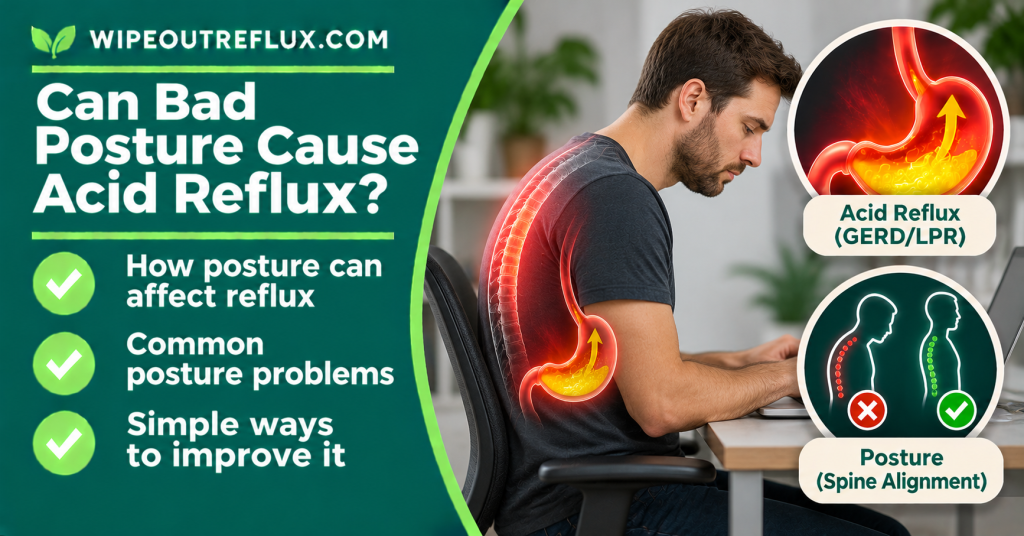
Yes, bad posture can contribute to acid reflux. When you slouch, your chest folds down toward your hips and squeezes your stomach. That raises the pressure inside your abdomen, and the extra pressure can push stomach contents up past the valve at the bottom of your esophagus. It’s the same mechanism that makes tight belts, bending over and big meals trigger heartburn.
The strongest research comes from people with a permanently stooped spine, where reflux is much more common. In one study, 35% of people with a curved lower back had reflux disease, compared with under 10% of people without. Everyday slouching at a desk or over a phone is milder, and there are no trials on it directly. But it works the same way, and the fixes are free and easy: sit tall after meals, bring screens up to eye level, loosen your waistband and practice belly breathing.
Key Takeaways
- Slouching compresses the abdomen, which raises pressure on the stomach and can push acid up past the lower esophageal sphincter.
- People with a stooped spine (kyphosis) have much higher rates of both heartburn-type reflux and silent reflux in the throat.
- In a 5-year study, people whose spine became more stooped and whose back muscles weakened were more likely to develop reflux.
- A tight waist belt was enough to cause short bursts of acid reflux in healthy volunteers, showing how sensitive the valve is to abdominal squeezing.
- Diaphragmatic breathing after meals cut reflux episodes in people with upright reflux by strengthening the valve area.
- The most important time for good posture is the 2 to 3 hours after eating.
- Simple fixes: sit tall, raise screens, hinge at the hips rather than curling forward, loosen tight clothing and strengthen your back.
How Slouching Squeezes Your Stomach
Your stomach sits just under your diaphragm, in a space with fixed walls at the back (your spine) and flexible walls at the front (your abdominal muscles). Anything that shrinks that space squeezes the stomach.
When you sit upright, your ribcage is lifted and there is room between your chest and your hips. When you slump, your ribcage drops toward your pelvis, your belly bunches up and the space shrinks. Your stomach, especially when it’s full, gets squeezed from above and in front.
That squeeze matters because reflux is partly a pressure battle. The lower esophageal sphincter (LES) and the diaphragm around it hold the line. The stomach pushes against them. When stomach pressure rises higher than the valve can hold, acid and pepsin escape upward. I explain the valve’s role in detail in the lower esophageal sphincter and acid reflux.
Interestingly, people with upright reflux seem to run higher stomach pressure after meals. In one study, patients with reflux that happened mainly while upright had average stomach pressures of 12 mmHg after a meal, compared with 7 mmHg in healthy controls. Straining (the Valsalva maneuver) caused reflux in 65% of the patients [Halland et al., American Journal of Gastroenterology, 2021]. Anything that adds to that pressure, slouching included, makes reflux more likely.
What the Research Shows
A stooped spine and reflux
Most of the research on posture and reflux comes from Japan, where researchers have studied kyphosis, a forward curve of the spine that leaves people permanently stooped. These are more severe cases than everyday slouching, but they show the effect clearly.
- In 245 middle-aged and older adults, a more curved lower spine, poorer standing balance and weaker back muscles were all independent risk factors for reflux symptoms [Imagama et al., European Spine Journal, 2012].
- When the same research group followed people without reflux for 5 years, those whose lower spine became more curved, whose posture leaned further forward and whose back muscles weakened were significantly more likely to develop reflux [Imagama et al., European Spine Journal, 2019].
- In older people with osteoporosis, reflux symptom scores rose with the angle of the lower spine curve and the number of lower spine fractures [Miyakoshi et al., Osteoporosis International, 2009].
The 5-year study is the most interesting because it shows a sequence. Posture got worse first, and reflux followed.
Posture and silent reflux in the throat
Posture doesn’t only affect heartburn. In a study comparing 20 people with a curved lower back with 31 controls, 25% of the kyphosis group had laryngopharyngeal reflux (LPR) on a symptom score, compared with just 3% of controls. For heartburn-type reflux, the figures were 35% versus 10%. Hoarseness and swallowing problems were especially common in the stooped group [Matsuzaki et al., Journal of Voice, 2016].
That’s relevant if your main symptoms are throat clearing, a croaky voice or a lump in your throat. See LPR symptoms.
Squeezing the waist causes reflux, even in healthy people
The best experimental evidence that abdominal squeezing causes reflux comes from a study on waist belts. Researchers studied 24 healthy volunteers with no reflux symptoms, with and without a tightened belt. The belt caused part of the stomach to slide up into the diaphragm opening (a partial hiatal hernia) and increased acid exposure just above the stomach. The effect was strongest in people carrying extra weight around the middle [Lee et al., Gut, 2014].
Slouching isn’t the same as a tight belt, but both reduce the space around your stomach. Slumping in tight jeans after a big lunch combines the two. See tight clothing and acid reflux and hiatal hernia and reflux.
What we don’t know yet
To be honest about the evidence: no one has run a trial taking people who slouch at desks, teaching them to sit up straight and measuring their reflux. The spine studies are mostly in older adults with structural curves, not younger people who slouch out of habit. So I wouldn’t expect posture alone to cure significant reflux. But the mechanism is solid, the risk of trying is zero, and many people notice the difference within days.
Everyday Postures That Make Reflux Worse
- Slumping on the sofa after dinner. A full stomach, a folded body and often a tight waistband. This is the classic one.
- Hunching over a laptop. Low screens pull your head and shoulders forward and your chest down.
- Looking down at your phone. Long periods with your head dropped and back rounded, often while sitting low.
- Low, deep car seats. Your hips sit lower than your knees and your belly folds, especially on long drives after eating.
- Curling forward to pick things up. Bending at the waist rather than the hips or knees. See heartburn when bending over.
- Eating hunched over a desk or a plate on your lap. You start compressing your stomach at the moment it’s filling up.
Posture Fixes That Ease Heartburn
1. Prioritize the 2 to 3 hours after meals
Your stomach is fullest and most acidic after eating, so this is when posture matters most. Eat sitting upright at a table, and stay upright for a while afterward. A gentle walk is even better than sitting, because it keeps you upright and helps the stomach empty. See does walking after meals help acid reflux and is lying down after eating bad.
2. Set up your desk properly
- Raise your screen so the top is around eye level. A laptop stand or a pile of books works.
- Use a separate keyboard and mouse so you don’t have to hunch over the laptop.
- Sit with your hips slightly higher than your knees, which opens the angle at your hips and gives your belly more room.
- Sit back in the chair with your lower back supported, rather than perching forward.
- Stand up and move every 30 to 45 minutes.
3. Bring your phone up
Hold your phone closer to eye level rather than dropping your head to it, especially after meals. Propping it on a stand while you eat lunch is a simple change.
4. Hinge, don’t curl
When you pick something up, bend at your knees and hips and keep your back long, rather than curling forward from the waist. This keeps the squeeze off your stomach.
5. Loosen your waistband
Tight belts, high-waisted jeans and shapewear add to the pressure that slouching creates. If you can’t change the clothes, at least loosen the belt a notch after meals.
6. Practice diaphragmatic breathing
Your diaphragm wraps around the LES and acts as a second valve. Training it can strengthen the barrier against reflux.
In the same study, slow belly breathing after a meal raised the pressure at the valve during each in-breath and cut post-meal reflux episodes from 2.6 to 0.36 per patient. Acid exposure in the two hours after the meal fell from 11.8% to 5.2% [Halland et al., American Journal of Gastroenterology, 2021]. In an Austrian trial, 4 weeks of breathing training reduced acid exposure and improved quality of life, and people who kept it up for 9 months used far less PPI medication [Eherer et al., American Journal of Gastroenterology, 2012].
Good posture and good breathing go together. It’s very hard to breathe deeply into your belly while slumped. I show you how to do it in breathing exercises for acid reflux.
7. Strengthen your back
Weak back muscles were linked to reflux in both of the Imagama studies. Exercises that strengthen the upper and lower back, like rows, back extensions, bird dogs and planks, help you hold an upright posture without effort. Avoid heavy straining and inverted positions straight after meals. See exercise and acid reflux.
8. Mind your weight around the middle
Extra weight around the waist raises abdominal pressure all the time, and it amplified the effect of the waist belt in the Lee study. Even a modest loss can help. See acid reflux and weight loss.
Posture While You Sleep
Posture still matters when you’re lying down. Lying flat removes gravity’s help in keeping acid down. Raising the head of your bed by 6 to 8 inches, or using a wedge, helps, and sleeping on your left side tends to reduce reflux. Avoid propping yourself up on a pile of pillows, though. That bends you at the waist and can squeeze your stomach, which is the opposite of what you want. See the best sleeping position for silent reflux.
Posture Is Only Part of the Picture
Better posture reduces the pressure on your stomach. It doesn’t change what’s in your stomach. If you are still eating large, fatty or acidic meals, especially late in the evening, posture fixes will only go so far. Meal size matters a lot. See does overeating cause acid reflux.
The combination works best: smaller, reflux-friendly meals, eaten upright, with time to digest before you slump or lie down. That’s the approach behind the Wipeout Diet Plan.
When to See a Doctor
- Heartburn more than twice a week despite lifestyle changes
- Difficulty swallowing, or food sticking
- Unexplained weight loss, vomiting or black stools
- Chest pain, especially with breathlessness, sweating or pain spreading to the arm or jaw
- A noticeable increase in stooping, height loss or back pain, which can be a sign of spinal fractures from osteoporosis
Conclusion
Bad posture can cause acid reflux, or at least make it worse. Slouching folds your body over your stomach, raising the pressure inside your abdomen and pushing against the valve that keeps acid down. People with a stooped spine have much higher rates of both heartburn and silent reflux, and a 5-year study found that worsening posture and weakening back muscles came before new reflux. Even a tight belt was enough to cause acid reflux in healthy volunteers.
Everyday slouching hasn’t been studied directly, so posture alone won’t fix serious reflux. But it’s one of the easiest things to change. Sit tall at a table to eat, stay upright for a couple of hours afterward, raise your screens, hinge rather than curl when you bend, loosen tight waistbands and practice belly breathing. Many people notice a difference within days.
To get the full benefit, pair better posture with the right meals. The Wipeout Diet Plan is my in-depth guide to calming reflux through food, portion size, meal timing and daily habits. I designed it first for LPR, the throat-based form of reflux, but because it works on the same underlying mechanisms, it helps just as much with classic heartburn.
Frequently Asked Questions
Can bad posture cause acid reflux?
It can contribute. Slouching compresses your abdomen and raises pressure on your stomach, which can push acid past the lower esophageal sphincter, especially after a meal.
Does sitting up straight help heartburn?
Yes, for many people. Sitting upright gives your stomach room and keeps gravity working for you. It matters most in the 2 to 3 hours after eating.
Can slouching cause silent reflux?
Possibly. People with a stooped spine had much higher rates of laryngopharyngeal reflux in one study. Everyday slouching likely has a smaller effect, but the mechanism is the same.
Why do I get heartburn when I sit at my desk?
Hunching over a laptop folds your body over your stomach. Combined with a recent meal, coffee or a tight waistband, that pressure can push acid upward.
Is it bad to slouch after eating?
Yes. Your stomach is fullest after a meal, so squeezing it then has the biggest effect. Sit upright or take a short walk instead.
Can a posture corrector help acid reflux?
It may remind you to sit up straight, but don’t rely on one that straps tightly around your middle, as that adds abdominal pressure. Strengthening your back is a better long-term fix.
Does stomach breathing really help reflux?
Studies suggest it does. Diaphragmatic breathing after meals cut reflux episodes in one trial, and four weeks of training reduced acid exposure in another.
Research & References
- [Halland et al., American Journal of Gastroenterology, 2021] — In upright reflux patients, post-meal stomach pressure was higher than in controls, and diaphragmatic breathing increased LES pressure and reduced post-meal reflux events and acid exposure.
- [Imagama et al., European Spine Journal, 2012] — In 245 adults, lumbar kyphosis, poor sagittal balance, weaker back muscles and number of daily medications were independent risk factors for reflux symptoms.
- [Imagama et al., European Spine Journal, 2019] — Over 5 years, worsening lumbar kyphosis and spinal inclination, weaker back muscles and sarcopenia predicted new-onset reflux in 178 adults.
- [Miyakoshi et al., Osteoporosis International, 2009] — In 112 osteoporosis patients, lumbar kyphosis angle and lumbar vertebral fractures were linked to higher reflux symptom scores.
- [Matsuzaki et al., Journal of Voice, 2016] — LPR (25% vs 3%) and GERD (35% vs 10%) were significantly more common in people with lumbar kyphosis than in controls.
- [Lee et al., Gut, 2014] — In healthy volunteers, a tightened waist belt and central obesity caused partial hiatal herniation and increased acid exposure just above the stomach.
- [Eherer et al., American Journal of Gastroenterology, 2012] — Four weeks of abdominal breathing training reduced acid exposure and improved quality of life, and continued training cut PPI use at 9 months.

David Gray
12 years living with LPR · Consultant & researcher
I've lived with LPR for twelve years — the misdiagnoses, the PPI courses that did nothing, the slow work of figuring out what actually helps. Wipeout Reflux is where I translate the research into plain terms for people stuck in the same place. Every claim here is sourced to peer-reviewed work, and I consult one-to-one with LPR sufferers.