
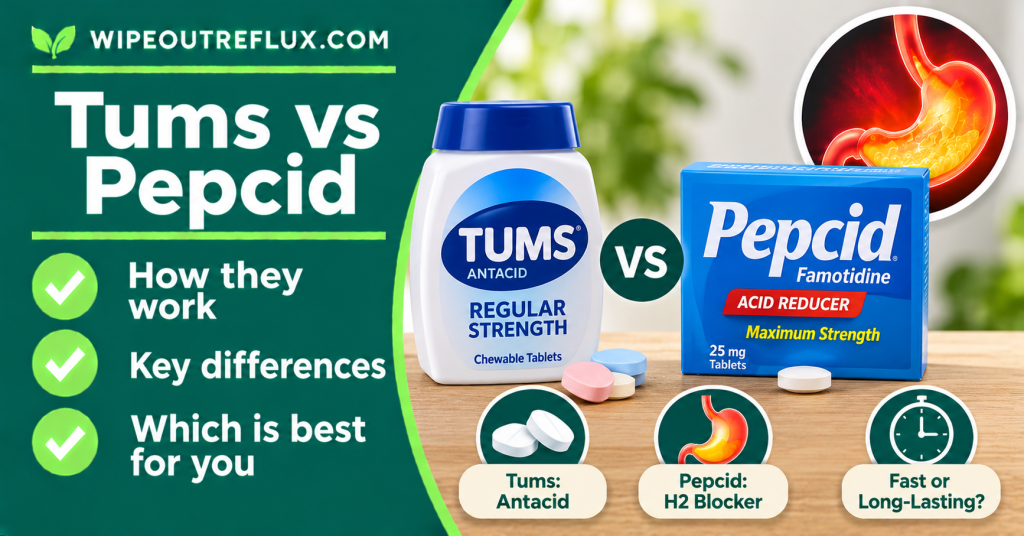
Tums works faster, but Pepcid lasts much longer. Tums (calcium carbonate) neutralizes acid that’s already in your stomach, so it starts working within minutes, but the effect only lasts about an hour. Pepcid (famotidine) blocks your stomach from making acid in the first place. It takes around an hour to kick in, but its effect can last nine hours or more.
So the simple rule is: Tums for fast relief of heartburn that’s happening right now, Pepcid for preventing heartburn or controlling it for longer stretches, like overnight. You can take them together, and there’s even a product, Pepcid Complete, that combines both. Below I’ll explain how each one works, what the studies show, and how to choose for your symptoms.
Key Takeaways
- Tums is an antacid. It neutralizes existing stomach acid and works within minutes, but wears off in about an hour.
- Pepcid is an H2 blocker. It reduces acid production, starts working in roughly an hour, and lasts up to 9 hours or more.
- In a head-to-head trial, Tums started working right away but lasted only 60 minutes, while Pepcid took 90 minutes to start and lasted at least 9 hours. Peak strength was similar.
- Pepcid works best taken before a trigger meal or at bedtime. Tums is best for occasional heartburn after it starts.
- You can take Tums and Pepcid together. Pepcid Complete combines famotidine with calcium carbonate and magnesium hydroxide in one tablet.
- Pepcid can lose some effect when taken every day, as the body builds tolerance within days.
- Regular heavy use of Tums can cause constipation and, rarely, a calcium overload called milk-alkali syndrome.
- Neither tackles pepsin or stops reflux happening, so for silent reflux (LPR) an alginate is often a better fit.
Tums vs Pepcid at a Glance
- Active ingredient: Tums is calcium carbonate. Pepcid AC is famotidine.
- Type of drug: Tums is an antacid. Pepcid is an H2 receptor blocker (an “acid reducer”).
- How it works: Tums neutralizes acid that’s already there. Pepcid reduces how much acid your stomach makes.
- Starts working: Tums within minutes. Pepcid in about an hour.
- Lasts: Tums around an hour. Pepcid up to 9 to 12 hours.
- Best for: Tums for occasional heartburn happening now. Pepcid for preventing heartburn, or for night-time symptoms.
- Main downsides: Tums doesn’t last and heavy use adds a lot of calcium. Pepcid is slow to start, and daily use can lead to tolerance.
How Tums Works
Tums is calcium carbonate, a simple alkaline compound. When it hits the acid in your stomach, it reacts with it chemically and neutralizes it. There’s no waiting for your body to respond. As soon as the chewed tablet reaches your stomach, the acid starts being neutralized. You can read more about this class of drug in my article on what an antacid is.
The catch is that it only deals with acid that’s already there. Your stomach keeps making more, and once the tablet is used up, or it’s emptied out of your stomach along with your meal, the effect is gone. That’s why Tums gives quick but short relief.
How Pepcid Works
Pepcid (famotidine) works upstream. Histamine is one of the main signals that tells the acid-making cells in your stomach lining to switch on. Famotidine blocks the histamine-2 (H2) receptors on those cells, so they make less acid in the first place.
Because the drug has to be absorbed into your bloodstream and reach your stomach lining, it takes time to start. But once it’s working, it keeps acid production down for many hours. It doesn’t do anything to acid that’s already sitting in your stomach, which is why it’s not the fastest fix for heartburn you’re feeling right now. For more detail, see my articles on famotidine dosage and famotidine side effects.
What the Research Shows: Speed vs Staying Power
The clearest comparison comes from a study published in JAMA in 1996 that tested exactly these two products. Healthy volunteers took Pepcid AC 10 mg, Tums 1,000 mg or a placebo an hour after a meal, and researchers measured acid continuously for the next nine hours [Feldman, JAMA, 1996].
- Tums started working immediately, neutralizing acid in the first 30 minutes, but its effect lasted only 60 minutes.
- Pepcid didn’t start working until after 90 minutes, but its effect lasted at least 540 minutes (9 hours), right to the end of the study.
- At their peaks, the two were roughly equally strong.
A second study in fasting volunteers found the same pattern. An antacid (Rennie, a calcium-magnesium carbonate tablet similar to Tums) raised stomach pH above 3 in a median of 5.8 minutes, versus 70.1 minutes for famotidine 10 mg. But over the four hours measured, the antacid kept pH above 3 just 10.4% of the time, compared with 56.6% for famotidine [Netzer et al., Alimentary Pharmacology and Therapeutics, 1998]. The researchers concluded that antacids are better for rapid relief, while H2 blockers suit preventing symptoms, such as at night.
So neither one is simply “stronger.” They’re built for different jobs.
Which Should You Choose?
Choose Tums if…
- You get heartburn occasionally, a few times a month or less
- The heartburn is happening right now and you want relief fast
- It’s a one-off after a heavy or spicy meal
The label directions for Tums Extra Strength are to chew 2 to 4 tablets as symptoms occur, with no more than 10 tablets in 24 hours, and not to use the maximum dose for more than two weeks unless a doctor advises it [TUMS Extra Strength 750 product label, Haleon]. I go through safety in more depth in are Tums safe for acid reflux?
Choose Pepcid if…
- You know a trigger meal is coming and want to prevent heartburn
- Your heartburn tends to hit at night or lasts for hours
- You need relief for longer than an antacid can give
Maximum Strength Pepcid AC directions are one tablet to relieve symptoms, or one tablet 10 to 60 minutes before eating food or drinking drinks that cause heartburn, with no more than two tablets in 24 hours. The label says not to use it for more than 14 days without asking a doctor [Maximum Strength Pepcid AC Drug Facts Label]. There’s a good reason bedtime is a popular time to take it, which I explain in why take famotidine at night.
Choose both if…
You’re in the middle of a heartburn episode and want relief that’s both fast and lasting. Tums covers the first hour while Pepcid gets going.
Can You Take Tums and Pepcid Together?
Yes. In fact, that’s exactly what Pepcid Complete is: 10 mg of famotidine plus 800 mg of calcium carbonate and 165 mg of magnesium hydroxide in one chewable tablet. The antacid gives quick relief and the famotidine takes over as it wears off. A review of the antacid research notes this combination has been studied in clinical trials alongside the single-ingredient products [Garg et al., Journal of International Medical Research, 2022].
One question people ask is whether the antacid stops the famotidine being absorbed. In a bioavailability study, famotidine levels in the blood were essentially the same whether it was taken alone or in the combination tablet with calcium carbonate and magnesium hydroxide [Zhai et al., Arzneimittelforschung, 2008]. So taking them together isn’t a problem.
If you’re deciding between the two Pepcid versions, I compare them directly in Pepcid AC vs Pepcid Complete.
Side Effects and Safety
Tums
At normal, occasional doses, Tums is very safe. The issues come with frequent, heavy use:
- Constipation and gas. Calcium is constipating, and the reaction with acid releases carbon dioxide, which can cause burping. I cover this in do antacids cause burping and gas?
- Too much calcium. Milk-alkali syndrome is a combination of high blood calcium, kidney impairment and metabolic alkalosis. It has made a comeback largely because of over-the-counter calcium carbonate [Medarov, Mayo Clinic Proceedings, 2009].
- Kidney stones. In a large study of women, calcium taken as supplements was linked to a higher risk of kidney stones, whereas calcium from food was linked to a lower risk [Curhan et al., Annals of Internal Medicine, 1997].
- Drug interactions. Antacids can reduce the absorption of some medicines, including certain antibiotics and thyroid medication. Spacing them a few hours apart usually helps, but check with your pharmacist.
Pepcid
Famotidine is well tolerated by most people. Headache, dizziness and constipation or diarrhea are the commonest complaints. In older adults and people with reduced kidney function, it can build up and occasionally cause confusion, so the dose often needs lowering [Famotidine Tablets Prescribing Information].
The bigger practical issue is tolerance. Studies show the acid-reducing effect of H2 blockers starts to weaken from the second day of regular dosing [McRorie et al., World Journal of Gastrointestinal Pharmacology and Therapeutics, 2014]. That’s why Pepcid works best on an as-needed basis, and why daily users often feel it “stops working.” I go into this in why famotidine stops working.
Tums and Pepcid in Pregnancy
Heartburn is very common in pregnancy, and both products are widely used. Tums is often the first choice, but there are dosing limits to stick to. I cover this in can you take Tums while pregnant? and which antacids are safe in pregnancy. Always check with your doctor or midwife before taking any medication while pregnant.
What About Silent Reflux (LPR)?
This is where both Tums and Pepcid fall short. If your reflux shows up as throat clearing, hoarseness, a lump in the throat or post-nasal drip, the key player is pepsin, a digestive enzyme that can stick to the delicate tissue of your throat and get reactivated by acid later.
Tums only neutralizes acid in your stomach for an hour, and Pepcid only reduces acid. Neither stops reflux from happening or does anything about pepsin that’s already in your throat. For LPR, an alginate is usually the more useful over-the-counter option. It forms a raft on top of your stomach contents that physically blocks reflux, especially after meals and at bedtime. See my guide to alginates for acid reflux and my comparison of Tums vs Gaviscon. I’ve also written about Pepcid for silent reflux specifically.
Medication also works far better when it’s not fighting your diet. If you’re reaching for Tums or Pepcid most days, the Wipeout Diet Plan shows you how to cut out the triggers behind those episodes in the first place.
When to See a Doctor
Occasional heartburn is normal. But talk to your doctor if:
- You need Tums or Pepcid more than twice a week, or for longer than two weeks
- Your heartburn keeps coming back as soon as you stop
- You have trouble or pain swallowing, unexplained weight loss, vomiting, or black or bloody stools
- You have chest pain that you’re unsure about, especially with breathlessness, sweating or pain spreading to your arm or jaw. Treat this as an emergency until proven otherwise.
Frequent heartburn may be GERD, which may need a different treatment plan. My guide to the best over-the-counter medicine for acid reflux covers the other options, including PPIs and alginates.
Conclusion
Tums and Pepcid aren’t really competitors. They’re tools for different situations. Tums neutralizes the acid that’s already there, so it’s the fastest way to put out heartburn that’s flaring right now, but it wears off in about an hour. Pepcid turns down acid production, so it’s slower to start but can cover you for most of a day or a whole night. The research backs this up: in a direct comparison, Tums worked within the first 30 minutes and was gone after an hour, while Pepcid took 90 minutes to start and was still working nine hours later.
If you get the odd bout of heartburn, Tums is a perfectly good choice. If you know when your heartburn is coming, Pepcid beforehand makes more sense. And if you need both speed and duration, taking them together, or using Pepcid Complete, is safe and effective.
But if you’re needing either one regularly, that’s a sign the underlying problem isn’t being dealt with. Neither drug stops reflux from happening, and neither does anything about pepsin, which matters a lot if your symptoms are in your throat. That’s where the Wipeout Diet Plan comes in. It’s my complete, step-by-step guide to calming reflux through what and when you eat, built from 12 years of managing it myself. I designed it around silent reflux first, the throat-based kind that’s hardest to shift, but since it targets the same root causes, it works equally well if your symptoms are classic heartburn. Get the diet right and you’ll find yourself reaching for the Tums a lot less often.
Frequently Asked Questions
Is Tums or Pepcid better for heartburn?
It depends on the situation. Tums is better for quick relief because it starts neutralizing acid within minutes. Pepcid is better for preventing heartburn or for longer relief, because it lasts up to 9 hours or more but takes about an hour to start working.
Can I take Tums and Pepcid at the same time?
Yes. They work in different ways and don’t cancel each other out. Pepcid Complete combines famotidine with the same type of antacid in Tums, and studies show the antacid doesn’t affect how well famotidine is absorbed. Stick to the maximum doses on each label.
How long after taking Pepcid can I take Tums?
You don’t need to wait. You can take Tums at the same time as Pepcid or at any point afterward for breakthrough heartburn, as long as you stay within the daily limits on each label.
Which works faster, Tums or Pepcid?
Tums. In studies, calcium carbonate antacids started working within minutes, while famotidine took 70 to 90 minutes to have a measurable effect on stomach acid.
Is Pepcid stronger than Tums?
Not exactly. In a direct comparison, their peak acid-reducing effects were similar. The difference is timing: Pepcid’s effect lasts far longer, while Tums acts faster but fades within an hour.
Can I take Pepcid every day?
Over-the-counter Pepcid shouldn’t be used for more than 14 days without talking to a doctor. Daily use can also lead to tolerance, where it becomes less effective. If you need it daily, ask your doctor about a proper diagnosis and treatment plan.
Is Tums or Pepcid better for night-time reflux?
Pepcid, generally. Tums wears off within an hour, which won’t cover you through the night. Pepcid taken before bed can reduce acid for many hours. For night-time throat symptoms, an alginate before bed is also worth considering.
Research & References
- [Feldman, JAMA, 1996] — Randomized, placebo-controlled crossover trial in 18 volunteers: Tums (1,000 mg) neutralized acid within 30 minutes but lasted only 60 minutes, while Pepcid AC (10 mg) began working after 90 minutes and lasted at least 540 minutes, with similar peak potency.
- [Netzer et al., Alimentary Pharmacology and Therapeutics, 1998] — Crossover trial in 16 fasting volunteers: an antacid raised stomach pH above 3 in a median 5.8 minutes versus 70.1 minutes for famotidine 10 mg, but famotidine kept pH above 3 for 56.6% of four hours versus 10.4% for the antacid.
- [Garg et al., Journal of International Medical Research, 2022] — Review of antacid evidence concluding they remain a mainstay of reflux self-management, and summarizing trials comparing antacids, H2 blockers and famotidine-antacid combinations.
- [Zhai et al., Arzneimittelforschung, 2008] — Crossover bioavailability study in 12 healthy volunteers showing calcium carbonate and magnesium hydroxide in a fixed-dose combination had no significant effect on famotidine absorption.
- [McRorie et al., World Journal of Gastrointestinal Pharmacology and Therapeutics, 2014] — Review showing tolerance to H2 blockers is detectable from the second day of dosing, across drugs, doses and patient groups.
- [Medarov, Mayo Clinic Proceedings, 2009] — Review of milk-alkali syndrome describing its triad of high calcium, kidney impairment and metabolic alkalosis, and its resurgence driven by over-the-counter calcium carbonate.
- [Curhan et al., Annals of Internal Medicine, 1997] — Large prospective cohort study in women finding supplemental calcium was associated with higher kidney stone risk, whereas dietary calcium was associated with lower risk.
- [Maximum Strength Pepcid AC Drug Facts Label] — OTC directions: one tablet to relieve symptoms or 10 to 60 minutes before trigger foods, a maximum of two tablets in 24 hours, and ask a doctor before using for more than 14 days.
- [Famotidine Tablets Prescribing Information] — Prescribing information covering adult dosing, dose reduction in kidney impairment and central nervous system effects in patients with reduced kidney function.
- [TUMS Extra Strength 750 product label, Haleon] — Product directions: chew 2 to 4 tablets as symptoms occur, no more than 10 tablets in 24 hours, and do not use the maximum dosage for more than two weeks unless advised by a doctor.

David Gray
12 years living with LPR · Consultant & researcher
I've lived with LPR for twelve years — the misdiagnoses, the PPI courses that did nothing, the slow work of figuring out what actually helps. Wipeout Reflux is where I translate the research into plain terms for people stuck in the same place. Every claim here is sourced to peer-reviewed work, and I consult one-to-one with LPR sufferers.