
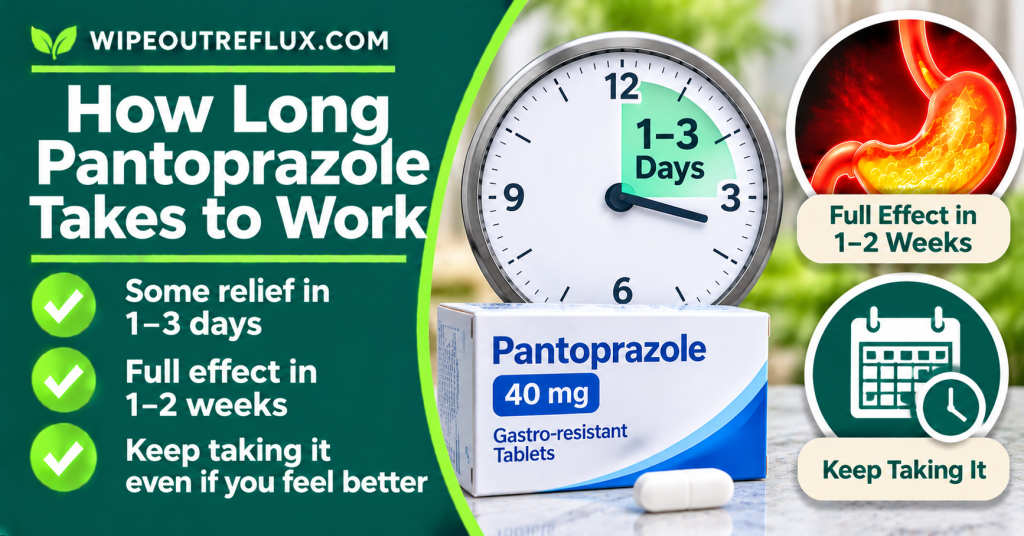
Pantoprazole starts reducing stomach acid within about 2.5 hours of your first dose, and some people notice less heartburn on the very first day. But it takes around 3 to 7 days of daily dosing to reach its full acid-blocking effect, so most people feel a clear difference within the first week.
Healing is slower. An inflamed esophagus usually takes 4 to 8 weeks to heal, and if your reflux affects your throat (LPR or silent reflux), improvement often takes 2 to 3 months or longer. If you’ve taken pantoprazole properly for 8 weeks and nothing has changed, that’s a sign to revisit the diagnosis or the plan rather than just keep going.
Key Takeaways
- Pantoprazole begins blocking acid within hours. A single 40 mg dose reduced acid output by about half within 2.5 hours.
- Full effect takes several days. After 7 days of daily dosing, acid output was reduced by around 85%.
- Some people get heartburn relief from day 1, and many are heartburn-free within the first week.
- Healing of erosive esophagitis takes 4 to 8 weeks. In trials, 72% were healed at 4 weeks and 88% at 8 weeks on 40 mg.
- LPR (silent reflux) is much slower. Many people need 3 to 6 months, and some don’t respond to PPIs at all.
- Taking it 30 minutes before breakfast, every day, makes it work faster and better.
- Pantoprazole isn’t designed for instant relief. For heartburn right now, an antacid or alginate is quicker.
- If there’s no improvement after 8 weeks of correct use, talk to your doctor rather than just increasing the dose.
Why Pantoprazole Doesn’t Work Instantly
To understand the timeline, you need to know what pantoprazole actually does. It’s a proton pump inhibitor (PPI). Your stomach lining contains millions of tiny “proton pumps” that push acid into your stomach. Pantoprazole switches them off permanently, one by one.
There are two catches. First, it can only switch off pumps that are actively working at the moment the drug is in your blood. Pumps that are resting get missed. Second, your body keeps making new pumps all the time. About 20% of the pumps are replaced every 24 hours [Shin and Kim, Journal of Neurogastroenterology and Motility, 2013].
So each dose knocks out a portion of the pumps. The next day’s dose knocks out more, plus some of the new ones. It takes a few days of this before you reach a steady state where most pumps are switched off. That’s why PPIs build up their effect rather than hitting full strength on day one. The review above puts that steady state at about three days.
This is also why pantoprazole isn’t the best choice for heartburn you’re feeling right now. An antacid neutralizes acid within minutes. Pantoprazole works on tomorrow’s acid more than today’s.
The Pantoprazole Timeline
First few hours
Pantoprazole reaches peak levels in your blood about 2.5 hours after a 40 mg tablet. In the official prescribing information, a single 40 mg dose reduced acid output by an average of 51% within 2.5 hours [Protonix Prescribing Information, Pfizer]. So it is doing something from the first day. It’s just not at full power yet.
Day 1 to day 3
Many people feel some improvement in the first couple of days. In the main dose-finding trial for erosive esophagitis, people taking pantoprazole 40 mg experienced symptom relief on day 1 of treatment [Richter and Bochenek, The American Journal of Gastroenterology, 2000].
Even the lower 20 mg dose works quickly for many. In a reanalysis of two trials, 39% of people on pantoprazole 20 mg were completely free of heartburn by day 2, compared with 14.5% on the older acid reducer nizatidine [Haag and Holtmann, Clinical Therapeutics, 2010]. UK over-the-counter pantoprazole notes it may take 2 to 3 days of daily use to notice improvement [Pantoprazole 20 mg (OTC) Summary of Product Characteristics, emc].
Day 4 to day 7
By the end of the first week, pantoprazole is close to full strength. After 7 days of once-daily 40 mg dosing, average acid output was reduced by 85%, and by more than 95% in half of people tested [Protonix Prescribing Information, Pfizer]. This is when most people notice a clear, steady difference in their heartburn.
Weeks 2 to 4
Symptoms keep improving as the esophagus starts to heal. For people taking 20 mg for milder reflux, UK guidance says symptom relief is generally achieved within 2 to 4 weeks [Pantoprazole 20 mg Summary of Product Characteristics, emc].
In the erosive esophagitis trial, 72% of people on 40 mg were healed at 4 weeks, versus 55% on 20 mg and 14% on placebo [Richter and Bochenek, The American Journal of Gastroenterology, 2000].
Weeks 4 to 8
This is the standard healing window. By 8 weeks, 88% of people on pantoprazole 40 mg had a healed esophagus in that same trial. A pooled analysis of two trials also found that being free of symptoms was a strong predictor of healing [Bochenek et al., Alimentary Pharmacology and Therapeutics, 2004]. So if your symptoms have gone, that’s a good sign the damage is healing too.
How Long Does Pantoprazole Take to Work for LPR?
This is where the timeline changes dramatically. If your reflux shows up as throat clearing, hoarseness, a lump in the throat, a chronic cough or post-nasal drip, expect it to take months rather than weeks.
In a study of 127 people with LPR, only 28.1% had a high or complete response at three months. Almost half (47.1%) needed six or even nine months, and the visible signs in the throat improved more slowly than the symptoms [Lechien et al., The Laryngoscope, 2021]. A later study of 159 people with confirmed LPR found that a one-month course was enough for about a third, but early non-responders could need three to nine months [Lechien, Otolaryngology–Head and Neck Surgery, 2024].
Why so slow? The tissue in your throat is far more delicate than the lining of your esophagus, so it takes longer to recover. And acid isn’t the main problem in LPR. The damage is driven largely by pepsin, a digestive enzyme that reaches the throat during reflux, sticks to the tissue, and gets reactivated by acid, including acid from food and drink. Pantoprazole lowers stomach acid, but it doesn’t stop reflux reaching your throat and doesn’t remove pepsin that’s already there. I explain this in why PPIs don’t work for LPR.
That’s why, for LPR, I always recommend combining medication with an alginate after meals and before bed, and with a low-acid diet that stops reactivating pepsin. The Wipeout Diet Plan sets that diet out step by step.
How to Make Pantoprazole Work Faster
You can’t force a PPI to reach full strength in hours, but you can make sure it isn’t slower than it needs to be:
- Take it 30 minutes before breakfast. PPIs can only block active pumps, and eating switches pumps on. A crossover study found a PPI taken before breakfast kept stomach acid in the damaging range for 17.2% of the day, versus 42.0% when taken without a meal afterward [Hatlebakk et al., Alimentary Pharmacology and Therapeutics, 2000]. Taking it at bedtime on an empty stomach is one of the commonest reasons it underperforms.
- Take it every day. The effect builds over several days of consistent dosing. Taking it on and off resets the clock.
- Swallow it whole. The coating protects the drug from stomach acid until it’s absorbed.
- Use an antacid or alginate for breakthrough symptoms. These work within minutes and don’t interfere with pantoprazole. See my guide to alginates for acid reflux.
- Cut down your triggers. Large meals, late eating, alcohol and very acidic or fatty food all make reflux harder to control, whatever medication you’re on.
For more on dose and timing, see my pantoprazole dosage guide.
Is Pantoprazole Slower Than Other PPIs?
All the PPIs follow the same build-up pattern, so the difference in onset between them is small. My guides to how long omeprazole takes to work and how long Nexium takes to work show a very similar timeline. Milligram for milligram, pantoprazole is less potent, which is why the standard dose is 40 mg. I compare them in pantoprazole vs omeprazole.
The genuinely faster option is a newer type of drug called a potassium-competitive acid blocker. Vonoprazan reaches full acid suppression much faster than a PPI, and in a large trial it healed erosive esophagitis in 92.9% of people by 8 weeks, compared with 84.6% on the PPI lansoprazole [Laine et al., Gastroenterology, 2023]. I cover it in Voquezna (vonoprazan) for acid reflux.
What If Pantoprazole Isn’t Working?
If you’ve taken pantoprazole correctly for 8 weeks with little or no improvement, it’s time to rethink rather than just wait longer. It’s more common than you’d think. When people with ongoing symptoms despite PPIs were tested with pH-impedance monitoring, only 9% still had too much acid reflux. 36% had a sensitive esophagus reacting to normal amounts of reflux, and 55% had symptoms that weren’t caused by reflux at all [Roman et al., Neurogastroenterology and Motility, 2015].
In other words, when pantoprazole “doesn’t work,” it’s often because acid wasn’t the main problem in the first place. Common reasons include:
- Taking it at the wrong time, or not every day
- Non-acid or weakly acidic reflux, which a PPI can’t fix
- LPR, where pepsin rather than acid is doing most of the damage
- A sensitive esophagus, or a different condition such as eosinophilic esophagitis or a motility problem
- Bile reflux, or a large hiatal hernia
Your doctor may suggest checking your technique, trying twice-daily dosing, switching drugs, or testing. My article on acid reflux medication not working goes through each option.
See a doctor promptly whatever your timeline if you have difficulty or pain swallowing, unexplained weight loss, persistent vomiting, or black or bloody stools.
How Long Does Pantoprazole Last After You Stop?
Because pantoprazole permanently disables the pumps it hits, its effect outlasts the drug itself. The tablet’s half-life is only about an hour, but the acid-reducing effect lasts more than 24 hours. After the last dose, acid production returned to normal within a week [Protonix Prescribing Information, Pfizer].
After a longer course, stopping can bring a temporary rebound of acid as your stomach adjusts. That’s why I recommend tapering. See getting off PPIs and acid rebound.
Conclusion
Pantoprazole starts working within hours of the first dose, but it’s a slow builder rather than a quick fix. Expect some improvement in the first few days, a clear difference by the end of the first week, and healing of an inflamed esophagus over 4 to 8 weeks. That’s simply how PPIs work: each daily dose switches off more acid pumps until most of them are out of action.
The two things that make the biggest difference to how quickly it works are timing and consistency. Take it every day, about 30 minutes before breakfast, and use an antacid or alginate for breakthrough symptoms while it builds up. If you have LPR, be patient but realistic. Throat symptoms often take three to six months, and for many people a PPI on its own isn’t enough, because it doesn’t deal with pepsin.
That’s the gap the Wipeout Diet Plan was designed to fill. It’s my complete, step-by-step approach to calming reflux through food choice, meal timing and the daily habits that matter most, drawn from 12 years of managing reflux myself. I built it first for LPR, the stubborn throat-based kind, but since it works on the same root causes, it’s just as effective for GERD and heartburn. Used alongside your medication, it can help you get results sooner, and give you a realistic path to needing less medication over time with your doctor’s support.
Frequently Asked Questions
How quickly does pantoprazole relieve heartburn?
Some people notice relief on day 1, and many are heartburn-free within the first few days. In one analysis, 39% of people on pantoprazole 20 mg had no heartburn by day 2. Full effect takes about a week of daily dosing.
Can I take pantoprazole as needed for instant relief?
It’s not ideal for instant relief, because it takes hours to start and days to reach full strength. For heartburn that’s happening now, an antacid or alginate works within minutes. Pantoprazole 20 mg can be used on demand for milder reflux, but it works best taken daily.
How long does pantoprazole take to heal the esophagus?
Usually 4 to 8 weeks. In clinical trials of pantoprazole 40 mg, 72% of people with erosive esophagitis were healed at 4 weeks and 88% at 8 weeks.
How long does pantoprazole take to work for a sore throat or LPR?
Much longer than for heartburn. Studies suggest only around a quarter to a third of people with LPR respond well within one to three months, and many need six months or more. Some don’t respond to PPIs at all, because pepsin rather than acid is driving the symptoms.
Why do I feel worse after starting pantoprazole?
Side effects such as headache, nausea or diarrhea can appear in the first week and usually settle. If your reflux symptoms seem worse, check that you’re taking it before a meal. Persistent worsening is worth discussing with your doctor.
Does pantoprazole work faster if I take it twice a day?
Twice-daily dosing can give stronger acid suppression, but it should only be done if your doctor prescribes it. Taking your existing dose correctly, before breakfast and every day, makes a big difference on its own.
Should pantoprazole be taken on an empty stomach?
Ideally, take it on an empty stomach about 30 minutes before your first meal. The meal then switches on the acid pumps while the drug is in your bloodstream, which helps it block more of them.
Research & References
- [Protonix Prescribing Information, Pfizer] — Official labeling: a single 40 mg dose reduced acid output by 51% within 2.5 hours, rising to 85% after 7 days of once-daily dosing, with acid secretion returning to normal within a week of stopping.
- [Shin and Kim, Journal of Neurogastroenterology and Motility, 2013] — Review of PPI pharmacology establishing that steady-state acid inhibition takes about three days and that roughly 20% of proton pumps are newly made every 24 hours.
- [Richter and Bochenek, The American Journal of Gastroenterology, 2000] — Trial of 603 patients with erosive esophagitis: healing was 72% at 4 weeks and 88% at 8 weeks on pantoprazole 40 mg, with symptom relief from day 1 of treatment.
- [Haag and Holtmann, Clinical Therapeutics, 2010] — Post hoc analysis of two trials: 39.0% of patients on pantoprazole 20 mg had complete heartburn relief by day 2, versus 14.5% on nizatidine.
- [Pantoprazole 20 mg (OTC) Summary of Product Characteristics, emc] — UK over-the-counter product information noting that tablets may need to be taken for 2 to 3 consecutive days to improve symptoms.
- [Pantoprazole 20 mg Summary of Product Characteristics, emc] — UK prescription product information stating symptom relief is generally achieved within 2 to 4 weeks, with a further 4 weeks if needed.
- [Bochenek et al., Alimentary Pharmacology and Therapeutics, 2004] — Pooled analysis of two trials showing pantoprazole controlled heartburn and regurgitation better than placebo or nizatidine, and that absence of symptoms strongly predicted healing.
- [Lechien et al., The Laryngoscope, 2021] — Study of 127 LPR patients: only 28.1% had a high or complete response at three months while 47.1% needed six or nine months.
- [Lechien, Otolaryngology–Head and Neck Surgery, 2024] — Study of 159 confirmed LPR patients finding a one-month regimen suffices for about a third, while early non-responders may need three to nine months.
- [Hatlebakk et al., Alimentary Pharmacology and Therapeutics, 2000] — Crossover trial showing a PPI taken before breakfast left gastric pH below 4 for 17.2% of the daytime versus 42.0% without a following meal.
- [Laine et al., Gastroenterology, 2023] — Randomized trial of 1,024 patients with erosive esophagitis: 92.9% healed by week 8 on vonoprazan versus 84.6% on lansoprazole.
- [Roman et al., Neurogastroenterology and Motility, 2015] — pH-impedance monitoring in 78 PPI non-responders found 9% with persistent acid reflux, 36% with reflux hypersensitivity and 55% with functional symptoms.

David Gray
12 years living with LPR · Consultant & researcher
I've lived with LPR for twelve years — the misdiagnoses, the PPI courses that did nothing, the slow work of figuring out what actually helps. Wipeout Reflux is where I translate the research into plain terms for people stuck in the same place. Every claim here is sourced to peer-reviewed work, and I consult one-to-one with LPR sufferers.