
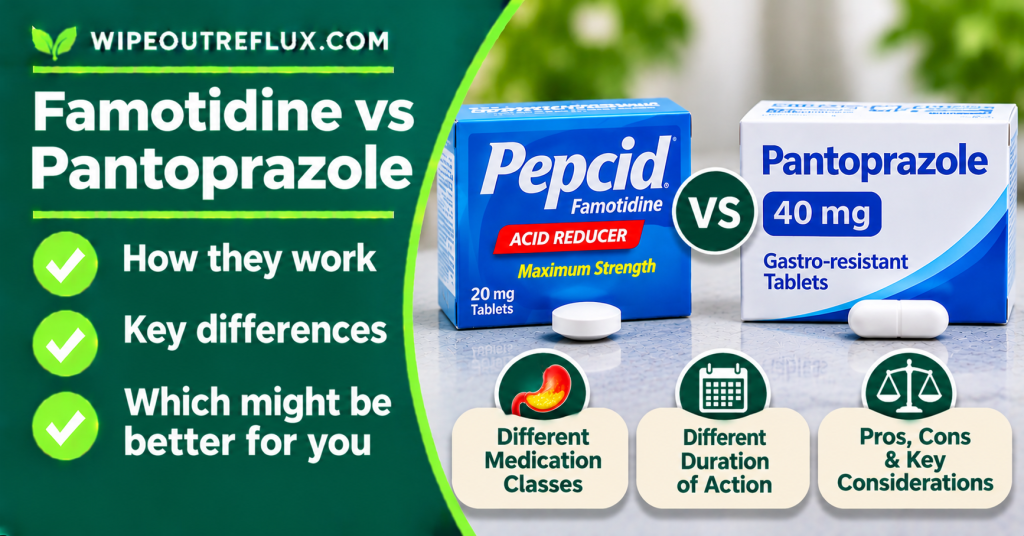
Pantoprazole is the stronger acid reducer. It’s a proton pump inhibitor (PPI) that shuts down acid production more completely and for longer, so it heals an inflamed esophagus and controls frequent reflux far better. Famotidine is an H2 blocker. It’s weaker, but it starts working within an hour, can be taken as needed, and makes a useful bedtime add-on.
So the honest answer to “which is better” depends on the job. For daily GERD, esophagitis or ulcers, pantoprazole wins clearly. For occasional heartburn, predictable trigger meals, night-time breakthrough, or stepping down off a PPI, famotidine often makes more sense.
Key Takeaways
- Pantoprazole (Protonix) is a PPI. Famotidine (Pepcid) is an H2 blocker. They switch off acid at different points.
- Famotidine starts working in about 30 to 60 minutes. Pantoprazole takes several days to reach full effect and is one of the slower PPIs on day one.
- In a direct head-to-head trial, high-dose famotidine let 20% of patients’ ulcers come back, compared with 0% on pantoprazole.
- PPIs heal erosive esophagitis much more reliably than H2 blockers at every grade of severity.
- Daily famotidine can lose effect within about two weeks due to tolerance. Pantoprazole doesn’t.
- Pantoprazole has very few drug interactions and is a preferred PPI for people on clopidogrel.
- The two are often combined, with pantoprazole in the morning and famotidine at bedtime.
- Neither stops reflux events or pepsin, which is why silent reflux often needs more than medication.
How Famotidine and Pantoprazole Work
Your stomach’s acid-producing cells pump acid out through a structure called the proton pump. Several chemical signals switch that pump on when you eat, including histamine.
Famotidine blocks the histamine signal. It’s like cutting one of the wires to the pump. Acid production drops, but the other signals can still drive the pump, especially after a big meal.
Pantoprazole blocks the pump itself. It binds to active proton pumps and disables them until new pumps are made. Because it acts at the final step, it doesn’t matter which signal is trying to switch the pump on. That’s why PPIs suppress acid so much more completely.
The trade-off is timing. Pantoprazole can only disable pumps that are active, so it needs to be taken before a meal and builds up over several days. Famotidine works on the next dose of acid within the hour.
Head-to-Head: What the Research Shows
The direct comparison
Direct trials of these two specific drugs are rare, but one is very telling. In 160 people with aspirin-related ulcers or erosions who kept taking aspirin, researchers compared famotidine 40 mg twice daily (a high dose) with pantoprazole 20 mg once daily. Over 48 weeks, 20% of the famotidine group had their ulcers or erosions come back, compared with none in the pantoprazole group. Bleeding was also more common on famotidine [Ng et al., Gastroenterology, 2010].
That’s a low dose of pantoprazole beating a high dose of famotidine, which says a lot about the gap in strength.
Healing an inflamed esophagus
For erosive esophagitis, the class evidence is consistent. A meta-analysis of head-to-head trials found standard-dose PPIs healed erosive esophagitis significantly more often than standard-dose H2 blockers at eight weeks, across all grades, including in people who hadn’t responded to H2 blockers [Wang et al., World Journal of Gastroenterology, 2005].
Symptom relief in the first week
You might expect famotidine’s faster start to give it the edge early on. Over a full week, it doesn’t. A pooled analysis of two trials comparing pantoprazole 20 mg once daily with twice-daily H2 blockers found that pantoprazole gave complete heartburn relief to more people from day two onwards. By day seven, 47.5% on pantoprazole were heartburn-free, compared with 14.5% on nizatidine [Haag and Holtmann, Clinical Therapeutics, 2010].
Speed: Famotidine’s Real Advantage
Where famotidine wins is the first hour or two. OTC famotidine 10 mg began raising stomach pH about 35 minutes after a fasting dose in a crossover study [Decktor et al., American Journal of Therapeutics, 1998]. That makes it useful as a planned dose before a meal you know will cause trouble.
Pantoprazole is the opposite. On the first day of treatment, it’s actually one of the slower PPIs. In a study comparing four PPIs in people with GERD, pantoprazole 40 mg kept stomach pH above 4 for only 35% of day one, compared with 54% to 60% for esomeprazole, rabeprazole and lansoprazole. By day five the gap had largely closed [Çelebi et al., Turkish Journal of Gastroenterology, 2016]. For the full picture, see how long pantoprazole takes to work.
So if you want relief tonight, famotidine is the better pick. If you want relief that holds over weeks, pantoprazole is.
The Tolerance Issue
Famotidine has a problem that pantoprazole doesn’t. When taken daily, its effect fades. In healthy volunteers, famotidine’s acid suppression had clearly weakened by day 14, especially overnight [Komazawa et al., Journal of Gastroenterology and Hepatology, 2003].
That’s a big reason famotidine works best as an as-needed or short-term drug, and why people switched from daily famotidine to a PPI often notice a step up in control. I go into this in why famotidine stops working.
Side Effects and Long-Term Safety
Both drugs are well tolerated short term. The differences matter more over months and years.
Famotidine
- Common side effects are mild: headache, dizziness, constipation or diarrhea.
- It’s cleared by the kidneys, so people with reduced kidney function need a lower dose. In older adults or those with kidney problems, confusion or agitation can occasionally occur.
- It doesn’t carry the long-term concerns linked to PPIs.
More detail in famotidine side effects.
Pantoprazole
- Common side effects include headache, diarrhea, nausea and stomach pain.
- Long-term use has been linked in observational studies to lower B12 and magnesium, bone fractures and certain infections. Most of these associations are modest, and the evidence on several is mixed.
- Stopping after long-term use can cause a temporary acid rebound.
More detail in pantoprazole side effects and getting off PPIs and acid rebound.
Drug Interactions
Both are relatively clean on interactions, which is one reason both are popular.
Pantoprazole stands out among PPIs here. A review of its interaction studies found it didn’t affect the pharmacokinetics or effects of a long list of drugs, including warfarin, phenytoin, diazepam, digoxin and a hormonal contraceptive [Steinijans et al., International Journal of Clinical Pharmacology and Therapeutics, 1996].
For people taking the blood thinner clopidogrel, US labeling suggests choosing pantoprazole (or lansoprazole, rabeprazole or dexlansoprazole) over omeprazole and esomeprazole, which interfere more with clopidogrel’s activation [Johnson et al., Postgraduate Medicine, 2014]. Famotidine is also a common choice in that situation.
Both drugs reduce stomach acid, so both can reduce absorption of medicines that need acid, such as some antifungals and certain cancer drugs. Always tell your pharmacist what else you take.
Which Should You Take?
- Heartburn a couple of times a month, or before trigger meals: famotidine as needed.
- Heartburn most days, or diagnosed GERD: pantoprazole, usually 40 mg once daily before breakfast. See pantoprazole dosage.
- Erosive esophagitis or an ulcer: pantoprazole. The healing data aren’t close.
- Night-time breakthrough on a PPI: your doctor may add famotidine at bedtime.
- Coming off a PPI: famotidine is often used as a bridge to manage rebound while you taper. My PPI taper schedule shows how.
- Kidney disease: famotidine needs a dose reduction, so check with your doctor.
Can You Take Famotidine and Pantoprazole Together?
Yes. It’s a standard combination when a PPI controls daytime symptoms but acid breaks through at night. In people taking a twice-daily PPI, adding a bedtime H2 blocker raised the share of the night with stomach pH above 4 from 51% to 96% [Xue et al., Alimentary Pharmacology & Therapeutics, 2001].
Bedtime famotidine doesn’t seem to blunt the next morning’s PPI either. A study testing this directly with omeprazole found no significant effect on the next day’s acid control [Tutuian et al., Alimentary Pharmacology & Therapeutics, 2002]. Because of the tolerance issue, some doctors use the bedtime famotidine intermittently rather than every night.
What About Silent Reflux (LPR)?
Both drugs are used for silent reflux, and both share the same limitation. They make refluxed material less acidic, but they don’t stop it from reaching your throat, and they don’t remove pepsin, the enzyme that drives a lot of throat irritation. I explain why in why PPIs don’t work for LPR.
In my own years of managing LPR, it’s been diet, meal timing and sleeping position that made the lasting difference, not acid reducers alone. That approach is what the Wipeout Diet Plan lays out. For a wider look at medication options, see best medication for LPR.
Conclusion
Famotidine and pantoprazole aren’t really rivals. Pantoprazole is the stronger, more reliable option for daily reflux, esophagitis and ulcers, and the evidence for that is consistent. Famotidine is the quicker, more flexible option, best used before trigger meals, at bedtime for night-time breakthrough, or as a stepping stone when you come off a PPI. Its daily effect fades, so it’s less suited to long-term use on its own.
What neither drug does is stop reflux from happening. They change what comes up, not how often it comes up. That’s why so many people end up on pantoprazole for years, or cycling between the two, without ever feeling properly on top of their symptoms.
If you want to reduce how much you rely on either one, the work happens at the source: what you eat, when you eat and how you manage your evenings. The Wipeout Diet Plan is my complete guide to doing exactly that. It was built first and foremost for LPR, the stubborn throat-based kind, but because it targets the same underlying mechanisms, it works just as well for GERD and everyday heartburn. Never stop a prescribed PPI suddenly, though. Plan any step-down with your doctor.
Frequently Asked Questions
Is famotidine stronger than pantoprazole?
No. Pantoprazole suppresses acid more completely and for longer. In a direct trial, pantoprazole 20 mg prevented ulcer recurrence better than famotidine 40 mg twice daily.
Which works faster, famotidine or pantoprazole?
Famotidine. It starts working within about an hour. Pantoprazole takes several days to reach full effect.
Can I switch from pantoprazole to famotidine?
Many people do as part of stepping down off a PPI, but expect some rebound acid for a few weeks. Talk to your doctor and taper gradually rather than stopping pantoprazole abruptly.
Can I take famotidine and pantoprazole at the same time?
Yes, it’s a common prescribed combination. Usually pantoprazole is taken before breakfast and famotidine at bedtime.
Is famotidine safer than pantoprazole long term?
Famotidine doesn’t carry the long-term concerns linked to PPIs, but it’s also less effective and loses strength with daily use. The safest choice is the one that controls your symptoms at the lowest effective dose.
Which is better for night-time reflux?
Famotidine at bedtime is particularly effective against overnight acid, and it’s often added to a morning PPI for this reason.
Which is better for silent reflux?
Neither is a complete fix, because neither stops reflux or pepsin from reaching the throat. Doctors use both, often alongside diet changes and alginates.
Research & References
- [Ng et al., Gastroenterology, 2010] — Randomized trial in 160 aspirin users with prior ulcers: 20% relapsed on famotidine 40 mg twice daily versus 0% on pantoprazole 20 mg daily over 48 weeks.
- [Wang et al., World Journal of Gastroenterology, 2005] — Meta-analysis showing standard-dose PPIs healed erosive esophagitis more often than H2 blockers at all grades of severity.
- [Haag and Holtmann, Clinical Therapeutics, 2010] — Pantoprazole 20 mg once daily gave more patients complete heartburn relief than twice-daily H2 blockers from day 2 through day 7.
- [Decktor et al., American Journal of Therapeutics, 1998] — OTC famotidine 10 mg began raising gastric pH about 35 minutes after a fasting dose.
- [Çelebi et al., Turkish Journal of Gastroenterology, 2016] — On day 1, pantoprazole 40 mg kept gastric pH above 4 for 35% of the time versus 54–60% for other PPIs, with the gap narrowing by day 5.
- [Komazawa et al., Journal of Gastroenterology and Hepatology, 2003] — Tolerance to famotidine’s acid-suppressing effect developed within 14 days of continuous use.
- [Steinijans et al., International Journal of Clinical Pharmacology and Therapeutics, 1996] — Review finding pantoprazole did not affect the pharmacokinetics or effects of a wide range of commonly co-prescribed drugs.
- [Johnson et al., Postgraduate Medicine, 2014] — Summarizes FDA labeling advising that patients on clopidogrel use pantoprazole, rabeprazole, lansoprazole or dexlansoprazole rather than omeprazole or esomeprazole.
- [Xue et al., Alimentary Pharmacology & Therapeutics, 2001] — Adding a bedtime H2 blocker to twice-daily PPIs raised overnight time with gastric pH above 4 from 51% to 96% and reduced nocturnal acid breakthrough.
- [Tutuian et al., Alimentary Pharmacology & Therapeutics, 2002] — Bedtime famotidine did not significantly reduce next-day acid control from a morning PPI.

David Gray
12 years living with LPR · Consultant & researcher
I've lived with LPR for twelve years — the misdiagnoses, the PPI courses that did nothing, the slow work of figuring out what actually helps. Wipeout Reflux is where I translate the research into plain terms for people stuck in the same place. Every claim here is sourced to peer-reviewed work, and I consult one-to-one with LPR sufferers.