
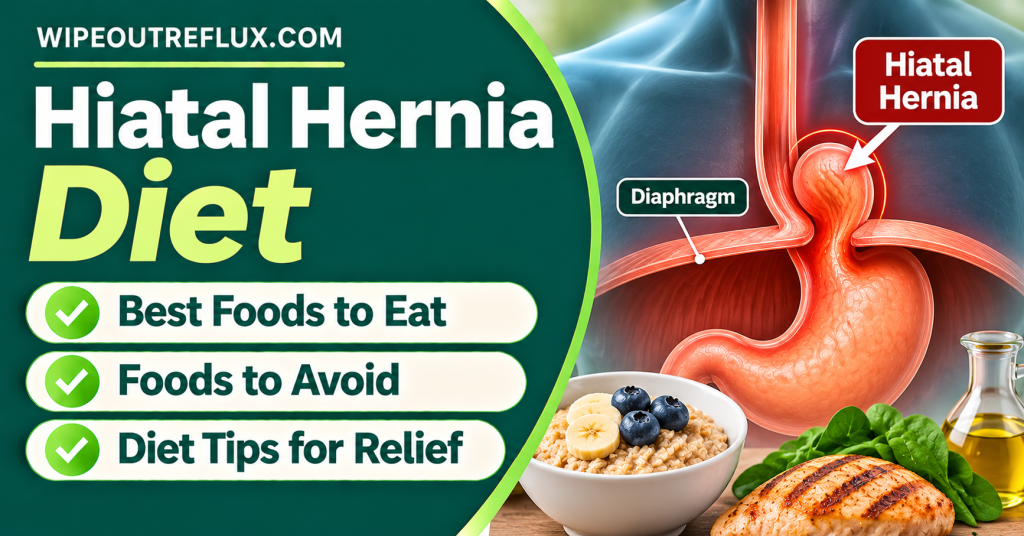
A hiatal hernia diet is built around one goal: keeping pressure off the valve at the top of your stomach. That means smaller meals, lower-fat cooking, a three-hour gap between your last meal and bed, and cutting back on the foods and drinks that relax that valve or fill your stomach with gas.
No food will push a hernia back down. What the right diet does is reduce how often acid and stomach contents squeeze up through the gap, which is what causes the heartburn, regurgitation and throat symptoms. Below I’ll explain why a hernia makes meals matter so much, then give you the foods to eat, the foods to limit, and a sample day of eating.
Key Takeaways
- A hiatal hernia weakens the barrier between your stomach and esophagus, so a full stomach is much more likely to push contents upward.
- In one study, stretching the stomach doubled the number of valve relaxations in people with a hernia compared with people without one.
- Meal size and calorie load matter more than any single “bad” food. Smaller, lower-calorie meals mean less acid exposure.
- Fatty meals increase how many reflux symptoms you feel, even when acid exposure is similar.
- Eating late is one of the clearest triggers. A late evening meal significantly increased lying-down reflux in a randomized crossover trial.
- Losing excess weight is the single most effective lifestyle change: in one trial, 65% of people with GERD symptoms saw them resolve completely.
- Good staples include lean proteins, oats, rice, potatoes, non-citrus fruits and cooked vegetables.
- Common triggers to limit include fried food, large portions, carbonated drinks, alcohol, chocolate, peppermint, coffee and citrus.
Why a Hiatal Hernia Makes Your Diet So Important
Your stomach normally sits below your diaphragm, the sheet of muscle that separates your chest from your abdomen. Where the esophagus passes through the diaphragm, two things work together to keep acid down: the lower esophageal sphincter and the diaphragm itself, which wraps around it like a second clamp.
With a hiatal hernia, part of the stomach slides up through that opening. The two clamps separate, and the barrier gets much weaker. That’s why hernia size tracks so closely with reflux. In a series of 175 GERD patients, people with larger hernias had weaker sphincter pressure, more acid reflux and more severe esophagitis [Rebecchi et al., American Surgeon, 2018].
Here’s the part that makes diet so important. Your sphincter doesn’t stay shut all the time. It briefly relaxes several times an hour, mostly to let swallowed air escape. These are called transient relaxations, and a stretched stomach triggers them. In one study, distending the stomach raised the rate of these relaxations by a median of 4 to 4.5 per hour in controls and GERD patients without a hernia, but by 9.5 per hour in patients with a hernia [Kahrilas et al., Gastroenterology, 2000].
Put simply: with a hernia, every time you overfill your stomach, your valve opens far more often. That’s why a hiatal hernia diet is less about banning foods and more about how much you eat, when you eat, and what makes your stomach swell.
The 5 Rules of a Hiatal Hernia Diet
1. Eat smaller meals, more often
This is the most important rule. Total calorie load is what drives acid exposure after a meal. In a study of reflux patients given meals of different fat and calorie content, the calorie density of the meal determined how much acid reached the esophagus [Fox et al., Clinical Gastroenterology and Hepatology, 2007].
Instead of three large meals, aim for four or five smaller ones. Stop when you feel satisfied, not full. If you’ve ever noticed your symptoms are worst after a big Sunday dinner or a buffet, this is why. I go into more detail in does overeating cause acid reflux?
2. Keep fat moderate
The same study found that while calories drove acid exposure, the fat content of a meal affected how many reflux symptoms people actually felt. High-fat meals produced more symptoms [Fox et al., Clinical Gastroenterology and Hepatology, 2007]. Fat also slows stomach emptying, which keeps your stomach fuller for longer.
You don’t need a no-fat diet. Choose grilled, baked, poached or steamed over fried, and use a little olive oil rather than butter or cream sauces. My article on whether fried food is bad for acid reflux covers this in more depth.
3. Stop eating three hours before bed
When you lie down, gravity stops helping. With a hernia, that matters even more because the stomach pocket above the diaphragm can pool acid. In a randomized crossover trial, eating the same standard meal two hours before bed instead of six hours before bed produced significantly more reflux while lying down [Piesman et al., American Journal of Gastroenterology, 2007].
A large Japanese study found that people who went to bed less than three hours after dinner had 7.45 times the odds of GERD compared with those who waited four hours or more [Fujiwara et al., American Journal of Gastroenterology, 2005]. I’ve written a full guide on how long before bed you should stop eating.
4. Avoid things that fill your stomach with gas
Because stomach stretching triggers valve relaxations, anything that bloats you is worth limiting. That includes carbonated drinks, beer, eating quickly, drinking through straws and chewing gum with lots of swallowed air. If you love fizzy water, my article on whether sparkling water is bad for acid reflux explains how to judge it for yourself.
5. Lose weight if you’re carrying extra
Excess weight, especially around the middle, raises the pressure inside your abdomen and pushes the stomach upward. Obesity is linked to physical separation of the sphincter and diaphragm, essentially worsening the hernia mechanism [Pandolfino et al., Gastroenterology, 2006].
The good news is that it works in reverse. In a structured weight-loss trial of 332 overweight and obese adults, 65% of those with GERD symptoms at the start had complete resolution after six months, with an average loss of about 13 kg [Singh et al., Obesity, 2013]. A systematic review of lifestyle measures found weight loss and head-of-bed elevation were the two with the best evidence [Kaltenbach et al., Archives of Internal Medicine, 2006].
Foods to Eat With a Hiatal Hernia
These foods are generally easy on the stomach, low in fat, low in acid and less likely to cause bloating. Everyone’s triggers are a little different, so treat this as a starting point.
Proteins
- Skinless chicken and turkey breast
- White fish such as cod, haddock and tilapia, plus salmon in moderate portions
- Eggs (many people tolerate whites better than yolks)
- Tofu
- Low-fat Greek yogurt and cottage cheese, if dairy agrees with you
Grains and starches
- Oatmeal
- Brown or white rice
- Potatoes and sweet potatoes, baked or boiled
- Whole-grain bread and plain crackers
- Pasta with a non-tomato sauce
- Quinoa and couscous
Fruit and vegetables
- Bananas, melon, pears, apples and papaya
- Cooked carrots, green beans, zucchini, broccoli and spinach
- Cucumber, lettuce and celery
A note on fiber: high-fiber foods help keep you regular. That matters with a hernia because straining on the toilet raises abdominal pressure. I explain the link in fiber and acid reflux.
Drinks
- Still water, sipped between meals rather than gulped with them
- Caffeine-free herbal teas such as chamomile or ginger
- Plant milks such as oat or almond milk
Foods to Limit With a Hiatal Hernia
The evidence on individual trigger foods is weaker than for meal size, timing and weight. The systematic review I mentioned found little controlled evidence that cutting out specific foods improves GERD on average [Kaltenbach et al., Archives of Internal Medicine, 2006]. But averages hide individual differences, and these are the foods my readers and consult clients most often find trouble with:
- Fried and fatty foods: fries, fried chicken, pizza, burgers, creamy sauces, pastries.
- Large portions of anything: the biggest trigger of all with a hernia.
- Carbonated drinks: soda, sparkling water, beer.
- Alcohol: relaxes the sphincter and often comes with late, heavy food.
- Chocolate and peppermint: both linked to sphincter relaxation.
- Coffee and caffeinated drinks: tolerance varies a lot from person to person.
- Citrus and tomatoes: they don’t cause reflux, but they burn an already irritated esophagus.
- Spicy food: again, more an irritant than a cause.
- Onions and garlic: raw versions bother many people more than cooked.
A Sample Day on a Hiatal Hernia Diet
Here’s what a day might look like, spread across five smaller meals:
- Breakfast (7:30am): Oatmeal made with oat milk, topped with sliced banana and a spoonful of ground flaxseed.
- Mid-morning (10:30am): A pear and a handful of plain crackers.
- Lunch (1pm): Grilled chicken breast with rice and steamed green beans, dressed with a little olive oil.
- Afternoon (4pm): Low-fat Greek yogurt with melon.
- Dinner (6:30pm): Baked cod with a baked sweet potato and roasted zucchini.
- Bedtime: Nothing after about 7:30pm if you sleep at 10:30pm.
For more meal ideas, see my breakfast recipes for acid reflux, acid reflux lunch ideas and acid reflux dinner recipes. If you’d rather have the whole thing mapped out, the Wipeout Diet Plan gives you complete meal plans and food lists so you’re not guessing every day.
Habits That Help Alongside Your Diet
Diet works best when you pair it with a few non-food habits that also reduce pressure on the stomach:
- Raise the head of your bed. A wedge or bed risers keep gravity on your side at night. See how to raise the head of your bed for acid reflux.
- Loosen tight waistbands. Belts and shapewear squeeze the stomach. I cover this in tight clothing and acid reflux.
- Take a gentle walk after meals rather than slumping on the sofa. Here’s why walking after meals helps.
- Avoid bending and heavy lifting straight after eating. Both raise abdominal pressure.
- Chew slowly to reduce swallowed air and give your fullness signals time to catch up.
Diet and habits are the foundation, but they’re not the whole picture for everyone. If you’re still struggling, my guide on how to treat a hiatal hernia covers medication and surgical options too.
Conclusion
A hiatal hernia changes the mechanics of reflux. With the diaphragm no longer reinforcing your valve, a full stomach pushes contents upward far more easily, and a stretched stomach triggers far more valve openings. That’s why the most effective hiatal hernia diet focuses on the things that reduce pressure: smaller meals, moderate fat, an early finish to eating, less gas, and losing excess weight if you need to.
Individual trigger foods still matter, but they’re the second layer. Get meal size and timing right first, then fine-tune by noticing which specific foods set you off. Keep a simple food and symptom diary for a couple of weeks and the patterns usually become obvious.
If you want a structured way to do all of this, the Wipeout Diet Plan is my complete guide. It lays out exactly what to eat, how to portion and time your meals, and how to reintroduce foods so you find your own limits. I built it first for LPR, the stubborn throat-based form of reflux, but because it targets the same pressure and acid mechanisms, it works just as well for hiatal hernia reflux and everyday heartburn. It takes the guesswork out of eating with a hernia, which is usually the hardest part.
Frequently Asked Questions
Can diet fix a hiatal hernia?
No. Diet can’t move the stomach back below the diaphragm. What it can do is reduce reflux symptoms significantly by lowering pressure on the weakened valve. Many people with small hernias manage well on diet and lifestyle changes alone.
What is the best breakfast for a hiatal hernia?
Oatmeal with banana or melon is a good option. It’s low in fat, gentle on the stomach and filling without being heavy. Egg whites with whole-grain toast also work well for many people.
Are eggs okay with a hiatal hernia?
Usually, yes. Some people find egg yolks or fried eggs trigger symptoms because of the fat. Boiled, poached or scrambled with little fat, or egg whites only, are the safest choices.
Is coffee bad for a hiatal hernia?
It depends on the person. Coffee doesn’t trigger reflux in everyone, but it’s a common culprit. Try cutting it for two weeks, then reintroduce a small cup with food and see how you feel.
Should I drink water with meals if I have a hiatal hernia?
Small sips are fine. Large volumes with a meal add to stomach fullness, which can trigger reflux. Try to drink most of your water between meals instead.
How many meals a day should I eat with a hiatal hernia?
Four to five smaller meals usually work better than three large ones. The goal is to avoid ever feeling very full, because stomach stretching is a major trigger with a hernia.
Does weight loss help a hiatal hernia?
Yes, if you’re carrying excess weight. Losing weight reduces abdominal pressure and is one of the best-supported lifestyle changes for reflux. In one trial, 65% of people with GERD symptoms had complete resolution after a structured weight-loss program.
Research & References
- [Rebecchi et al., American Surgeon, 2018] — Series of 175 GERD patients grouped by hernia size, finding that larger hernias were associated with lower sphincter pressure, weaker peristalsis, more acid reflux and more severe esophagitis.
- [Kahrilas et al., Gastroenterology, 2000] — Gastric distension increased transient sphincter relaxations by a median of 9.5 per hour in hernia patients, about double the increase seen in controls and GERD patients without a hernia.
- [Fox et al., Clinical Gastroenterology and Hepatology, 2007] — Study of reflux patients showing that calorie density determined esophageal acid exposure after a meal, while fat content affected how many reflux symptoms were reported.
- [Piesman et al., American Journal of Gastroenterology, 2007] — Randomized crossover trial in 32 reflux patients showing significantly more supine reflux after a late evening meal than after an early one.
- [Fujiwara et al., American Journal of Gastroenterology, 2005] — Case-control study finding that a dinner-to-bed time under three hours was associated with 7.45 times the odds of GERD compared with four hours or more.
- [Pandolfino et al., Gastroenterology, 2006] — High-resolution manometry study linking obesity to disruption of the esophagogastric junction, including separation of the sphincter and diaphragm.
- [Singh et al., Obesity, 2013] — Prospective trial of 332 overweight and obese adults: after an average 13 kg weight loss, 65% of those with GERD symptoms had complete resolution.
- [Kaltenbach et al., Archives of Internal Medicine, 2006] — Systematic review of lifestyle measures concluding that weight loss and head-of-bed elevation are effective, with little controlled evidence for avoiding individual foods.

David Gray
12 years living with LPR · Consultant & researcher
I've lived with LPR for twelve years — the misdiagnoses, the PPI courses that did nothing, the slow work of figuring out what actually helps. Wipeout Reflux is where I translate the research into plain terms for people stuck in the same place. Every claim here is sourced to peer-reviewed work, and I consult one-to-one with LPR sufferers.