
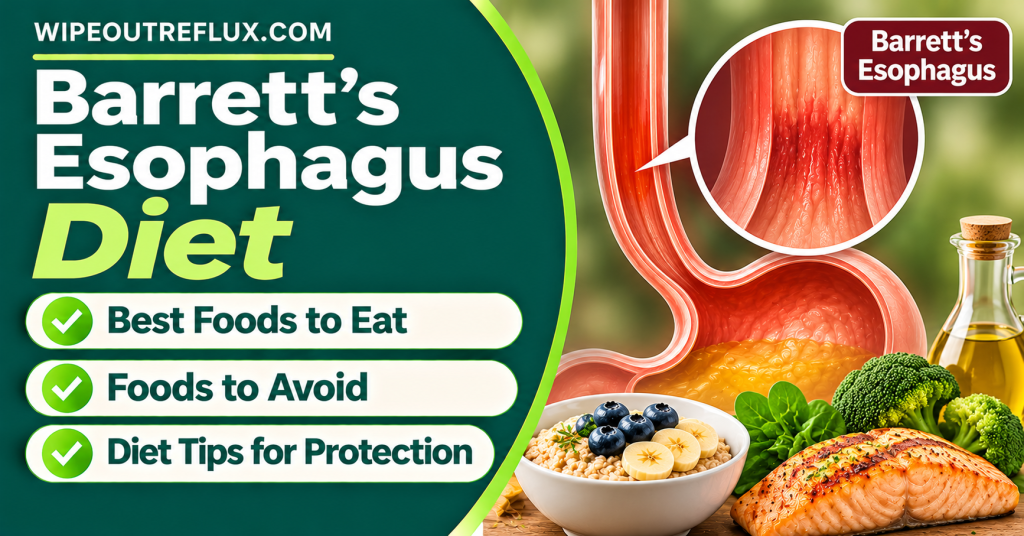
The best Barrett’s esophagus diet does two jobs. First, it calms the reflux that caused the Barrett’s, using the same rules as any good reflux diet: smaller meals, moderate fat, nothing late at night. Second, it leans heavily on fruit, vegetables and fiber, which are the dietary factors most consistently linked to a lower risk of Barrett’s and esophageal cancer.
No food reverses Barrett’s esophagus, and diet doesn’t replace your PPI or your surveillance endoscopies. But what you eat, how much you weigh and whether you smoke all influence your risk. Below I’ll walk through what the research shows, the foods to build your meals around, the ones to limit, and a sample day.
Key Takeaways
- Barrett’s esophagus is a change in the lining of the lower esophagus caused by long-term reflux. Controlling reflux is the first goal of any Barrett’s diet.
- Diets rich in fruit, vegetables (especially raw, leafy green and cruciferous) and fiber are the most consistently linked to lower risk of Barrett’s and esophageal adenocarcinoma.
- In one case-control study, people with the highest fiber intake had about a third of the odds of Barrett’s compared with the lowest.
- Belly fat matters more than overall weight. Central obesity is linked to roughly 2.5 times the odds of esophageal adenocarcinoma.
- Smoking raises the risk of developing Barrett’s and doubles the risk of it progressing to cancer.
- Coffee and tea don’t appear to raise Barrett’s risk. The evidence on alcohol is mixed, but it’s still a reflux trigger.
- Diet works alongside, not instead of, medication and regular endoscopy.
What Barrett’s Esophagus Is (and Why Diet Matters)
Your esophagus is normally lined with flat, tough cells built to handle food passing through. After years of acid and pepsin washing up from the stomach, the lining at the bottom of the esophagus can change into a different type of cell that looks more like the intestine. That change is Barrett’s esophagus.
On its own, Barrett’s usually causes no extra symptoms beyond the reflux that created it. I explain more in Barrett’s esophagus symptoms. The reason doctors take it seriously is that it’s a precancerous condition. A small percentage of people with Barrett’s go on to develop dysplasia, and a smaller number develop esophageal adenocarcinoma. Most never do.
Diet influences Barrett’s through two routes:
- Reflux control. Less reflux means less ongoing damage to the lining. Meal size, fat, timing and weight all affect how much reflux you have.
- Cancer-risk factors. Separately from reflux, certain dietary patterns are linked to a higher or lower chance of Barrett’s progressing.
It’s also worth knowing that hiatal hernias are very common in Barrett’s. In one study, most Barrett’s patients had a hernia, and their hernias were longer than those of controls [Cameron, American Journal of Gastroenterology, 1999]. If that applies to you, the meal-size and timing rules below are especially important.
What the Research Says About Diet and Barrett’s
Fruit and vegetables are the strongest signal
A comprehensive review of the evidence found the strongest and most consistent pattern was an inverse link between Barrett’s and esophageal adenocarcinoma and intake of vitamin C, beta-carotene, fruit and vegetables. Raw fruit and vegetables, dark green leafy vegetables and cruciferous vegetables (like broccoli and cabbage) stood out most [Kubo et al., Nutrition Research Reviews, 2010].
A later meta-analysis sharpened that picture. Pooling eight studies, it found vegetable intake was strongly linked to lower Barrett’s risk (odds ratio 0.45), while the link with fruit was weaker and not statistically significant [Zhao et al., Scientific Reports, 2016]. So if you prioritize one thing, make it vegetables.
These are observational studies, so they show association rather than proof. People who eat lots of vegetables tend to do other healthy things too. But the pattern has held up across many populations.
Fiber, especially from fruit and vegetables
In a Kaiser Permanente case-control study, people in the highest quarter of total fiber intake had about a third of the odds of Barrett’s (odds ratio 0.34) compared with the lowest quarter. Fiber from fruit and vegetables specifically was linked to roughly half the odds (0.47) [Kubo et al., Nutrition and Cancer, 2009].
An all-Ireland study reached the same conclusion. People in the highest third of fiber intake had lower odds of Barrett’s (odds ratio 0.44) than those in the lowest third, and fiber was also linked to lower risk of esophageal adenocarcinoma [Mulholland et al., Cancer Causes and Control, 2009]. There’s a plausible mechanism, too. Fiber helps with weight control and may reduce reflux. I explore this in fiber and acid reflux.
Belly fat matters more than the number on the scale
A meta-analysis found central adiposity, meaning fat carried around the abdomen, was associated with more esophageal inflammation, Barrett’s and adenocarcinoma. For adenocarcinoma, the odds were about 2.5 times higher than in people with a normal body shape [Singh et al., Clinical Gastroenterology and Hepatology, 2013].
Abdominal fat does two things. It raises pressure on the stomach, which pushes more reflux upward. And it’s metabolically active, releasing inflammatory signals. That’s why a diet that helps you lose belly fat is one of the most useful things you can do.
Smoking is a major, fixable risk
Smoking isn’t diet, but it belongs here because it’s so important. A pooled analysis of five studies found smoking increased the risk of developing Barrett’s, with risk rising with pack-years [Cook et al., Gastroenterology, 2012]. A Northern Ireland registry study found that among people who already had Barrett’s, current smokers had about double the risk of progressing to high-grade dysplasia or cancer [Coleman et al., Gastroenterology, 2012]. My article on whether smoking causes acid reflux covers the reflux side.
Coffee, tea and alcohol
Good news for coffee drinkers: in a study of US veterans comparing 310 Barrett’s patients with 1,728 controls, neither coffee nor tea, hot or cold, was associated with Barrett’s risk [Sajja et al., Clinical Gastroenterology and Hepatology, 2016]. Coffee can still trigger reflux symptoms in some people, which is a separate question. See is coffee bad for acid reflux?
Alcohol is mixed. A meta-analysis of 20 studies found no overall association between alcohol and Barrett’s, though liquor specifically was linked to a small increase [Xu et al., Medicine, 2015]. Because alcohol relaxes the sphincter and fuels late-night reflux, I’d still keep it low.
Foods to Eat With Barrett’s Esophagus
Build your plate around foods that are both reflux-friendly and rich in the nutrients linked to lower risk:
Vegetables (aim for half your plate)
- Leafy greens: spinach, kale, romaine, chard
- Cruciferous vegetables: broccoli, cauliflower, cabbage, Brussels sprouts, cooked well if raw ones bloat you
- Carrots, sweet potatoes and squash for beta-carotene
- Zucchini, green beans, asparagus, cucumber
Low-acid fruit
- Bananas, melon, papaya, pears, apples
- Berries in moderate amounts if you tolerate them
Fiber-rich grains and legumes
- Oats, brown rice, quinoa, barley
- Whole-grain bread
- Lentils and chickpeas, introduced slowly if they cause gas
Lean protein
- Fish, including oily fish like salmon in moderate portions
- Skinless chicken and turkey
- Tofu, beans and eggs
Healthy fats in moderation
- Olive oil, avocado, nuts and seeds, in small amounts
This pattern is very close to a Mediterranean, mostly plant-based way of eating. I’ve covered both in the Mediterranean diet for acid reflux and a plant-based diet for acid reflux. If you want it laid out meal by meal, the Wipeout Diet Plan does exactly that.
Foods and Habits to Limit
- Large, heavy meals. A stretched stomach triggers more reflux.
- Fried and very fatty food. Fat increases reflux symptoms and slows stomach emptying.
- Late meals. Finish eating at least three hours before bed.
- Fatty processed meat. Interestingly, red and processed meat haven’t been clearly linked to Barrett’s itself [Zhao et al., Scientific Reports, 2016]. But bacon, sausages and salami are fatty, salty reflux triggers, so they’re still worth keeping occasional. My article on red meat and acid reflux covers this.
- Trans fats. In the Kaiser Permanente study, higher trans-fat intake was linked to higher Barrett’s risk [Kubo et al., Nutrition and Cancer, 2009]. Check labels on packaged baked goods, fried snacks and margarines.
- Alcohol, especially spirits. A reflux trigger with a small possible Barrett’s link.
- Citrus, tomato and spicy food if they cause burning. They irritate rather than damage, but there’s no point provoking symptoms.
- Carbonated drinks. They bloat the stomach.
A Sample Day for Barrett’s Esophagus
- Breakfast: Oatmeal with sliced pear, a sprinkle of ground flaxseed and a few walnuts.
- Mid-morning: A banana.
- Lunch: Large spinach and romaine salad with grilled chicken, cucumber, grated carrot, chickpeas and an olive oil dressing (no vinegar if it bothers you).
- Afternoon: Melon with a small pot of plain yogurt.
- Dinner (finish 3+ hours before bed): Baked salmon, steamed broccoli and a baked sweet potato.
What Diet Can and Can’t Do
I want to be straight with you here. The diet evidence for Barrett’s is almost entirely observational. No trial has yet shown that changing your diet slows Barrett’s progression, and a small dietary trial in Barrett’s patients didn’t find short-term changes in markers of cell growth in the tissue.
That doesn’t mean diet is pointless. It means diet is one piece of a bigger plan. The strongest evidence for changing outcomes in Barrett’s comes from medication. In the large AspECT trial, high-dose PPI therapy, especially combined with aspirin, improved outcomes in people with Barrett’s [Jankowski et al., Lancet, 2018]. Don’t start aspirin on your own, though. It carries bleeding risks, so that’s a conversation for your doctor. I discuss the trade-offs in low-dose aspirin and acid reflux.
A realistic plan for Barrett’s looks like this:
- Take your prescribed acid suppression consistently.
- Keep your surveillance endoscopies.
- Eat a reflux-friendly, plant-rich, high-fiber diet.
- Lose belly fat if you’re carrying extra.
- Stop smoking.
For the bigger picture, see is Barrett’s esophagus reversible? and, for those with dysplasia, Barrett’s ablation: RFA vs cryotherapy.
Conclusion
A Barrett’s esophagus diet isn’t a special or extreme diet. It’s a solid reflux diet with a stronger emphasis on vegetables, fruit and fiber. Eat smaller meals, keep fat moderate, finish eating well before bed, and fill half your plate with vegetables. Those habits reduce the reflux that keeps irritating the lining, and they line up with the dietary patterns most linked to lower risk of Barrett’s and esophageal cancer.
Just as important are the non-food pieces: shifting belly fat, stopping smoking, taking your medication and keeping your endoscopy appointments. Diet supports all of that. It doesn’t replace any of it.
If you’d like a complete, structured plan rather than piecing it together yourself, the Wipeout Diet Plan is my full guide. It covers what to eat, portion sizes, meal timing and how to reintroduce foods safely. I designed it originally for silent reflux, but because it works on the same root causes, it suits anyone whose goal is calming reflux for the long term, including people managing Barrett’s. It gives you a clear daily routine so you’re not second-guessing every meal.
Frequently Asked Questions
Can diet reverse Barrett’s esophagus?
Diet alone hasn’t been shown to reverse Barrett’s. It helps by reducing reflux and supporting healthy weight, and plant-rich, high-fiber diets are linked to lower risk of progression. Reversal, when it happens, is usually through ablation treatment.
Is coffee safe with Barrett’s esophagus?
Coffee isn’t linked to a higher risk of developing Barrett’s. If coffee triggers your reflux symptoms, cut back or switch to a low-acid or decaf version, since reflux control still matters.
Can I drink alcohol with Barrett’s esophagus?
Studies haven’t found a clear overall link between alcohol and Barrett’s, but spirits showed a small association and alcohol triggers reflux. Keeping it occasional and away from bedtime is sensible.
What fruits are best for Barrett’s esophagus?
Low-acid fruits such as bananas, melon, pears, apples and papaya are easiest on reflux. Fruit and vegetable intake overall is linked to lower risk.
Should I avoid red meat with Barrett’s?
Red and processed meat haven’t been clearly linked to Barrett’s risk. Fatty and processed meats are still common reflux triggers, so keep them occasional and lean on fish, poultry and plant proteins day to day.
Does losing weight help Barrett’s esophagus?
Losing belly fat reduces reflux and is linked to lower risk. Central obesity is associated with about 2.5 times the odds of esophageal adenocarcinoma.
Do I still need endoscopies if I eat well?
Yes. Diet doesn’t replace surveillance. Endoscopy is how changes in the Barrett’s tissue are caught early, when treatment is most effective.
Research & References
- [Cameron, American Journal of Gastroenterology, 1999] — Study finding that most patients with Barrett’s esophagus had a hiatal hernia, and their hernias were longer than those of controls.
- [Kubo et al., Nutrition Research Reviews, 2010] — Comprehensive review concluding the strongest evidence is for an inverse relationship between vitamin C, beta-carotene, fruit and vegetables (especially raw, leafy green and cruciferous), fiber and iron and the risk of Barrett’s and esophageal adenocarcinoma.
- [Kubo et al., Nutrition and Cancer, 2009] — Kaiser Permanente case-control study: highest vs lowest total fiber intake associated with an odds ratio of 0.34 for Barrett’s, fiber from fruit and vegetables with 0.47, and higher trans-fat intake with increased risk.
- [Mulholland et al., Cancer Causes and Control, 2009] — All-Ireland case-control study: highest vs lowest third of fiber intake associated with an odds ratio of 0.44 for Barrett’s, with fiber also linked to lower esophageal adenocarcinoma risk.
- [Zhao et al., Scientific Reports, 2016] — Meta-analysis of eight studies: vegetable intake associated with lower Barrett’s risk (odds ratio 0.45), fruit not significantly associated, and saturated fat, red meat and processed meat not associated with Barrett’s risk.
- [Singh et al., Clinical Gastroenterology and Hepatology, 2013] — Systematic review and meta-analysis linking central adiposity to esophageal inflammation, metaplasia and adenocarcinoma (adjusted odds ratio 2.51 for adenocarcinoma).
- [Cook et al., Gastroenterology, 2012] — Pooled analysis from the BEACON consortium showing cigarette smoking increases the risk of Barrett’s, with risk rising with pack-years.
- [Coleman et al., Gastroenterology, 2012] — Northern Ireland Barrett’s registry study finding current smoking roughly doubled the risk of progression to high-grade dysplasia or cancer.
- [Sajja et al., Clinical Gastroenterology and Hepatology, 2016] — Cross-sectional study of 310 Barrett’s patients and 1,728 controls finding no association between coffee or tea consumption and Barrett’s risk.
- [Xu et al., Medicine, 2015] — Meta-analysis of 20 studies finding no overall association between alcohol and Barrett’s, with liquor showing a small increased risk.
- [Jankowski et al., Lancet, 2018] — AspECT randomized factorial trial showing high-dose esomeprazole, especially combined with aspirin, significantly improved outcomes in Barrett’s esophagus.

David Gray
12 years living with LPR · Consultant & researcher
I've lived with LPR for twelve years — the misdiagnoses, the PPI courses that did nothing, the slow work of figuring out what actually helps. Wipeout Reflux is where I translate the research into plain terms for people stuck in the same place. Every claim here is sourced to peer-reviewed work, and I consult one-to-one with LPR sufferers.