
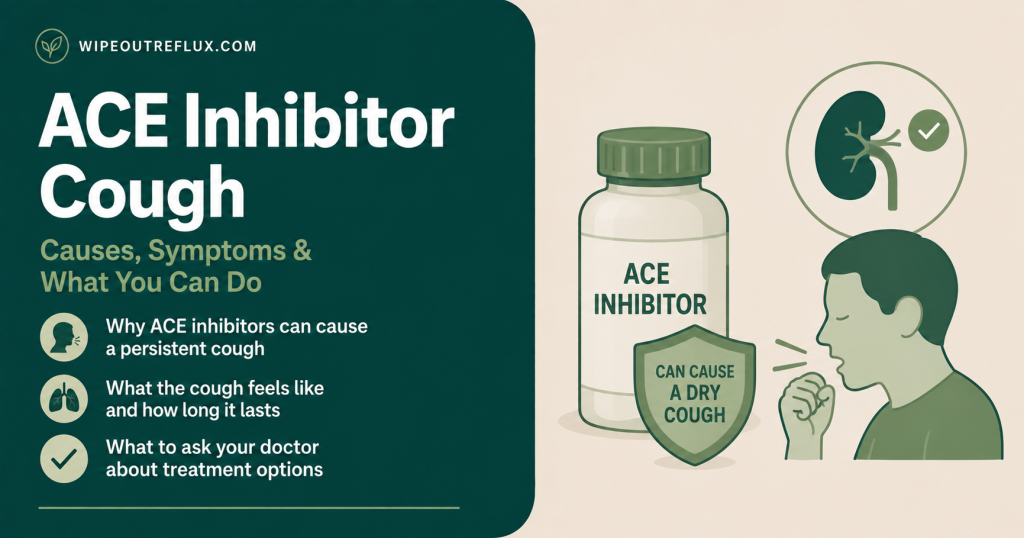
If you’ve started a blood pressure medication and picked up a nagging, dry, tickly cough that just won’t quit, there’s a good chance the two are connected. A persistent dry cough is one of the best-known side effects of ACE inhibitors — the family of blood pressure drugs whose names end in “-pril,” like lisinopril, ramipril and enalapril. It’s harmless in itself, but it can be maddening, and it affects a meaningful slice of the people who take these drugs.
Here’s why this matters on a reflux site: an ACE inhibitor cough looks almost identical to the chronic cough that acid reflux and silent reflux (LPR) cause. Both are dry, tickly and persistent, both nag at your throat, and both can drag on for months. So if you have reflux and you’re on a “-pril” drug, working out which one is behind your cough — or whether it’s both — is genuinely important, because the fixes are completely different.
Let me explain what ACE inhibitor cough is, why the drug causes it, how to tell it apart from a reflux cough, and what to do about it. One thing up front, though, and it matters: never stop or change a blood pressure medication on your own. This is about knowing what to raise with your doctor, not going it alone.
Key Takeaways
- A dry, persistent, tickly cough is a common side effect of ACE inhibitors — the “-pril” blood pressure drugs (lisinopril, ramipril, enalapril and others).
- It’s reported in roughly 5–35% of users and is more common in women.
- The cause is a build-up of natural airway irritants (bradykinin and substance P) that the drug stops your body from breaking down.
- It can start within hours of the first dose or not appear for months — which is what makes it so easy to miss.
- The cough usually clears within 1–4 weeks of stopping the drug, occasionally up to 3 months.
- It looks almost identical to a reflux or LPR cough, so the two are easy to confuse — and can occur together.
- The only reliable fix is a medication change made by your doctor — usually switching to an ARB. Never stop blood pressure medication yourself.
What is ACE inhibitor cough?
ACE inhibitors are a widely used class of blood pressure and heart medications — you’ll recognise them by the “-pril” ending: lisinopril, ramipril, enalapril, perindopril, captopril and the rest. They’re effective and generally well tolerated, but they have one famously annoying quirk: a dry, hacking, tickly cough.
It’s not a rare footnote, either. The cough has been reported in anywhere from 5% to 35% of people taking these drugs, and it shows up more often in women Dicpinigaitis, Chest, 2006. The cough is typically non-productive (nothing comes up), persistent, and comes with a scratchy, tickly sensation at the back of the throat that no amount of throat-clearing seems to fix. It’s often worse when lying down — which, unhelpfully, is exactly what a reflux cough does too.
Why ACE inhibitors make you cough
The mechanism is actually quite elegant, and worth understanding because it explains why the cough behaves the way it does. The “ACE” in ACE inhibitor stands for angiotensin-converting enzyme — but that enzyme has a second job beyond blood pressure. It also breaks down two irritant substances in your airways: bradykinin and substance P.
When an ACE inhibitor blocks the enzyme to lower your blood pressure, it also stops these irritants from being cleared — so bradykinin and substance P build up in the lining of your airways, where they stimulate the cough reflex and leave your throat feeling tickly and inflamed Israili & Hall, Annals of Internal Medicine, 1992. Because it’s the drug’s core action driving this, the cough is a class effect — it happens across all the different ACE inhibitors, which is why swapping one “-pril” for another usually doesn’t help.
When does it start, and how long does it last?
This is the part that trips people up. You might expect a drug side effect to appear the moment you start — but ACE inhibitor cough can begin anywhere from within hours of your first dose to months into treatment Dicpinigaitis, Chest, 2006. That delay is exactly why so many people never connect their cough to a medication they’ve been taking happily for weeks.
The good news is that once the drug is stopped, the cough reliably goes away — usually within one to four weeks, though occasionally it lingers for up to three months as the airway irritants clear. That predictable resolution is also the clearest diagnostic test there is: if your cough fades after your doctor switches your medication, you have your answer.
ACE inhibitor cough vs reflux (LPR) cough
This is the crux for anyone with reflux. A reflux cough — especially the kind driven by silent reflux (LPR) — is also dry, persistent, throat-based and worse lying down, so on the surface the two are near-identical. But there are clues that help tell them apart:
- Timing relative to the drug. If your cough appeared after starting or increasing a “-pril” medication, suspect the drug. If you’ve never taken one, that rules it out immediately.
- Other reflux signs. An LPR cough usually travels with company — frequent throat clearing, hoarseness, a lump-in-the-throat feeling, post-nasal drip or a sour taste. ACE inhibitor cough tends to be a lone tickle without those extras. The full picture is in my rundown of LPR symptoms.
- Relationship to food and posture. A reflux cough often flares after meals, after acidic or fatty foods, or when you bend over or lie down. ACE inhibitor cough isn’t tied to eating.
- The switch test. The cleanest answer: if your doctor switches you off the ACE inhibitor and the cough clears within a few weeks, it was the drug. If it persists, reflux (or another cause) is the more likely driver.
And an important caveat: it doesn’t have to be one or the other. Plenty of people have both a touch of reflux and an ACE inhibitor amplifying the irritation, so sorting it out can take a bit of detective work with your doctor. Reflux medications are on the broader list of drugs that interact with reflux, and the lisinopril connection specifically is covered in lisinopril and acid reflux.
What to do about ACE inhibitor cough
If you suspect your cough is from your blood pressure medication, the step is simple: talk to your doctor. Do not stop the drug yourself — abruptly halting a blood pressure medication can be dangerous, and this needs to be managed properly.
The usual solution is a straightforward one for your doctor to arrange: switching from the ACE inhibitor to an ARB (an angiotensin receptor blocker, the “-sartan” drugs like losartan or candesartan). ARBs control blood pressure through a similar pathway but don’t cause the bradykinin build-up, so they very rarely trigger the cough. Because ACE inhibitor cough is a class effect, swapping to a different “-pril” won’t help — it’s the move to a different class that does the trick. For most people, that one change resolves the cough within a few weeks.
What if the cough isn’t the drug?
If you’re not on an ACE inhibitor, or your cough persists after switching away from one, then the drug isn’t your answer — and it’s time to look elsewhere. The big causes of a chronic dry cough are reflux (particularly LPR), post-nasal drip and cough-variant asthma, and reflux is one of the most commonly missed. Silent reflux is notorious for masquerading as other things, which is why it’s so often mistaken for post-nasal drip or even asthma.
If the pattern fits reflux — a throat-based cough with clearing, hoarseness or a lump sensation, worse after meals or lying down — then calming that reflux is what finally quiets the cough. That’s the approach I lay out in the Wipeout Diet Plan, and there’s more background in the complete guide to LPR.
Conclusion
So, if a dry, tickly cough has appeared alongside a “-pril” blood pressure drug, the medication is a prime suspect — it’s a common, well-understood side effect caused by irritants building up in your airways, and it clears reliably once the drug is changed. The single most important thing is to raise it with your doctor rather than stopping the medication yourself; for most people, a switch to an ARB settles it within weeks.
But if you don’t take an ACE inhibitor, or the cough hangs on after you’ve switched, the culprit is often reflux — especially the silent, throat-based kind that mimics every other cause of a chronic cough. That’s where calming the reflux at its source does what no cough remedy can, and it’s exactly what my Wipeout Diet Plan is built for: the complete, in-depth system for getting reflux under control for good. I designed it first and foremost around LPR, the stubborn throat-based kind that’s hardest to treat, but because it works on the same underlying reflux mechanisms, it’s just as effective for GERD, heartburn and everyday acid reflux.
And to make the day-to-day easy, the Wipeout Food Reference Guide is the essential companion — it lays out the real pH values of foods and drinks for acid reflux and LPR, so you can quickly see what’s soothing your throat and what’s aggravating it. Rule out the medication with your doctor first; then, if reflux is the real driver, calm it at the source — that’s how the cough finally stops.
This article is for general information only and is not medical advice. Never start, stop or change a prescription medication — including blood pressure drugs — without talking to your doctor.
Frequently Asked Questions
What does an ACE inhibitor cough feel like?
It’s typically a dry, persistent, tickly cough with a scratchy sensation at the back of the throat, and nothing comes up when you cough. It’s often worse lying down and doesn’t respond to usual cough remedies. It can be mild and intermittent or frequent and disruptive.
How long after starting an ACE inhibitor does the cough begin?
Anywhere from within hours of the first dose to several months into treatment. That wide and often delayed onset is why many people don’t connect the cough to a medication they’ve been taking without trouble for weeks or months.
Will the cough go away if I stop the medication?
Yes, almost always — usually within one to four weeks of stopping, occasionally up to three months. But you must not stop a blood pressure medication on your own; ask your doctor, who can switch you to an alternative safely.
How do I know if my cough is from my blood pressure pill or from reflux?
Look at the timing and the company it keeps. If the cough started after a “-pril” drug and travels alone, suspect the medication. If it comes with throat clearing, hoarseness, a lump sensation or a sour taste, and worsens after meals or lying down, reflux is more likely. The clearest test is whether it clears after your doctor switches your medication.
What can I take instead of an ACE inhibitor?
The usual alternative is an ARB (an angiotensin receptor blocker, the “-sartan” drugs such as losartan or candesartan), which controls blood pressure similarly but rarely causes the cough. Switching to a different ACE inhibitor won’t help, since the cough is a class effect. Any change must be made by your doctor.
Research & References
- An evidence-based clinical practice guideline reported that ACE inhibitor-induced cough occurs in roughly 5–35% of treated patients, can begin from hours to months after starting the drug, and resolves within 1–4 weeks of stopping it (occasionally up to 3 months), with cessation being the only uniformly effective treatment Dicpinigaitis, Chest, 2006.
- A review of the literature and pathophysiology found that ACE inhibitor cough occurs in about 5–20% of patients, is more common in women, and is driven by the accumulation of airway irritants — bradykinin, substance P and prostaglandins — that the enzyme normally breaks down Israili & Hall, Annals of Internal Medicine, 1992.
- A strict low-acid diet produced dramatic symptom improvement in patients with stubborn laryngopharyngeal reflux, supporting a dietary approach when a chronic throat-based cough turns out to be reflux rather than medication Koufman, Annals of Otology, Rhinology & Laryngology, 2011.

David Gray
12 years living with LPR · Consultant & researcher
I've lived with LPR for twelve years — the misdiagnoses, the PPI courses that did nothing, the slow work of figuring out what actually helps. Wipeout Reflux is where I translate the research into plain terms for people stuck in the same place. Every claim here is sourced to peer-reviewed work, and I consult one-to-one with LPR sufferers.