
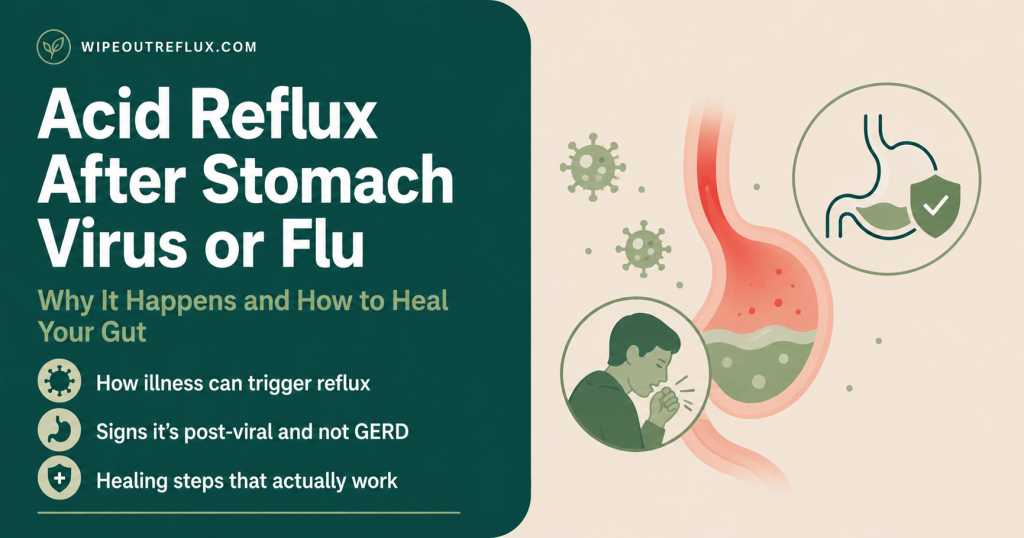
If you’ve come through a stomach bug or the flu and now find yourself dealing with heartburn, a sour taste or that burning feeling in your chest, you’re not imagining it — and you’re far from alone. Developing acid reflux after a viral illness is common, and the reassuring headline is that it’s usually temporary.
Here’s what’s going on. These infections put your digestive system through the wringer. The virus can slow your stomach’s emptying, inflame the lining of your gut, and disrupt the nerves and the valve that normally keep acid where it belongs. Add in the physical toll of vomiting, the medicines you took to feel better, and days of barely eating, and you’ve got a stomach that’s temporarily primed for reflux. For most people, it settles within days to a couple of weeks as everything heals.
Let me explain exactly why this happens, how a stomach virus differs from the flu here, how long you can expect it to last, and the best ways to soothe it while your gut recovers — plus the warning signs that mean it’s time to see a doctor.
Key Takeaways
- Acid reflux after a stomach virus or the flu is common and usually temporary, settling as your gut heals.
- Viruses can slow stomach emptying (a temporary, mostly self-limiting gastroparesis), leaving food and acid to back up.
- Infections also inflame the gut and can leave lingering upper-gut symptoms — the odds of ongoing indigestion roughly double after a stomach bug.
- Repeated vomiting strains the valve that holds acid down and exposes the oesophagus to acid, leaving it sore and reflux-prone.
- Painkillers like ibuprofen, plus days of an empty stomach, add extra irritation.
- Most post-viral reflux clears within days to a few weeks; occasionally it lingers for months.
- See a doctor if it lasts beyond 2–3 weeks, or you have trouble swallowing, weight loss, or blood in your vomit or stools.
Why you get acid reflux after a stomach bug or flu
It’s rarely one single thing — a viral illness tends to hit several of the systems that keep reflux in check at once. Understanding each one makes the recovery advice make sense.
Your stomach empties more slowly
This is the big one. A viral illness can temporarily paralyse part of the stomach’s muscle, slowing how fast it empties — a condition called gastroparesis. When the stomach empties sluggishly, food and acid sit around longer and back up more easily, which feels exactly like reflux. The good news is that post-viral gastroparesis is usually self-limiting: in one study of patients who developed it after a presumed viral illness, symptoms resolved on their own over a span of weeks to about a year, with an excellent overall prognosis Bityutskiy et al., American Journal of Gastroenterology, 1997. I explain this link in more depth in gastroparesis and acid reflux.
The infection inflames and irritates the gut
Stomach viruses inflame the lining of your stomach and gut, and that irritation doesn’t always vanish the moment the vomiting stops. In fact, acute gastroenteritis is a well-recognised trigger for lasting upper-gut trouble: a review found that the odds of developing ongoing indigestion — fullness, discomfort and reflux-type symptoms — were about two and a half times higher in the months after a stomach bug Futagami et al., Alimentary Pharmacology & Therapeutics, 2015. In other words, a bug can leave your digestive system touchy for a while, and reflux is part of that picture. It ties into the broader story of gut health and acid reflux.
Vomiting strains the valve and burns the oesophagus
Repeated vomiting is rough on the anti-reflux machinery. Each episode forces stomach contents up past the lower oesophageal sphincter — the valve meant to keep acid down — which can leave it stretched and weakened for a time. And all that acid washing up repeatedly irritates and inflames the oesophageal lining, leaving it raw and more sensitive. So even once the sickness passes, a sore, sensitised oesophagus can keep registering reflux and heartburn.
The medicines and the empty stomach
Two more factors pile on. Many people take anti-inflammatory painkillers like ibuprofen for the fever and body aches of flu — and those are hard on the stomach lining, one of several medications that make acid reflux worse. Antibiotics, if you were given them, can do the same. On top of that, days of barely eating leave acid sloshing in an empty stomach with no food to buffer it. Both add irritation to an already inflamed system.
Stomach virus vs the flu — is the reflux different?
People use “stomach flu” and “the flu” to mean different things, and the reflux route differs slightly between them — though they overlap.
A stomach virus (viral gastroenteritis — think norovirus or rotavirus) hits the gut directly, so reflux tends to come from the slowed emptying, inflammation and vomiting described above. The flu (influenza, a respiratory illness) works more indirectly: relentless coughing raises pressure in the abdomen and pushes acid upward, postnasal drip and lying in bed for days make reflux easier, and the painkillers and poor eating do the rest. A plain cold can do the same, which I cover in can a cold cause acid reflux, and post-viral throat symptoms can even mimic silent reflux, as in can COVID cause silent reflux. Either way, the underlying theme is the same: a temporarily disrupted, irritated system.
How long does post-viral reflux last?
For most people, the reflux fades within a few days to two or three weeks — roughly the time it takes for the stomach lining to calm down, the oesophagus to heal, and normal emptying to return. That timeline fits what we see with post-viral stomach slowing, which resolves on its own in the great majority of cases Bityutskiy et al., American Journal of Gastroenterology, 1997.
In a minority of people, though, symptoms linger for weeks or even months — the “post-infectious” indigestion pattern where the gut stays sensitised long after the infection has cleared Futagami et al., Alimentary Pharmacology & Therapeutics, 2015. If yours is dragging on, it doesn’t necessarily mean anything is seriously wrong — but it does mean the reflux is worth managing actively rather than just waiting out. A gentle, low-acid approach like my Wipeout Diet Plan is built for exactly this kind of lingering, sensitised reflux, and it’s worth a check-in with your doctor if symptoms pass the two-to-three-week mark.
How to soothe reflux while you recover
The goal during recovery is to give your gut the gentlest possible conditions to heal. A few simple steps help:
- Eat small, bland, low-acid meals. Little and often is far easier on a slow, irritated stomach than a few big meals. Gentle, low-acid eating is exactly what calms an inflamed system — the same principle behind the low-acid approach that dramatically improved symptoms in reflux patients Koufman, Annals of Otology, Rhinology & Laryngology, 2011. Think gentle soups, oats, bananas and rice.
- Rehydrate steadily. Sip water and gentle fluids through the day rather than gulping large amounts; my guide to what to drink with reflux has low-acid options.
- Try ginger. It settles nausea and is easy on reflux — see is ginger good for acid reflux.
- Stay upright after eating. Don’t lie down for a few hours; when you rest, prop yourself up rather than lying flat.
- Skip the extra irritants. Ease off anti-inflammatory painkillers where you can, and avoid alcohol, coffee and rich, fatty or spicy food until you’re back to normal.
- Consider a short-term barrier. An alginate can form a protective raft over the stomach contents for temporary relief while things settle.
When to see a doctor
Post-viral reflux is usually harmless and passing, but some signs deserve prompt medical attention. See a doctor if you notice any of the following:
- Reflux or heartburn that persists beyond two to three weeks, or keeps getting worse.
- Difficulty or pain when swallowing, or the feeling that food is sticking.
- Vomiting that won’t stop, or you can’t keep fluids down (risk of dehydration).
- Blood in your vomit, or black, tarry stools.
- Unintended weight loss, or severe or worsening stomach or chest pain.
These can point to something that needs proper assessment — from significant oesophageal irritation to dehydration — rather than a simple post-viral flare. When in doubt, get checked; there’s no harm in it.
Conclusion
So, if a stomach virus or a bout of flu has left you with acid reflux, take heart: it’s a common, usually temporary after-effect of a gut that’s been knocked off balance. Your stomach is emptying more slowly, your gut lining is inflamed, your oesophagus is sore from the vomiting, and the medicines and missed meals haven’t helped. Give it gentle, low-acid food, steady fluids, and a little time, and it typically resolves within a couple of weeks.
Sometimes, though, an illness like this doesn’t just cause a passing flare — it flips a switch, and the reflux hangs around long after you’ve otherwise recovered. If that’s you, the answer isn’t to keep waiting; it’s to calm the reflux at its source. That’s exactly what my Wipeout Diet Plan is built to do — the complete, in-depth system for getting reflux back under control for good. I designed it first and foremost around LPR, the stubborn throat-based kind that’s hardest to treat, but because it works on the same underlying reflux mechanisms, it’s just as effective for GERD, heartburn and everyday acid reflux.
And to make the recovery diet easy, the Wipeout Food Reference Guide is the essential companion — it lays out the real pH values of foods and drinks for acid reflux and LPR, so you can pick the gentlest options while your gut heals and beyond. Give your system time, feed it kindly, and see your doctor if anything lingers or alarms you — that’s how you get back to normal.
Frequently Asked Questions
Why do I have acid reflux after a stomach virus?
Because the infection temporarily disrupts your digestion in several ways: it slows your stomach’s emptying, inflames the gut lining, and the repeated vomiting strains the valve that holds acid down while irritating your oesophagus. Painkillers and days of not eating add to it. The result is a stomach that’s temporarily prone to reflux, which usually settles as you heal.
How long does reflux last after the flu or a stomach bug?
Usually a few days to two or three weeks, as your stomach lining calms, the oesophagus heals and normal emptying returns. In a minority of people it lingers for weeks or months. If it lasts beyond two to three weeks or worsens, it’s worth seeing a doctor.
Can the flu cause heartburn even though it’s a respiratory illness?
Yes. The flu triggers reflux more indirectly — persistent coughing raises abdominal pressure and pushes acid up, postnasal drip and lying in bed make reflux easier, and the painkillers plus poor eating irritate the stomach. A common cold can do the same thing.
What should I eat if I have reflux after being sick?
Keep it small, bland and low-acid: gentle soups, oats, bananas, rice and other easy foods, eaten little and often rather than in big meals. Sip fluids steadily, try ginger for nausea, stay upright after eating, and avoid alcohol, coffee and rich, fatty or spicy foods until you’re back to normal.
When should I worry about reflux after a virus?
Seek medical care if it lasts beyond two to three weeks or worsens, if you have trouble or pain swallowing, if you can’t keep fluids down, if you notice blood in your vomit or black stools, or if you have unexplained weight loss or severe pain. These warrant proper assessment rather than waiting it out.
Research & References
- A study of patients who developed gastroparesis (delayed stomach emptying) after a presumed viral illness found it to be largely self-limiting, with symptoms resolving over weeks to about a year and an excellent overall prognosis — explaining why post-viral reflux is usually temporary Bityutskiy et al., American Journal of Gastroenterology, 1997.
- A systematic review with meta-analysis found that the odds of developing post-infectious functional dyspepsia — lasting upper-gut symptoms including fullness, discomfort and reflux — were about 2.5 times higher in the months following acute gastroenteritis Futagami et al., Alimentary Pharmacology & Therapeutics, 2015.
- A strict low-acid diet produced dramatic symptom improvement in patients with stubborn reflux, supporting the value of gentle, low-acid eating while an irritated gut and oesophagus recover Koufman, Annals of Otology, Rhinology & Laryngology, 2011.

David Gray
12 years living with LPR · Consultant & researcher
I've lived with LPR for twelve years — the misdiagnoses, the PPI courses that did nothing, the slow work of figuring out what actually helps. Wipeout Reflux is where I translate the research into plain terms for people stuck in the same place. Every claim here is sourced to peer-reviewed work, and I consult one-to-one with LPR sufferers.