
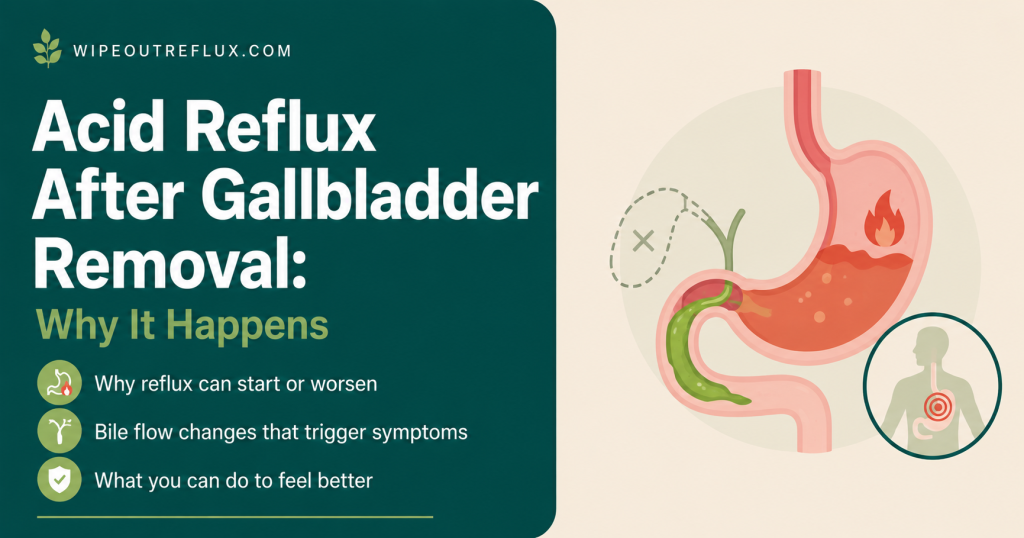
Reflux after gallbladder removal is real, common enough to be worth taking seriously, and almost universally explained the wrong way.
The standard account is bile reflux: without a gallbladder, bile drips continuously into the duodenum instead of arriving in timed boluses, so it washes back into the stomach and up into the oesophagus. That mechanism is plausible and partly true. But when researchers combined a meta-analysis of observational studies with genetic analysis, they found cholecystectomy raised GERD risk by a modest 37% (RR 1.37) — real, but far smaller than the way people talk about it.
And there’s a finding that reframes the whole question. In a prospective study of 302 patients, people scheduled for gallbladder surgery already had significantly higher reflux scores than controls before their operation — and their pain scores actually improved afterwards. Which raises an uncomfortable possibility: for a lot of people, the reflux was already there, hidden behind gallbladder pain.
That distinction matters enormously, because it changes what you should do. Below: what genuinely changes when the gallbladder goes, why acid-suppressing drugs so often disappoint here, and what actually helps.
Key Takeaways
- Cholecystectomy is associated with a modestly increased risk of GERD — RR 1.37 in meta-analysis, with supporting genetic evidence.
- The association survived adjustment for smoking, alcohol and BMI, so it isn’t purely confounding.
- But gallstone patients already have more reflux before surgery, and their pain scores improve afterwards.
- A prospective controlled study of 302 patients found no increase in reflux symptoms after cholecystectomy.
- Physiological studies are mixed: one found slightly increased bile in the stomach after surgery but no measurable difference in the oesophagus.
- Bile reflux is not acid reflux, which is why PPIs frequently fail to fix it — there’s little acid to suppress.
- Bile reflux tends to cause burning that doesn’t respond to antacids, upper abdominal pain, nausea and sometimes bile vomiting.
- Sucralfate coats damaged tissue directly and outperformed a PPI for epigastric pain and heartburn in post-cholecystectomy patients in one trial.
- Fat handling changes after surgery, so large fatty meals cause bloating and pressure as well as triggering reflux directly.
- Barrett’s oesophagus risk rises modestly, but the same analysis found no increase in oesophageal cancer risk.
What Actually Changes When the Gallbladder Goes
Worth understanding properly, because the popular version overstates it.
Your gallbladder is a storage and concentration organ, not a production one. The liver makes bile continuously — roughly 600ml a day — and between meals the gallbladder collects it and concentrates it, up to about tenfold. When a fatty meal arrives in the duodenum, cholecystokinin is released, the gallbladder contracts, and a concentrated bolus of bile is delivered exactly when it’s needed.
Remove the gallbladder and the liver carries on making bile at the same rate, but there’s nowhere to store it. Bile now trickles into the duodenum continuously, whether you’re eating or not.
Two consequences follow, and only one of them is about reflux:
1. There’s bile in your duodenum when there’s no food to absorb it. Between meals and overnight, bile is arriving in an empty upper gut. If any of it moves backwards through the pyloric valve into the stomach — which happens to some degree in everyone — there’s now nothing to dilute or buffer it.
2. Fat digestion is less efficient at any single meal. Without a concentrated bolus on demand, a large fatty meal outpaces the bile available to emulsify it. Most people adapt over months as the bile ducts dilate slightly and hold more, but early on this produces bloating, loose stools and wind — and bloating raises abdominal pressure, which is its own route to reflux.
Notice that neither of these directly loosens your lower oesophageal sphincter. That’s the gap in the popular explanation, and it’s why the evidence is messier than you’d expect.
Bile Reflux — The Mechanism Everyone Cites
The chain runs: continuous bile flow → more bile in the duodenum → more duodenogastric reflux through the pylorus → bile in the stomach → and when the stomach refluxes, what comes up now contains bile as well as acid.
That mixed refluxate is called duodenogastro-oesophageal reflux, and it’s genuinely more damaging than acid alone. Bile acids injure the oesophageal lining through a different route from acid — they’re detergents, and they disrupt cell membranes directly. They’re also particularly harmful in weakly acidic conditions, which is exactly the environment you create when you put someone on a PPI without addressing the bile.
So the mechanism is coherent. The question is how much it actually happens after cholecystectomy, and that’s where the evidence gets interesting. There’s fuller background on the distinction in bile reflux vs acid reflux.
What the Evidence Actually Shows
Three bodies of evidence, pointing in three directions. I’ll take them in order.
Physiological studies are mixed and mostly underwhelming. One study monitored 17 symptomatic gallstone patients with 24-hour oesophageal and gastric pH-metry plus gastric bilirubin monitoring, repeating the whole thing three months after surgery. Cholecystectomy did not result in increased bile reflux into the stomach or increased gastro-oesophageal acid reflux — and the patients who did show increased postoperative duodenogastric reflux were entirely asymptomatic Manifold et al., The American Journal of Gastroenterology, 2000. Small study, but it measured the right things directly.
A larger investigation of 696 patients with upper gastrointestinal symptoms, of whom 55 had undergone cholecystectomy, found that cholecystectomy slightly augmented bile reflux into the stomach — particularly supine gastric bile reflux — but with no detectable difference in the oesophagus Fein et al., Digestive Diseases and Sciences, 2008.
That’s an important detail. Bile getting into the stomach is not the same as bile getting into the oesophagus, and the second step — the one that would cause your symptoms — is the one that didn’t show up.
Symptom studies say no. The best-designed one recruited 302 patients scheduled for either elective cholecystectomy or hernia repair as controls, at two hospitals, and had both groups complete validated Reflux Symptom Score and Gastrointestinal Symptom Rating Scale questionnaires before and after surgery. The conclusion was that cholecystectomy does not lead to an increase in reflux symptoms Lin et al., Annals of Surgery, 2010. The authors noted that six previous studies had suggested reflux worsens after cholecystectomy, but all had design limitations their study was built to avoid.
The newest and largest analysis says yes, modestly. Researchers combined a meta-analysis of observational studies with Mendelian randomisation — using genetic variants as a natural experiment, which sidesteps a lot of the confounding that plagues observational work. Cholecystectomy was a risk factor for GERD (RR 1.37, 95% CI 1.09–1.72), and the genetic analysis independently found associations between cholecystectomy and both GERD (OR 1.04, 95% CI 1.02–1.06) and Barrett’s oesophagus (OR 1.13, 95% CI 1.06–1.19). These persisted after adjusting for smoking, alcohol consumption and BMI Ma et al., Frontiers in Medicine, 2024.
Two methods agreeing is much stronger than either alone. I take this as the best current answer: there is a real effect, and it is modest. A 37% relative increase on a common condition is meaningful at population level, but it’s a long way from “gallbladder removal causes reflux.”
The Finding That Reframes Everything
Buried in that prospective study is the detail I’d most want you to know.
At baseline — before any surgery — the patients heading for gallbladder removal had significantly higher reflux symptom scores than the hernia controls: 1.44 versus 1.02 on the Reflux Symptom Score, and 1.91 versus 1.43 on the GSRS reflux subscore. Meanwhile, their pain subscores decreased after the operation.
Read that carefully. People with symptomatic gallstones already have more reflux than the general surgical population. Their surgery reduced their pain. And yet a substantial number will tell you their reflux started after the operation.
There are several honest explanations, and they probably all contribute:
Attribution. Before surgery, upper abdominal discomfort had an obvious culprit. Afterwards, with the gallbladder gone, the same sensations need a new explanation — and now they get noticed rather than filed under “my gallbladder.”
Shared risk factors. Gallstones and reflux have overlapping causes: excess weight, central adiposity, a high-fat diet, rapid weight loss, pregnancy, older age. Someone who develops gallstones is someone with an elevated reflux risk already.
Genuine overlap. Biliary pain and reflux can feel similar — upper abdominal or lower chest, worse after fatty meals, sometimes radiating. Some proportion of people who have their gallbladder out for “biliary” symptoms were partly or wholly experiencing reflux all along, which is why surgery doesn’t fix them.
And a real, modest surgical effect on top. The genetic evidence suggests this isn’t purely confounding.
The practical upshot: if your reflux appeared after gallbladder surgery, it’s worth considering that it may not have been created by the operation. That’s not a dismissal — the symptoms are the same either way — but it points towards treating it as ordinary reflux, which has far more effective treatments than “post-cholecystectomy bile reflux,” a label that tends to lead people down unproductive paths.
Why Your PPI Isn’t Working
This is the most practically valuable section, and it’s the commonest source of frustration I hear about after this surgery.
The usual sequence: reflux symptoms after gallbladder removal, GP prescribes omeprazole, it helps a bit or not at all, dose gets doubled, still not right. People conclude their reflux is untreatable.
The explanation is mechanistic. PPIs reduce stomach acid production. If your refluxate is substantially bile rather than acid, you’re suppressing the wrong thing — and worse, bile acids are more injurious to the oesophageal lining in weakly acidic conditions than in strongly acidic ones. Turning the acid down can theoretically shift the chemistry in an unhelpful direction while doing nothing about the volume of what’s coming up.
Clues that bile is a significant part of your picture:
- Burning that doesn’t respond well to antacids or acid suppression
- Upper abdominal pain rather than purely chest burning
- Nausea, particularly in the morning or between meals
- Occasionally vomiting greenish-yellow fluid
- A persistent bitter taste, distinct from the sour taste of acid
- Symptoms that are worse lying down or overnight, when there’s no food in the stomach
None of these is diagnostic on its own — there’s a lot of overlap with ordinary reflux — but the combination of poor PPI response plus bitterness and nausea is suggestive. If you’re in that position, acid reflux medication not working and why PPIs don’t work for LPR cover the wider reasons acid suppression fails.
What Actually Helps
Ranked roughly by how much benefit most people get.
Change the shape of your meals
The highest-value change and the one most within your control. Because bile now arrives continuously rather than on demand, your system copes far better with several modest meals than with one large fatty one.
Practically: smaller portions, more often. Moderate the fat at any single sitting rather than eliminating it — you still need fat for fat-soluble vitamins, and total avoidance backfires. Spread it across the day instead of concentrating it in one meal. Fried food is the worst case on every count — see is fried food bad for acid reflux.
Meal volume is an independent reflux trigger regardless of any of this, as covered in does overeating cause acid reflux. And because bile is trickling in overnight with no food to meet it, the evening cut-off matters more here than usual — see how long before bed you should stop eating.
Ask about sucralfate
This is the option most often overlooked, and it targets bile specifically rather than acid. Sucralfate forms a physical protective coating over damaged mucosa, so it works regardless of whether the irritant is acid or bile.
In a randomised trial in post-cholecystectomy patients, sucralfate reduced epigastric pain in 45% of patients against 30% on rabeprazole, and heartburn in 44% against 35%. Modest numbers, but it outperformed the PPI in the exact population this article is about. More in sucralfate for reflux.
Use an alginate
Raft-forming alginates create a physical barrier floating on the stomach contents, which blocks reflux mechanically rather than chemically. That makes them useful whatever the refluxate contains. See alginates for acid reflux and Gaviscon Advance. For many people this is more useful than another PPI dose increase.
Ask about ursodeoxycholic acid
UDCA shifts your bile pool towards a less irritating composition. The evidence is genuinely mixed — one placebo-controlled trial reported around 80% symptomatic improvement but no change on endoscopy or histology, while a randomised trial in a different surgical population found bile reflux reduced but the symptom difference not statistically significant. Worth discussing if other measures haven’t worked; not a guaranteed answer.
Consider a prokinetic
If the problem is partly that things aren’t moving forward properly, a prokinetic can help clear the stomach faster and reduce the window for reflux. It’s a specialist decision with real trade-offs — see prokinetics for acid reflux.
Bile acid sequestrants — with realistic expectations
Cholestyramine and similar drugs bind bile acids. They’re commonly tried, but the evidence for symptom relief in bile reflux is weak and bloating can be significant. They’re much more useful for bile acid diarrhoea, which is a separate and genuinely common post-cholecystectomy problem — see below.
Sleep on an incline
Given that bile arrives continuously overnight and there’s no food in the stomach to buffer it, raising the head of the bed does more here than in ordinary reflux. Blocks under the bed legs, not extra pillows.
When It’s Something Else
“Post-cholecystectomy syndrome” is an umbrella term covering persistent symptoms after gallbladder removal, and reflux is only one possibility. Worth ruling out the others rather than assuming.
Bile acid diarrhoea. Very common and frequently missed. Continuous bile delivery overwhelms reabsorption in the terminal ileum, and unabsorbed bile acids reach the colon, causing urgent watery diarrhoea, often after meals. It responds well to bile acid sequestrants, which is exactly where those drugs do earn their place.
Retained stone in the bile duct. Causes pain, sometimes jaundice, sometimes abnormal liver blood tests. Needs investigating.
Sphincter of Oddi dysfunction. Biliary-type pain continuing after surgery, sometimes with abnormal liver enzymes.
Fat malabsorption. Bloating, wind, pale or greasy stools after fatty meals — a digestion problem rather than a reflux one, though the resulting distension can worsen reflux. See acid reflux and gas.
Something that was never the gallbladder. If your symptoms are unchanged after surgery, the gallstones may have been incidental — they’re extremely common and often silent. Functional dyspepsia, ordinary reflux and IBS all produce overlapping symptoms.
Given that list, a symptom diary and a proper conversation with your surgeon or GP beats self-diagnosis. Investigation options are covered in how is acid reflux diagnosed and endoscopy for acid reflux.
Should You Worry About Barrett’s?
A fair question given that bile is implicated in Barrett’s development, and one that deserves a proportionate answer rather than either reassurance or alarm.
The genetic analysis did find an association between cholecystectomy and Barrett’s oesophagus (OR 1.13), and gallstones themselves carried a stronger association (RR 1.77 in meta-analysis). So the risk is modestly elevated.
But the same study looked for an increase in oesophageal adenocarcinoma and did not find one — despite GERD and Barrett’s being the main pathway to it. The authors’ own conclusion was that patients with gallstones or cholecystectomy should be alert to oesophageal symptoms, but that invasive screening isn’t warranted on these grounds alone.
That’s a sensible position and I’d endorse it. Take persistent symptoms seriously, get them assessed rather than self-managing indefinitely, but don’t treat gallbladder removal as a cancer risk factor. Related reading in can silent reflux cause Barrett’s oesophagus and can acid reflux cause cancer.
When to See a Doctor
Get medical advice promptly if you have:
- Yellowing of the skin or eyes, or pale stools and dark urine
- Fever with upper abdominal pain
- Severe or worsening abdominal pain
- Difficulty or pain on swallowing, or food sticking
- Vomiting blood, or black tarry stools
- Unintentional weight loss
- Persistent vomiting
The first two suggest a biliary complication rather than reflux and need assessing quickly. More on the general alarm features in when to see a doctor and can acid reflux make it hard to swallow.
Conclusion
Reflux after gallbladder removal is real but smaller than its reputation. The best current evidence — a meta-analysis backed by genetic analysis, which is a genuinely strong combination — puts the increase at around 37%, persisting after adjustment for weight, smoking and alcohol. Meanwhile the best-designed symptom study found no increase at all, and direct physiological monitoring found bile creeping into the stomach without measurably reaching the oesophagus.
The finding I keep coming back to is that gallstone patients had more reflux than controls before their surgery, and less pain after it. That doesn’t mean your symptoms aren’t real or aren’t new to you. It means a significant portion of post-cholecystectomy reflux is probably reflux that was already present, previously attributed to the gallbladder, now unmasked — plus a modest genuine surgical effect on top.
Why does that matter? Because “bile reflux caused by my surgery” tends to feel like a permanent structural problem with no solution, whereas ordinary reflux has a great many effective treatments. The practical answer is usually neither exotic nor surgical: smaller and less fatty meals spread through the day, a firm evening cut-off, an alginate for symptom relief, sleeping on an incline, and a conversation about sucralfate if acid suppression alone isn’t cutting it.
The one thing I’d push back on is escalating PPI doses when they clearly aren’t working. If your refluxate is substantially bile, more acid suppression is treating the wrong molecule — and that’s a conversation worth having with your doctor rather than something to endure.
Since meal size, fat load and timing do most of the work here, this is a situation where diet genuinely is the treatment rather than a supporting act. Working out which foods need to go, which just need portioning or timing differently, and in what order to test them is most of the real work — and it’s what the Wipeout Diet Plan is structured around, as a way of reducing reflux episodes rather than a list of prohibitions. I built it first and foremost for LPR and silent reflux, the stubborn throat-based form that responds worst to medication, though because it targets the same underlying mechanisms it works just as well for GERD and everyday heartburn. Alongside it, the Wipeout Food Reference Guide is the practical companion — the full list of foods and drinks that are safe for acid reflux and LPR with their actual pH values, which is particularly useful when you’re rebuilding your meals around a smaller fat load.
Frequently Asked Questions
Why do I have acid reflux after gallbladder removal?
Partly because bile now flows continuously rather than in timed boluses, so more can wash back into the stomach and join what refluxes. But the effect is modest — around a 37% increased risk — and gallstone patients already had more reflux than controls before surgery, so some of it predates the operation and was previously attributed to the gallbladder.
Is it bile reflux or acid reflux?
Often both. Clues pointing towards bile include poor response to antacids and PPIs, upper abdominal pain rather than pure chest burning, nausea between meals, a bitter rather than sour taste, and occasionally vomiting greenish-yellow fluid. The two overlap considerably, so this is suggestive rather than diagnostic.
Why isn’t omeprazole helping my reflux after gallbladder surgery?
Because PPIs reduce acid, and if your refluxate is substantially bile there’s little acid to suppress. Bile acids also damage the oesophageal lining more readily in weakly acidic conditions. If acid suppression clearly isn’t working, escalating the dose is unlikely to help — ask about sucralfate or an alginate instead.
How long does reflux last after gallbladder removal?
Many people improve over three to six months as the bile ducts adapt and hold slightly more bile between meals. Symptoms that persist beyond that, or that are severe from the start, are worth investigating properly rather than waiting out — particularly to rule out a retained stone or another cause.
What should I eat after gallbladder removal to avoid reflux?
Smaller meals more often, with fat spread across the day rather than concentrated in one sitting. You don’t need to eliminate fat — you need fat for absorbing fat-soluble vitamins — but a large fatty meal outpaces the bile available for it. Fried food is the worst case, and a firm evening cut-off matters more than usual.
Can gallbladder removal cause silent reflux or throat symptoms?
Plausibly, since anything that increases what reaches the oesophagus can potentially reach the throat, and bile is more damaging to unprotected tissue than acid alone. But this hasn’t been studied specifically after cholecystectomy, so I’d treat it as reasonable inference rather than established fact.
Does everyone get reflux after gallbladder removal?
No — most people don’t. In one physiological study, 83% of patients were asymptomatic three months after surgery, and the largest prospective symptom study found no increase in reflux scores at all. If you’re symptomatic you’re in a minority, which is worth knowing when the internet suggests otherwise.
Does bile reflux increase my cancer risk after gallbladder removal?
The risk of Barrett’s oesophagus appears modestly raised (OR 1.13 in genetic analysis), but the same study found no increase in oesophageal adenocarcinoma risk, and its authors concluded that invasive screening isn’t warranted on these grounds. Take persistent symptoms seriously and get them assessed, but this isn’t a reason for alarm.
What is post-cholecystectomy syndrome?
An umbrella term for persistent or new symptoms after gallbladder removal. It covers bile reflux, bile acid diarrhoea, retained bile duct stones, sphincter of Oddi dysfunction and fat malabsorption — as well as conditions that were never the gallbladder’s fault. The label describes a situation rather than a diagnosis, so it’s worth pushing for a specific cause.
Should I have avoided the surgery?
Almost certainly not, if you had symptomatic gallstones. The same prospective study showing no increase in reflux scores also found pain scores improved after surgery. Untreated symptomatic gallstones risk cholecystitis, pancreatitis and duct obstruction, which are considerably more serious than reflux.
Research & References
- Ma et al., Frontiers in Medicine, 2024 — Combined meta-analysis of observational studies and Mendelian randomisation analysis assessing associations between cholelithiasis or cholecystectomy and gastro-oesophageal reflux disease, Barrett’s oesophagus and oesophageal adenocarcinoma. Meta-analysis found cholelithiasis linked to increased Barrett’s risk (RR 1.77, 95% CI 1.37–2.29) and cholecystectomy a risk factor for GERD (RR 1.37, 95% CI 1.09–1.72). Genetic analysis found associations between cholecystectomy and GERD (OR 1.04, 95% CI 1.02–1.06) and Barrett’s (OR 1.13, 95% CI 1.06–1.19), persisting after adjustment for smoking, alcohol and BMI. No increase in oesophageal adenocarcinoma risk was observed, and the authors concluded invasive screening was not warranted on these grounds.
- Lin et al., Annals of Surgery, 2010 — Prospective controlled study of 302 patients scheduled for elective cholecystectomy or hernia repair (controls) at two hospitals, completing the validated Reflux Symptom Score and Gastrointestinal Symptom Rating Scale 1–15 days before and 4–12 weeks after surgery. Baseline reflux scores were significantly higher in the cholecystectomy group than controls (RSS 1.44 vs 1.02; GSRS reflux subscore 1.91 vs 1.43; P < 0.05), and GSRS pain subscores decreased after surgery in the cholecystectomy group. The study concluded that cholecystectomy does not lead to an increase in reflux symptoms.
- Manifold et al., The American Journal of Gastroenterology, 2000 — Study of 17 symptomatic gallstone patients undergoing 24-hour ambulatory oesophageal and gastric pH-metry with gastric bilirubin monitoring, repeated three months after cholecystectomy, with H. pylori status ascertained in all. Cholecystectomy did not result in increased bile reflux into the stomach or increased gastro-oesophageal acid reflux; patients with increased postoperative duodenogastric reflux were entirely asymptomatic, and 83% of patients were asymptomatic after surgery.
- Fein et al., Digestive Diseases and Sciences, 2008 — Study of 696 patients with upper gastrointestinal symptoms, of whom 55 had a history of cholecystectomy, assessing gastric and oesophageal bile reflux. Cholecystectomy slightly augmented bile reflux into the stomach, particularly supine gastric bile reflux, without detectable differences in the oesophagus.
- Katz et al., The American Journal of Gastroenterology, 2022 — ACG clinical guideline for the diagnosis and management of gastro-oesophageal reflux disease, which recommends weight loss for patients who are overweight, suggests avoiding meals within 2 to 3 hours of bedtime, and suggests avoiding individual trigger foods as a conditional recommendation on low-quality evidence.

David Gray
12 years living with LPR · Consultant & researcher
I've lived with LPR for twelve years — the misdiagnoses, the PPI courses that did nothing, the slow work of figuring out what actually helps. Wipeout Reflux is where I translate the research into plain terms for people stuck in the same place. Every claim here is sourced to peer-reviewed work, and I consult one-to-one with LPR sufferers.