
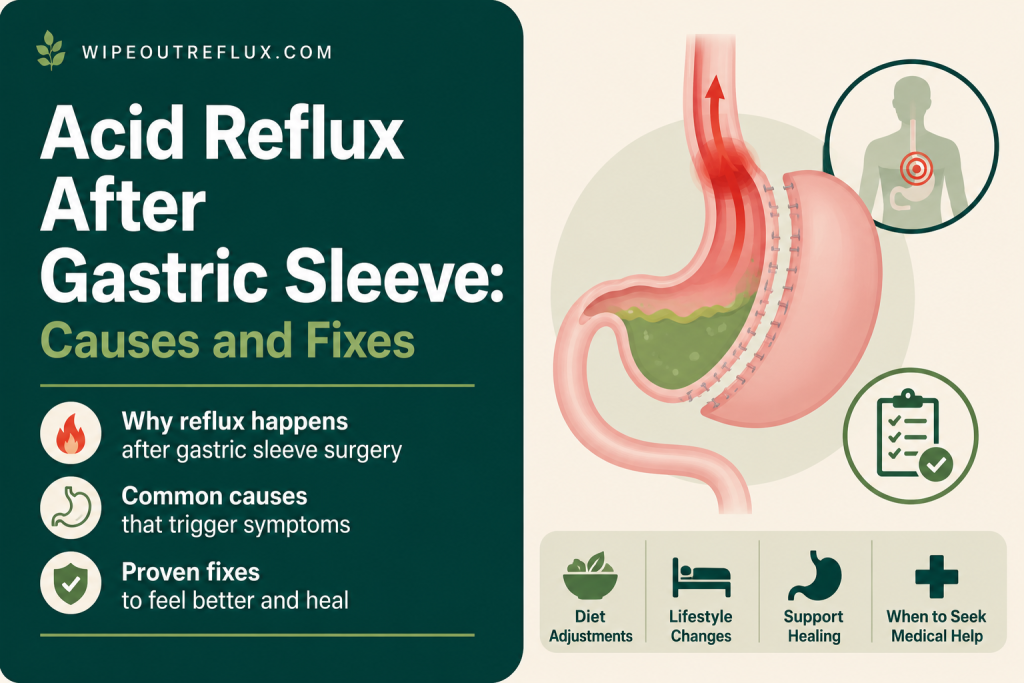
Reflux after a gastric sleeve is common, it’s anatomical rather than dietary, and it’s the single biggest long-term trade-off of the operation.
The numbers are clear. Across 46 studies covering 10,718 patients, de novo reflux — new reflux in people who didn’t have it before — occurred in 23%. Long-term oesophagitis was found in 28%, Barrett’s oesophagus in 8%, and 4% needed conversion to a gastric bypass because the reflux couldn’t be controlled. At ten years in a randomised trial, oesophagitis was present in 31% of sleeve patients against 7% of bypass patients.
Here’s the part that matters most and gets least attention: symptoms don’t reliably track the damage. The meta-analysis authors specifically concluded that endoscopic surveillance may be warranted even in people with no symptoms at all. Plenty of sleeve patients with visible oesophagitis feel nothing.
The reason it happens is structural. A sleeve removes the part of the stomach that forms part of your anti-reflux barrier, and turns the rest into a narrow high-pressure tube. That’s not something you can eat your way out of — though what you eat still matters a great deal. Below: the anatomy, the honest numbers, what actually helps, and when conversion surgery becomes the answer.
This article is general information, not medical advice. If you’ve had bariatric surgery, your surgical team should be your first call about any new or worsening reflux.
Key Takeaways
- De novo reflux affects around 23% of sleeve patients, and existing reflux worsens in a further 19%.
- At 10 years in a randomised trial, endoscopic oesophagitis was found in 31% after sleeve versus 7% after gastric bypass.
- Symptoms correlate poorly with tissue damage — you can have significant oesophagitis and feel fine.
- The cause is anatomical: the sleeve removes the fundus, alters the angle of His, divides sling fibres and creates a high-pressure tube.
- Sleeve surgery changes the angle of His from roughly 36° to 51°, degrading the flap-valve mechanism at the junction.
- Reported Barrett’s rates vary widely — 8% in meta-analysis, but only 4% in the best randomised trial with systematic endoscopy, no different from bypass.
- Around 4% of sleeve patients eventually need conversion to gastric bypass for reflux.
- A standard fundoplication is not possible after a sleeve, because the fundus used to build the wrap has been removed.
- An undiagnosed or unrepaired hiatal hernia is one of the most common correctable causes.
- Conversion to Roux-en-Y gastric bypass is the definitive fix and works well — it isn’t a failure, it’s a planned second step.
Why the Sleeve Causes Reflux
This is anatomy, not lifestyle, and understanding it explains why the usual reflux advice only takes you so far.
The pathophysiology is multifactorial — the result of anatomical, physiological and physical factors interacting, with the shape of the sleeve, the degree of injury to the lower oesophageal sphincter and the presence of hiatal hernia all contributing Felinska et al., Annals of the New York Academy of Sciences, 2020. Five mechanisms are worth knowing individually.
1. The angle of His is flattened
Where your oesophagus meets your stomach, it enters at a sharp angle rather than joining end to end. That acute angle — the angle of His — creates a flap-valve effect: as the stomach fills, pressure presses the flap shut. It’s a genuine mechanical component of your anti-reflux barrier, working alongside the muscular sphincter.
A sleeve resects the fundus, which forms one wall of that angle. Measurements show the angle changing from roughly 36° before surgery to around 51° afterwards. A flatter angle is a less effective valve.
2. The sling fibres are divided
The lower oesophageal sphincter isn’t a discrete ring of muscle. Part of its closing pressure comes from gastric sling fibres — muscle fibres that loop around the junction from the stomach side. Sleeve gastrectomy potentially divides these, and resecting the lower sling fibres is associated with reduced resting sphincter pressure. Background on the valve itself in the lower oesophageal sphincter and acid reflux.
3. You’ve created a high-pressure tube
Roughly 80% of the stomach is removed, leaving a narrow tube of perhaps 100 to 150ml. Crucially, the part removed — the fundus — is the part that stretches to accommodate a meal.
The result is markedly reduced gastric compliance. Food entering a rigid, narrow tube raises intragastric pressure far more than it would in a normal stomach, and that pressure has two possible exits: forward through the pylorus, or backwards past a sphincter that has just been weakened. Studies describe decreased compliance and raised pressures creating relative sphincter hypotension — the valve isn’t just weaker, it’s facing more pressure.
This is why portion size matters so disproportionately after a sleeve. Slightly overfilling a compliant stomach is uncomfortable; slightly overfilling a sleeve pushes contents upward.
4. The flap valve is gone
Related to the angle of His but distinct: the gastro-oesophageal flap valve is a visible anatomical structure at the junction, gradeable at endoscopy. Sleeve gastrectomy essentially eliminates it. You lose a component of the barrier that doesn’t regenerate.
5. Hiatal hernia — the correctable one
This is the mechanism worth pursuing hardest, because unlike the other four it can be fixed.
Hiatal hernias are common in people with obesity and often go undetected before surgery. If one is present and not repaired at the time of the sleeve, you’ve combined a weakened barrier with a displaced junction. There’s also the possibility of the sleeve migrating upward through the hiatus afterwards, particularly if the phreno-oesophageal ligament was disturbed during dissection.
If you developed reflux after a sleeve and nobody has looked for a hiatal hernia, that’s the first question to ask. See hiatal hernia and reflux.
The Numbers, Honestly
The evidence here is unusually good — randomised trials with endoscopic follow-up, which is rare in reflux research.
The pooled picture. A systematic review and meta-analysis of 46 studies totalling 10,718 patients found that worsening of pre-existing GERD occurred in 19% and de novo reflux in 23%. Long-term prevalence of oesophagitis was 28% and of Barrett’s oesophagus 8% — against roughly 1.6% in the general population. Four percent of all patients required conversion to Roux-en-Y gastric bypass for severe reflux Yeung et al., Annals of Surgery, 2020.
The randomised comparison. The SLEEVEPASS trial randomised 240 patients to sleeve or gastric bypass and followed them for ten years, with 176 of 228 surviving patients (77%) undergoing gastroscopy at the end — systematic endoscopy rather than symptom questionnaires. Oesophagitis was significantly more prevalent after sleeve: 31% versus 7% (P < 0.001). Barrett’s oesophagus was found in 4% after each procedure, with no significant difference Salminen et al., JAMA Surgery, 2022.
Where the evidence disagrees. Barrett’s rates. The meta-analysis found 8%; some earlier series reported 14 to 17%; SLEEVEPASS found 4% and no difference against bypass. Its authors noted their cumulative incidence was markedly lower than previously reported.
I’d weight the randomised trial with systematic endoscopy more heavily than pooled observational series, which are vulnerable to selection effects — people who get scoped are disproportionately those with symptoms. So my read is that Barrett’s risk after sleeve is real but at the lower end of the published range, and the oesophagitis risk is the better-established concern.
None of this makes the sleeve a bad operation. The same trial found good, sustained weight loss with both procedures, and the sleeve is technically simpler with fewer nutritional consequences. It’s a trade-off to manage, not a reason for regret.
The Silent Damage Problem
If you take one thing from this article beyond the anatomy, take this.
The meta-analysis authors’ explicit conclusion was that symptoms do not always correlate with the presence of pathology, and that endoscopic surveillance may therefore be important even in asymptomatic patients.
That’s an unusual statement in reflux medicine and it deserves attention. In most reflux, symptoms are a rough guide to what’s happening. After a sleeve, that link loosens. People with visible oesophagitis frequently report no heartburn at all, and the reasons are plausible: altered oesophageal sensitivity, symptoms attributed to normal post-surgical adjustment, or a refluxate whose composition produces less burning.
The practical consequence is that “I feel fine” is weaker evidence than usual. If you’ve had a sleeve and haven’t had an endoscopy in some years, it’s worth asking your bariatric team whether you should — particularly at the five-year mark and beyond, since these are long-term rather than early findings. See endoscopy for acid reflux.
Equally, don’t let this frighten you into unnecessary procedures. Surveillance practice varies between centres and countries, and this is a conversation to have with your surgeon rather than a rule I can give you.
Does It Settle Down?
Partly, and the timeline is worth knowing so you can judge your own situation.
The first few months. Early reflux is common and often improves. Post-operative swelling narrows the sleeve further, the tissue is still healing, and you’re adjusting to entirely new portion sizes. Many people find this phase eases by three to six months.
Six to twenty-four months. As weight comes off, intra-abdominal pressure falls, which works in your favour. Some people’s reflux genuinely improves during this window.
Beyond two years. This is where the anatomical reality asserts itself. The oesophagitis and Barrett’s findings above are long-term ones, and reflux that persists past two years generally reflects structure rather than healing — it doesn’t tend to resolve spontaneously.
So the rule of thumb: early reflux often settles, late reflux usually doesn’t. Reflux that begins or worsens years after surgery deserves investigation rather than patience — it may indicate a hiatal hernia that has developed, a sleeve that has dilated, or a stricture.
What Actually Helps
Start with the non-surgical measures. They won’t fix the anatomy, but they meaningfully reduce how often the anatomy causes trouble.
Volume discipline — the highest-value change
Because your sleeve is a low-compliance tube, portion control does more here than in ordinary reflux. Slightly too much food doesn’t just feel uncomfortable, it directly raises the pressure pushing against a weakened valve.
Practically: stop eating at the first sense of fullness rather than pushing past it. Eat slowly — twenty to thirty minutes per meal — because a sleeve fills faster than your satiety signals arrive. Chew thoroughly. And separate fluids from solids by around thirty minutes, since drinking with meals adds volume to a container that has very little spare capacity. See does overeating cause acid reflux.
Protect the evening
Lying down removes gravity, which matters more when your mechanical barrier is compromised. A firm cut-off three hours before bed, and raising the head of the bed on blocks rather than piling up pillows, are both high-value. See how long before bed you should stop eating, how to raise the head of your bed and the best sleeping position.
Medication that fits the problem
PPIs are the mainstay and are often needed long-term after a sleeve — that’s a legitimate use rather than a failure. Because the mechanism is mechanical, though, acid suppression treats the consequence rather than the cause, and some people find it incomplete. Trade-offs in omeprazole side effects, and timing in proton pump inhibitors.
An alginate is a particularly good fit here, because it forms a physical raft that blocks reflux mechanically — addressing a mechanical problem mechanically. See alginates for acid reflux and Gaviscon Advance. Sucralfate is worth asking about if there’s established oesophagitis, since it coats damaged tissue directly.
The rest of the standard measures
Avoid tight waistbands. Don’t lie down or bend forward after eating. Stop smoking. Keep losing weight if you have more to lose — falling intra-abdominal pressure genuinely helps. And note that GLP-1 medications, increasingly used alongside or after bariatric surgery, slow gastric emptying and can themselves worsen reflux — see GLP-1 medications and silent reflux and does Ozempic cause heartburn.
Surgical Fixes — and Why Fundoplication Isn’t One
If medical management isn’t enough, surgery is on the table. But the options are narrower than for ordinary reflux, and it’s worth understanding why.
Why you can’t have a standard fundoplication. A Nissen or Toupet wrap works by taking the gastric fundus and wrapping it around the lower oesophagus to reinforce the valve. After a sleeve, the fundus has been removed — it’s the part that was resected. There’s no tissue left to build the wrap from. This surprises a lot of people who’ve read about fundoplication as the standard anti-reflux operation, and it’s the single most useful thing to understand about your options. Background in Nissen vs Toupet fundoplication.
Hiatal hernia repair. If a hernia is present, repairing it is the most targeted intervention available and is sometimes sufficient on its own. This is why imaging and endoscopy matter before deciding anything more drastic.
Conversion to Roux-en-Y gastric bypass. The definitive answer, and the reason bypass consistently outperforms sleeve on reflux in the trials. A bypass creates a small gastric pouch and diverts both acid and bile away from the oesophagus, so it addresses the problem at source rather than reinforcing a damaged barrier. Roughly 4% of sleeve patients eventually go this route.
Worth framing this properly: conversion is not a failed operation. Sleeve-to-bypass is a recognised, planned pathway, and many surgeons discuss it as a possibility before the first operation. It also typically produces additional weight loss.
Other options. Magnetic sphincter augmentation is used in some centres after sleeve, though evidence in this specific population is limited — see the LINX device. Various fundus-sparing and cardiopexy techniques exist, but they’re less established. Broader context in surgery for reflux.
Before any of this, proper assessment matters: endoscopy, and usually oesophageal manometry and pH monitoring to confirm what’s actually happening. See how acid reflux is diagnosed.
If You Haven’t Had Surgery Yet
If you’re weighing up a sleeve, this is the conversation to have with your surgeon rather than something to decide alone. Broadly, the considerations that come up:
Significant pre-existing reflux, oesophagitis or Barrett’s usually points towards gastric bypass instead — a sleeve tends to worsen existing reflux rather than improve it, and the trials bear this out. A hiatal hernia should be looked for and repaired at the same operation if found. Pre-operative endoscopy is standard in many centres partly for this reason.
And it’s worth being realistic rather than deterred: roughly three-quarters of sleeve patients don’t develop new reflux, weight loss is comparable between procedures, and the sleeve has genuine advantages in simplicity and nutritional profile. The point is to go in knowing the trade-off.
When to See a Doctor
Contact your bariatric team or GP promptly if you have:
- Difficulty or pain on swallowing, or food sticking
- Regurgitating food rather than just acid
- Vomiting blood, or black tarry stools
- Reflux that persists despite PPI treatment
- New or worsening reflux months or years after surgery
- Unintentional weight loss beyond what’s expected
- Chest pain, particularly if new or severe
Food sticking and regurgitation of solids are particularly worth acting on, since they can indicate a stricture or twist in the sleeve rather than reflux — a different problem with a different fix. See can acid reflux make it hard to swallow and when to see a doctor.
Conclusion
Reflux after a gastric sleeve is anatomical. The operation removes the fundus, flattens the angle of His from about 36° to 51°, divides sling fibres that contribute to sphincter pressure, and converts a compliant reservoir into a narrow high-pressure tube. Every one of those degrades the anti-reflux barrier, which is why roughly a quarter of patients develop reflux they didn’t have before, and why oesophagitis was found in 31% of sleeve patients at ten years against 7% after bypass.
The finding I’d most want you to act on is that symptoms are an unreliable guide here. The meta-analysis authors recommended considering endoscopic surveillance even in people with no symptoms, which is not something you often hear in reflux medicine. Feeling fine is genuinely weaker reassurance after a sleeve than it would be otherwise.
On the other hand, the alarm about Barrett’s has probably outrun the evidence. The best randomised trial, with systematic endoscopy at ten years, found 4% — the same as after bypass, and well below the 14 to 17% some earlier series reported.
Practically: volume discipline does more here than almost anything, because a low-compliance tube punishes overfilling in a way a normal stomach doesn’t. Protect the evening and raise the bed. Use an alginate alongside acid suppression, since a mechanical barrier suits a mechanical problem. Get a hiatal hernia looked for, because that’s the correctable piece. And if reflux persists past two years despite all of it, understand that a fundoplication isn’t available to you — the fundus is gone — and that conversion to gastric bypass is the established answer rather than an admission of failure.
Where diet can genuinely move the needle is in reducing how often that weakened barrier is challenged. Working out which foods need to go, which just need portioning or timing differently, and in what order to test them is most of the real work — and it’s what the Wipeout Diet Plan is structured around, as a way of reducing reflux episodes rather than a list of prohibitions. I built it first and foremost for LPR and silent reflux, the stubborn throat-based form that responds worst to medication, though because it targets the same underlying mechanisms it works just as well for GERD and everyday heartburn. Alongside it, the Wipeout Food Reference Guide is the practical companion — the full list of foods and drinks that are safe for acid reflux and LPR with their actual pH values, which is genuinely useful when every meal has to earn its place in a much smaller stomach.
Frequently Asked Questions
Why do I have acid reflux after gastric sleeve surgery?
Because the operation alters the anatomy that prevents reflux. It removes the fundus, flattens the angle of His from around 36° to 51°, divides sling fibres that contribute to sphincter closing pressure, eliminates the flap valve, and creates a narrow tube with much higher internal pressure. It’s structural rather than dietary.
How common is reflux after a gastric sleeve?
De novo reflux occurs in around 23% of patients and pre-existing reflux worsens in around 19%, based on 46 studies covering 10,718 patients. At 10 years, endoscopic oesophagitis was present in 31% of sleeve patients versus 7% after gastric bypass in a randomised trial.
Will the reflux go away on its own?
Early reflux often improves over three to six months as swelling settles and weight comes off. Reflux persisting beyond about two years usually reflects the underlying anatomy and doesn’t tend to resolve by itself. Reflux that starts or worsens years later should be investigated rather than waited out.
Can I have a fundoplication after a gastric sleeve?
Not a standard one. A Nissen or Toupet wrap is constructed from the gastric fundus, which is exactly the part removed during a sleeve, so there’s no tissue to build it from. This is why conversion to gastric bypass is the usual surgical answer instead.
Do I need to convert to a gastric bypass?
Only if medical management fails — around 4% of sleeve patients do. Conversion diverts acid and bile away from the oesophagus and is highly effective, and typically produces further weight loss. It’s a recognised pathway rather than a failed operation, and worth discussing without shame.
Does gastric sleeve cause Barrett’s oesophagus?
The risk is raised but probably less than feared. Meta-analysis found 8% and some earlier series reported 14 to 17%, but the best randomised trial with systematic endoscopy at 10 years found 4% — no different from gastric bypass. Take it seriously enough to discuss surveillance, not seriously enough to panic.
Can I have reflux after a sleeve without symptoms?
Yes, and this is the important point. Symptoms correlate poorly with tissue damage after sleeve surgery, and the meta-analysis authors recommended considering endoscopic surveillance even in asymptomatic patients. Feeling fine is less reassuring here than it would be with ordinary reflux.
Should I be on a PPI forever after a gastric sleeve?
Many people need long-term acid suppression after a sleeve, and given the anatomy that’s a reasonable use rather than a failure. It’s still worth periodic review with your team, since the mechanism is mechanical and acid suppression treats the consequence rather than the cause.
Why does drinking with meals make it worse?
Because a sleeve holds only around 100 to 150ml and has lost the part of the stomach that stretches to accommodate volume. Adding liquid to solids overfills a container with almost no spare capacity, raising pressure against an already weakened valve. Separating fluids from meals by about 30 minutes helps noticeably.
Should I have chosen a gastric bypass instead?
If you had significant reflux, oesophagitis or Barrett’s beforehand, bypass is generally the recommended option — but hindsight isn’t useful now. Around three-quarters of sleeve patients don’t develop new reflux, weight loss outcomes are broadly comparable, and conversion remains available if you need it.
Research & References
- Yeung et al., Annals of Surgery, 2020 — Systematic review and meta-analysis of 46 studies totalling 10,718 patients assessing oesophageal outcomes after sleeve gastrectomy. Worsening of postoperative GERD occurred in 19% and de novo reflux in 23%. Long-term prevalence of oesophagitis was 28% and of Barrett’s oesophagus 8%, compared with approximately 1.6% in the general population. Four percent of all patients required conversion to Roux-en-Y gastric bypass for severe reflux. The authors noted that symptoms do not always correlate with the presence of pathology, suggesting endoscopic surveillance may be important even in asymptomatic patients.
- Salminen et al., JAMA Surgery, 2022 — Ten-year outcomes of the SLEEVEPASS multicentre randomised clinical trial in which 240 patients with severe obesity were randomised to laparoscopic sleeve gastrectomy (n=121) or laparoscopic Roux-en-Y gastric bypass (n=119) in Finland. At 10 years, 176 of 228 patients (77%) underwent gastroscopy. Oesophagitis was significantly more prevalent after sleeve gastrectomy (31% vs 7%, P < 0.001), while the cumulative incidence of Barrett’s oesophagus was 4% after each procedure with no significant difference (P = 0.29) and markedly lower than reported in previous trials. Median excess weight loss was 43.5% after sleeve and 50.7% after bypass.
- Felinska et al., Annals of the New York Academy of Sciences, 2020 — Review of the pathophysiology of gastro-oesophageal reflux disease after sleeve gastrectomy, concluding that the mechanism is most likely multifactorial and triggered by the interaction of anatomical, physiological and physical factors, with contributing factors including the shape of the sleeve, the extent of injury to the lower oesophageal sphincter, and the presence of hiatal hernia.
- Katz et al., The American Journal of Gastroenterology, 2022 — ACG clinical guideline for the diagnosis and management of gastro-oesophageal reflux disease, which recommends weight loss for patients who are overweight, suggests avoiding meals within 2 to 3 hours of bedtime, and suggests avoiding individual trigger foods as a conditional recommendation on low-quality evidence.

David Gray
12 years living with LPR · Consultant & researcher
I've lived with LPR for twelve years — the misdiagnoses, the PPI courses that did nothing, the slow work of figuring out what actually helps. Wipeout Reflux is where I translate the research into plain terms for people stuck in the same place. Every claim here is sourced to peer-reviewed work, and I consult one-to-one with LPR sufferers.