
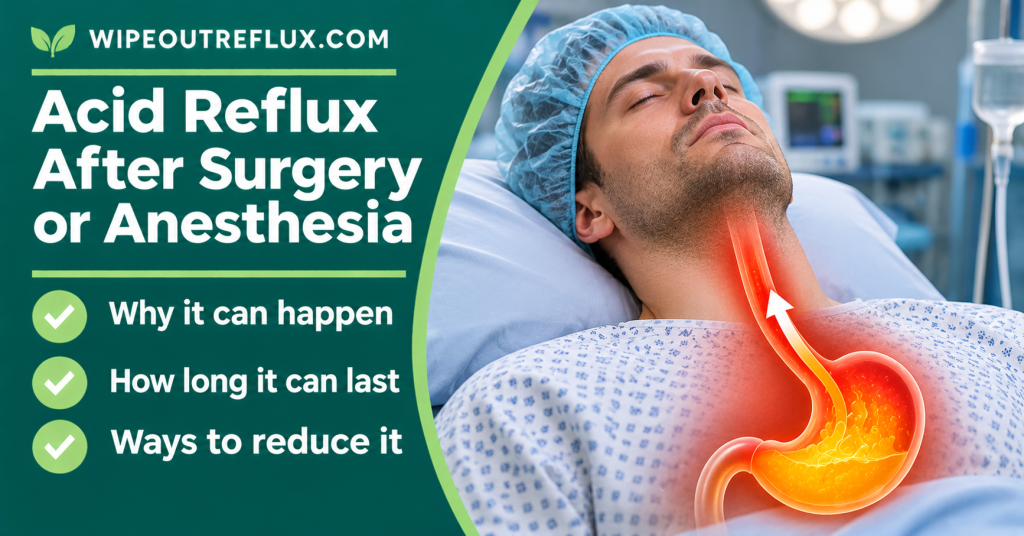
It’s common to get acid reflux, heartburn or a burning sore throat in the days after surgery, even if you rarely had reflux before. Several things stack up at once. Anesthetic drugs and opioid painkillers relax the valve at the bottom of your esophagus and slow stomach emptying. You spend more time lying down. Nausea and vomiting are common. And the breathing tube used during general anesthesia can leave your throat raw, which makes any reflux that reaches it feel much worse.
For most people this settles within days to a couple of weeks as the drugs wear off and normal eating, movement and sleep return. A few practical steps can speed that up a lot: keeping your head raised, eating small and gentle meals, moving early, cutting opioids as soon as you safely can, and using an alginate to block reflux. Symptoms that persist beyond a few weeks, or that started after surgery on the stomach or esophagus, deserve a closer look.
Key Takeaways
- Post-surgery reflux is common and usually temporary.
- Anesthetic drugs, especially at deeper levels of sedation, lower the pressure of the lower esophageal sphincter (LES).
- Opioid painkillers relax the LES and slow stomach emptying, which is a major driver of reflux and nausea after surgery.
- Around 30% of surgical patients have post-operative nausea and vomiting, rising to as high as 80% in high-risk groups.
- A breathing tube commonly causes sore throat and hoarseness, which can mimic or intensify silent reflux symptoms.
- Lying flat, constipation, NSAIDs, stress and reduced eating all add to the problem.
- Keep your head raised, eat small soft meals, walk early, limit opioids and use an alginate after meals and at bedtime.
- Persistent symptoms after stomach, esophageal or weight-loss surgery need follow-up with your surgical team.
Why Surgery and Anesthesia Trigger Reflux
1. Anesthetic drugs relax the reflux valve
Your lower esophageal sphincter (LES) normally keeps stomach contents out of your esophagus. Many anesthetic and sedative drugs reduce its pressure. A Cleveland Clinic study in healthy volunteers found that propofol and dexmedetomidine sedation caused a dose-dependent drop in LES pressure of about 25% at higher drug levels [Turan et al., Anesthesiology, 2010]. The researchers noted that drops like this are the main physiological cause of reflux during anesthesia, though in healthy people at sedation doses the effect was modest.
Volatile (inhaled) anesthetics and benzodiazepines such as midazolam also lower LES tone. The effect wears off as the drugs clear, but if you already have a borderline valve or a hiatal hernia, it can be enough to tip you into symptoms. I explain how the valve works in the lower esophageal sphincter and acid reflux.
2. Opioid painkillers slow everything down
Opioids are often the biggest factor after you leave the operating room. They act on receptors throughout the gut. A review in Clinical Gastroenterology and Hepatology describes opioid effects including esophageal dysmotility and a marked delay in gastric emptying, with post-meal nausea and early fullness [Camilleri et al., Clinical Gastroenterology and Hepatology, 2017]. Acute morphine use also lowers resting LES pressure.
A stomach that empties slowly stays fuller for longer, with more contents pressing against a weaker valve. That’s a recipe for heartburn, regurgitation and burping. Opioids also cause constipation, and straining raises abdominal pressure, which pushes more reflux upward. If slow stomach emptying is a long-term issue for you, see gastroparesis and acid reflux.
3. Nausea and vomiting
Post-operative nausea and vomiting (PONV) affects roughly 30% of surgical patients and up to 80% of those in high-risk groups [Jin et al., Therapeutics and Clinical Risk Management, 2020]. Risk factors include being female, non-smoking, a history of motion sickness or previous PONV, inhaled anesthetics, longer surgery and opioid use. Vomiting brings stomach acid and pepsin into the esophagus and throat directly, and retching strains the reflux barrier.
4. The breathing tube irritates your throat
If you had a general anesthetic with a breathing tube (endotracheal tube), it passes between your vocal cords. Sore throat afterward is very common, reported in 21% to about 72% of patients, and hoarseness in 40–50% [Hu et al., PLOS ONE, 2013].
That matters for reflux in two ways. Tube-related irritation can look just like silent reflux, with a burning throat, hoarseness, throat clearing and a lump-in-the-throat feeling. And an already irritated throat is far more sensitive to any reflux that reaches it. A small amount that you’d never normally notice can burn noticeably. Tube-related soreness usually improves within a few days. If throat symptoms drag on for weeks, reflux becomes the more likely cause. See can acid reflux cause hoarseness and sore throat that won’t go away.
5. Lying flat and moving less
After surgery you spend much more time lying down, often flat on your back. Gravity no longer helps keep stomach contents down, and reflux that does occur stays in contact with the esophagus for longer.
6. Other medications and stress
- NSAIDs such as ibuprofen are often prescribed for post-op pain. They can irritate the stomach and esophagus. See does ibuprofen cause acid reflux.
- Antibiotics and iron supplements can cause stomach upset or pill irritation if swallowed lying down.
- Stress and poor sleep raise sensitivity to reflux. See can stress cause acid reflux.
- Fasting, then eating again: long periods without food followed by a sudden large meal can trigger symptoms.
Surgery on the Stomach or Esophagus Is Different
The causes above apply after almost any operation. But some surgeries change your anatomy in ways that directly affect reflux, and symptoms after these need to go back to your surgical team rather than being managed as “ordinary” reflux:
- Sleeve gastrectomy: reflux is a well-known issue after this weight-loss operation. See acid reflux after gastric sleeve.
- Gallbladder removal: some people notice more upper digestive symptoms afterward, sometimes involving bile. See acid reflux after gallbladder removal.
- Fundoplication or hiatal hernia repair: swallowing difficulty and bloating are expected early on, but reflux returning is not. See fundoplication recovery diet and hiatal hernia surgery.
How Long Does Reflux Last After Surgery?
For most people, it improves noticeably within a few days and is gone within one to two weeks, as anesthetic effects disappear, opioids are reduced, and you’re eating, moving and sleeping normally again. Throat soreness from the breathing tube usually eases within a few days.
If you already had reflux before surgery, expect a flare that may take a little longer to settle back to your baseline. My guide to acid reflux flare-ups covers how to calm one down.
Symptoms that last beyond three to four weeks, or that keep getting worse, are worth raising with your doctor.
How to Manage Reflux After Surgery
Always follow your surgeon’s specific instructions first, especially on diet, positioning and medication. Within those, these steps help.
Keep your head and chest raised
Sleep and rest with your upper body raised about 6–8 inches, using a wedge pillow or raising the head of the bed, rather than stacking regular pillows that bend you at the waist. If your surgery allows it, lying on your left side can also reduce reflux. See how to raise the head of your bed.
Eat small, gentle meals
- Start with small portions and build up gradually.
- Choose soft, low-fat, low-acid foods: oatmeal, rice, eggs, broth-based soups, bananas, plain chicken or fish, cooked vegetables.
- Avoid fried and fatty food, citrus, tomato, chocolate, mint, carbonated drinks, alcohol and lots of coffee while you recover.
- Stop eating 3 hours before lying down for the night.
- Sip water through the day, not large volumes with meals.
Move as early as you’re allowed
Walking helps the gut wake up, speeds stomach emptying and reduces constipation. Even short, frequent walks around the house help.
Minimize opioids, and manage their side effects
Use the lowest dose that controls your pain, for the shortest time, and switch to non-opioid options when your team says you can. Ask about a stool softener or laxative if you’re on opioids, since constipation and straining make reflux worse.
Use an alginate
An alginate such as Gaviscon Advance forms a raft on top of your stomach contents that physically blocks reflux. That’s well suited to post-surgical reflux, where the problem is mainly a relaxed valve and a slow, full stomach rather than too much acid. Take it after meals and at bedtime. See alginates for acid reflux. Check with your pharmacist about spacing it from other medicines.
Acid reducers when appropriate
Your team may prescribe a PPI or H2 blocker, particularly if you’re on NSAIDs or steroids, or have a history of ulcers. Take these as directed, and ask how long you’re meant to stay on them, so a short-term prescription doesn’t quietly become a long-term one.
Take pills properly
Swallow tablets with a full glass of water while sitting upright, and stay upright for at least 30 minutes. This avoids pill irritation of the esophagus, which is more likely when you’re spending a lot of time in bed.
For a longer-term plan to keep reflux down once you’re back on your feet, the Wipeout Diet Plan walks you through the foods, meal timing and habits step by step.
When to Call Your Doctor or Get Urgent Help
Chest pain after surgery should never be assumed to be heartburn. Blood clots in the lungs and heart problems are real post-operative risks. Get urgent medical help for:
- Chest pain, especially with breathlessness, a fast heartbeat, coughing up blood, sweating, or pain spreading to your arm, jaw or back
- Sudden shortness of breath
- Calf pain or swelling in one leg
- Vomiting blood or material like coffee grounds, or black, tarry stools
- Inability to keep fluids down, or severe abdominal pain or swelling
- Fever, or a cough with fever, which can signal infection or aspiration
- Difficulty swallowing that’s getting worse, especially after esophageal or stomach surgery
Contact your doctor at a less urgent pace if reflux lasts more than three to four weeks, you’re relying on antacids every day, or you’re losing weight unintentionally. See heartburn or heart attack for how to tell them apart.
Preparing for Surgery If You Already Have Reflux
If you know you have GERD or silent reflux, tell your anesthesia team at your pre-op assessment. Reflux affects how they plan to protect your airway, and they may give you an acid-reducing or anti-nausea medicine beforehand. Bring a list of your reflux medications and follow the fasting instructions exactly. Ask whether you should take your usual PPI on the morning of surgery.
Going into surgery with your reflux well controlled also makes the recovery smoother, since you’re starting from a calmer baseline.
Conclusion
Acid reflux after surgery is common and, in most cases, temporary. Anesthetic drugs relax the reflux valve, opioid painkillers relax it further and slow stomach emptying, nausea and vomiting are frequent, and the breathing tube can leave the throat sore and extra sensitive. Add lying flat, constipation, NSAIDs and disrupted eating, and it’s no surprise that reflux flares.
Most of these factors fade within days to a couple of weeks. You can help by keeping your head raised, eating small, gentle meals, walking early, keeping opioids to a minimum, managing constipation, and using an alginate after meals and at bedtime. Never assume chest pain after surgery is heartburn. And if reflux lasts beyond a few weeks, or follows surgery on your stomach or esophagus, check in with your doctor or surgical team.
If surgery has stirred up reflux that was already lurking, recovery is a good time to build habits that keep it settled for good. The Wipeout Diet Plan is my in-depth guide to doing that, covering which foods to swap, how to time your meals, and the day-to-day habits that calm reflux at its source. I originally designed it around silent reflux, the throat-focused kind that a sore post-intubation throat can make so noticeable, but because it targets the same underlying mechanisms, it works equally well for GERD and classic heartburn.
Frequently Asked Questions
Can anesthesia cause acid reflux?
Yes. Many anesthetic and sedative drugs lower the pressure of the lower esophageal sphincter, which makes reflux easier. The effect is temporary and fades as the drugs clear.
Why do I have heartburn after surgery?
Usually a combination of anesthetic effects, opioid painkillers that relax the reflux valve and slow stomach emptying, lying flat, nausea and vomiting, and changes in eating. Most of these settle within days to weeks.
How long does acid reflux last after anesthesia?
For most people, a few days to two weeks. If symptoms continue beyond three to four weeks, or keep getting worse, see your doctor.
Is a burning throat after surgery reflux or the breathing tube?
Often the breathing tube in the first few days, since sore throat and hoarseness are very common after intubation. If throat symptoms persist for weeks, reflux becomes more likely, and the irritated throat makes any reflux feel worse.
Do opioids cause acid reflux?
They can contribute. Opioids relax the lower esophageal sphincter, slow stomach emptying and cause constipation, all of which make reflux more likely.
Can I take Gaviscon after surgery?
Usually, yes, but check with your surgical team or pharmacist first, especially after stomach or esophageal surgery, and space it from other medicines as advised.
Should I worry about chest pain after surgery?
Yes. Don’t assume it’s heartburn. Chest pain after surgery can signal a blood clot in the lungs or a heart problem, so get urgent medical help, especially if you’re also breathless.
Research & References
- [Turan et al., Anesthesiology, 2010] — Randomized crossover study in healthy volunteers showing a dose-dependent drop of about 25% in lower esophageal sphincter pressure with propofol and dexmedetomidine sedation.
- [Camilleri et al., Clinical Gastroenterology and Hepatology, 2017] — Review of opioid effects on the gut, including esophageal dysmotility, delayed gastric emptying, post-meal nausea and constipation.
- [Jin et al., Therapeutics and Clinical Risk Management, 2020] — Review of PONV reporting a risk of about 30% in the general surgical population and up to 80% in high-risk patients, with volatile anesthesia and opioids among risk factors.
- [Hu et al., PLOS ONE, 2013] — Meta-analysis noting post-operative sore throat in 21–71.8% and hoarseness in 40–50% of intubated patients, with smaller tubes linked to less sore throat in women.

David Gray
12 years living with LPR · Consultant & researcher
I've lived with LPR for twelve years — the misdiagnoses, the PPI courses that did nothing, the slow work of figuring out what actually helps. Wipeout Reflux is where I translate the research into plain terms for people stuck in the same place. Every claim here is sourced to peer-reviewed work, and I consult one-to-one with LPR sufferers.