
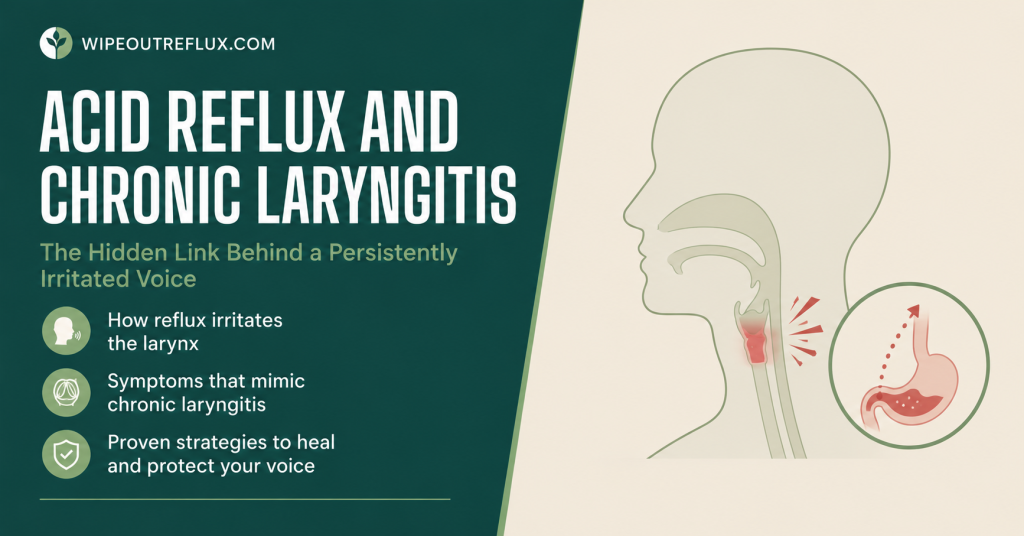
If your voice has been hoarse, rough, or tired for weeks, you keep clearing your throat, and nothing seems to shift it, acid reflux is one of the first things worth ruling in. Chronic laryngitis simply means the voice box stays inflamed over the long term — and when the cause isn’t a virus, smoking, or overuse, it’s very often reflux quietly reaching your throat. It doesn’t always come with heartburn, which is exactly why it gets missed.
The link is well established. When researchers looked at people showing up with laryngeal and voice problems, around two-thirds turned out to have reflux traveling up to the throat Koufman et al., Otolaryngology–Head and Neck Surgery, 2000. The reassuring part is that most reflux-driven vocal cord changes are inflammatory and reversible when you calm the reflux down. Here’s exactly what reflux does to your vocal cords, which changes are which, and how to turn it around.
Key Takeaways
- Chronic laryngitis is long-term inflammation of the voice box; reflux is one of its most common and most missed causes.
- The damage is driven by stomach acid and pepsin — a digestive enzyme that keeps attacking throat tissue even when the reflux isn’t very acidic.
- Your throat has almost none of the defenses your esophagus has, so it takes far less reflux to cause harm up there.
- Typical signs are hoarseness, a rough or lower voice, constant throat-clearing, a lump-in-the-throat feeling, and vocal fatigue — often without heartburn.
- Visible changes range from simple redness and swelling to contact ulcers and granulomas, and reflux can contribute to polypoid (Reinke’s) swelling.
- Most inflammatory changes reverse once reflux is controlled — in one series, aggressive reflux treatment fully resolved the majority of vocal cord granulomas.
- The biggest lever is your everyday diet and habits, because they decide how much acid and pepsin reach your throat in the first place.
How Acid Reflux Causes Chronic Laryngitis
To understand the vocal cord changes, it helps to see what’s actually reaching your throat and why it does so much damage there.
It’s not just acid — it’s pepsin
When stomach contents travel up past your throat, they don’t only bring acid. They bring pepsin, the enzyme your stomach uses to digest protein. Pepsin is the part that makes throat reflux so stubborn: it lodges in the delicate tissue of the larynx and stays there, and it can reactivate and keep damaging cells whenever the local environment turns acidic again — even from something as ordinary as a fizzy drink. Researchers found pepsin in the laryngeal tissue of most patients with throat reflux but in none of the healthy controls Johnston et al., The Laryngoscope, 2004. That’s a big reason throat symptoms can linger long after a reflux episode.
It gets worse: pepsin doesn’t even need acid to cause harm. In laboratory work, pepsin damaged throat cells at a neutral pH, being taken up directly into the cells rather than needing an acidic burn to do its work Johnston et al., Annals of Otology, Rhinology & Laryngology, 2009. So even “non-acid” or weakly acidic reflux can keep your larynx inflamed — which is why some people don’t improve on acid-suppressing pills alone. There’s more on calming this enzyme down in this guide to neutralizing pepsin in the throat.
Your throat can’t defend itself like your esophagus can
Your esophagus is built to cope with the occasional splash of acid — it has a mucus layer, clears acid with waves of muscle contraction, and neutralizes it with saliva. Your larynx has almost none of that. It’s why a small amount of reflux that your chest wouldn’t even notice can leave your voice box inflamed. Throat tissue under reflux also becomes depleted of a protective protein it normally uses to buffer acid, leaving it even more exposed Johnston et al., The Laryngoscope, 2004. Less reflux, more damage — the opposite of what most people assume.
The classic pattern is silent
Because the injury is happening in your throat rather than your chest, many people never feel classic heartburn. Instead the reflux shows up as voice and throat symptoms — which is exactly the picture of silent reflux (LPR). In fact, when acid and pepsin were studied experimentally in the larynx, even a modest number of reflux events was enough to produce real laryngeal injury Koufman, The Laryngoscope, 1991. You don’t need dramatic reflux to develop chronic laryngitis — you just need it landing on tissue that can’t cope.
Vocal Cord Changes Reflux Can Cause
Reflux doesn’t cause just one thing. It sits on a spectrum, from simple irritation to distinct structural lesions. Here’s what a doctor may see when they look at your larynx.
Redness and swelling (the earliest stage)
The most common finding is straightforward inflammation — the back of the voice box and the vocal cords look red and puffy, sometimes with thickened tissue and pooled mucus. This is often called posterior laryngitis because it tends to affect the rear part of the larynx nearest the esophagus. At this stage the changes are purely inflammatory, and they typically settle once the reflux is controlled.
Contact ulcers and granulomas
With ongoing irritation, raw spots (contact ulcers) can form on the vocal processes at the back of the cords, and the body can respond by building up lumps of granulation tissue called granulomas. Reflux is a leading cause, usually alongside throat-clearing and forceful voice use that hammer the same spot. The encouraging news is how treatable they are: in a 12-year series, aggressive reflux management resolved most contact ulcers and granulomas completely, without surgery Emami et al., Journal of Voice, 1999. Habitual throat-clearing keeps the cycle going, so breaking that habit matters — here’s how to stop constant throat-clearing from reflux.
Polypoid swelling (Reinke’s edema)
In longer-standing cases the vocal cords can take on a soft, floppy, water-balloon swelling known as Reinke’s edema or polypoid corditis, which lowers and roughens the voice. Smoking is by far the biggest driver here, but chronic reflux and heavy voice use are recognized contributors that keep the tissue irritated. If you smoke and reflux, the two stack up on your cords in a particularly damaging way.
Thickening and leukoplakia
Persistent irritation can also thicken the lining of the cords and, in some cases, produce white patches (leukoplakia). Most of these changes are benign, but because chronic irritation of any kind is something specialists watch carefully, any voice change lasting more than a few weeks deserves a proper look by an ENT rather than guesswork.
How to Know It’s Reflux (and Not Something Else)
Reflux laryngitis has a recognizable fingerprint. The symptoms tend to be worse in the morning after a night of lying flat, they come without the fever or sudden onset of a viral laryngitis, and they cluster together: hoarseness, a lump-in-the-throat sensation, frequent throat-clearing, a dry nagging cough, mild throat discomfort, and a voice that tires quickly. Only some people also get heartburn.
That said, hoarseness lasting more than three weeks should always be assessed by a doctor, ideally an ENT who can look at your cords directly. This isn’t about alarm — it’s about ruling out other causes and confirming reflux is really what’s driving your particular picture before you commit to a plan.
How to Reverse Reflux Laryngitis
Because most reflux-driven vocal cord changes are inflammatory, the goal is simple: stop acid and pepsin reaching your throat, then give the tissue time to heal. These are the levers that matter most.
1. Tighten the diet that’s feeding the reflux
This is the foundation. Since pepsin reactivates in acid, lowering the acidity and trigger load of what you eat and drink directly reduces how much damage lands on your cords. Cutting back on obvious offenders — fatty and fried food, late heavy meals, alcohol, and acidic drinks — takes real pressure off the larynx. A structured reset like the 2-week acid reflux diet is a good way to see how much of your voice trouble is reflux-driven.
2. Protect your throat overnight
A lot of laryngeal reflux happens while you sleep, when you’re flat and swallowing rarely. Finish eating two to three hours before bed, and raise the head of your bed or use a wedge so gravity keeps stomach contents down — see the best sleeping position for reflux. An alginate raft taken after your evening meal can form a physical barrier that helps stop night-time reflux reaching your throat; here’s more on using Gaviscon Advance.
3. Stop the throat-clearing cycle
Throat-clearing feels like it helps, but it slams the cords together and keeps them inflamed — feeding the exact granulomas and ulcers you’re trying to heal. Swap it for a sip of water or a gentle dry swallow, and treat it as a habit to unlearn rather than a reflex to obey.
4. Give your voice a rest
Inflamed cords heal better when they aren’t being overworked. Avoid shouting, prolonged loud talking, and forceful whispering (which strains the cords more than gentle speech), and stay well hydrated so the tissue stays lubricated. If your voice is central to your work, a speech therapist can teach you lower-impact ways to use it.
5. Don’t rely on acid pills alone
Acid-suppressing medication has a place, but because pepsin can damage your throat even without much acid, pills often don’t fully fix reflux laryngitis on their own — which frustrates a lot of people. The diet-and-habits foundation is what addresses the pepsin side of the problem. If you want the fuller picture, this guide to silent reflux treatment walks through how the pieces fit together.
The Bottom Line
Chronic laryngitis that won’t quit is very often reflux in disguise. The mechanism is straightforward once you see it: acid and pepsin travel up to a voice box that has almost no defenses, pepsin embeds in the tissue and keeps causing harm even when things aren’t very acidic, and the result is a spectrum of vocal cord changes — from simple redness and swelling to contact ulcers, granulomas, and polypoid swelling. Because so much of it happens without heartburn, it’s one of the most under-recognized causes of a rough, tired, hoarse voice.
The genuinely good news is that these changes are usually inflammatory rather than permanent. Calm the reflux and the cords tend to recover — treatment aimed at reflux resolved the majority of granulomas in the studies, and everyday hoarseness from reflux typically eases once acid and pepsin stop reaching the throat. The key is to work on the source: how much reflux you’re generating day to day, how well you protect your throat at night, and whether you’re letting habits like throat-clearing keep the fire going.
Since that comes down to what and when you eat more than anything else, a great place to start is the Wipeout Food Reference Guide, an essential reference covering which foods and drinks are safe for acid reflux and LPR along with their pH values — so you can build a throat-friendly diet with confidence. And if you want the complete, step-by-step system for healing a reflux-irritated throat for good, the Wipeout Diet Plan goes far deeper — it’s the ultimate guide to calming the underlying reflux so your voice can finally settle.
Frequently Asked Questions
Can acid reflux really cause chronic laryngitis?
Yes. Reflux is one of the most common causes of long-term voice-box inflammation. When acid and pepsin repeatedly reach the throat, they inflame the larynx and vocal cords. In studies of patients with laryngeal and voice disorders, around two-thirds were found to have reflux traveling up to the throat.
How do I know if my laryngitis is from reflux and not something else?
Reflux laryngitis tends to be worse in the morning, comes without the fever or sudden onset of a viral infection, and clusters with throat-clearing, a lump-in-the-throat feeling, and a tired, hoarse voice — often without heartburn. Any hoarseness lasting more than three weeks should be checked by an ENT to confirm the cause.
Are the vocal cord changes from reflux permanent?
Usually not. Most reflux-related changes — redness, swelling, even contact ulcers and granulomas — are inflammatory and tend to reverse once the reflux is controlled. In one long-term series, aggressive reflux treatment fully resolved the majority of vocal cord granulomas without surgery.
Why isn’t my acid reflux medication fixing my voice?
Because acid isn’t the whole story. Pepsin, the digestive enzyme that comes up with reflux, can damage throat tissue even when it isn’t very acidic, so acid-suppressing pills alone often don’t fully resolve reflux laryngitis. Diet and habit changes that reduce the overall reflux and pepsin load usually make the bigger difference.
Does throat-clearing make reflux laryngitis worse?
Yes. Throat-clearing forcefully bangs the vocal cords together and keeps them inflamed, feeding the very ulcers and granulomas you’re trying to heal. Replacing it with a sip of water or a gentle swallow is an important part of recovery.
How long does it take for reflux laryngitis to heal?
It varies with how long the tissue has been irritated and how consistently you control the reflux, but many people notice their voice improving over several weeks once acid and pepsin stop reaching the throat. Deeper changes like granulomas can take longer, and persistent symptoms should be followed up with an ENT.
Research & References
- Koufman et al., Otolaryngology–Head and Neck Surgery, 2000 — In 113 consecutive patients with laryngeal and voice disorders, reflux to the throat was highly prevalent, with the majority of those tested showing abnormal reflux.
- Koufman, The Laryngoscope, 1991 — Landmark clinical and experimental study using 24-hour pH monitoring in 225 patients, showing acid and pepsin can produce laryngeal injury even with relatively few reflux events.
- Johnston et al., The Laryngoscope, 2004 — Detected pepsin in laryngeal tissue of most reflux patients but none of the controls, and found depletion of a key protective protein (carbonic anhydrase III), weakening the throat’s defenses.
- Johnston et al., Annals of Otology, Rhinology & Laryngology, 2009 — Showed pepsin damages throat epithelial cells even at neutral pH, being taken into cells directly — explaining why non-acid reflux can still harm the larynx.
- Emami et al., Journal of Voice, 1999 — 12-year retrospective analysis of laryngeal contact ulcers and granulomas in which aggressive reflux management produced complete resolution in most patients without surgery.

David Gray
12 years living with LPR · Consultant & researcher
I've lived with LPR for twelve years — the misdiagnoses, the PPI courses that did nothing, the slow work of figuring out what actually helps. Wipeout Reflux is where I translate the research into plain terms for people stuck in the same place. Every claim here is sourced to peer-reviewed work, and I consult one-to-one with LPR sufferers.