
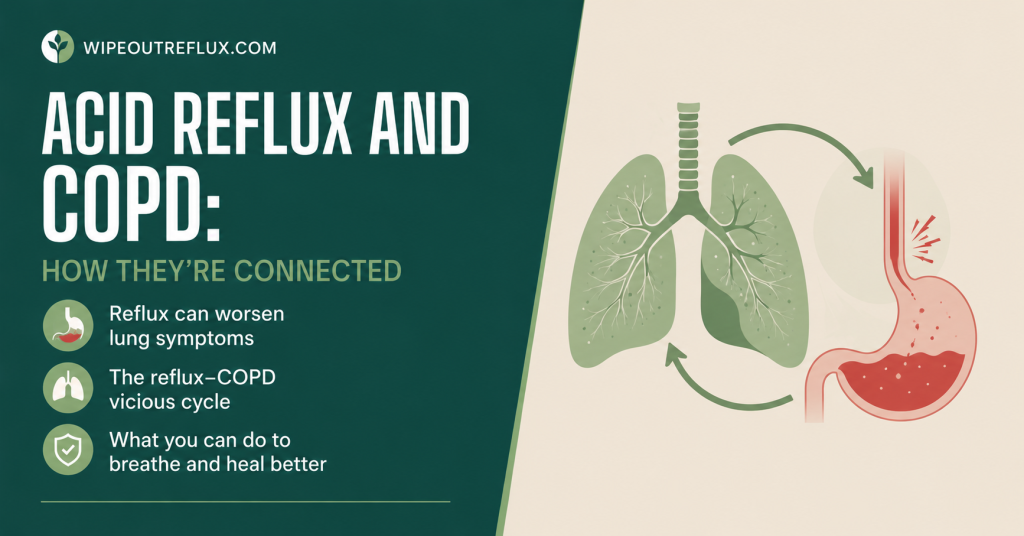
If you have COPD, acid reflux is worth paying attention to — not as a minor side issue, but as something that can genuinely affect how often you flare up. The two conditions turn out to be closely linked, and the relationship runs in both directions: COPD makes reflux more likely, and reflux can make COPD harder to control. Many people with COPD have reflux without the classic heartburn, so it often goes unnoticed while quietly adding to breathing trouble.
The connection is well documented. Reflux is far more common in people with COPD than in the general population, and it’s been identified as an independent risk factor for exacerbations — the flare-ups that set your breathing back Lee & Goldstein, International Journal of COPD, 2015. The encouraging part is that reflux is one of the more manageable pieces of the COPD picture. Here’s how the two are connected, and what you can do about it — alongside, never instead of, your usual COPD care.
Key Takeaways
- Reflux is much more common in people with COPD than in the general population, with prevalence estimates ranging widely from around 17% to 78%.
- The link is bidirectional: COPD’s breathing mechanics promote reflux, and reflux can worsen COPD.
- Reflux is a recognized, independent risk factor for COPD exacerbations — the flare-ups that damage lung health over time.
- The main mechanism is microaspiration: tiny amounts of acid and pepsin reaching the airways, where they inflame lung tissue.
- Reflux in COPD often comes without heartburn, so it’s easily missed.
- Managing reflux — through diet, night-time habits, and posture — may help reduce flare-ups, but it works alongside proper COPD treatment, not as a replacement.
- Any breathing changes or persistent reflux should always be managed with your doctor.
How Acid Reflux and COPD Are Connected
The relationship isn’t a one-way street. Each condition feeds the other, which is part of why they so often appear together.
How COPD makes reflux more likely
The mechanics of COPD work against your anti-reflux defenses. Labored breathing and a chronic cough create big swings in the pressure inside your chest and abdomen, which can push stomach contents up past the lower esophageal sphincter — the valve meant to keep acid down. A flattened diaphragm from air trapping weakens that same barrier, and some bronchodilator medications used to open the airways can also relax the sphincter as a side effect. Put together, COPD creates the perfect conditions for reflux to happen more often.
How reflux makes COPD worse
Reflux returns the favor. When stomach contents travel up, tiny amounts can be inhaled into the airways — a process called microaspiration. Even small quantities of acid and pepsin reaching the lungs irritate and inflame the airway lining, and in airways already damaged by COPD, that added inflammation can be enough to tip you into a flare-up. Researchers describe this aspirated acid and pepsin as setting off a sustained inflammatory response in the airways, which is exactly what you don’t want on top of COPD Lee & Goldstein, International Journal of COPD, 2015. There may also be a reflex effect, where acid in the lower esophagus triggers airway tightening even without aspiration.
It’s often silent
Because this reflux is frequently reaching high into the airway rather than just burning the chest, many people with COPD have it without obvious heartburn — the pattern of silent reflux (LPR). Instead of classic acid symptoms, it can show up as more coughing, more mucus, throat-clearing, or simply more frequent flare-ups. That silence is exactly why reflux gets overlooked in COPD, and why it’s worth considering even if your chest never burns. If your main experience is breathlessness, it’s worth reading about silent reflux and shortness of breath.
Reflux and COPD Flare-Ups: What the Research Shows
This is where the connection matters most, because exacerbations are what drive COPD downhill over time. The evidence linking reflux to flare-ups is consistent and fairly strong.
In the large ECLIPSE study, which followed COPD patients over three years to work out what predicts flare-ups, reflux stood out as one of the independent markers of people prone to frequent exacerbations Hurst et al., New England Journal of Medicine, 2010. It wasn’t a minor footnote — it was one of the handful of factors that flagged the high-risk group.
Earlier work pointed the same way. In COPD patients tracked for a year, those with weekly reflux symptoms had roughly twice the exacerbation rate of those without — about 3.2 flare-ups a year versus 1.6 Rascón-Aguilar et al., Chest, 2006. And a large national cohort found that people newly diagnosed with reflux had a raised risk of a COPD flare-up in the year that followed, suggesting the reflux was contributing rather than just coming along for the ride Lin et al., International Journal of Clinical Practice, 2015.
Pulling it together, a meta-analysis combining ten studies and more than 13,000 patients found that reflux was associated with a substantially higher risk of COPD exacerbation and a greater number of flare-ups overall Huang et al., BMC Pulmonary Medicine, 2020. The takeaway isn’t that reflux causes COPD — it doesn’t — but that when the two coexist, reflux makes the COPD harder to control.
How to Manage Reflux When You Have COPD
The goal is to reduce how much acid and pepsin reach your airways, which may help take one trigger out of the flare-up equation. These steps sit alongside your prescribed COPD treatment — they don’t replace any of it, and you shouldn’t change your medications without talking to your doctor.
1. Work on the diet driving the reflux
This is the foundation. Reducing the acidity and trigger load of what you eat and drink directly lowers how much reflux is available to reach your airways. Easing off fatty and fried food, large meals, alcohol, and acidic drinks takes pressure off the whole system, and smaller meals are gentler on a chest that’s already working hard. A structured approach like the 2-week acid reflux diet is a practical way to start.
2. Protect your airway overnight
Night-time is when reflux most easily reaches the lungs, because lying flat removes gravity’s help and you swallow less. Finish eating three hours before bed, and raise the head of your bed or use a wedge so stomach contents stay down — see the best sleeping position for reflux and this guide to acid reflux at night. An alginate raft after your evening meal can add a physical barrier against night-time reflux; here’s more on using Gaviscon Advance.
3. Eat smaller, and don’t lie down after meals
Large meals distend the stomach and raise the odds of reflux, which is especially unhelpful when a flattened diaphragm is already pressing on things. Smaller, more frequent meals reduce that pressure, and staying upright for a couple of hours after eating keeps acid where it belongs while your stomach empties.
4. Review your medications with your doctor
Because some bronchodilators can relax the anti-reflux valve, and because reflux management may reduce flare-ups, it’s worth discussing the whole picture with your doctor or pulmonologist. Don’t stop or change any inhaler or COPD medication on your own — but do raise reflux as a topic, since treating it is part of managing the COPD. If you’re on long-term acid-suppressing medication, any changes to that should also be doctor-guided; here’s background on coming off PPIs and acid rebound.
5. Don’t smoke — it drives both
Smoking is the leading cause of COPD and it also weakens the anti-reflux valve and increases acid production, so it fuels both conditions at once. Stopping smoking is the single most powerful thing for your lungs, and it helps your reflux too. If you have COPD and reflux and you smoke, this is the highest-value change on the list.
A Word of Caution
Reflux is one contributor to COPD flare-ups, not the whole story, and controlling it is a complement to proper medical care rather than a substitute. COPD is a serious condition that needs ongoing management with your healthcare team, including inhalers, pulmonary rehabilitation, vaccinations, and a clear flare-up action plan. If your breathing changes, your flare-ups increase, or you develop new symptoms, contact your doctor rather than assuming it’s just reflux. Think of reflux management as one useful lever you can pull — not a replacement for the rest.
The Bottom Line
Acid reflux and COPD are more entangled than most people realize. COPD’s altered breathing mechanics — big pressure swings, a chronic cough, a flattened diaphragm, and sometimes bronchodilator side effects — make reflux more likely, and the refluxed acid and pepsin that microaspirate into the airways add inflammation to lungs that are already struggling. The result is a two-way loop, and one that shows up in the data as more frequent, harder-to-control flare-ups when reflux is present.
The genuinely useful part is that reflux is one of the more controllable factors in that loop. You can’t undo COPD, but you can reduce how much reflux reaches your airways — and because reflux is a recognized, independent risk factor for exacerbations, doing so may help take one trigger out of the mix. The key is to treat it as part of your overall COPD management, in partnership with your doctor, rather than something to tackle in isolation.
Since so much of reflux control comes down to what and when you eat, a great place to start is the Wipeout Food Reference Guide, an essential reference covering which foods and drinks are safe for acid reflux and LPR along with their pH values — so you can build a reflux-friendly diet with confidence. And if you want the complete, step-by-step system for calming reflux at the source, the Wipeout Diet Plan goes far deeper — the ultimate guide to settling reflux so it’s one less thing working against your lungs. Always keep your COPD team in the loop as you make changes.
Frequently Asked Questions
Can acid reflux make COPD worse?
Yes. Reflux is a recognized, independent risk factor for COPD exacerbations. When acid and pepsin are microaspirated into the airways, they add inflammation to lungs already damaged by COPD, which can help trigger flare-ups. Studies consistently link reflux to more frequent exacerbations, though it worsens COPD rather than causing it.
Why is acid reflux so common in people with COPD?
COPD’s breathing mechanics work against your anti-reflux defenses. A chronic cough and labored breathing create pressure swings that push stomach contents up, a flattened diaphragm weakens the valve that keeps acid down, and some bronchodilator medications can relax that valve too. Together these make reflux much more likely.
Does treating reflux reduce COPD flare-ups?
Managing reflux may help reduce one trigger for flare-ups, since reflux is linked to more frequent exacerbations. However, it works alongside proper COPD treatment, not instead of it, and the evidence is still developing. Any changes to reflux or COPD medication should be guided by your doctor.
Can I have reflux-related lung symptoms without heartburn?
Yes. Reflux in COPD is often silent, reaching high into the airway without causing classic chest burning. It can show up as more coughing, more mucus, throat-clearing, or simply more flare-ups rather than heartburn, which is why it’s so often missed.
Should I stop my inhalers if they might worsen reflux?
No — never stop or change COPD medication on your own. While some bronchodilators can relax the anti-reflux valve, your inhalers are essential for managing your lungs. Instead, raise the reflux issue with your doctor so the whole picture can be managed together.
What foods should I avoid if I have COPD and reflux?
The usual reflux triggers apply: fatty and fried foods, large meals, alcohol, and acidic drinks. Smaller, more frequent meals are also gentler when a flattened diaphragm is already crowding the stomach. A reflux-friendly food guide can help you identify which foods and drinks are safest for you.
Research & References
- Lee & Goldstein, International Journal of COPD, 2015 — Review of GERD in COPD reporting a prevalence of roughly 17–78%, identifying reflux as a significant predictor of exacerbations, and outlining mechanisms including microaspiration and lower esophageal sphincter dysfunction.
- Hurst et al., New England Journal of Medicine, 2010 — The ECLIPSE study, which followed COPD patients over three years and identified reflux as one of the independent factors associated with being prone to frequent exacerbations.
- Rascón-Aguilar et al., Chest, 2006 — Found COPD patients with weekly reflux symptoms had roughly double the exacerbation rate of those without (about 3.2 vs 1.6 per year).
- Lin et al., International Journal of Clinical Practice, 2015 — Nationwide population-based cohort showing newly diagnosed GERD was associated with an increased risk of acute COPD exacerbation during the first year after diagnosis.
- Huang et al., BMC Pulmonary Medicine, 2020 — Systematic review and meta-analysis of 10 studies (over 13,000 patients) finding GERD associated with a substantially higher risk and greater number of COPD exacerbations.

David Gray
12 years living with LPR · Consultant & researcher
I've lived with LPR for twelve years — the misdiagnoses, the PPI courses that did nothing, the slow work of figuring out what actually helps. Wipeout Reflux is where I translate the research into plain terms for people stuck in the same place. Every claim here is sourced to peer-reviewed work, and I consult one-to-one with LPR sufferers.