
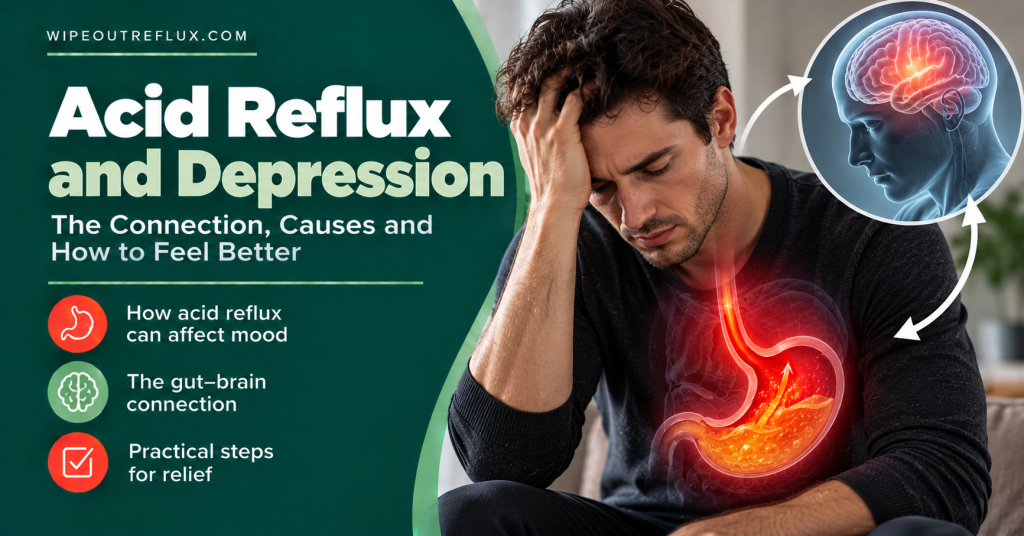
Acid reflux and depression are genuinely linked, and the connection goes both ways. People with reflux are more likely than average to have low mood, and research suggests reflux itself can raise the risk of depression, not just the other way round. Living with a symptom that doesn’t go away, disrupted sleep, a restricted diet and the frustration of treatments that don’t seem to work all take an emotional toll.
Low mood can also make reflux feel worse. Stress and depression turn up how strongly the body registers sensations from the throat and esophagus, so symptoms feel louder even when the amount of reflux hasn’t changed.
If this sounds familiar, you’re far from alone, and it isn’t a sign of weakness. The encouraging part is that working on both sides together, easing the reflux and looking after your mood, tends to help each one improve.
Key Takeaways
- Depression is more common in people with reflux. A large review found depressive symptoms in about a quarter of people with GERD.
- Silent reflux (LPR) has its own emotional weight, with ongoing throat, voice and swallowing symptoms that affect work, eating and social life.
- Genetic studies suggest reflux may increase the risk of depression, and some suggest depression may increase the risk of reflux too.
- Stress and low mood make the throat and esophagus more sensitive, so the same reflux can feel worse.
- Poor sleep from night-time reflux is one of the strongest links between reflux and mood.
- Some antidepressants can affect reflux, while others are sometimes used to calm an oversensitive throat, so it’s worth discussing both with your doctor.
- Treating the reflux and supporting your mood at the same time works better than tackling either one alone.
- If you’re feeling persistently low, talking to your doctor is a strong and sensible step, and support is available.
Is There a Link Between Acid Reflux and Depression?
Yes. It’s one of the more consistent findings in reflux research, even if it doesn’t get talked about much in the clinic.
A large systematic review and meta-analysis pooled data from 30 studies and over 14,000 people with GERD. It found depressive symptoms in about 24% of them, and people with GERD had roughly two and a half times the odds of depression compared with healthy controls [Zamani et al., American Journal of Gastroenterology, 2023]. The authors concluded that the relationship is likely to run in both directions.
Other researchers have used genetics to look at cause and effect, an approach called Mendelian randomization. One study found that a genetic tendency toward GERD raised the risk of depression by about 32% [Zeng et al., Frontiers in Psychiatry, 2023]. Another found the link worked both ways: a tendency toward depression raised the risk of GERD, and GERD raised the risk of depression [Miao et al., Genes, 2022].
So if your mood has dipped since your reflux started, that isn’t in your imagination. There are real, physical reasons for it.
The Emotional Toll of Silent Reflux
I write a lot about anxiety and reflux, and that link is real. But in the reflux communities I follow, a different theme keeps coming up. One of the most-read threads on a big patient forum is, in essence, “LPR is wrecking my mental health.” It isn’t panic people are describing. It’s being worn down.
Silent reflux is particularly good at that, for a few reasons:
- It’s constant. A throat that’s sore, tight or full of mucus every day is something you notice dozens of times an hour.
- It affects how you connect with people. A hoarse voice, constant throat clearing and coughing make conversations, phone calls and social plans harder.
- It changes how you eat. Meals out, drinks with friends and favorite foods can start to feel off limits. See eating out with acid reflux.
- It’s often dismissed. Scopes look normal, medication doesn’t help, and you may be told it’s nothing serious, which can leave you feeling unheard.
- It takes time. Throat tissue heals slowly, so progress can feel invisible for weeks.
Research backs up what readers tell me. In one study of 231 people with throat symptoms, depression was more common in those diagnosed with LPR (45.6%) than in those without it (27.0%) [Joo et al., Psychiatry Investigation, 2017]. Another found that people with LPR had worse social functioning and general health than healthy controls, and those whose LPR came with GERD symptoms took more sick leave and reported more impact on their social lives [Cheung et al., Digestion, 2009].
A 2025 study found people with LPR had higher depression, anxiety and stress scores than healthy volunteers. Importantly, the more severe their reflux symptoms, the higher their depression scores tended to be [Barillari et al., European Archives of Oto-Rhino-Laryngology, 2025]. The authors describe it as a “vicious cycle,” and noted that most participants didn’t have a full psychiatric disorder. Their mood was being dragged down by their symptoms.
After twelve years of managing LPR myself, I know how much a throat symptom that just won’t let up can wear on you. Saying that out loud is part of dealing with it.
How Reflux and Low Mood Feed Each Other
Poor sleep
Night-time reflux wakes you up, makes you cough or leaves your throat raw by morning. Poor sleep is one of the most reliable ways to lower mood, sap energy and make everything feel harder. If your reflux is worst at night, sorting out your evenings may do more for your mood than anything else. See can silent reflux cause insomnia and silent reflux and fatigue.
A more sensitive throat and esophagus
Stress and low mood don’t just make reflux feel more upsetting. They change how strongly the body registers it. In a classic study, putting people with GERD under stress made them report more reflux symptoms, even though monitoring showed no increase in actual acid reflux [Bradley et al., American Journal of Gastroenterology, 1993]. The volume knob on the sensation turned up, not the reflux itself.
That’s an important, hopeful point. It means some of what you feel is adjustable from the nervous-system side, through better sleep, calmer days and support for your mood.
The gut-brain connection
The gut and brain are in constant two-way contact, largely through the vagus nerve. Signals from an irritated esophagus and throat travel up to the brain, and stress signals travel back down, affecting digestion and sensitivity. I explain this in the vagus nerve and acid reflux.
Lifestyle changes that tend to follow low mood
When you feel low, it’s natural to reach for comfort: a late snack, an extra coffee, a glass of wine, less movement, later nights. Many of these happen to be reflux triggers. That isn’t a criticism. It’s just one more way the two can quietly reinforce each other.
Feeling stuck
Trying medications that don’t work, being told your scope is fine and not knowing how long this will last can leave you feeling stuck. If you’ve been on PPIs without much relief, it may help to know that they often don’t work well for throat symptoms, and that isn’t your fault. See why PPIs don’t work for LPR.
Antidepressants and Reflux
If you take an antidepressant, or are considering one, there are two things worth knowing.
First, some antidepressants can affect reflux in some people, for example by relaxing the valve at the bottom of the esophagus or causing a dry mouth. Not everyone is affected, and it’s never a reason to stop a medication on your own. If you notice your reflux changing after starting or adjusting a dose, mention it to your doctor, who may be able to adjust the timing or choice. See can antidepressants cause acid reflux.
Second, certain medications in this family are sometimes used in low doses to calm an oversensitive throat or esophagus, quite separately from treating mood. Low-dose amitriptyline is one example. See amitriptyline and gabapentin for reflux cough.
What Helps
Because reflux and low mood feed each other, the most effective approach works on both together. Small, steady steps are enough.
Ease the reflux
- Protect your evenings. Finish eating three hours before bed and raise the head of your bed. Better nights help both reflux and mood. See how to raise the head of your bed.
- Follow a clear plan rather than guessing. Not knowing what’s safe to eat is draining. Having a structured plan takes the daily decision-making away. My Wipeout Diet Plan sets out exactly what to eat and drink, and when, which many readers tell me is as much a relief mentally as physically.
- Use an alginate after meals and at bedtime to keep stomach contents down. See alginates for acid reflux.
- Expect gradual progress. Throat symptoms usually take weeks to months to settle. Knowing the typical timeline makes slow weeks easier. See the LPR recovery timeline and is LPR permanent?
Support your mood
- Move a little each day. A walk after meals helps digestion and is one of the most reliable mood lifters. See does walking after meals help acid reflux.
- Calm the nervous system. Slow, deep belly breathing for a few minutes a day helps both stress and reflux. See breathing exercises for acid reflux.
- Keep doing things you enjoy. Adapt them if you need to, rather than letting reflux shrink your world.
- Stop tracking every sensation. Checking your throat constantly keeps your attention fixed on it. My article on health anxiety and acid reflux explains why and what to do instead.
- Talk to someone. A partner, friend, or others with reflux who understand. Feeling heard matters.
- Consider talking therapy. Approaches like cognitive behavioral therapy can help with both low mood and how you relate to physical symptoms.
When to Talk to Your Doctor
It’s completely reasonable to raise your mood with your doctor at the same appointment as your reflux. You don’t need to wait until things feel serious. A good time to book is if, for two weeks or more:
- You feel low, flat or hopeless most days
- You’ve lost interest in things you usually enjoy
- Your sleep, appetite or energy has changed noticeably
- You’re finding it hard to work, concentrate or keep up with daily life
Your doctor can talk through options, from talking therapies to medication, and can make sure any treatment works alongside your reflux plan.
If you ever feel overwhelmed or have thoughts of harming yourself, please reach out for support right away. In the US you can call or text 988 to reach the Suicide & Crisis Lifeline. In the UK and Ireland, Samaritans are available any time on 116 123. Elsewhere, your local emergency number or doctor can point you to support near you.
If anxiety is a bigger part of your picture than low mood, my articles on whether silent reflux causes anxiety and whether stress can cause acid reflux go into that side in more depth.
Conclusion
Acid reflux and depression are connected in real, physical ways. Reflux raises the odds of low mood, low mood can make reflux feel worse, and poor sleep, a restricted diet and slow progress add to the weight of it all. Silent reflux in particular can wear people down, because the symptoms are there all day, affect the voice and social life, and are often brushed off. If that’s where you are, it isn’t weakness or overreaction. It’s an understandable response to a hard, ongoing problem, and it can get better.
The approach that works is gentle and two-sided: reduce the reflux, protect your sleep and look after your mood at the same time. For the reflux side, the Wipeout Diet Plan is what I’d recommend first. It’s my complete, step-by-step plan, refined over twelve years of living with LPR, and it takes the guesswork out of eating so you can stop worrying about every meal. I built it around silent reflux, the throat-based kind that tends to weigh most heavily on people’s mood, but it works on the same root causes as heartburn and GERD, so it helps just as well there.
If you’d rather start with something lighter, the Wipeout Food Reference Guide is the essential companion. It lists the foods and drinks that are safe for acid reflux and LPR with their pH values, so you have a simple, reliable reference whenever you’re unsure.
Frequently Asked Questions
Can acid reflux cause depression?
It can contribute. People with GERD are more likely to have depressive symptoms, and genetic studies suggest reflux may increase the risk of depression. Ongoing symptoms, poor sleep, dietary restriction and frustration with treatment all play a part. Reflux is rarely the only factor, but easing it often helps mood.
Can depression make acid reflux worse?
Yes. Stress and low mood make the throat and esophagus more sensitive, so the same amount of reflux feels stronger. Low mood can also lead to habits that trigger reflux, such as late eating, more alcohol or caffeine and less activity. Some research also suggests depression may increase the risk of developing GERD.
Why does silent reflux affect my mental health so much?
Silent reflux symptoms are constant and very noticeable: a sore or tight throat, mucus, throat clearing and a hoarse voice. They affect eating, talking and socializing, often don’t respond to standard medication, and are sometimes dismissed. Studies show depression and stress scores are higher in people with LPR, and rise with symptom severity.
Can antidepressants cause acid reflux?
Some can affect reflux in some people, for example by relaxing the lower esophageal sphincter or causing a dry mouth. Many people take them with no reflux change at all. Never stop an antidepressant on your own. Talk to your doctor if you notice a difference, as timing or the choice of medication can often be adjusted.
Will my mood improve if my reflux gets better?
For many people it does, especially when reflux has been disrupting sleep or limiting daily life. Better nights and fewer symptoms can lift mood noticeably. If low mood continues even as reflux improves, it deserves support in its own right, and your doctor can help.
Does stress cause reflux or just make it feel worse?
Mostly the second. Studies show stress increases how strongly people feel reflux symptoms, often without increasing the amount of acid reflux. Stress may also affect digestion and habits in ways that add to reflux, so calming it helps on several fronts.
What should I do if reflux is getting me down?
Take it seriously and be kind to yourself. Work on the reflux with a clear plan, protect your sleep, stay active and connected, and mention your mood to your doctor. If you ever feel overwhelmed or unsafe, contact a crisis line such as 988 in the US or Samaritans on 116 123 in the UK and Ireland.
Research & References
- [Zamani et al., American Journal of Gastroenterology, 2023] — Systematic review and meta-analysis finding depressive symptoms in 24.2% of people with GERD (30 studies, 14,030 patients) and about 2.6 times the odds of depression compared with healthy controls, with the relationship likely bidirectional.
- [Zeng et al., Frontiers in Psychiatry, 2023] — Mendelian randomization study finding genetically predicted GERD increased the risk of depression (OR 1.32) and anxiety disorders (OR 1.35).
- [Miao et al., Genes, 2022] — Mendelian randomization study suggesting a two-way causal relationship, with major depression increasing GERD risk (OR 1.31) and GERD increasing depression risk (OR 1.28).
- [Joo et al., Psychiatry Investigation, 2017] — Prospective study of 231 people with throat symptoms, finding depression in 45.6% of those diagnosed with LPR compared with 27.0% without it.
- [Cheung et al., Digestion, 2009] — Quality-of-life study of 76 people with LPR and 73 healthy controls, showing worse social functioning, pain and general health in LPR, with GERD-related LPR linked to more sick leave and social impact.
- [Barillari et al., European Archives of Oto-Rhino-Laryngology, 2025] — Study of 45 people with LPR and 29 controls finding higher depression, anxiety and perceived stress scores in LPR, with depression scores rising alongside reflux symptom severity.
- [Bradley et al., American Journal of Gastroenterology, 1993] — Controlled study showing stress increased reported reflux symptoms in people with GERD without increasing measured acid reflux, pointing to heightened symptom perception.

David Gray
12 years living with LPR · Consultant & researcher
I've lived with LPR for twelve years — the misdiagnoses, the PPI courses that did nothing, the slow work of figuring out what actually helps. Wipeout Reflux is where I translate the research into plain terms for people stuck in the same place. Every claim here is sourced to peer-reviewed work, and I consult one-to-one with LPR sufferers.