
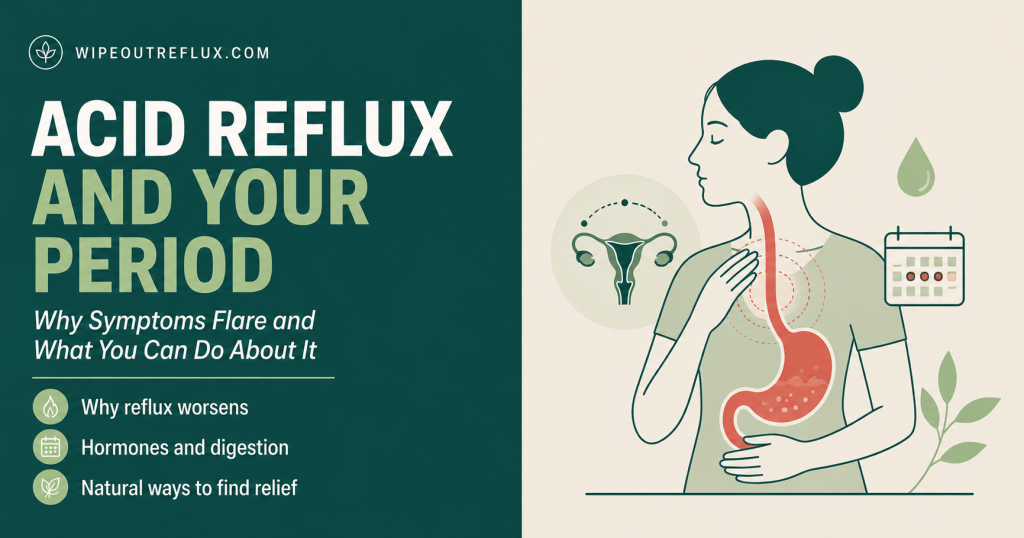
If your heartburn reliably flares in the week before your period and settles once bleeding starts, you’re not imagining it. Around 73% of healthy women report at least one gut symptom before or during menstruation, and reflux is one of the ones people rarely mention to a doctor because it seems too vague to bring up.
The explanation you’ll find everywhere is that progesterone relaxes your lower oesophageal sphincter, the same way it does in pregnancy. That’s the tidy answer. It’s also, on the actual evidence, surprisingly shaky — one small study found sphincter pressure dropped in the luteal phase, and a later, better-controlled one found no change at all.
Which matters, because if you chase the hormone explanation you end up feeling stuck: you can’t change your cycle. The mechanisms that probably drive most perimenstrual reflux are ones you can do something about — the ibuprofen you take for cramps, the bloating pressing up on your stomach, slower gastric emptying, the food you crave, and the sleep you lose. That’s where this article spends most of its time.
Key Takeaways
- 73% of healthy women report at least one gastrointestinal symptom before or during their period, most commonly abdominal pain (58% pre-menstrually) and diarrhoea.
- The classic 1979 study found lower oesophageal sphincter pressure fell from 19.0 to 16.5 mmHg in the luteal phase, with reflux detected in 5 of 10 women versus 1 in the follicular phase.
- A larger 1999 study of 19 women found no difference in sphincter pressure or 24-hour acid exposure despite a twelvefold rise in progesterone — so the hormone story is genuinely contested.
- NSAIDs taken for cramps are a strong and overlooked contributor: GERD symptoms were reported by 27% of NSAID users versus 19% of non-users.
- Postmenopausal oestrogen-only hormone therapy carried an odds ratio of 1.66 for reflux symptoms, suggesting oestrogen matters at least as much as progesterone.
- Bloating, constipation and slowed gastric emptying all raise pressure on your stomach, which is a mechanical route to reflux independent of hormones.
- Symptoms typically build across the luteal phase, peak in the two or three days before bleeding, and ease once your period starts.
- Tracking symptoms against your cycle for two or three months is the single most useful thing you can do, because it tells you exactly when to pre-empt.
First: yes, this is real and common
Perimenstrual gut symptoms are well documented. In a study of 156 healthy women — not a clinic population, just ordinary menstruating women — 73% experienced at least one primary gastrointestinal symptom before or during menses. Abdominal pain affected 58% pre-menstrually and 55% during; diarrhoea 24% and 28%; fatigue over half in both phases Bernstein et al., BMC Women’s Health, 2014.
Worth being precise: that study asked about abdominal pain, diarrhoea, constipation, nausea and vomiting — it didn’t have a heartburn question. So it doesn’t prove reflux is cyclical. What it establishes is that the gut as a whole is demonstrably affected by the menstrual cycle in most women, which makes cyclical reflux entirely plausible rather than something you invented.
If you have IBS alongside reflux, you’ll already know this — IBS symptoms reliably worsen around menstruation, and the two conditions overlap heavily.
The hormone explanation, and why it’s shakier than you’ve read
The study everyone cites
In 1979, researchers measured lower oesophageal sphincter pressure in 10 women at two points in their cycle: days 2 to 8 (follicular, low hormones) and days 20 to 30 (luteal, high hormones).
Oestradiol roughly doubled and progesterone rose more than twelvefold. Sphincter pressure fell from 19.0 to 16.5 mmHg — a statistically significant drop. And acid reflux was detected in 5 of the 10 women during the luteal phase, versus just 1 during the follicular phase Van Thiel et al., American Journal of Obstetrics and Gynecology, 1979.
That’s the study behind every article you’ve read on this. It’s a clean finding and it fits the pregnancy analogy neatly.
The study nobody cites
Twenty years later, a Spanish team ran a better version. Nineteen healthy women, full manometry and 24-hour ambulatory pH monitoring — so not just sphincter pressure but actual measured acid exposure across a whole day.
Progesterone rose from 0.37 to 4.64 ng/ml between phases, a substantial swing. Sphincter pressure: 29.82 mmHg follicular versus 30.45 luteal. No difference. Total time below pH 4: 3.04% versus 3.18%. No difference. Upright, supine, nothing moved. Their conclusion was blunt — physiological progesterone fluctuation does not predispose to reflux in healthy menstruating women Alvarez-Sánchez et al., The American Journal of Gastroenterology, 1999.
Two studies, opposite answers. The second is larger and used the better outcome measure, so I’d weight it more heavily — but nineteen women is still small, and neither study included women who actually had reflux disease. It’s entirely possible progesterone does little to a healthy sphincter but matters when the sphincter is already weak. Nobody has tested that.
And oestrogen may be the bigger player anyway
Here’s a finding that complicates the standard story further. In 51,637 postmenopausal women from the Nurses’ Health Study, 23% reported reflux symptoms. Compared with women who’d never used hormone therapy, the odds ratio was 1.66 for current users of oestrogen alone, 1.41 for combined oestrogen and progesterone, and 1.46 for past users. Both oestrogen dose and duration of use showed a dose-response Jacobson et al., Archives of Internal Medicine, 2008.
Note the direction. Oestrogen-only came out worse than the combination that included progesterone. If progesterone were the villain, you’d expect the reverse.
That’s postmenopausal hormone therapy at pharmacological doses, not your natural cycle, so don’t over-read it. But it does suggest that “progesterone relaxes your sphincter” is an incomplete account at best. If you’re approaching menopause and noticing reflux changes, it’s directly relevant.
The mechanisms that probably matter more
This is the part I’d actually act on.
1. The painkillers you take for cramps
This one is significant and almost never mentioned, which frustrates me, because it’s the most fixable thing on the list.
Ibuprofen, naproxen and aspirin are the standard treatment for period pain, and they work by blocking prostaglandins. The problem is that they block prostaglandins everywhere, including the ones protecting your stomach lining. They also irritate the oesophagus directly on the way down, particularly if swallowed with little water or taken lying down.
The association is measurable. In a study of 6,823 French adults, 33% of whom had used NSAIDs in the previous three months, reflux symptoms were reported by 27% of NSAID users versus 19% of non-users — with NSAID use, age and female sex all independent predictors Ruszniewski et al., Alimentary Pharmacology and Therapeutics, 2008. A separate cohort analysis found a relative risk of 2.11 for developing reflux disease among people with at least one NSAID prescription Kotzan et al., Pharmaceutical Research, 2001.
Now think about the timing. You take NSAIDs for two or three days a month — the exact days your reflux is worst. It would be remarkable if that weren’t contributing. And because the pain and the heartburn arrive together, it’s very easy to blame the hormones for something the tablets are doing.
What to do about it is a conversation with your GP or pharmacist rather than something to change unilaterally, especially if you have heavy or very painful periods where NSAIDs are doing real work. But things worth asking about: taking them with food rather than on an empty stomach, swallowing with a full glass of water and staying upright for half an hour afterwards, whether paracetamol could cover part of the load, and whether short-term acid suppression or an alginate alongside makes sense for those few days. This is one of the clearer examples of medications making reflux worse.
2. Bloating and constipation raise the pressure on your stomach
Premenstrual bloating is close to universal, and it’s not just a feeling — there are measurable increases in intraluminal gas around menstruation.
Mechanically, this matters more than people realise. Anything that raises pressure inside your abdomen pushes upward on your stomach, and the sphincter has to hold against that pressure. It’s the same reason overeating triggers reflux so reliably. Luteal-phase constipation compounds it.
This is a hormonal effect, but it’s an indirect and mechanical one — and unlike sphincter pressure, it’s something you can influence with fibre, fluid, and movement.
3. Everything moves more slowly
Progesterone relaxes smooth muscle throughout the digestive tract, which slows gastric emptying and gut transit generally. Food sitting in your stomach longer means a longer window during which it can reflux, and more of that fullness-and-pressure feeling after meals.
If you already have any degree of impaired oesophageal motility, or delayed emptying, the luteal phase will make it noticeably worse.
4. What you eat changes
Premenstrual cravings skew reliably towards chocolate, fat, sugar and salt. That’s a genuinely unhelpful combination for reflux: chocolate relaxes the sphincter through both its methylxanthine and fat content, and fatty meals slow gastric emptying further and are among the most consistent heartburn triggers going.
Add larger portions, later meals, and for some people a glass of wine, and you have a fairly complete explanation for cyclical heartburn that requires no direct hormonal effect on the sphincter at all.
I’m not saying don’t eat chocolate before your period. I’m saying if your heartburn spikes on exactly the days your diet changes, the diet is a reasonable suspect.
5. Sleep and stress
Sleep quality drops in the late luteal phase for a lot of women, and disturbed sleep slows oesophageal clearance overnight — acid sits for longer when you’re not swallowing properly. Premenstrual anxiety and low mood, meanwhile, increase oesophageal sensitivity, so the same amount of acid produces more symptoms. Stress genuinely amplifies reflux without changing the underlying physiology at all.
That’s an important idea. Some of what you experience premenstrually may not be more reflux — it may be the same reflux, felt more.
When in your cycle to expect it
The usual pattern:
- Days 1 to 5 (bleeding). Prostaglandins peak, cramps peak, and NSAID use peaks. Symptoms often stay bad for the first day or two, then improve.
- Days 6 to 13 (follicular). Hormones low, gut transit normal. This is usually the calmest window.
- Ovulation, around day 14. Some women get a brief flare; most don’t.
- Days 15 to 28 (luteal). Progesterone and oestrogen both rise. Bloating builds, transit slows, cravings start.
- The last 2 to 4 days before bleeding. The peak for most people — maximum bloating, worst sleep, lowest mood.
Cycle lengths vary enormously, so rather than trusting those numbers, track it. Note reflux severity daily alongside your cycle for two or three months. Two things come out of that: you find out whether your reflux is genuinely cyclical or you’ve been pattern-matching, and if it is, you learn exactly which days to pre-empt.
That record is also worth showing your GP. “Worse before my period” is easy to wave away; a three-month chart isn’t.
What actually helps
The useful move is to treat the luteal phase as a known high-risk window and prepare for it, rather than reacting once symptoms arrive.
In the week before your period:
- Eat earlier. Finishing your last meal three to four hours before lying down does more than anything else on this list — the same principle as stopping eating before bed, applied strategically.
- Smaller, more frequent meals. Gastric emptying is already slow; don’t add volume to it.
- Watch the cravings rather than banning them. Chocolate mid-afternoon is a different proposition from chocolate at 10pm on the sofa.
- Stay ahead of constipation. Fibre, fluid, and walking. Less abdominal pressure means less reflux.
- Sleep on your left side, head elevated. The left lateral position measurably speeds acid clearance, and it costs nothing.
- Be deliberate about painkillers. With food, upright, plenty of water — and discuss alternatives with your GP if this is the pattern.
- Consider an alginate after meals on the bad days. Products like Gaviscon Advance form a physical raft rather than suppressing acid, which suits short predictable windows.
And be a little kinder to yourself about it. Fighting cramps, bloating, poor sleep and heartburn simultaneously is genuinely hard, and adding rigid dietary rules on the worst days of the month tends to backfire.
The pill, the coil, and hormonal contraception
People ask about this constantly and the honest answer is that the evidence is thin.
What we can say: the postmenopausal hormone therapy data shows a real association between exogenous hormones and reflux symptoms, with a dose-response for oestrogen. It’s reasonable to suspect that combined oral contraceptives, which contain oestrogen, could do something similar in some women — but that specific question hasn’t been well studied, and the doses and populations are very different.
Practically: some women find combined pills worsen reflux and progestogen-only methods don’t, some find the opposite, and many notice nothing. Methods that suppress cycling altogether often flatten out cyclical symptoms simply by removing the cycle. If your reflux changed noticeably within a couple of months of starting or switching contraception, that’s worth raising with whoever prescribes it — it’s a legitimate side effect to discuss, not something you have to accept.
When it isn’t just your period
A few things worth taking seriously rather than filing under hormones:
- Reflux that no longer follows the cycle. If it used to be cyclical and now it’s constant, something has changed.
- Difficulty or pain on swallowing, food sticking, unintentional weight loss, vomiting, or any sign of bleeding. These need prompt medical assessment regardless of your cycle.
- Severe cyclical abdominal or pelvic pain with gut symptoms — endometriosis can affect the bowel and is chronically underdiagnosed.
- A missed period plus new heartburn. Worth a pregnancy test; reflux in pregnancy is extremely common and often an early sign.
- Thyroid disorders can cause both menstrual irregularity and gut symptoms, and are worth ruling out if things have changed generally — see thyroid problems and acid reflux.
Conclusion
Cyclical reflux is real, but the standard explanation for it — progesterone loosening your sphincter — rests on one small study from 1979 that a better-designed study later failed to replicate. I think that’s worth knowing, not because the hormones are irrelevant, but because it moves the focus onto things you can actually change. The bloating pressing up on your stomach, the slower gastric emptying, the ibuprofen you take for cramps on exactly the days your heartburn peaks, the chocolate at 10pm, the broken sleep: those add up to a complete explanation without requiring your sphincter to change at all.
The practical version is simple. Track your symptoms against your cycle for two or three months so you know which days are yours. Then treat that window deliberately — eat earlier and lighter, stay ahead of constipation, be careful with painkillers, and sleep on your left side. Most women get a meaningful improvement out of that alone.
If you want to tighten up the food side without guessing, the Wipeout Food Reference Guide is the essential reference for which foods and drinks are actually safe with acid reflux and LPR, with the pH value of each one — particularly useful for finding premenstrual snacks that satisfy the craving without setting your chest on fire.
And if the reflux is a year-round problem that your cycle merely amplifies, the underlying issue needs addressing rather than managing four days a month. That’s what the Wipeout Diet Plan is for — the fuller, structured approach covering sequencing, timing and the healing phase. I built it around LPR and silent reflux, the stubborn throat-based form, but because it works on the same underlying mechanisms it applies equally to GERD and ordinary heartburn. Get the baseline down and the monthly peak has less to build on.
Frequently Asked Questions
Why is my acid reflux worse before my period?
Several things stack up in the luteal phase: bloating and constipation raise pressure on your stomach, gastric emptying slows, cravings shift towards chocolate and fat, sleep worsens, and many women take NSAIDs for cramps. Hormonal effects on the sphincter itself are less clear-cut than commonly claimed.
Does progesterone cause acid reflux?
The evidence is genuinely mixed. A 1979 study found sphincter pressure dropped from 19.0 to 16.5 mmHg in the luteal phase, but a 1999 study with 24-hour pH monitoring found no difference in sphincter pressure or acid exposure despite a large progesterone rise. Progesterone does slow gut transit, which contributes indirectly.
Can period cramps cause heartburn?
Not directly, but what you take for them often does. NSAIDs like ibuprofen and naproxen block the prostaglandins that protect your stomach lining and can irritate the oesophagus directly. Reflux symptoms are reported by 27% of NSAID users versus 19% of non-users.
How long does period-related reflux last?
Typically it builds over the luteal phase, peaks in the two to four days before bleeding, and eases within the first couple of days of your period. If yours doesn’t follow that pattern or has become constant, it’s worth investigating separately.
Can birth control pills cause acid reflux?
Possibly in some women, though it hasn’t been well studied. Postmenopausal oestrogen therapy showed a clear dose-response association with reflux symptoms, which makes it plausible for combined pills. If your symptoms changed within a couple of months of starting or switching, raise it with your prescriber.
Is acid reflux a sign of PMS?
It’s not one of the formal diagnostic symptoms, but gut symptoms are extremely common premenstrually — 73% of healthy women report at least one. Women with more emotional premenstrual symptoms also report more gut symptoms, which fits with heightened sensitivity rather than more acid.
Should I stop taking ibuprofen for my period?
Don’t change it on your own, especially if you have heavy or very painful periods where it’s doing real work. Do raise it with your GP or pharmacist — taking it with food and water while upright, using paracetamol for part of the load, or adding short-term protection for those days are all reasonable things to ask about.
Will my reflux improve after menopause?
Not necessarily. Cyclical fluctuation stops, which helps if that was your main issue, but reflux risk rises with age and weight regardless. Hormone therapy is associated with more reflux symptoms rather than fewer, with an odds ratio of 1.66 for oestrogen-only use.
Research & References
- Survey of 156 healthy menstruating women finding that 73% experienced at least one primary gastrointestinal symptom before or during menses, with abdominal pain in 58% pre-menstrually and 55% during, diarrhoea in 24% and 28%, and fatigue in 53% and 49% Bernstein et al., BMC Women’s Health, 2014.
- Manometric study of 10 women measured in the follicular phase (days 2–8) and luteal phase (days 20–30), finding lower oesophageal sphincter pressure fell from 19.0 ± 1.5 to 16.5 ± 1.3 mmHg (p < 0.01) alongside a doubling of oestradiol and a twelvefold rise in progesterone, with acid reflux detected in 5 women during the luteal phase versus 1 during the follicular phase Van Thiel et al., American Journal of Obstetrics and Gynecology, 1979.
- Study of 19 healthy women using manometry and 24-hour ambulatory pH monitoring in both cycle phases, finding no significant difference in lower oesophageal sphincter pressure (29.82 versus 30.45 mmHg) or total time with pH below 4 (3.04% versus 3.18%) despite progesterone rising from 0.37 to 4.64 ng/ml, and concluding that physiological progesterone fluctuation does not predispose to reflux in healthy menstruating women Alvarez-Sánchez et al., The American Journal of Gastroenterology, 1999.
- Analysis of 51,637 postmenopausal women in the Nurses’ Health Study, of whom 12,018 (23%) reported reflux symptoms, finding multivariate odds ratios versus never-users of 1.66 (95% CI 1.54–1.79) for current oestrogen-only users, 1.41 (1.29–1.54) for current combined oestrogen and progesterone users and 1.46 (1.36–1.56) for past users, with dose-response relationships for both oestrogen dose and duration of use Jacobson et al., Archives of Internal Medicine, 2008.
- Observational study of 6,823 adults, 33% of whom had used non-steroidal anti-inflammatory drugs in the previous three months, finding reflux symptoms in 27% of NSAID users versus 19% of non-users (p ≤ 0.001), with NSAID use, age and female sex identified as independent predictors Ruszniewski et al., Alimentary Pharmacology and Therapeutics, 2008.
- Retrospective cohort analysis of a Medicaid population initially free of reflux disease, finding an absolute risk of gastro-oesophageal reflux disease of 0.80 among those with at least one NSAID prescription versus 0.38 without, giving a relative risk of 2.11 and an adjusted odds ratio of 1.82 Kotzan et al., Pharmaceutical Research, 2001.

David Gray
12 years living with LPR · Consultant & researcher
I've lived with LPR for twelve years — the misdiagnoses, the PPI courses that did nothing, the slow work of figuring out what actually helps. Wipeout Reflux is where I translate the research into plain terms for people stuck in the same place. Every claim here is sourced to peer-reviewed work, and I consult one-to-one with LPR sufferers.