
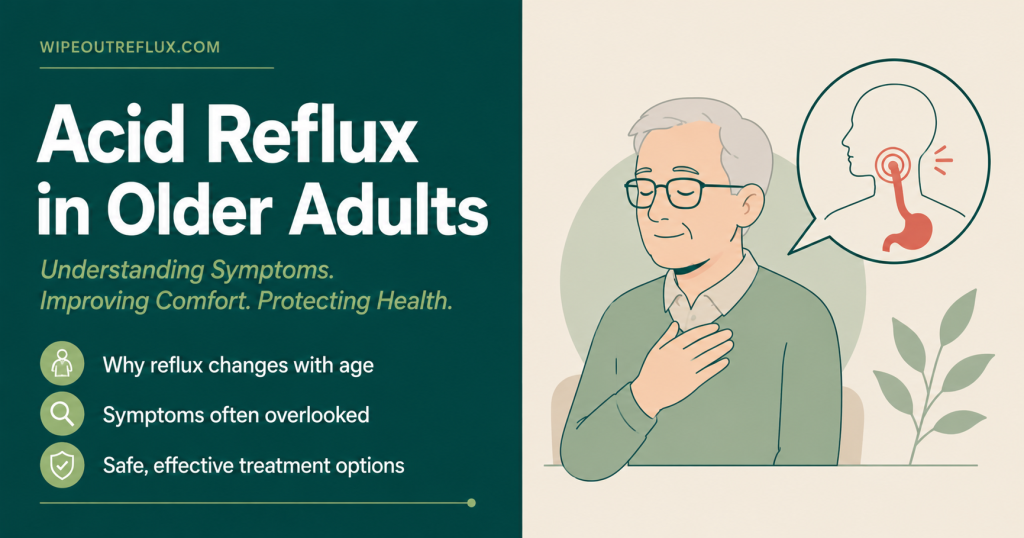
Acid reflux changes as you get older, and it changes in a way that catches a lot of people out. The symptoms often become milder — less heartburn, less obvious burning — while the actual damage to the oesophagus becomes more severe. That combination is the central problem with reflux in later life.
The reason is that several protective mechanisms weaken with age at the same time. Saliva production falls, so there’s less natural acid neutralisation. The oesophagus clears refluxed acid more slowly. Hiatal hernias become more common. And nerve sensitivity in the oesophagus declines, so the same amount of acid simply hurts less. Add in the medications many older adults take — several of which relax the valve at the bottom of the oesophagus — and you have reflux that does more harm while announcing itself less.
This is why reflux in older adults deserves proper medical assessment rather than years of over-the-counter antacids. It’s also why the practical management differs from what works at 35.
Key Takeaways
- Older adults typically report less heartburn but have more severe oesophageal damage — reduced nerve sensitivity masks the problem [Chait, World Journal of Gastrointestinal Endoscopy, 2010].
- Presentation is often atypical: regurgitation, difficulty swallowing, chest discomfort, nausea, cough or hoarseness rather than classic burning.
- Age-related changes that worsen reflux: reduced saliva, slower oesophageal clearance, higher rates of hiatal hernia, and more time spent lying down.
- Many common prescriptions — calcium channel blockers, nitrates, anticholinergics, some antidepressants, bisphosphonates and NSAIDs — can aggravate reflux. A medication review is often the highest-value step.
- Never assume chest pain is reflux. In older adults, cardiac causes must be ruled out first — this is a medical assessment, not a self-diagnosis.
- Difficulty swallowing, weight loss, vomiting blood, black stools or anaemia need prompt investigation, and endoscopy is considered more readily in this age group.
- Long-term PPI use carries a different risk profile in later life, so the goal is the lowest effective dose with periodic review — never stopping a prescribed medicine without medical advice.
Why Reflux Symptoms Become Less Obvious With Age
This is the counterintuitive part, and it’s worth understanding properly because it drives everything else.
Sensory nerve function in the oesophagus declines with age. The result is that older adults often perceive reflux far less intensely than younger people do — the acid is still there, still causing inflammation, but it registers as mild discomfort or nothing at all. Reviews of reflux in older patients consistently describe this pattern: fewer and milder reported symptoms, but more erosive oesophagitis, strictures and Barrett’s oesophagus when the oesophagus is actually examined [Chait, World Journal of Gastrointestinal Endoscopy, 2010].
Because the symptoms are quieter, the diagnosis gets missed or delayed. A significant proportion of older adults present with atypical complaints instead of heartburn — regurgitation, swallowing difficulty, nausea, vomiting, or non-cardiac chest pain — which makes reflux easy to overlook [Kurin and Fass, Drugs & Aging, 2019]. Meanwhile, the acid exposure has often been accumulating for decades.
The practical takeaway: in later life, the absence of bad heartburn is not reassurance. Symptom severity is a poor guide to what’s happening in the oesophagus.
What Actually Changes With Age
Saliva production drops
Saliva is one of the body’s main defences against reflux — it’s alkaline, it neutralises acid, and swallowing it washes the oesophagus clean. Saliva volume and bicarbonate concentration both decline with age, and many common medications reduce it further. Less saliva means refluxed acid sits in contact with tissue for longer.
The oesophagus clears more slowly
Peristalsis — the wave of muscle contraction that pushes material down — weakens and becomes less coordinated with age. When reflux happens, it takes longer to clear. This “prolonged contact time” does more damage than the number of reflux events alone would suggest.
Hiatal hernia becomes more common
Hiatal hernias increase steadily with age. They reduce pressure at the lower oesophageal sphincter and increase the frequency of transient relaxations, both of which make reflux more likely. My guide to the stomach sphincter and reflux explains how that valve works.
Medications add up
This is often the biggest and most fixable factor. Several widely prescribed drug classes relax the lower oesophageal sphincter or irritate the oesophagus directly:
- Calcium channel blockers (for blood pressure)
- Nitrates (for angina)
- Anticholinergics (for bladder problems, among others)
- Some antidepressants
- Bisphosphonates (for osteoporosis) — these can irritate the oesophagus directly
- NSAIDs such as ibuprofen and naproxen
- Theophylline and some inhaled medications
Older adults on multiple prescriptions may have several of these at once. Do not stop any prescribed medicine on your own — but a medication review with a GP or pharmacist is often the single most productive step, since alternatives or timing changes are frequently available.
Other contributors
Reduced mobility means more time lying or reclining, particularly after meals. Conditions like diabetes can slow stomach emptying. Stroke and neurological conditions can affect swallowing. And decades of accumulated acid exposure mean the oesophagus starts from a more vulnerable baseline.
Silent Reflux in Older Adults
Throat and airway symptoms — chronic cough, hoarseness, throat clearing, a lump-in-the-throat sensation, excess mucus — are common in later life and frequently reflux-related, even when there’s no heartburn at all. This is laryngopharyngeal reflux, or silent reflux.
It’s especially easy to miss in older adults, because hoarseness and cough get attributed to age, post-nasal drip, or medication side effects. A review of LPR specifically in the over-65s found that presentation and treatment response in older patients differ from younger populations, which adds to the diagnostic difficulty [Lechien, Clinical Interventions in Aging, 2022].
There’s also a practical safety dimension here. Reduced swallowing coordination plus reflux raises the risk of material entering the airway, which is a recognised route to aspiration pneumonia in frail older adults. Persistent coughing during or after meals, a wet-sounding voice after swallowing, or recurrent chest infections should always be mentioned to a doctor.
My articles on GERD vs LPR and the lump-in-throat sensation cover the silent reflux pattern in more detail.
Red Flags: When to Seek Medical Assessment
Two points deserve particular emphasis in this age group.
First: chest pain must never be assumed to be reflux. Heartburn and cardiac pain can feel very similar, and the risk of heart disease rises substantially with age. Any new, severe, or exertion-related chest pain — especially with breathlessness, sweating, nausea, or pain spreading to the arm, neck or jaw — needs emergency assessment. Getting this checked is always the right call.
Second: because symptoms under-represent the damage, doctors have a lower threshold for investigating reflux in older adults. Endoscopy is considered more readily here than in a younger person with identical complaints.
Seek prompt medical attention for:
- Difficulty swallowing, or food sticking
- Pain on swallowing
- Unintentional weight loss
- Vomiting blood, or vomit resembling coffee grounds
- Black, tarry stools
- Anaemia or unexplained fatigue
- Persistent vomiting
- Recurrent chest infections, or choking and coughing during meals
- Hoarseness lasting more than three weeks
- Any new or changing chest pain
Expert consensus on reflux in older adults stresses this combination of atypical symptoms, more severe oesophageal injury, and higher complication rates as the reason for a lower threshold to investigate [Liu et al., Aging Medicine, 2024].
Treatment: What’s Different in Later Life
Lifestyle measures still do a lot
The fundamentals work at any age, and some become more important:
- Elevate the head of the bed by 6–8 inches, using bed risers or a wedge. With slower acid clearance, gravity matters more than ever. My sleeping position guide covers this, including the benefit of sleeping on the left side.
- Leave 3 hours between the last meal and lying down — including naps and reclining in an armchair, which are easy to overlook.
- Smaller, more frequent meals. Large meals are harder to manage with slower stomach emptying.
- Stay upright after eating. Even a short gentle walk helps.
- Stay well hydrated and take medicines with a full glass of water while sitting or standing upright — this matters especially for bisphosphonates and NSAIDs, which can irritate the oesophagus if they linger.
- Address dry mouth with your GP or dentist. Since saliva is a genuine defence against reflux, improving it has a real mechanical benefit.
Medication considerations
PPIs remain effective in older adults, and where there’s erosive oesophagitis or Barrett’s, treatment is important. But the risk-benefit calculation shifts with age. Long-term acid suppression has been associated with reduced absorption of vitamin B12, magnesium and calcium, an increased fracture risk, and a higher risk of certain infections — all of which carry more weight in an older person. There are also potential interactions with other medicines to consider.
None of that means avoiding PPIs. It means the aim is the lowest effective dose, reviewed periodically rather than repeated indefinitely on autopilot — a conversation to have with the prescribing doctor. If you’re on long-term acid suppression, it’s reasonable to ask whether the dose is still right and whether B12 or magnesium levels should be checked.
One practical warning: stopping a PPI abruptly can cause a temporary rebound in acid production, which is easily mistaken for the reflux returning worse than before. I explain that in getting off PPIs and acid rebound — but any change should be planned with a doctor, not attempted independently.
Alginates such as Gaviscon Advance are often a useful addition, since they form a physical raft rather than suppressing acid, and they suit the throat-symptom pattern well. Check with a pharmacist about sodium content and interactions if you take other medicines or have heart or kidney conditions.
If treatment isn’t working
Persistent symptoms on medication warrant reassessment rather than an increased dose indefinitely — the cause may be non-acid or bile reflux, a motility problem, or something else entirely. My article on acid reflux medication not working covers the common reasons.
Conclusion
The most important thing to take from all this is the mismatch: as you get older, reflux tends to hurt less while doing more. Reduced nerve sensitivity, less saliva, slower oesophageal clearance and more hiatal hernias combine to produce a condition that quietly progresses. Mild symptoms are genuinely not reassurance in later life, which is precisely the opposite of the instinct most people have.
That makes two things worth acting on. First, get persistent reflux properly assessed rather than managing it indefinitely with over-the-counter remedies — doctors investigate more readily in this age group for good reason. Second, review your medications with a GP or pharmacist, because so many common prescriptions aggravate reflux and adjustments are often straightforward. Alongside that, the mechanical basics carry more weight than ever: raising the head of the bed, leaving a proper gap before lying down, smaller meals, and staying upright after eating.
And please treat chest pain as a cardiac question until a doctor says otherwise. That’s not caution for its own sake — it’s the single most consequential distinction in this whole topic.
If you’d like to go deeper on the dietary side, the Wipeout Diet Plan is the complete system I built from my own recovery — it explains the mechanisms behind reflux and LPR and walks through a low-acid, pepsin-aware approach step by step, which pairs well with the elevation and timing changes above. Do talk it through with your doctor or a dietitian first if you’re managing other health conditions or take regular medication, since nutrition needs shift with age.
The Wipeout Food Reference Guide is an essential everyday companion too — it covers the foods and drinks that are allowed for acid reflux and LPR along with their pH values, so you can check anything at a glance without memorising lists.
Frequently Asked Questions
Does acid reflux get worse with age?
The underlying reflux typically worsens, even though the symptoms often feel milder. Saliva production falls, the oesophagus clears acid more slowly, hiatal hernias become more common, and medications add to the problem. At the same time, reduced nerve sensitivity means you feel less of it. That’s why older adults tend to report less heartburn but show more oesophageal damage on endoscopy.
Why don’t I get heartburn any more, even though I have reflux?
Sensory nerve function in the oesophagus declines with age, so the same acid exposure produces less sensation. It’s a well-documented pattern and an important one, because the reduced pain doesn’t mean reduced damage. If you’ve had reflux for years and the burning has faded, that’s a reason to be assessed rather than reassured.
Could my blood pressure medication be causing reflux?
It’s possible — calcium channel blockers in particular can relax the valve at the base of the oesophagus, and nitrates, anticholinergics, some antidepressants, bisphosphonates and NSAIDs can all contribute. Never stop a prescribed medicine on your own, but do ask your GP or pharmacist for a medication review; alternatives or timing adjustments are often available.
Is it safe to take PPIs long term as an older adult?
PPIs are effective and often necessary, particularly with erosive oesophagitis or Barrett’s oesophagus. But long-term use has been linked to reduced B12, magnesium and calcium absorption, increased fracture risk, and higher infection risk — all of which matter more with age. The sensible approach is the lowest effective dose with periodic review by your doctor, rather than an indefinite repeat prescription.
How do I tell reflux chest pain from heart pain?
You often can’t reliably tell them apart, and in older adults you shouldn’t try. Cardiac risk rises with age, and reflux and angina can feel remarkably similar. Any new, severe, or exertion-related chest pain — particularly with breathlessness, sweating, nausea, or pain spreading to the arm, neck or jaw — needs emergency assessment.
Can reflux cause chest infections or pneumonia in older adults?
It can contribute. Reduced swallowing coordination combined with reflux increases the chance of material entering the airway, which is a recognised route to aspiration pneumonia, especially in frail or less mobile people. Coughing during or after meals, a wet-sounding voice after swallowing, or repeated chest infections should be reported to a doctor.
Should I have an endoscopy for reflux at my age?
That’s your doctor’s decision, but the threshold for investigating is deliberately lower in older adults — precisely because symptoms tend to understate the damage and complication rates are higher. Endoscopy is generally recommended sooner if there’s difficulty swallowing, weight loss, anaemia, bleeding, or symptoms that persist despite treatment.
Research Sources
- [Chait, World Journal of Gastrointestinal Endoscopy, 2010] — A review of reflux in older patients establishing that although elderly patients report fewer symptoms, their disease is more often severe, with higher rates of erosive oesophagitis, stricture, Barrett’s oesophagus and extra-oesophageal complications.
- [Kurin and Fass, Drugs & Aging, 2019] — A review of reflux management in older patients, describing the higher proportion presenting with atypical symptoms rather than heartburn, the resulting risk of missed diagnosis, and the greater frequency of severe erosive oesophagitis.
- [Lechien, Clinical Interventions in Aging, 2022] — An evidence review of laryngopharyngeal reflux in patients over 65, covering how clinical presentation, diagnosis and treatment response differ from younger populations.
- [Liu et al., Aging Medicine, 2024] — Expert consensus on reflux disease in older adults, noting that prevalence rises with age and that the condition is characterised by atypical symptoms alongside relatively severe oesophageal injury and more complications.

David Gray
12 years living with LPR · Consultant & researcher
I've lived with LPR for twelve years — the misdiagnoses, the PPI courses that did nothing, the slow work of figuring out what actually helps. Wipeout Reflux is where I translate the research into plain terms for people stuck in the same place. Every claim here is sourced to peer-reviewed work, and I consult one-to-one with LPR sufferers.