
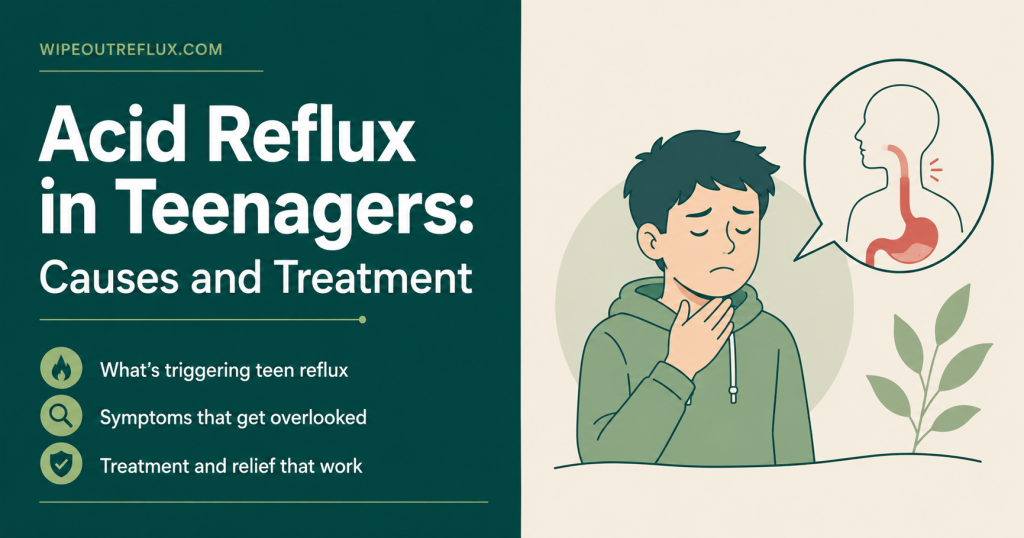
Acid reflux in teenagers is far more common than most parents expect. Symptoms of reflux affect somewhere in the region of 2–8% of children and adolescents, and in surveys of teenagers specifically the numbers run higher — one study of 14–18 year olds found a substantial minority reporting regular heartburn or regurgitation [Nelson et al., Archives of Pediatrics and Adolescent Medicine, 2000].
By the teenage years, reflux starts to look much more like the adult version: heartburn, chest discomfort, regurgitation, a sour taste, and sometimes throat symptoms like hoarseness or chronic cough. That’s a real shift from infancy, where reflux is usually a spitting-up problem that resolves on its own.
What drives it in teenagers is also fairly specific — late-night eating, energy drinks and caffeine, exam stress, weight changes during puberty, irregular sleep, and sometimes vaping or alcohol. The good news is that most of these are modifiable. The important caveat: a teenager with persistent reflux symptoms should be assessed by a GP or paediatrician rather than left to self-manage, because a few conditions that mimic reflux need ruling out.
Key Takeaways
- Teenage reflux resembles adult GERD — heartburn, regurgitation, chest discomfort — rather than the spitting-up seen in babies.
- Common triggers in this age group: late-night meals, energy drinks and caffeine, fizzy drinks, stress, irregular sleep, weight gain, vaping, alcohol, and NSAID painkillers.
- Throat and airway symptoms (hoarseness, chronic cough, throat clearing) can also be reflux — this is silent reflux, or LPR, and it’s easily mistaken for allergies or asthma.
- Lifestyle changes come first. Paediatric guidelines specifically advise against using acid-suppressing medication for cough, wheeze and other airway symptoms in young people [Rosen et al., JPGN, 2018].
- Where medication is appropriate, guidelines suggest a defined 4–8 week trial for typical reflux symptoms, with review — not indefinite use.
- Red flags — difficulty swallowing, weight loss, vomiting blood, black stools, persistent vomiting — need prompt medical assessment, not home management.
- Any teenager with ongoing symptoms should see a doctor before starting medication, supplements, or a restrictive diet.
What Acid Reflux Looks Like in Teenagers
The symptom picture in adolescence is closer to adult reflux than to infant reflux. Typical signs include:
- Heartburn — a burning feeling behind the breastbone, often after meals or when lying down
- Regurgitation — food or sour liquid coming back up into the throat or mouth
- Chest pain or discomfort that isn’t related to exercise
- Nausea, especially in the morning or after eating
- A sour or bitter taste, or bad breath
- Burping and bloating
- Pain or discomfort on swallowing
But reflux in teenagers doesn’t always announce itself that clearly. A meaningful proportion have throat and airway symptoms instead — persistent throat clearing, a hoarse voice, a chronic dry cough, the feeling of a lump in the throat, or post-nasal-drip-like mucus. This is laryngopharyngeal reflux (silent reflux), and it’s routinely mistaken for allergies, a lingering virus, or asthma. If your teenager has been coughing for months with no clear cause, reflux is worth raising with their doctor.
My guides on GERD vs LPR and LPR symptoms explain the difference between the two patterns, and my article on constant throat clearing from reflux covers that particular symptom in detail.
Why Teenagers Get Acid Reflux: The Common Causes
Late-night eating
This is probably the single biggest driver in this age group. Teenagers eat later, snack at night, and then go straight to bed. A full stomach plus lying flat is the classic recipe for reflux — gravity stops helping, and stomach pressure is at its highest exactly when the protective mechanisms shut down. My article on acid reflux at night explains this mechanism more fully.
Energy drinks, coffee and fizzy drinks
Energy drinks are a genuine problem here, and they’re everywhere in teenage life. They combine high caffeine (which can relax the lower oesophageal sphincter), high acidity, carbonation (which increases stomach pressure and triggers belching), and often large volumes consumed quickly. Fizzy drinks and iced coffee do a milder version of the same thing.
Weight change during puberty
Rapid weight gain increases pressure inside the abdomen, which pushes stomach contents upward. This is one of the better-established risk factors for reflux across all ages, and adolescence is a period of significant body change. This deserves a gentle touch — the goal is health, not appearance, and weight conversations with teenagers need care.
Stress, anxiety and exams
Stress doesn’t create acid, but it reliably makes reflux worse and makes symptoms feel more intense. Exam periods, disrupted routines, and skipped-then-large meals are a common pattern behind a flare-up. There’s also a genuine two-way link between reflux and anxiety, which I cover in can LPR be caused by anxiety.
Irregular sleep
Late bedtimes, all-nighters, and lying down soon after eating all increase night-time reflux exposure. Teenage body clocks naturally shift later, which compounds the late-eating problem.
Vaping, smoking and alcohol
Nicotine relaxes the lower oesophageal sphincter, and alcohol both relaxes it and irritates the oesophageal lining directly. Vaping is often assumed to be harmless in this respect, but nicotine has the same sphincter effect regardless of the delivery method. If reflux appears in a teenager alongside new vaping, that’s a plausible connection worth exploring — ideally in a non-confrontational conversation, since honesty matters more here than a lecture.
NSAID painkillers
Regular ibuprofen — often taken for sports injuries, headaches or period pain — can irritate the stomach and oesophagus and worsen reflux symptoms. If a teenager is taking NSAIDs frequently, it’s worth mentioning to their doctor.
Sport and exercise
Some exercise reduces reflux, but high-intensity activity, core work, and anything involving bending or inversion can provoke it — particularly if done soon after eating. The fix is usually timing rather than stopping the sport.
Other conditions that can look like reflux
Several conditions produce reflux-like symptoms in teenagers and need a doctor to distinguish: eosinophilic oesophagitis (increasingly recognised in this age group, especially with swallowing difficulty), H. pylori infection, functional dyspepsia, and gastritis. Disordered eating can also produce reflux symptoms, and if there’s any concern in that direction, it needs compassionate professional support rather than a diet-focused response. This is a large part of why self-diagnosis isn’t the right approach in adolescence.
When to See a Doctor — and the Red Flags
Any teenager with reflux symptoms that persist beyond a couple of weeks, recur regularly, or interfere with eating, sleep or school should be seen by a GP. That’s the baseline.
Some symptoms warrant prompt medical attention rather than watchful waiting:
- Difficulty swallowing, or food feeling like it sticks
- Pain on swallowing
- Unintentional weight loss or poor growth
- Vomiting blood, or vomit that looks like coffee grounds
- Black, tarry stools or blood in the stool
- Persistent vomiting
- Anaemia or unexplained fatigue
- Chest pain with breathlessness, or pain during exertion
- Symptoms that wake them from sleep every night
Paediatric guidelines flag these kinds of warning features as needing further investigation rather than empirical treatment, because they can point to conditions other than simple reflux [Rosen et al., JPGN, 2018].
How Acid Reflux in Teenagers Is Treated
Lifestyle changes come first
For most teenagers, conservative measures do the heavy lifting, and they’re where any doctor will start:
- Stop eating 3 hours before bed. If only one change is made, make it this one. It’s the highest-impact adjustment available and costs nothing.
- Cut energy drinks. Often the single most effective dietary change in this age group.
- Reduce fizzy drinks and heavy caffeine, and swap iced coffee for something gentler where possible.
- Smaller, more regular meals instead of skipping breakfast and eating a huge dinner.
- Elevate the head of the bed by 6–8 inches if night-time symptoms are prominent. Unlike babies — where sleep positioners are unsafe — this is appropriate for teenagers, and my guide to sleeping position for silent reflux covers the detail, including the benefit of left-side sleeping.
- Address vaping, smoking and alcohol where relevant.
- Reduce trigger foods — but sensibly. Growing teenagers need adequate nutrition, so this means identifying genuine personal triggers rather than imposing broad restriction.
Medication
Where lifestyle measures aren’t enough, a doctor may consider medication — but the guidelines are deliberately measured about this. For typical reflux symptoms, a defined trial of acid suppression of around 4–8 weeks is suggested, followed by review, rather than open-ended prescribing. Crucially, guidelines advise against using acid suppression for extraoesophageal symptoms such as cough, wheeze and asthma in children and young people, where evidence of benefit is weak [Rosen et al., JPGN, 2018].
That last point matters for the silent reflux picture specifically. If a teenager’s main symptom is chronic cough or hoarseness, a PPI is not automatically the answer, and a proper assessment is more useful than a prescription.
It’s also worth knowing that coming off PPIs can produce a temporary rebound in acid, which sometimes gets mistaken for the reflux returning — I explain that in getting off PPIs and acid rebound. That’s a conversation to have with the prescribing doctor rather than something to manage alone.
Further investigation
If symptoms persist despite treatment, a paediatric gastroenterologist may recommend endoscopy — partly to assess the oesophagus, and partly to rule out eosinophilic oesophagitis, which is an important alternative diagnosis in teenagers. pH-impedance monitoring may follow if endoscopy looks normal.
Helping a Teenager Manage It Day to Day
The practical challenge with teenagers isn’t knowing what helps — it’s the fact that they’re managing it themselves, mostly outside the house. A few things that tend to work better than rules:
- Explain the mechanism, not just the restriction. “Caffeine relaxes the valve that keeps acid down” lands better than “no energy drinks.” Teenagers generally comply with reasons more readily than instructions.
- Pick one or two changes, not ten. Cutting energy drinks and shifting dinner earlier will do more than a long list nobody follows.
- Make it about performance where relevant. Better sleep, less morning nausea, and a clearer voice tend to motivate more than long-term health arguments.
- Watch the school-day pattern. Skipped breakfast, nothing until a rushed lunch, then a huge evening meal is a very common reflux-generating rhythm.
- Keep it low-drama. Reflux is manageable and usually improves. Framing it as a catastrophe adds stress, which makes symptoms worse.
Conclusion
Acid reflux in teenagers sits in an awkward middle ground — it’s no longer the harmless infant spitting-up that resolves on its own, but it’s also not quite the entrenched adult condition. That’s actually good news, because adolescence is a point where relatively small changes to eating timing, caffeine intake and sleep habits often produce real improvement before patterns become established.
The most useful things to focus on are the ones with the biggest mechanical effect: leaving a proper gap between the last meal and bed, cutting energy drinks and heavy caffeine, eating more regularly across the day, and elevating the head of the bed if nights are the worst part. If throat symptoms like chronic cough or hoarseness are the main complaint, keep silent reflux in mind — it’s routinely missed and often misattributed to allergies.
Above all, get a proper assessment. A GP or paediatrician can confirm whether it really is reflux, rule out the conditions that mimic it — eosinophilic oesophagitis in particular is worth excluding in this age group — and guide any medication decisions safely. Please don’t start a teenager on medication, supplements, or a restrictive diet without that input; growth and nutrition matter, and reflux-like symptoms have several possible causes.
If you’re an adult managing your own reflux and recognising the pattern in your teenager, the Wipeout Diet Plan is the complete system I built from my own recovery — it’s designed for adults, and it explains the mechanisms behind reflux and LPR in a way that will help you understand what’s happening and have a better-informed conversation with your teenager’s doctor. The Wipeout Food Reference Guide is an essential everyday companion for your own diet too, covering the foods and drinks allowed for acid reflux and LPR along with their pH values. For your teenager’s own treatment plan, though, their doctor is the one to follow.
Frequently Asked Questions
Is acid reflux common in teenagers?
Yes — more common than most people assume. Reflux symptoms affect roughly 2–8% of children and adolescents overall, and surveys of high-school-age teenagers specifically report higher rates of regular heartburn and regurgitation. It’s frequently under-recognised because teenagers often don’t mention it, or describe it as “indigestion” or feeling sick.
Can energy drinks cause acid reflux in teenagers?
They’re one of the most likely culprits. Energy drinks combine high caffeine, high acidity, carbonation and rapid consumption of large volumes — each of which contributes to reflux, and together they’re a potent trigger. Cutting energy drinks is often the single most effective change in this age group.
Will my teenager grow out of acid reflux?
It’s less predictable than infant reflux, which usually resolves by itself. Teenage reflux behaves more like adult reflux, and childhood reflux is a recognised risk factor for symptoms continuing into adolescence and young adulthood. That’s precisely why it’s worth addressing the triggers now rather than waiting it out.
Can stress and exams cause reflux in teenagers?
Stress doesn’t produce more acid, but it consistently worsens reflux symptoms and heightens how intensely they’re felt. Exam periods also disrupt the habits that keep reflux in check — sleep, regular meals, and eating times. Flare-ups around exams are a very common pattern.
Should my teenager take omeprazole for reflux?
That’s a decision for their doctor, not something to start independently. Guidelines suggest a defined 4–8 week trial for typical reflux symptoms followed by review, and specifically advise against acid suppression for cough, wheeze and other airway symptoms in young people. Lifestyle changes are the first step in almost every case.
Could my teenager’s chronic cough be silent reflux?
It’s possible, and it’s frequently missed. Silent reflux causes throat and airway symptoms — cough, hoarseness, throat clearing, a lump-in-throat sensation — without obvious heartburn, so it gets attributed to allergies or asthma. Raise it with their doctor, particularly if a cough has lasted months with no clear cause and hasn’t responded to allergy or asthma treatment.
What foods should a teenager with reflux avoid?
Rather than a blanket exclusion list, focus first on the big mechanical triggers: energy drinks, fizzy drinks, heavy caffeine, and very large late-night meals. Beyond that, triggers are individual — a short symptom diary is more useful than cutting food groups. Growing teenagers need adequate nutrition, so any significant dietary restriction should be supervised by a doctor or dietitian.
Research Sources
- [Rosen et al., JPGN, 2018] — The joint NASPGHAN-ESPGHAN pediatric reflux clinical practice guideline covering ages 0–18; defines red-flag warning symptoms, recommends a 4–8 week trial of acid suppression for typical reflux symptoms, and advises against acid suppression for extraoesophageal symptoms such as cough and wheeze.
- [Nelson et al., Archives of Pediatrics and Adolescent Medicine, 2000] — A pediatric practice-based survey of 3–17 year olds establishing the prevalence of reflux symptoms across childhood and adolescence, and the proportion of symptomatic young people receiving treatment.
- [Lechien, Children, 2023] — An evidence-based review of pediatric laryngopharyngeal reflux, describing how the clinical picture shifts with age, with GERD prevalence falling and LPR symptoms and findings becoming relatively more prominent in older children.

David Gray
12 years living with LPR · Consultant & researcher
I've lived with LPR for twelve years — the misdiagnoses, the PPI courses that did nothing, the slow work of figuring out what actually helps. Wipeout Reflux is where I translate the research into plain terms for people stuck in the same place. Every claim here is sourced to peer-reviewed work, and I consult one-to-one with LPR sufferers.