
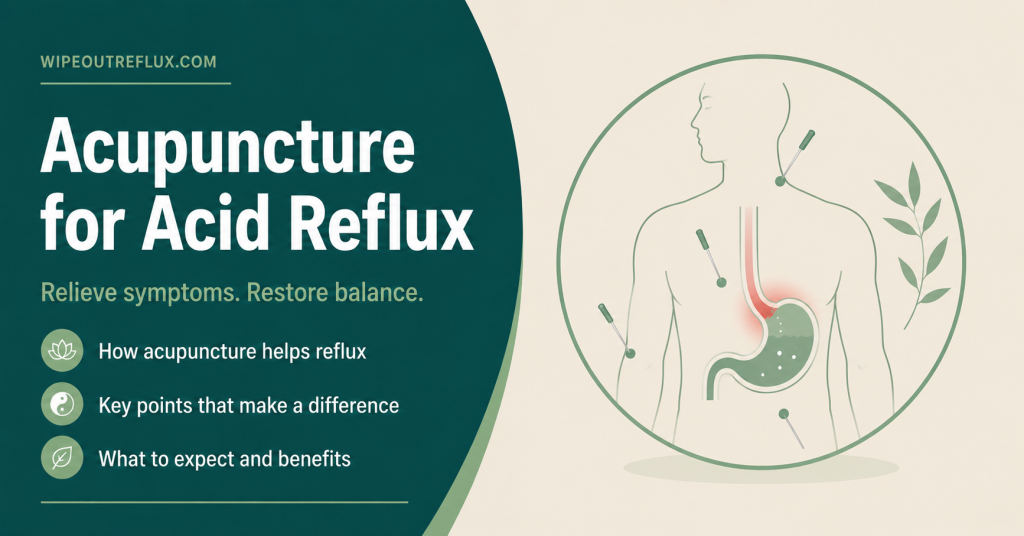
Can acupuncture actually help acid reflux? The honest answer is a qualified yes: for some people it does, the mechanism is plausible, and there are real trials behind it — but the evidence is thinner and shakier than acupuncture clinics tend to admit. The most interesting finding is that acupuncture seems to help most in exactly the situation where standard treatment lets people down: reflux symptoms that don’t respond to a proton pump inhibitor (PPI).
The single best trial found that in patients who still had heartburn on a standard PPI, adding acupuncture worked better than doubling the drug dose. That’s a striking result, because doubling the PPI is the usual next step your doctor reaches for. But it was one small study, and the wider literature is dominated by low-quality trials from a single country, so it’s worth understanding what acupuncture can and can’t realistically do before you book a course.
Here’s what the trials actually show, how acupuncture might work on reflux, and where the evidence falls short — with a particular eye on LPR (silent reflux), the throat-based form that so often shrugs off acid-suppressing drugs.
Key Takeaways
- Acupuncture shows the most promise for refractory reflux — symptoms that persist despite a PPI — where one trial found it more effective than doubling the drug dose.
- A meta-analysis of 12 trials found acupuncture added to standard medication improved symptoms more than medication alone, and acupuncture on its own was linked to lower relapse rates.
- For LPR specifically, a separate meta-analysis found acupuncture alongside usual care improved throat-symptom and laryngoscopy scores, though the studies were small and low quality.
- The plausible mechanism is autonomic and motility-based: acupoint stimulation can reduce transient lower oesophageal sphincter relaxations, the main trigger for reflux events.
- The evidence has real weaknesses — small samples, poor blinding, and most trials coming out of China — so treat acupuncture as a possible add-on, not a proven cure.
- It’s safest and most sensible as a complement to the fundamentals: diet, reflux-reducing habits, and where needed medication — not a replacement for them.
Does acupuncture work for acid reflux?
Let me start with the study that put acupuncture for reflux on the map. Researchers took patients who still had heartburn despite a once-daily PPI — the classic frustrating scenario — and split them into two groups. One group doubled their PPI dose; the other kept the standard dose and added acupuncture. After four weeks, the acupuncture group had significantly better control of their heartburn and regurgitation, while doubling the drug did comparatively little [Dickman et al., Alimentary Pharmacology & Therapeutics, 2007].
That matters because doubling the PPI is exactly what tends to happen next when the first dose isn’t enough, and it often fails — a problem I’ve written about in depth in why reflux medication stops working. If a needle protocol can beat a dose increase in that group, it’s worth taking seriously. The catch is the size: this was 30 patients. One small, unblinded trial is a promising signal, not a verdict.
Zoom out to the broader literature and the picture is encouraging but blurry. A systematic review pooling 12 randomised trials with over 1,200 patients found that acupuncture combined with standard Western medication improved overall symptoms more than medication alone, and that acupuncture by itself was associated with markedly lower recurrence rates. But the same authors were blunt about the caveat: the trials were small and methodologically weak, so the conclusions need better studies to confirm them [Zhu et al., Acupuncture in Medicine, 2017].
How acupuncture might actually work on reflux
This is where I want to be mechanism-first, because “it balances your energy” isn’t an explanation I find useful. The more credible story is about your nervous system and your valves.
Most reflux doesn’t happen because your stomach is simply too acidic. It happens because the lower oesophageal sphincter — the ring of muscle meant to keep stomach contents down — relaxes at the wrong moments. These are called transient lower oesophageal sphincter relaxations, and they’re the single biggest trigger of reflux events. Here’s the interesting bit: in controlled physiology studies, stimulating the acupoint on the inner wrist (PC6, the same point used for nausea) reduced the rate of these inappropriate relaxations, and with it the number of reflux episodes [Zou et al., American Journal of Physiology-Gastrointestinal and Liver Physiology, 2005].
The proposed route is the vagus nerve and the wider autonomic system. Acupuncture appears to nudge the balance between the “fight or flight” and “rest and digest” branches, and that shift can influence sphincter behaviour, gastric emptying and gut sensitivity. If your reflux is driven more by a lax or trigger-happy valve and a jangled nervous system than by raw acid volume, you can see why acid-suppressing drugs might underwhelm while something that acts on motility and tone could help. It’s also why acupuncture sits comfortably alongside other natural approaches to LPR that target the mechanism rather than just the acid.
Acupuncture for LPR and silent reflux
LPR is where I’m most interested, because it’s the form that most often defeats standard treatment. In silent reflux, the damage is done in the throat and voice box by pepsin and acid, and PPIs frequently disappoint — the reasons for which I’ve laid out in why PPIs don’t work for LPR. So an add-on that might help the non-responders is exactly what this group needs.
There is LPR-specific evidence, and it points the same way as the GERD data. A meta-analysis of seven trials in nearly 700 LPR patients found that acupuncture added to usual treatment improved throat symptoms more than usual treatment alone, with meaningful reductions in the Reflux Symptom Index and the Reflux Finding Score — the two standard measures of how bad LPR is by symptoms and by what the ENT sees on the scope. It even reported a small rise in upper oesophageal sphincter pressure, which would fit the mechanism [Oh et al., Journal of Acupuncture Research, 2023].
Encouraging — but I have to flag the same problem the authors did: every one of those trials was conducted in China, the samples were small, and the overall quality of evidence was rated low. That doesn’t make the finding wrong, but it does mean the effect could be smaller than reported once better-designed, blinded trials are run. If you want the fuller distinction between the two conditions, my guide to GERD vs LPR is a good primer.
Where the evidence falls short
I’d be doing you a disservice if I sold acupuncture harder than the data allows, so here’s the honest ledger. The trials are almost all small. Blinding is genuinely hard with acupuncture — it’s difficult to give a convincing “fake” needle, and the strong placebo response that surrounds any hands-on ritual can inflate results. Most of the studies come from a single research culture, which tends to produce more uniformly positive findings than the global literature does. And the outcomes are mostly symptom scores over a few weeks, not long-term healing or objective reflux measurements.
None of that means acupuncture is useless. It means the appropriate confidence level is “plausibly helpful for some people, especially as an add-on when drugs fall short,” not “proven treatment.” Acupuncture is also generally very safe in trained hands, with side effects usually limited to minor bruising, so the risk-benefit balance is reasonable if you go in with realistic expectations and don’t abandon the things that do the heavy lifting.
Should you try it?
If your reflux is well controlled by simple measures, you probably don’t need it. Where I think acupuncture is most worth a look is the refractory situation — ongoing heartburn or throat symptoms despite a PPI and sensible habits — because that’s precisely the group the evidence favours, and it’s a group with few good options. Treat it as a several-week trial from a properly qualified practitioner, keep track of your symptom scores, and judge it on your own results.
Crucially, don’t let it replace the foundations. Acupuncture might calm a trigger-happy valve, but it can’t undo a diet full of reflux triggers or a habit of eating late and lying down. The people who get the best results pair any add-on like this with a genuinely reflux-friendly way of eating — which is where the real, durable change comes from.
Conclusion
Acupuncture for acid reflux is one of the more legitimate members of the complementary-therapy family: there’s a plausible mechanism, there are randomised trials, and the standout finding — beating a doubled PPI dose in people who weren’t responding — speaks directly to the frustration so many readers write to me about. But the evidence is early and imperfect, so I’d frame it as a reasonable add-on to try, not a cure to bank on, and certainly not a reason to skip the fundamentals.
Because those fundamentals are what actually move the needle for most people, that’s where I’d put your energy first, and it comes down to what you eat and drink. The Wipeout Diet Plan is the complete, step-by-step method I built for calming reflux at its source — it was designed first and foremost around LPR, the stubborn throat-based form that so often ignores medication, but because it works on the same underlying reflux mechanisms it’s every bit as effective for GERD, heartburn and classic acid reflux. If you want a lighter starting point, the Wipeout Food Reference Guide is the essential companion, laying out which foods and drinks are safe for acid reflux and LPR along with their pH values, so you can strip out the triggers first. Get the diet right, and anything you add on top — acupuncture included — is working with you rather than against a tide of triggers.
Frequently Asked Questions
Does acupuncture really work for acid reflux?
There is genuine trial evidence that it can help, especially for reflux that hasn’t responded to a PPI. One randomised study found adding acupuncture beat doubling the drug dose, and a meta-analysis found it improved symptoms as an add-on to medication. But the trials are mostly small and low quality, so it’s best seen as a promising complementary option rather than a proven standalone treatment.
How does acupuncture help reflux?
The most credible mechanism is through the nervous system and the reflux valves. Stimulating certain acupoints can reduce transient relaxations of the lower oesophageal sphincter — the main trigger for reflux — and shift autonomic balance toward “rest and digest,” which influences gut motility and sensitivity. In other words, it may act on the mechanism of reflux rather than on stomach acid.
Can acupuncture help LPR or silent reflux?
Possibly. A meta-analysis of LPR trials found acupuncture added to usual care improved throat-symptom scores and laryngoscopy findings more than usual care alone. LPR is also the form that most often fails to respond to PPIs, so an add-on that helps non-responders is appealing — but the evidence is low quality and comes from small studies, so keep expectations measured.
Is acupuncture safe to try for reflux?
In the hands of a trained, licensed practitioner using sterile single-use needles, acupuncture is generally very safe, with side effects usually limited to minor bruising or soreness. The main risk is opportunity cost — relying on it instead of proven measures like diet, reflux-reducing habits and, where needed, medication. Use it as a complement, not a replacement.
How many acupuncture sessions do I need for reflux?
The trials typically ran courses of around two sessions a week for four weeks or more before judging the effect. If you try it, treat it as a defined trial over several weeks, track your symptoms with something like a Reflux Symptom Index score, and decide based on whether you actually improve rather than on open-ended commitment.
Research & References
- Randomised controlled trial in patients with heartburn refractory to a standard-dose PPI, finding that adding acupuncture controlled symptoms significantly better than doubling the PPI dose over four weeks [Dickman et al., Alimentary Pharmacology & Therapeutics, 2007].
- Systematic review and meta-analysis of 12 randomised trials (over 1,200 patients) reporting that acupuncture combined with Western medication improved global symptoms more than medication alone, and that acupuncture alone was associated with lower recurrence — while cautioning that the included trials were small and of poor methodological quality [Zhu et al., Acupuncture in Medicine, 2017].
- Physiology study showing that electrical stimulation of the PC6 acupoint reduced the rate of transient lower oesophageal sphincter relaxations — the main mechanism behind reflux events — supporting a motility-based explanation for how acupuncture may work [Zou et al., American Journal of Physiology-Gastrointestinal and Liver Physiology, 2005].
- Systematic review and meta-analysis of seven trials (nearly 700 patients) in laryngopharyngeal reflux, finding acupuncture added to usual treatment reduced the Reflux Symptom Index and Reflux Finding Score more than usual treatment alone, with the authors noting low overall quality of evidence [Oh et al., Journal of Acupuncture Research, 2023].

David Gray
12 years living with LPR · Consultant & researcher
I've lived with LPR for twelve years — the misdiagnoses, the PPI courses that did nothing, the slow work of figuring out what actually helps. Wipeout Reflux is where I translate the research into plain terms for people stuck in the same place. Every claim here is sourced to peer-reviewed work, and I consult one-to-one with LPR sufferers.