
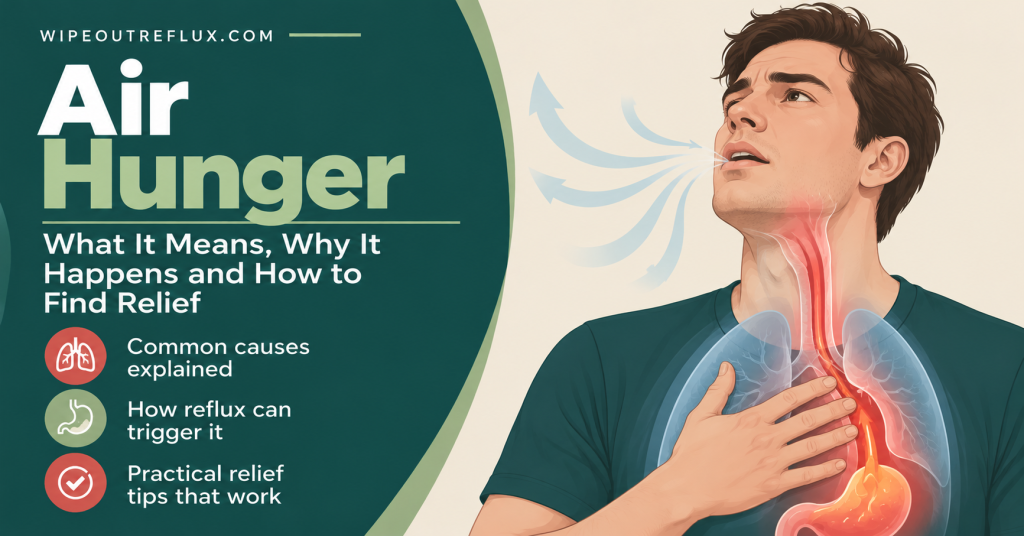
Air hunger is the feeling that you can’t get a satisfying breath. You breathe in and it doesn’t “land”. The breath feels incomplete, so you try again, take a bigger one, yawn or sigh, and you still don’t get the click of a full breath. It’s different from ordinary shortness of breath, where you’re breathing fast because you’ve run for a bus. With air hunger you can often breathe perfectly well. It just doesn’t feel like enough.
The most common causes are a disordered breathing pattern (often linked to stress or anxiety), heart and lung conditions, anemia, and, less well known, irritation in the throat and voice box from reflux. If your pulse oximeter says your oxygen is fine but you still feel like you can’t breathe, that combination usually points away from your lungs and towards the way you’re breathing, or towards your throat.
I’ve heard this exact story from readers many times: an ENT diagnosis of LPR, a lump in the throat, constant yawning, and “I feel like I can’t breathe even though my oxygen is fine”. This article explains why that happens and what helps, starting with the warning signs that mean you shouldn’t wait.
Key Takeaways
- Air hunger is the sensation of an unsatisfying or incomplete breath. It’s not the same as breathing hard or being out of breath.
- Researchers treat air hunger as a distinct type of breathlessness, and it’s rated as more unpleasant than the effort of breathing hard.
- A normal oxygen reading is reassuring for your lungs, but it doesn’t rule out anemia, some heart problems or a blood clot, so new symptoms still need checking.
- Frequent yawning and sighing are often the body trying to “reset” a breath that feels incomplete, and are typical of dysfunctional breathing.
- LPR can cause air hunger by irritating the voice box, creating a tight or lump-like throat, and making the larynx overreact.
- Anxiety and air hunger feed each other. Treating only one side of the loop rarely works.
- Slow, low breathing exercises, reducing reflux reaching the throat, and calming the larynx are the main tools that help.
When Air Hunger Needs Urgent Help
Call emergency services (999 in the UK, 911 in the US) if the breathlessness comes with any of these:
- Chest pain, pressure or tightness, especially if it spreads to your arm, jaw, neck or back
- Sudden breathlessness that came on out of nowhere, or is getting rapidly worse
- Blue or grey lips, face or fingertips
- An oxygen reading that is low for you (below about 92% in most healthy adults) or falling
- Coughing up blood, or a painful, swollen calf (possible blood clot)
- Noisy, high-pitched breathing (stridor), or swelling of the lips, tongue or throat
- Fainting, confusion, or being too breathless to speak in full sentences
See a doctor soon (within days, not months) if your air hunger is new, gets worse with exertion, wakes you at night gasping, comes with ankle swelling, a racing or irregular heart, wheeze, unexplained weight loss or extreme tiredness. Reflux is a common cause of air hunger, but heart and lung problems, anemia and blood clots should be ruled out first, not last.
What Is Air Hunger? (And What It Isn’t)
“Shortness of breath” is a loose phrase that covers several different sensations. Breathing scientists split it into distinct types, and the American Thoracic Society’s statement on breathlessness describes at least three: air hunger (an unsatisfied urge to breathe), work or effort (breathing feels hard), and chest tightness [Parshall et al., American Journal of Respiratory and Critical Care Medicine, 2012].
Air hunger is the feeling you get towards the end of holding your breath: a primal urge to breathe that isn’t satisfied. One of the leading researchers in the field describes it as the most distressing component of breathlessness, and notes that a full expansion of the lungs is one of the things that relieves it [Banzett et al., Comprehensive Physiology, 2021]. That explains why people with air hunger keep trying to take one big, deep breath. They’re chasing that sense of a complete breath.
It’s also why air hunger feels so frightening. In laboratory studies, air hunger was rated as more unpleasant than hard breathing, even when both were rated as equally intense [Banzett et al., American Journal of Respiratory and Critical Care Medicine, 2008]. Brain imaging shows it activates areas involved in fear and anxiety. So if this sensation has made you panic, that isn’t weakness. It’s what the sensation is designed to do.
Air hunger vs shortness of breath
- Shortness of breath from exertion or lung disease: you’re breathing fast or hard, often on exertion, and your body genuinely needs more air.
- Air hunger: you can breathe, often at rest, but each breath feels unsatisfying. It often comes with yawning, sighing, a need to take “one more” deep breath, and a feeling that your chest or throat won’t open fully.
- Chest tightness: a squeezing or constricted feeling, which can come from asthma, the heart, or reflux in the esophagus. My article on acid reflux and chest tightness covers that one.
If your main problem is genuinely being out of breath, wheezy or breathless on stairs, my guide to silent reflux and shortness of breath is the better read. This article is about the unsatisfying breath specifically.
“But My Oxygen Level Is Good”: Why That Happens
A pulse oximeter measures how much of the hemoglobin in your blood is carrying oxygen. If you have air hunger but a normal reading, it usually means your lungs are moving oxygen into your blood perfectly well. The problem lies in the sensation of breathing, or in your breathing pattern, rather than in gas exchange.
In fact, people who over-breathe (taking big sighs and deep breaths to chase that satisfying breath) often show oxygen readings of 98 to 100%. Over-breathing pushes down carbon dioxide, and low carbon dioxide can cause tingling, lightheadedness, chest tightness and, paradoxically, more air hunger. That’s one reason the feeling can snowball.
That said, a normal reading doesn’t clear everything. Anemia lowers the amount of oxygen your blood can carry while the percentage stays normal. Some heart problems and early blood clots can also give normal readings at rest. That’s why new or worsening air hunger needs a proper check-up, even if your oximeter looks fine.
Common Causes of Air Hunger
Dysfunctional breathing
Dysfunctional breathing (also called breathing pattern disorder) means your breathing pattern has changed in a way that causes breathlessness without enough heart or lung disease to explain it. A major review classified it into several types, including hyperventilation syndrome, periodic deep sighing (frequent sighs with an irregular breathing pattern), and upper-chest dominant breathing [Boulding et al., European Respiratory Review, 2016]. Most people with persistent air hunger and normal tests fit somewhere in this group, and it’s very treatable.
Anxiety
Anxiety and air hunger have a two-way relationship. Anxiety changes how you breathe (higher, faster, with more sighs), and the unsatisfying breath that results feels threatening, which raises anxiety further. Anxiety air hunger is real. It isn’t “all in your head”, it’s a physical breathing pattern that anxiety switches on. If reflux has made you anxious, see does silent reflux cause anxiety and health anxiety and acid reflux.
Heart, lung and blood causes
Asthma, COPD, heart failure, heart rhythm problems, anemia, thyroid problems and blood clots can all cause breathlessness that’s sometimes described as air hunger. These are the causes your doctor will want to rule out first, usually with an examination, blood tests (including a full blood count), an ECG and sometimes a chest X-ray or breathing tests.
Reflux and the larynx
This is the cause that almost nobody mentions, and the one I see most in readers with LPR. It has its own section below.
How LPR Can Cause Air Hunger
Laryngopharyngeal reflux (LPR) is reflux that reaches the throat and voice box. Most people with LPR don’t get heartburn, so they often don’t connect their breathing symptoms with reflux at all. But “breathing difficulties or choking episodes” is one of the nine items on the Reflux Symptom Index, the standard LPR questionnaire [Belafsky et al., Journal of Voice, 2002]. Breathing symptoms are part of LPR, not separate from it.
Here’s how I understand the mechanisms.
1. The throat feels narrowed
Reflux reaching the throat can leave the tissue around the voice box swollen and irritated. Pepsin, the stomach’s protein-digesting enzyme, can stick to throat tissue and be reactivated by later acid exposure, so the irritation can last for months [Johnston et al., The Laryngoscope, 2007]. When your throat feels thick, tight or blocked, the brain reads that as “the airway isn’t fully open”, and every breath feels like it’s coming through a straw, even though airflow is normal.
This is the same mechanism behind globus, the lump-in-the-throat feeling, which is why air hunger and globus so often show up together. See my guide to the lump in throat from reflux.
2. The larynx becomes oversensitive
Repeated irritation can make the larynx hypersensitive, so it overreacts to normal triggers like talking, cold air, perfume or swallowing. A recent review building on the San Diego consensus on throat symptoms found that hypersensitivity, hypervigilance and symptom-specific anxiety were more strongly linked to ongoing throat symptoms than the amount of reflux measured on testing [Walsh et al., Neurogastroenterology and Motility, 2026]. In other words, once the larynx is sensitized, it can keep sending “something’s wrong” signals even when reflux is better controlled. I cover this in more depth in laryngeal sensory neuropathy.
3. The vocal cords can close when they shouldn’t
In some people, an irritated larynx starts to partly close on breathing in, a condition called inducible laryngeal obstruction (ILO), or vocal cord dysfunction. Reflux, LPR and ILO overlap so much that specialists describe them as conditions that are difficult to tell apart from each other and from asthma [Eapen et al., Journal of Allergy and Clinical Immunology, 2024]. ILO typically causes difficulty breathing in, throat tightness and sometimes noisy breathing. See vocal cord dysfunction vs silent reflux and, for sudden episodes where the throat snaps shut, laryngospasm from silent reflux.
4. Reflux, anxiety and breathing pattern lock together
This is the loop I see most often. Throat symptoms create worry, worry shifts breathing up into the chest with lots of sighs, the breathing pattern makes air hunger worse, and the air hunger makes you more focused on your throat. Each part keeps the others going, which is why treating reflux alone sometimes isn’t enough, and why breathing work alone sometimes isn’t either.
Air Hunger and Yawning
Constant yawning is one of the most recognizable features of air hunger. You yawn to get a full breath, but the yawn often doesn’t “complete”. It gets stuck partway, so you try again, and again.
The best explanation comes from research on sighs. A sigh (and a yawn works in a similar way) is a large breath that seems to “reset” the breathing system, stretching the lungs and briefly relieving that unsatisfied feeling. Occasional sighs help regulate breathing and emotional state, but researchers suggest that excessive sighing becomes counterproductive and disrupts breathing regulation rather than restoring it [Vlemincx et al., Biological Psychology, 2022]. Each big breath blows off more carbon dioxide, which leaves the next breath feeling just as unsatisfying.
Why does the yawn get stuck? Nobody has studied this properly, so I’ll be careful. But a yawn needs the throat to open wide, and in people with a swollen, irritated or tight larynx, that full opening often feels blocked. Many readers with LPR describe exactly this: the yawn starts, catches at the throat, and doesn’t finish. It fits with everything above, but it’s an observation rather than proven science.
The practical point: chasing the perfect yawn or sigh tends to keep the cycle going. The fix is usually to breathe less, not more (see the exercises below).
Air Hunger After Eating
If your air hunger is worse after meals, there are a few likely reasons:
- A full stomach pushes up on the diaphragm, reducing how far your lungs can expand, especially after a large meal or if you’re bloated.
- A hiatal hernia can make this worse, since part of the stomach sits above the diaphragm. See hiatal hernia and reflux.
- Meals trigger reflux, and after-meal reflux reaching the throat can bring on the tight, narrowed feeling.
- Swallowed air and trapped gas add pressure and bloating.
Smaller meals, slowing down, and staying upright for a few hours after eating usually help. My article on shortness of breath after eating goes into this in more detail.
Is It Reflux? Signs That Point to the Throat
Your air hunger may be reflux-related if:
- Your heart, lungs and bloods have been checked and look normal
- Your oxygen readings are consistently normal, even during episodes
- It comes with a lump in the throat, throat clearing, hoarseness, a postnasal drip feeling or a chronic cough
- It’s worse after meals, when lying down, or the morning after a late dinner
- You’ve had an ENT tell you your larynx looks irritated or red
- Talking, cold air or strong smells make your throat tighten
If several fit, try the Reflux Symptom Index. A score over 13 suggests reflux is likely to be involved.
How to Fix Air Hunger
The approach depends on the cause, so get checked first. If you’ve been told your heart and lungs are fine and LPR or anxiety is in the picture, these are the things I’d focus on.
1. Breathing exercises for air hunger
The aim is to breathe lower, slower and smaller, so carbon dioxide can come back up to normal and the urge to sigh fades. It feels counterintuitive, because you want a bigger breath, but this is what calms the cycle.
- Get comfortable. Sit back, drop your shoulders, and put one hand on your chest and one on your belly.
- Breathe through your nose. Nose breathing naturally slows and softens your breathing.
- Let the belly move, not the chest. Breathe in gently so the lower hand rises and the upper hand stays fairly still.
- Make the breath smaller than you want. A soft, quiet in-breath for about three or four seconds, then a slow, relaxed out-breath for five or six.
- Pause briefly at the end of the out-breath before the next breath comes in on its own.
- Swallow a sigh or yawn. When the urge to sigh comes, swallow instead, or take a small sip of air and hold it for a second, then breathe out slowly.
Practice for five to ten minutes, two or three times a day, not only when you feel breathless. You’re retraining a habit, which takes a few weeks. Breathing retraining is supported by good evidence: in a UK trial of 655 people with asthma, a self-guided breathing retraining programme improved quality of life as much as face-to-face physiotherapy [Bruton et al., The Lancet Respiratory Medicine, 2018]. There’s a bonus for reflux too: a 2026 meta-analysis of ten trials found diaphragmatic breathing modestly improved GERD symptom scores, though the studies varied a lot [Abureesh et al., Journal of Clinical Medicine, 2026]. My guide to breathing exercises for acid reflux has more techniques.
If you’re struggling, ask your GP for a referral to a respiratory physiotherapist who treats breathing pattern disorder. For throat tightness and ILO, a speech and language therapist is the right specialist. See voice therapy for silent reflux.
2. Reduce the reflux reaching your throat
If reflux is irritating your larynx, the throat won’t settle while it keeps getting hit. This is the part I’ve spent twelve years working on, and diet is where I’d start. Acidic food and drink can reactivate pepsin that’s already sitting in the throat. My Wipeout Diet Plan walks you through a low-acid way of eating that gives your throat a chance to calm down. The list of LPR foods to avoid is a good place to begin.
- Use an alginate such as Gaviscon Advance after meals and at bedtime to form a protective raft over the stomach contents. See alginates for acid reflux.
- Stop eating about three hours before bed. See how long before bed you should stop eating.
- Raise the head of your bed and avoid big, late meals.
- Learn how to neutralize pepsin in the throat.
3. Calm the larynx
- Cut down on hard throat clearing, which keeps the voice box irritated. Swap it for a sip of water and a firm swallow.
- Stay hydrated and use a humidifier if your air is dry.
- If a trigger (cold air, perfume, talking) brings on throat tightness, try “sniff” breathing: two short sniffs in through the nose, then a slow breath out through pursed lips. Speech therapists use this to help open the vocal cords.
4. Break the anxiety loop
- Remind yourself during episodes: “My oxygen is fine. This is a sensation, not suffocation.” Naming it takes away some of its power.
- Stop checking your oximeter repeatedly once you know your readings are normal, since checking keeps your attention locked on breathing.
- CBT, mindfulness and gut-directed hypnotherapy can help where anxiety is a big driver.
Expect gradual improvement rather than an overnight fix. Most people notice the episodes getting shorter and less frightening before they stop altogether.
Conclusion
Air hunger is one of the most unsettling symptoms there is: the feeling that you can’t get a full, satisfying breath, often with constant yawning and sighing, even though your oxygen level is perfectly normal. Once heart, lung and blood causes have been ruled out, the usual culprits are a disordered breathing pattern, anxiety, and an irritated, oversensitive throat, and for many people with LPR, all three at once.
The good news is that each of those can be worked on. Breathing retraining calms the pattern, understanding the sensation takes the fear out of it, and reducing the reflux that reaches your throat lets the larynx settle so it stops sending “blocked” signals. For that last part, the Wipeout Diet Plan is where I’d start. It’s my complete, step-by-step plan for taking the acid out of your meals and drinks so pepsin stops irritating your throat. I built it around LPR, the throat-based form of reflux behind most of these breathing symptoms, but because it works on the same root causes, it helps just as much with classic GERD and heartburn.
If you’d prefer to start with something lighter, the Wipeout Food Reference Guide is the essential companion. It lists the foods and drinks that are safe for acid reflux and LPR along with their pH values, so you can check what you’re eating at a glance while your throat recovers.
Frequently Asked Questions
What does air hunger feel like?
Most people describe it as not being able to get a satisfying or complete breath. You can breathe in, but it doesn’t feel like enough, so you keep taking deep breaths, yawning or sighing. It’s often worse at rest and can come with a tight throat or chest.
Why do I feel like I can’t breathe when my oxygen is fine?
Because the problem is usually the sensation or pattern of breathing, not your lungs’ ability to get oxygen in. Dysfunctional breathing, anxiety and an irritated larynx can all create air hunger with normal readings. Anemia and some heart problems can also cause it with a normal oximeter reading, so get new symptoms checked.
Can acid reflux cause air hunger?
Yes. Reflux reaching the throat (LPR) can irritate and swell the voice box, make the larynx oversensitive, and sometimes trigger vocal cord dysfunction. All of these can make breathing feel blocked or incomplete. Breathing difficulty is one of the symptoms on the Reflux Symptom Index.
Why does air hunger make me yawn so much?
A yawn is a large stretch breath that briefly relieves the unsatisfied feeling, so your body keeps reaching for it. But frequent yawning and sighing lower carbon dioxide and disrupt your breathing pattern, which keeps the air hunger going. Gentle, smaller breaths work better.
Is air hunger a sign of anxiety?
It often is, but not always. Anxiety commonly causes air hunger through changes in breathing pattern, and air hunger in turn makes anxiety worse. Because heart and lung conditions can cause the same feeling, it’s worth seeing a doctor before putting it down to anxiety.
How do I stop air hunger quickly?
Sit down, drop your shoulders, and breathe slowly through your nose into your belly, keeping the breaths smaller than you want. Breathe out for longer than you breathe in. Swallow instead of sighing. Most episodes ease within a few minutes once your breathing slows.
How long does air hunger last?
Individual episodes usually last minutes, but the pattern can persist for weeks or months if the underlying cause isn’t addressed. With breathing retraining and reflux control, most people see steady improvement over four to twelve weeks.
Research & References
- [Parshall et al., American Journal of Respiratory and Critical Care Medicine, 2012] — Official American Thoracic Society statement on breathlessness, describing distinct sensations including air hunger, work/effort and chest tightness.
- [Banzett et al., Comprehensive Physiology, 2021] — Review defining air hunger as the urge to breathe, noting it is the most debilitating and most common component of clinical breathlessness, activates fear and anxiety areas of the brain, and is relieved by lung expansion.
- [Banzett et al., American Journal of Respiratory and Critical Care Medicine, 2008] — Laboratory study in healthy volunteers showing air hunger is rated as more unpleasant than the work and effort of breathing at similar intensity.
- [Boulding et al., European Respiratory Review, 2016] — Review proposing a classification of dysfunctional breathing, including hyperventilation syndrome, periodic deep sighing and thoracic-dominant breathing.
- [Belafsky et al., Journal of Voice, 2002] — Developed the Reflux Symptom Index, a nine-item LPR questionnaire that includes breathing difficulties or choking episodes; scores above 13 are considered abnormal.
- [Johnston et al., The Laryngoscope, 2007] — Showed pepsin remains stable in the throat and can be reactivated by acid, helping explain ongoing laryngeal irritation.
- [Walsh et al., Neurogastroenterology and Motility, 2026] — Review building on the San Diego consensus, reporting that laryngeal hypersensitivity, hypervigilance and symptom-specific anxiety are more strongly linked to persistent throat symptoms than measured reflux, and outlining behavioral therapies.
- [Eapen et al., Journal of Allergy and Clinical Immunology, 2024] — Review of GERD, LPR and vocal cord dysfunction/inducible laryngeal obstruction as overlapping conditions that are hard to distinguish from each other and from asthma.
- [Vlemincx et al., Biological Psychology, 2022] — Review proposing that sighs reset breathing and emotional state, but that excessive sighing becomes maladaptive and disrupts regulation.
- [Bruton et al., The Lancet Respiratory Medicine, 2018] — UK randomized trial of 655 people with asthma showing breathing retraining, delivered by DVD or face to face, improved quality of life compared with usual care.
- [Abureesh et al., Journal of Clinical Medicine, 2026] — Meta-analysis of ten randomized trials (476 patients) finding diaphragmatic breathing modestly improved GERD symptom scores, with substantial variation between studies.

David Gray
12 years living with LPR · Consultant & researcher
I've lived with LPR for twelve years — the misdiagnoses, the PPI courses that did nothing, the slow work of figuring out what actually helps. Wipeout Reflux is where I translate the research into plain terms for people stuck in the same place. Every claim here is sourced to peer-reviewed work, and I consult one-to-one with LPR sufferers.