
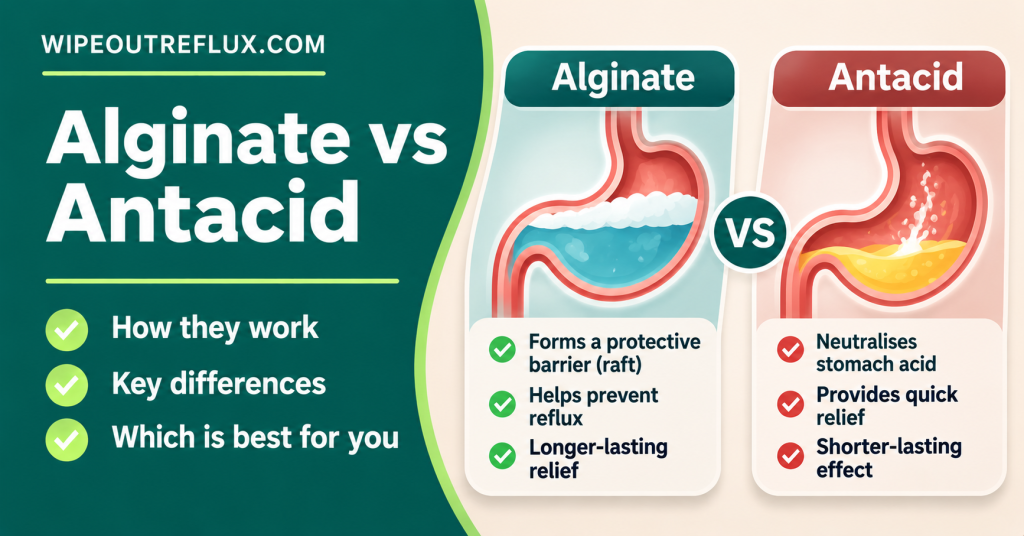
An antacid and an alginate both relieve reflux, but they work in completely different ways. An antacid (like Tums, Rolaids or Maalox) is a base that neutralizes acid already in your stomach. It makes reflux less acidic, but it doesn’t stop reflux from happening. An alginate (like Gaviscon Advance) turns into a floating gel “raft” on top of your stomach contents, which physically holds them down so less reflux reaches your esophagus and throat.
That difference decides which one you should reach for. Antacids are great for quick relief from occasional heartburn. Alginates are better for regular post-meal reflux, nighttime symptoms, regurgitation and especially LPR, where pepsin reaching the throat matters as much as acid. Many products, including most Gaviscon formulas, are “alginate antacids” that combine both, and the balance between the two changes how well they work.
Key Takeaways
- Antacids change the chemistry of stomach acid. Alginates create a physical barrier against reflux.
- Antacids work within minutes but wear off fairly quickly. An alginate raft is designed to stay in place after a meal.
- After a meal, a pocket of acid floats on top of your food near the top of the stomach. Alginate rafts settle in that same spot, while plain antacids sink lower down.
- In head-to-head studies, alginates reduced post-meal reflux more than antacids and delayed the first reflux episode.
- An antacid makes refluxed liquid less acidic but does nothing to stop pepsin reaching the throat. That’s why alginates suit LPR far better.
- “Alginate antacid” products contain both. Formulas heavy on antacid with no calcium source form weaker rafts, and US Gaviscon is mostly antacid.
- For occasional heartburn, an antacid is fine. For frequent, nighttime or throat-based reflux, an alginate after meals and at bedtime is the better tool.
What’s the Difference Between an Alginate and an Antacid?
Here’s the simplest way I can put it. An antacid tries to make the acid less harmful. An alginate tries to keep the acid where it belongs.
- How it works: antacids neutralize acid chemically. Alginates form a floating gel barrier.
- Does it reduce reflux? Antacids don’t. Reflux still happens, it’s just less acidic. Alginates reduce how much comes up, especially after meals.
- Where it sits in the stomach: antacids mix in and sink. Alginate rafts float at the top, near the valve.
- Effect on pepsin and non-acid reflux: antacids have none. Alginates physically hold the refluxate back.
- Best timing: antacids work best taken when symptoms hit. Alginates work best after meals and at bedtime, before reflux starts.
- Best for: antacids suit occasional heartburn. Alginates suit frequent reflux, regurgitation, nighttime symptoms and LPR.
Neither one cures reflux. They don’t change why your valve lets stomach contents back up. But knowing how each works helps you pick the right one and stop wasting money on the wrong one.
How Antacids Work
Antacids are alkaline salts. The common ones are:
- Calcium carbonate: Tums, Rolaids
- Magnesium hydroxide or carbonate: milk of magnesia, and part of Maalox and Mylanta
- Aluminum hydroxide: the other half of Maalox, Mylanta and US Gaviscon
- Sodium bicarbonate: baking soda, Alka-Seltzer
When they meet stomach acid, they react with it and raise the pH. If you then reflux, what comes up is less acidic, so it burns less. That’s why antacids feel so fast. In a randomized trial comparing over-the-counter Tums with Pepcid, the calcium carbonate antacid started working quickly but had a short duration of action [Feldman, JAMA, 1996].
The limitation is built into the mechanism. An antacid can only neutralize the acid that’s there when you take it. Your stomach keeps making more, especially after a meal. And because antacids don’t create any barrier, the same volume of stomach contents can still travel up the esophagus. I’ve covered the different types in more detail in what is an antacid, and the safety side of everyday use in are Tums safe for acid reflux.
How Alginates Work
Alginates come from brown seaweed. On their own, they’re just a thickening fiber. Pair them with the right ingredients, though, and they do something clever in your stomach.
Building the raft
- Alginate meets acid and gels. In the acidic stomach, sodium alginate turns into a thick gel.
- Bicarbonate makes it float. The sodium or potassium bicarbonate in the formula reacts with acid to release carbon dioxide. The bubbles get trapped in the gel and lift it to the top of the stomach.
- Calcium makes it stronger. Calcium carbonate releases calcium, which cross-links the alginate chains into a firmer, more cohesive raft.
That third step matters more than most people realize. In a lab study of alginate products, formulas with plenty of antacid but no calcium source formed weak, low-volume rafts that behaved more like floating sludge than a coherent gel. Formulas with a calcium source formed stronger rafts, and the stronger rafts were more resilient and better at resisting reflux [Hampson et al., International Journal of Pharmaceutics, 2005].
Why the raft lands in exactly the right place
After you eat, fresh, highly acidic gastric juice doesn’t mix evenly into your meal. It pools on top of the food, right below the valve at the top of your stomach. Researchers call this the “acid pocket,” and it’s the source of much post-meal reflux.
Because an alginate raft floats, it settles at the same spot. Imaging studies show the raft localizing to the acid pocket and pushing it away from the esophagus [Kwiatek et al., Alimentary Pharmacology and Therapeutics, 2011]. A plain antacid can’t do that. In an MRI study, Gaviscon Advance formed a mass near the junction between esophagus and stomach, while a simple antacid sank to the lower part of the stomach [Sweis et al., Alimentary Pharmacology and Therapeutics, 2013].
For the full picture of how alginates are used, see my guide to alginates for acid reflux.
What the Research Shows When They’re Compared Head to Head
This isn’t just theory. Several studies have put alginates and antacids side by side.
- Fewer reflux episodes, later onset. In a randomized study of 16 people with GERD and large hiatal hernias, an alginate-antacid displaced the acid pocket and significantly reduced acid reflux episodes compared with a plain antacid. The time until the first reflux episode was around 63 minutes with the alginate, versus 14 minutes with the antacid [Rohof et al., Clinical Gastroenterology and Hepatology, 2013].
- Less reflux after meals. In the MRI study above, people with reflux had significantly fewer post-meal reflux events after Gaviscon Advance than after a non-raft-forming antacid [Sweis et al., Alimentary Pharmacology and Therapeutics, 2013].
- Better symptom relief overall. A meta-analysis of 14 trials in 2,095 people found alginates were more effective than placebo or antacids at resolving reflux symptoms [Leiman et al., Diseases of the Esophagus, 2017].
To be fair to antacids, the Sweis study also found that overall acid exposure lower down in the esophagus was similar with both products. The alginate’s biggest advantage is in stopping reflux that rises higher, which is exactly the kind that reaches the throat.
Alginate Antacids: Products That Do Both
This is where people get confused, because most alginate products also contain some antacid. That’s what the search term “alginate antacid” usually refers to. The antacid part neutralizes some acid, and the bicarbonate and carbonate double as the raft-forming ingredients. The question is how the formula is balanced.
- Mainly alginate: UK Gaviscon Advance contains 1,000 mg of sodium alginate per 10 ml with potassium bicarbonate and calcium carbonate [Gaviscon Advance Peppermint Summary of Product Characteristics, Reckitt Benckiser, 2025]. It’s a raft first and an antacid second.
- Balanced alginate antacid: UK Gaviscon Original and Double Action combine alginate with a more meaningful antacid dose, so you get some neutralizing as well as a raft.
- Mainly antacid: US Gaviscon Regular and Extra Strength list aluminum hydroxide and magnesium carbonate as the active ingredients, with alginate only as an inactive ingredient [Gaviscon Liquid Antacid label, Haleon, DailyMed]. Despite the name, it behaves much more like Maalox than like Gaviscon Advance.
If you’re in the US, this is the single most important thing to know. Buying “Gaviscon” at a US pharmacy usually means buying an antacid. My articles on Gaviscon Advance vs Extra Strength and getting Gaviscon Advance in the US explain your options.
Why the Difference Matters So Much for LPR
If you have silent reflux or LPR, this is the section that matters most.
In LPR, much of the damage in the throat comes from pepsin, the digestive enzyme carried up in reflux. Pepsin can stick to throat tissue and reactivate later when it meets acid from food or drink. A lot of LPR reflux is also weakly acidic or non-acid, rising as a fine mist rather than a burning splash.
An antacid doesn’t help with any of that. Making the refluxed liquid less acidic doesn’t stop pepsin landing on your throat tissue, and it does nothing about reflux that wasn’t very acidic to begin with. An alginate works on the problem directly: less reflux rising means less pepsin reaching the throat. Lab studies also suggest Gaviscon Advance can inhibit pepsin activity beyond its neutralizing effect alone [Strugala et al., Journal of Pharmacy and Pharmacology, 2009], though that’s lab evidence, not proof of what happens in your throat.
That’s why, in my experience, antacids can calm heartburn but rarely shift LPR symptoms like throat clearing, hoarseness or a lump in the throat. Gaviscon Advance, taken after meals and at bedtime, has been shown to improve LPR symptom scores and throat findings over six months [McGlashan et al., European Archives of Oto-Rhino-Laryngology, 2009].
Alginate or Antacid: Which Should You Use?
Occasional heartburn after a big meal
An antacid is fine here. It’s cheap, fast and easy to carry. A couple of Tums after an unusually rich dinner is a sensible, low-risk choice. See Tums vs Gaviscon for a product-level comparison.
Reflux after most meals
Use an alginate after meals. The raft covers the post-meal window when the acid pocket is largest and reflux is most likely, and it lasts longer than a quick neutralizing dose.
Nighttime reflux or waking up with symptoms
An alginate at bedtime is the better choice. Lying flat makes reflux easier, and a raft in place is more useful than an antacid that’s already been used up. It’s worth pairing with the basics, such as not eating late and raising the head of your bed.
Regurgitation
Use an alginate. An antacid doesn’t reduce the volume of what comes up. A raft does.
LPR and silent reflux
An alginate, ideally a high-dose one like Gaviscon Advance, after each meal and at bedtime. An antacid alone is unlikely to make much difference to throat symptoms.
Still getting symptoms on a PPI
An alginate is the logical add-on. In a double-blind trial of people still symptomatic on a once-daily PPI, adding Gaviscon Advance reduced reflux symptoms significantly more than placebo [Reimer et al., Alimentary Pharmacology and Therapeutics, 2016]. A PPI reduces acid production, but it doesn’t stop reflux itself, so the raft covers a different part of the problem.
Pregnancy
Both are commonly used, but alginates have the most direct safety data. A prospective study of Liquid Gaviscon in pregnant women reported very few treatment-related side effects and good symptom relief [Strugala et al., ISRN Obstetrics and Gynecology, 2012]. See which antacids are safe in pregnancy before using any product regularly.
Can You Take an Alginate and an Antacid Together?
Yes. Because they work in different ways, there’s no conflict in principle, and many alginate products already contain an antacid. A common approach is to use an alginate as your routine after meals and at bedtime, and keep an antacid for breakthrough heartburn.
Two cautions. First, don’t stack calcium: if your alginate contains calcium carbonate and you’re also taking Tums and a calcium supplement every day, the total adds up. Second, both can affect how some medicines are absorbed, including thyroid hormone, iron, bisphosphonates and certain antibiotics. Leave a gap of about two hours [Gaviscon Advance Peppermint Summary of Product Characteristics, Reckitt Benckiser, 2025].
Getting the Timing Right
- Alginates go after food, not before. The raft needs a meal to float on. Take it shortly after eating.
- Never skip the bedtime alginate dose if you have nighttime or throat symptoms.
- Don’t drink straight after an alginate. Give the raft a little time to settle.
- Antacids go when symptoms start. They neutralize what’s there, so there’s little point taking them in advance.
- Space them from other medicines by about two hours.
Whichever you use, both are short-term tools. They manage reflux after it happens. They don’t reduce how often your stomach contents are pushing upward. Food choices, meal size and timing do that, and that’s where the bigger, lasting improvement comes from. The Wipeout Diet Plan walks you through it step by step.
Conclusion
Alginates and antacids aren’t rival versions of the same thing. They’re different tools. An antacid is a chemical buffer: fast, cheap and good for occasional heartburn, but it doesn’t stop reflux and it does nothing for pepsin. An alginate is a physical barrier. It floats to the exact spot where the post-meal acid pocket sits, reduces how much reflux rises, and in head-to-head studies it beats plain antacids for post-meal reflux.
For frequent reflux, nighttime symptoms, regurgitation and especially LPR, an alginate after meals and at bedtime is the smarter choice. And if you’re in the US, check the label: a lot of what’s sold as “Gaviscon” is really an antacid.
But even the best raft only manages reflux once it’s already happening. If you want to need these products less, the real work is in reducing what drives your reflux in the first place. That’s what the Wipeout Diet Plan is for. It’s my complete guide to the foods, meal patterns and habits that calm reflux. It was designed first for LPR, the stubborn throat-based kind, but because it targets the same underlying triggers, it works just as well for GERD and classic heartburn.
Frequently Asked Questions
What is the difference between an alginate and an antacid?
An antacid neutralizes stomach acid chemically, so reflux is less acidic. An alginate forms a floating gel raft on top of your stomach contents that physically reduces how much reflux reaches your esophagus and throat.
What is an alginate antacid?
An alginate antacid is a product that combines a raft-forming alginate with an antacid, such as UK Gaviscon Original or Double Action. The antacid neutralizes some acid, while the alginate forms a barrier. The balance varies a lot between products.
Is Gaviscon an alginate or an antacid?
It depends which Gaviscon. UK Gaviscon Advance is mainly an alginate. UK Gaviscon Original is an alginate antacid. US Gaviscon Regular and Extra Strength are mainly aluminum and magnesium antacids, with alginate only as an inactive ingredient.
Which works faster, an alginate or an antacid?
Both work within minutes. Antacids give the fastest relief from an acute burn. Alginates form a raft quickly too, but their main advantage is protecting you for longer after a meal.
Are alginates better than antacids for LPR?
Yes. LPR damage is driven largely by pepsin and by reflux that rises high enough to reach the throat. Antacids don’t stop either. Alginates reduce how much reflux rises, and Gaviscon Advance has trial evidence in LPR.
Can I take an alginate and an antacid together?
Generally yes, as they work differently. Many people use an alginate after meals and at bedtime, and keep an antacid for breakthrough heartburn. Watch your total calcium intake and keep a two-hour gap from other medicines.
Do alginates neutralize stomach acid?
Pure alginate doesn’t, but most alginate products contain a bicarbonate or carbonate that neutralizes some acid as it forms the raft. Their main job is blocking reflux rather than neutralizing acid.
Research & References
- [Feldman, JAMA, 1996] — Randomized, double-blind, placebo-controlled trial comparing over-the-counter famotidine with a calcium carbonate antacid (Tums), showing the antacid had a rapid onset but short duration of action.
- [Hampson et al., International Journal of Pharmaceutics, 2005] — In vitro study of alginate products showing that formulas with high antacid content and no calcium source formed weak rafts, while stronger rafts were more resilient and resisted reflux better.
- [Kwiatek et al., Alimentary Pharmacology and Therapeutics, 2011] — Study in symptomatic GERD patients showing an alginate-antacid formulation can eliminate or displace the post-meal acid pocket.
- [Sweis et al., Alimentary Pharmacology and Therapeutics, 2013] — MRI and pH-impedance study. Gaviscon Advance formed a mass near the esophagogastric junction while a simple antacid sank to the distal stomach, and Gaviscon Advance significantly reduced post-meal reflux events compared with the antacid.
- [Rohof et al., Clinical Gastroenterology and Hepatology, 2013] — Randomized study in 16 GERD patients. Compared with an antacid, the alginate-antacid localized to and displaced the acid pocket, reduced acid reflux episodes and delayed the first reflux episode (63 vs 14 minutes).
- [Leiman et al., Diseases of the Esophagus, 2017] — Meta-analysis of 14 studies (2,095 people) finding alginates more effective than placebo or antacids for GERD symptoms.
- [Strugala et al., Journal of Pharmacy and Pharmacology, 2009] — In vitro models showing Gaviscon Advance inhibited pepsin activity in a dose-dependent way, over and above its neutralizing effect.
- [McGlashan et al., European Archives of Oto-Rhino-Laryngology, 2009] — Randomized study in 49 LPR patients. Gaviscon Advance 10 ml four times daily significantly improved Reflux Symptom Index and Reflux Finding Score compared with no treatment.
- [Reimer et al., Alimentary Pharmacology and Therapeutics, 2016] — Double-blind trial in 136 patients still symptomatic on a once-daily PPI. Adding Gaviscon Advance reduced reflux symptoms significantly more than placebo.
- [Strugala et al., ISRN Obstetrics and Gynecology, 2012] — Prospective study of Liquid Gaviscon for heartburn in pregnancy, reporting very few treatment-related adverse events and high efficacy.
- [Gaviscon Advance Peppermint Summary of Product Characteristics, Reckitt Benckiser, 2025] — Official UK prescribing information listing composition and the recommended two-hour gap from other medicines.
- [Gaviscon Liquid Antacid label, Haleon, DailyMed] — US Gaviscon label listing aluminum hydroxide and magnesium carbonate as active ingredients and sodium alginate as an inactive ingredient.

David Gray
12 years living with LPR · Consultant & researcher
I've lived with LPR for twelve years — the misdiagnoses, the PPI courses that did nothing, the slow work of figuring out what actually helps. Wipeout Reflux is where I translate the research into plain terms for people stuck in the same place. Every claim here is sourced to peer-reviewed work, and I consult one-to-one with LPR sufferers.