
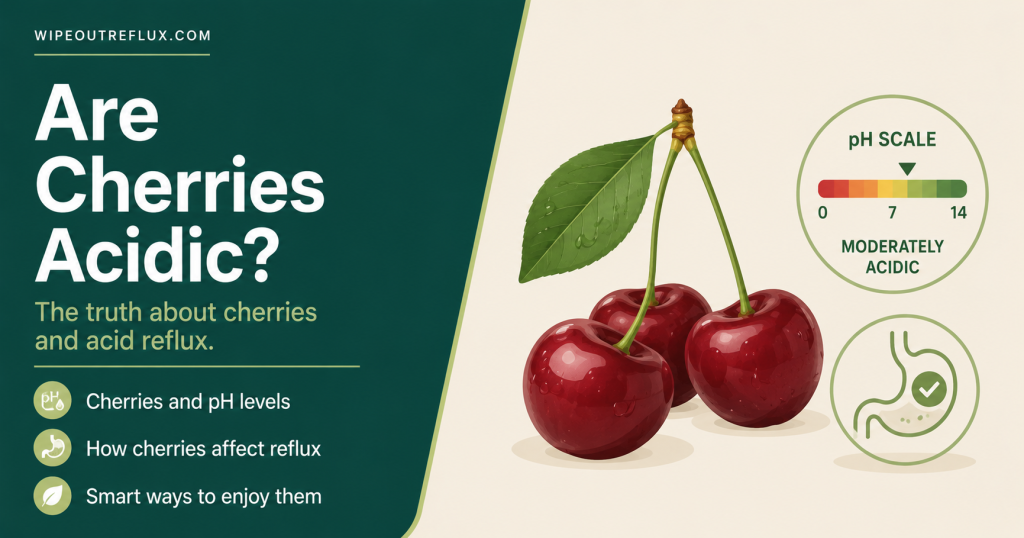
Yes, cherries are mildly acidic — but far less than most people fear, and they’re one of the more reflux-friendly fruits you can eat. Sweet cherries sit at a pH of roughly 3.7 to 4.5, while tart (sour) cherries are noticeably sharper at around 2.6 to 3.3. So on the pH scale they count as acidic, but the type of acid and everything else they bring to the table matters more than the number alone.
Here’s the key point: cherries get their tang mainly from malic acid, the same gentle acid in apples — not the harsh citric acid that makes oranges and lemons such reliable heartburn triggers. And they’re loaded with anti-inflammatory compounds that most acidic foods simply don’t have. That combination is why sweet cherries, eaten sensibly, sit comfortably for a lot of reflux sufferers.
The nuances worth knowing: sweet cherries beat tart cherries for reflux, whole cherries beat concentrated cherry juice, and — as always — your own throat gets the final vote. Let me break it all down.
Key Takeaways
- Cherries are mildly acidic: sweet cherries around pH 3.7–4.5, tart (sour) cherries around pH 2.6–3.3.
- Their acidity comes mainly from malic acid (the apple acid), which is gentler than the citric acid in citrus fruits.
- Cherries are rich in anti-inflammatory anthocyanins, which sets them apart from most acidic foods.
- Sweet cherries are the better choice for reflux — they’re less acidic and sweeter than tart cherries.
- Tart cherry juice is more concentrated and acidic, so it’s more likely to bother sensitive refluxers than whole fruit.
- Portion and timing matter: a modest handful of ripe sweet cherries is very different from a large bowl late at night.
- If you have LPR (silent reflux), your throat may be more acid-sensitive, so test cherries cautiously.
Are cherries acidic? The pH, explained
On paper, yes. Anything with a pH below 7 is acidic, and cherries land comfortably under that. But there’s a big spread depending on the variety. Sweet cherries — the dark red Bing-type ones you snack on — measure around pH 3.7 to 4.5. Tart or sour cherries, the kind used in pies and juices, are much sharper at roughly pH 2.6 to 3.3.
What gives cherries their acidity is largely malic acid, the dominant organic acid in the fruit, measured in one analysis of sweet cherry cultivars at several hundred milligrams per 100 grams Hayaloglu & Demir, Journal of Food Science, 2015. Malic acid is the same acid that makes apples pleasantly tart, and it’s gentler on reflux than the citric acid that dominates oranges, lemons and limes. That distinction is easy to miss if you only look at the pH number — two foods can share a pH but behave very differently in your gut.
For context, cherries are meaningfully less acidic than citrus (lemons sit near pH 2) and sit in a similar zone to blueberries. You can see where they fall against other fruits in my acidity of fruits chart.
Why cherries are usually still reflux-friendly
This is where cherries pull ahead of their pH. Two things work in their favour.
First, the type of acid. Malic acid is milder and better tolerated than citric acid, so a moderately acidic cherry tends not to provoke the same burn a similarly acidic orange would. Second, and more importantly, cherries are packed with anthocyanins — the pigments that give them their deep red colour and deliver genuine anti-inflammatory power. In a review of human studies, cherry consumption reduced markers of inflammation in the majority of trials examined Kelley et al., Nutrients, 2018.
That matters for reflux because irritated, inflamed tissue in the oesophagus and throat is a big part of what makes symptoms miserable. A food that’s mildly acidic but actively anti-inflammatory is a very different proposition from one that’s acidic and pro-inflammatory. It’s why cherries earn a place on most reflux-friendly fruit lists — see my full rundown in LPR foods to eat.
Sweet vs tart (sour) cherries for reflux
If reflux is your concern, reach for sweet cherries. The difference is real: sweet cherries are roughly a full pH point milder than tart cherries and carry far more natural sugar to balance the acid, so they taste and feel gentler. Tart cherries, prized for their sharpness in cooking, are more acidic and more likely to nudge sensitive refluxers.
That doesn’t make tart cherries off-limits — they have superb anti-inflammatory credentials and plenty of people tolerate them fine — but if you’re actively symptomatic or just testing the waters, sweet cherries are the safer starting point. Choose them ripe, too: a fully ripe cherry is sweeter and slightly less acidic than an underripe one.
What about cherry juice?
Cherry juice is a different animal from whole fruit, and tart cherry juice especially so. Juicing concentrates the fruit — you’re drinking the acid of many cherries in one glass, without the whole-fruit fibre that slows things down — so it’s more likely to trigger symptoms than eating cherries whole. If you love tart cherry juice, dilute it with water, keep the portion small, and never drink it on an empty stomach.
There’s an interesting wrinkle here: tart cherries are a natural source of melatonin, which is why the juice is popular for sleep. Melatonin has actually been studied for reflux in its own right, which I cover in melatonin for acid reflux. Just weigh that against the acidity — a concentrated acidic drink close to bedtime is a classic setup for night-time reflux, so timing is everything. For lower-risk ways to get cherries in, a small handful blended into an acid reflux smoothie with alkaline ingredients is a gentler bet.
How to eat cherries if you have reflux
A few simple rules keep cherries on the friendly side:
- Pick sweet over tart and choose fully ripe fruit for the mildest acidity.
- Keep portions modest — a handful, not a heaping bowl. Even friendly foods can overload things in large amounts.
- Don’t eat them on an empty stomach if you’re sensitive; pair them with something neutral like oats or yoghurt.
- Avoid late-night cherries if you get night-time symptoms, and be extra cautious with concentrated juice before bed.
- Favour whole fruit over juice so you keep the fibre and dilute the acid load naturally.
Listen to your own reflux
Averages only get you so far. If you have LPR — the silent, throat-based form of reflux — your tissues can react to pepsin at acidity levels that wouldn’t bother a classic heartburn sufferer, so you may need to treat even mildly acidic foods with more care. (If you’re not sure which type you have, my GERD vs LPR guide will help.)
The smart move with any borderline food is to test it deliberately: eat a small, ripe portion when your symptoms are calm, then notice how you feel over the next few hours. Cherries are friendly enough that most people pass this test easily — but you’re the only reliable judge of your own throat.
Conclusion
So, are cherries acidic? Technically yes — but they’re one of the gentler acidic fruits, and for most people with reflux, a modest serving of ripe sweet cherries is a genuinely good choice. Their acid is the mild malic kind, their anthocyanins fight the very inflammation that makes reflux hurt, and only the tart varieties and concentrated juices really warrant caution. Judge cherries by the whole package, not just the pH number.
That’s exactly the trap the pH number sets, though: it tells you a food is acidic without telling you whether it’ll actually trigger you. That’s why I put together the Wipeout Food Reference Guide — the essential reference for which foods and drinks are safe for acid reflux and LPR, with their pH values laid out, so you can stop second-guessing individual foods like cherries and see the full picture at a glance.
And if you want to stop managing reflux food by food and actually calm it at the source, the Wipeout Diet Plan is the complete, in-depth system. I built it first and foremost around LPR, the stubborn throat-based kind that’s so hard to shift, but because it works on the same underlying reflux mechanisms, it’s just as effective for GERD, heartburn and everyday acid reflux. Get the mechanism calmed down and foods like cherries stop being something you have to worry about at all.
Frequently Asked Questions
Are cherries good or bad for acid reflux?
For most people, sweet cherries in a modest portion are good — they’re only mildly acidic, their malic acid is gentler than citrus acid, and their anthocyanins are anti-inflammatory. Tart cherries and concentrated cherry juice are more acidic and more likely to trigger sensitive refluxers, so choose sweet, ripe, whole cherries if you’re cautious.
Which is less acidic, sweet or tart cherries?
Sweet cherries. They measure around pH 3.7–4.5 versus roughly 2.6–3.3 for tart (sour) cherries, and they contain more balancing sugar. If reflux is a concern, sweet cherries are the clear pick.
Is cherry juice bad for acid reflux?
It can be harder on reflux than whole cherries because juicing concentrates the acid and removes the fibre. Tart cherry juice is the most acidic. If you drink it, dilute it, keep the portion small, and avoid it late at night — concentrated acidic drinks near bedtime are a common reflux trigger.
Do cherries cause heartburn?
They’re unlikely to for most people, especially sweet cherries in sensible amounts. Heartburn is more likely from large portions, tart varieties, cherry juice, or eating them on an empty stomach or right before bed. As with any food, individual tolerance varies.
Are cherries safe for LPR (silent reflux)?
Often yes, but with a little more caution. LPR tissue can be more acid-sensitive, so start with a small serving of ripe sweet cherries when your symptoms are calm and see how you respond. Their anti-inflammatory compounds are a point in their favour for throat-based reflux.
Research & References
- An analysis of sweet cherry cultivars found malic acid is the dominant organic acid responsible for their tartness, present at several hundred milligrams per 100 grams of fruit Hayaloglu & Demir, Journal of Food Science, 2015.
- A review of human studies found that cherry consumption decreased markers of inflammation in 11 of 16 trials and markers of oxidative stress in 8 of 10, reflecting the anti-inflammatory and antioxidant activity of their polyphenols Kelley et al., Nutrients, 2018.

David Gray
12 years living with LPR · Consultant & researcher
I've lived with LPR for twelve years — the misdiagnoses, the PPI courses that did nothing, the slow work of figuring out what actually helps. Wipeout Reflux is where I translate the research into plain terms for people stuck in the same place. Every claim here is sourced to peer-reviewed work, and I consult one-to-one with LPR sufferers.