
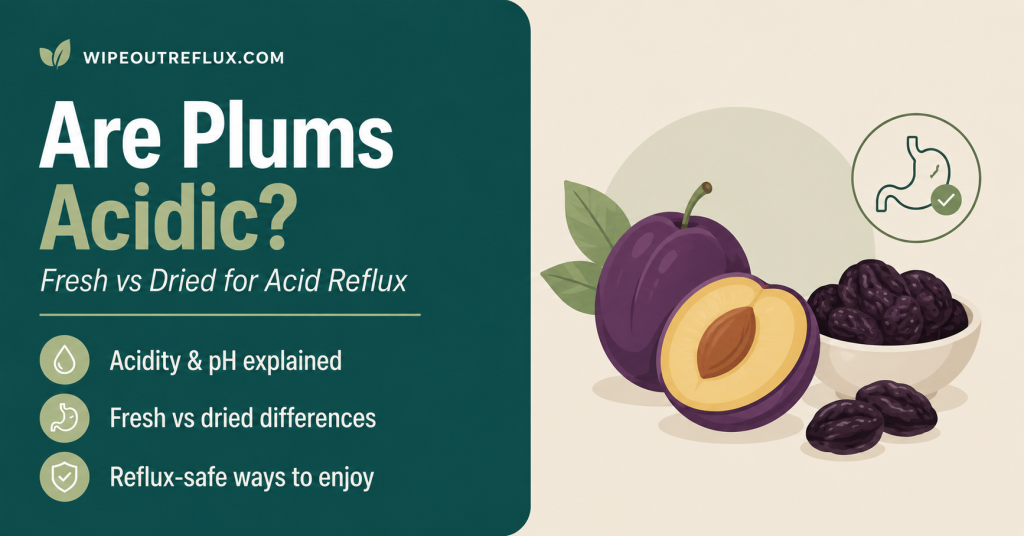
Yes, plums are acidic — not alkaline. Fresh plums sit at roughly pH 2.8 to 4.5 depending on the variety and how ripe they are, with most ripe dessert plums landing around pH 3.5 to 4.5 and tart cooking plums like damsons dipping lower. So while a soft, sweet plum can taste mild, it’s genuinely acidic fruit.
The acidity comes mainly from malic acid — the same apple-type acid that gives plums their fresh, slightly sharp edge. And here’s the twist most articles miss: dried plums (prunes) behave very differently from fresh ones for reflux, and it isn’t really about acid at all.
Below I’ll cover the pH, why ripeness and skin colour matter, and the crucial difference between fresh plums and prunes when you have acid reflux or LPR.
Key Takeaways
- Plums are acidic, not alkaline — fresh plums range from about pH 2.8 to 4.5, driven mainly by malic acid.
- Ripeness matters a lot: a fully ripe, sweet plum is noticeably gentler than a firm, tart one, and the skin is the most acidic part.
- Dark red and purple plums carry anti-inflammatory anthocyanins in their skins, so like grapes and cherries they bring something useful alongside the acid.
- Prunes (dried plums) are less about acidity and more about sorbitol — a fermentable sugar alcohol that can cause gas and bloating, which raises abdominal pressure and can worsen reflux.
- Prune juice concentrates both the sorbitol and the sugar, so it’s the form most likely to cause trouble.
- If you have LPR (silent reflux), fresh plums sit below the pH 4 threshold where pepsin reactivates in the throat, so treat them cautiously during active symptoms.
- A single ripe plum or a couple of prunes is a very different thing from a big bowl of fruit or a glass of prune juice.
Are plums acidic or alkaline? The pH, explained
Plums are acidic. Fresh plums measure somewhere between about pH 2.8 and 4.5, which is firmly on the acid side of neutral (pH 7). Exactly where a plum lands depends on the variety and its ripeness — sweet, fully ripe dessert plums sit at the higher, gentler end, while tart or underripe plums and cooking varieties like damsons are sharper.
The occasional claim that plums are “alkalising” comes from the alkaline-ash theory, which is about the mineral residue a food leaves after your body metabolises it — not the pH of the fruit itself or what it does in your oesophagus straight after you eat it. That theory is about urine pH, and it isn’t a useful guide for reflux. I’ve gone through where it holds up and where it doesn’t in the alkaline diet and GERD. You can also see how plums compare with other fruits in my acidity of fruits chart.
The main acid in plums is malic acid — a study of plum cultivars found malic acid to be the predominant organic acid in both the flesh and the skin, with the skin more acidic than the flesh [Nour et al., Horticulturae, 2025]. Malic acid is the same acid that dominates apples, and it’s a gentler customer than the citric acid in citrus — part of why a ripe plum feels softer on the palate than, say, a grapefruit at the same pH.
Ripeness and skin: why one plum isn’t like another
If reflux is your concern, ripeness is the single most useful thing to pay attention to. As a plum ripens, its acid content falls and its sugar rises, so a fully ripe, soft, sweet plum is meaningfully gentler than a firm, tart one straight from the shop. When you’re symptomatic, let plums ripen fully before eating them.
The skin matters too. Because malic acid concentrates in the peel, the skin is the sharpest part of the fruit — and it’s also where the polyphenols live. In dark red and purple plums, those skins are rich in anthocyanins, the same anti-inflammatory pigments that make dark grapes and cherries worth eating despite their acidity. So a ripe dark plum is a genuine trade-off: a little acid, but real anti-inflammatory value alongside it. That matters for reflux, where inflamed, irritated tissue in the throat and oesophagus is a big part of what makes symptoms miserable.
Fresh plums vs prunes: the important difference
This is where plums get interesting, because drying a plum into a prune changes the reflux picture completely — and not in the direction you’d expect.
You’d assume drying concentrates the acid and makes prunes worse. In practice, the bigger issue with prunes isn’t acidity at all — it’s sorbitol, a naturally occurring sugar alcohol that plums are unusually high in and that becomes concentrated when the fruit is dried. Sorbitol is poorly absorbed in the small intestine and fermented by gut bacteria further down, which is exactly why prunes are such a famously effective remedy for constipation [Attaluri et al., Alimentary Pharmacology & Therapeutics, 2011].
That fermentation produces gas and bloating in sensitive people — and bloating is a reflux problem in its own right. When the abdomen distends, pressure builds against the valve at the top of the stomach and pushes stomach contents upward. So for a lot of people, the trouble with prunes is pressure, not pH. Sorbitol is a classic FODMAP, and if you have the kind of gut that reacts to fermentable carbohydrates — there’s a big overlap between IBS and reflux — prunes are worth keeping to small portions.
Prune juice is the form to be most careful with: it concentrates the sorbitol and sugar into a drink with none of the whole fruit’s fibre to slow things down.
The practical upshot: a couple of prunes as part of a meal is fine for most people, but a large handful — or a glass of prune juice — is asking for gas, and potentially reflux with it.
Plums, prunes and LPR (silent reflux)
Here’s where I’d give different advice depending on which kind of reflux you have.
In silent reflux, much of the damage to the throat is done by pepsin — a stomach enzyme — rather than acid alone. Pepsin that has already reached the larynx can bind to the tissue and lie dormant, then reactivate when something acidic arrives and drops the local pH. Human pepsin is most damaging in acidic conditions and keeps meaningful activity up to around pH 4, which is why acidic foods can set off throat symptoms so quickly [Johnston et al., The Laryngoscope, 2007]. There’s more in how pepsin reactivates in the throat and what is pepsin.
Fresh plums, sitting below pH 4, fall below that line — which is why strict LPR protocols like the Koufman diet leave acidic fruit out during the initial healing phase. My practical read: if your throat symptoms are active, ease off fresh plums for a few weeks, then reintroduce a single ripe one and see how you get on. Prunes are a double consideration for LPR — some residual acidity plus the bloating risk — so keep portions small. If your reflux is classic heartburn rather than throat-based, all of this matters less; the oesophagus tolerates acid better than the larynx. More on that distinction in GERD vs LPR.
How to eat plums if you have reflux
A few simple rules keep plums and prunes on the friendlier side:
- Let fresh plums ripen fully — ripe and sweet is gentler than firm and tart.
- Favour dark, sweet varieties for the anti-inflammatory anthocyanins in the skin.
- Keep prunes to a small portion — two or three, not a handful — to stay under the sorbitol threshold that triggers gas.
- Eat them with other food rather than alone on an empty stomach if you’re sensitive.
- Go easy on prune and plum juice, and avoid them close to bedtime.
If you’d rather not gamble on borderline fruit while you’re healing, it’s worth knowing which options reliably sit on the safe side. I keep a running list in LPR foods to eat, and the whole framework is built out in the Wipeout Diet Plan.
Conclusion
So, are plums acidic or alkaline? Acidic — roughly pH 2.8 to 4.5, built on malic acid, with ripeness and skin colour deciding how gentle any given plum turns out to be. But the real lesson with plums is that fresh and dried are two different foods for reflux: fresh plums are an acidity question, while prunes are mostly a sorbitol-and-bloating question. For most people with classic heartburn, a ripe plum or a couple of prunes is fine; for active LPR, fresh plums are best reintroduced carefully once your throat has settled, and prunes kept to small portions.
If you want to stop weighing up fruit one at a time and actually calm reflux at its source, the Wipeout Diet Plan is the complete, in-depth system I built for exactly that. It was designed first and foremost around LPR — the stubborn, throat-based form — but because it targets the same underlying reflux mechanisms, it works just as well for GERD, heartburn and everyday acid reflux. Get the mechanism settled and foods like plums stop being something you have to second-guess.
And if you just want a quick, reliable reference for which foods and drinks are safe and where they sit on the pH scale, the Wipeout Food Reference Guide is the essential companion — it lays out the safe options and their pH values so you can see the whole picture at a glance.
Frequently Asked Questions
Are plums good or bad for acid reflux?
Fresh plums are acidic (around pH 2.8 to 4.5), so they can trigger symptoms in sensitive people — but a ripe, sweet plum in a modest portion is fine for most people with classic heartburn, and dark plums bring anti-inflammatory anthocyanins with them. During an active flare or with silent reflux, it’s better to hold off and reintroduce carefully.
Are prunes bad for acid reflux?
Prunes are less of an acid problem and more of a bloating one. They’re high in sorbitol, a fermentable sugar alcohol that can cause gas and abdominal pressure, which can push acid upward. A couple of prunes is usually fine; a large handful or a glass of prune juice is more likely to cause trouble, especially if you have a sensitive gut.
Which is more acidic, fresh plums or prunes?
Both are acidic, but the key difference isn’t the acidity — it’s that prunes concentrate sorbitol and sugar. With fresh plums, acidity is the main reflux consideration; with prunes, the gas and bloating from sorbitol usually matter more than the pH.
Do plums cause heartburn?
They can, particularly tart or underripe plums, large portions, or prune juice on an empty stomach. A single ripe plum eaten with other food is unlikely to trigger heartburn in most people. Portion, ripeness, timing and your own tolerance decide it.
Are plums safe for LPR (silent reflux)?
With caution. Fresh plums sit below the pH 4 threshold where laryngeal pepsin can reactivate, so strict LPR protocols leave them out during the initial healing phase. Once your throat symptoms have settled, try reintroducing a single ripe plum and see how you respond. Keep prunes to small portions because of the added bloating risk.
Is plum skin more acidic than the flesh?
Yes — malic acid concentrates in the skin, so the peel is the sharpest part of the plum. The skin is also where the anti-inflammatory anthocyanins are, so it’s a genuine trade-off rather than something to always avoid.
Are dried plums lower in FODMAPs than fresh?
No — drying concentrates the sorbitol, so prunes are higher in this fermentable sugar alcohol than fresh plums by weight. That’s why prunes work as a constipation remedy, and why small portions are wise if you’re prone to gas and bloating-related reflux.
Research & References
- A study of the nutritional and phytochemical properties of plum cultivars found malic acid to be the predominant organic acid in both the flesh and the peel, with the peel more acidic than the flesh [Nour et al., Horticulturae, 2025].
- A randomised clinical trial found dried plums (prunes) were more effective than psyllium at improving stool frequency and consistency in chronic constipation, an effect attributed largely to their sorbitol and fibre content — the same fermentable components that can cause gas and bloating [Attaluri et al., Alimentary Pharmacology & Therapeutics, 2011].
- A study of human pepsin’s activity and stability found the enzyme is maximally active in strongly acidic conditions and retains significant activity up to around pH 4, remaining stable and reactivatable by acid even after exposure to higher pH — the basis for why acidic foods provoke laryngeal reflux symptoms [Johnston et al., The Laryngoscope, 2007].

David Gray
12 years living with LPR · Consultant & researcher
I've lived with LPR for twelve years — the misdiagnoses, the PPI courses that did nothing, the slow work of figuring out what actually helps. Wipeout Reflux is where I translate the research into plain terms for people stuck in the same place. Every claim here is sourced to peer-reviewed work, and I consult one-to-one with LPR sufferers.