
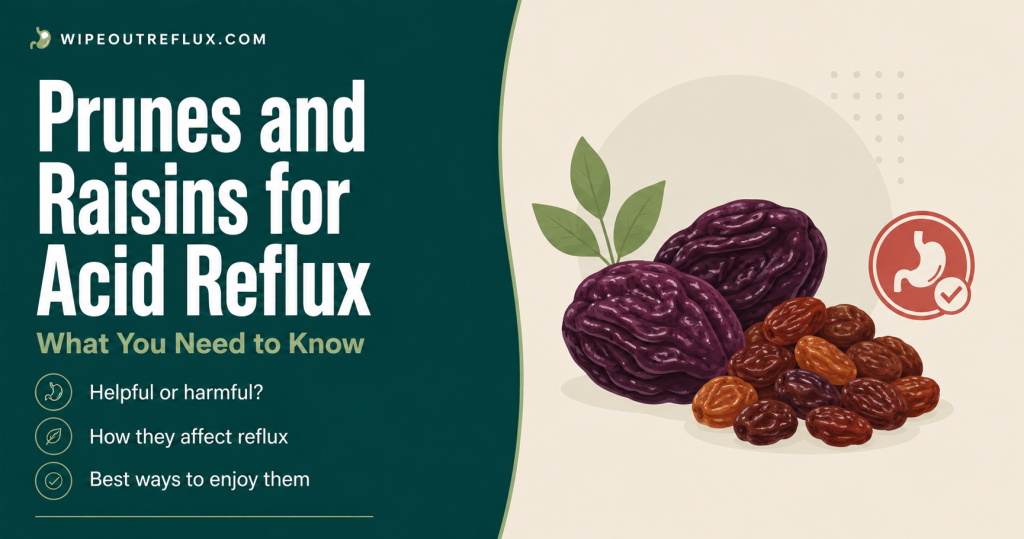
Prunes and raisins are a genuine mixed bag for acid reflux, and the reason comes down to one thing most people overlook: drying. A prune is a dried plum and a raisin is a dried grape, and when you take the water out of a fruit, you don’t remove the acid or the sugar — you concentrate them. What’s left is a small, sticky, intensely sweet-and-tart parcel that packs the acid of several pieces of fresh fruit into one bite.
So are prunes good for acid reflux? They have a real point in their favour — they’re high in fibre, and fibre is one of the best-evidenced dietary helpers for reflux. But that upside sits alongside concentrated acid, concentrated sugar, a sticky texture that prolongs acid contact, and (in prunes especially) sorbitol that can cause bloating. The answer is “in moderation, and with care,” not a simple yes.
Here’s how drying changes the picture, and how to get the fibre benefit without the downsides.
Key Takeaways
- Prunes are dried plums and raisins are dried grapes — drying removes the water and concentrates whatever’s left, including the acid and the sugar.
- Gram for gram, dried fruit is far more acidic and sugary than fresh, and it’s much easier to overeat — a small handful of raisins is many grapes’ worth.
- The real upside is fibre: prunes and raisins are fibre-rich, and dietary fibre has strong evidence behind it for reducing reflux.
- Prunes contain sorbitol, a sugar alcohol that ferments in the gut and can cause gas and bloating — which raises abdominal pressure and can nudge reflux.
- Their sticky texture clings to teeth and the throat, prolonging acid contact — a particular downside for LPR and for dental enamel.
- Without the water that dilutes acid in fresh fruit, dried fruit delivers its acid more concentrated, so it sits below the pH 5 threshold that matters for silent reflux.
- Small portions, soaking or stewing, and pairing with neutral foods let you keep the fibre benefit while limiting the downsides.
What drying actually does
This is the key to the whole question, so it’s worth being clear about. When a plum becomes a prune or a grape becomes a raisin, roughly three-quarters of its water is driven off. Everything that isn’t water — the sugars, the organic acids, the fibre, the minerals — stays behind and becomes concentrated in a much smaller, denser package.
That has two consequences for reflux. First, the acid load per bite goes up sharply: the malic acid in plums and the tartaric and malic acids in grapes are all still there, just squeezed into a fraction of the original volume. Second, the water that would have diluted that acid in the fresh fruit is gone. Fresh fruit is largely water, and that water buffers the acid as you eat it; dried fruit has lost that cushion. So even though a prune and a fresh plum have broadly similar pH readings, the prune delivers its acid in a far more concentrated hit — and it’s much easier to eat a lot of it. Nobody eats fifteen grapes without noticing; fifteen raisins vanish in one distracted handful.
Prunes: fibre, acid and sorbitol
Prunes are the more interesting of the two, because they pull hardest in both directions.
On the plus side, they’re genuinely fibre-rich, and fibre is one of the few dietary factors with solid reflux evidence behind it. In a clinical trial, adding fibre to the diet of people with reflux raised the pressure of the valve at the top of the stomach and cut the number of reflux episodes by roughly a third Morozov et al., World Journal of Gastroenterology, 2018, and high fibre intake tracks with lower reflux risk in population data too El-Serag et al., Gut, 2005. So the fibre in prunes is a real asset.
On the minus side, prunes are famously high in sorbitol, a sugar alcohol — it’s why they work as a natural laxative. Sorbitol isn’t fully absorbed; it draws water into the bowel and gets fermented by gut bacteria, producing gas. Bloating raises pressure inside the abdomen, which mechanically pushes stomach contents up against the sphincter — so prunes can worsen reflux through the pressure route even though the acid itself is fairly modest. It’s the same mechanism I describe in acid reflux and gas, and it’s why prunes sit awkwardly on a low-FODMAP approach. A couple of prunes is fine for most people; a big serving is asking for wind and pressure.
Raisins: concentrated grape
Raisins are more straightforward — they’re simply concentrated grapes. All the tartaric and malic acid of the grape is still there, along with all the natural sugar, minus the water. That makes them more acidic and far more sugar-dense per gram than fresh grapes, and the sticky texture means they linger in the mouth and throat rather than being washed down quickly.
They’re not a disaster — raisins are lower in sorbitol than prunes, so they cause less bloating, and they bring some fibre and antioxidants. But the same “easy to overeat” problem applies, and the concentrated acid is a consideration if your reflux is sensitive. If you found the fresh-fruit version manageable, treat raisins as a more potent form of the same thing and scale the portion down accordingly.
The sticky problem
There’s one downside that’s easy to miss and specific to dried fruit: it’s sticky. Prunes and raisins cling to your teeth and coat the back of the mouth and throat, which means their acid and sugar stay in contact with the tissue far longer than a mouthful of watery fresh fruit would. For anyone, that’s a concern for dental enamel — sticky acidic fruit is one of the classic causes of erosion, which I cover in acid reflux and teeth erosion. For people with silent reflux, prolonged acid contact at the throat is exactly what you’re trying to avoid. Rinsing with water after eating dried fruit is a small habit that helps a lot.
Prunes, raisins and LPR
If your reflux is the throat-based LPR kind, dried fruit deserves extra caution. In silent reflux, much of the damage is done by pepsin, a stomach enzyme that lodges in the throat and reactivates when acid arrives — and human pepsin stays active up to around pH 5 Johnston et al., The Laryngoscope, 2007. There’s more on this in how pepsin reactivates in the throat and what is pepsin.
Dried fruit sits below that pH 5 threshold, delivers its acid concentrated and un-diluted, and then sticks around in the throat longer than fresh fruit does — three strikes for a sensitive larynx. This is why strict LPR protocols, built around foods above pH 5, leave dried fruit out during the healing phase; see the Koufman diet for how that works. If your reflux is classic heartburn rather than throat-based, dried fruit is easier to get away with, and the fibre benefit may well be worth it — the distinction is explained in GERD vs LPR. Other dried fruits follow the same logic, incidentally: it’s the same story for dates and dried coconut.
How to eat prunes and raisins with reflux
You don’t have to give them up — you have to be deliberate about them:
- Keep portions small. Two or three prunes, or a small scattering of raisins, not a bowlful. This is the single most important rule.
- Soak or stew prunes. Rehydrating them softens the texture, dilutes the concentrated acid and sugar, and makes them gentler — stewed prunes are much kinder than dried.
- Pair them with neutral foods like porridge, yoghurt or oats rather than eating them alone. This buffers the acid and slows the sugar.
- Rinse your mouth with water afterwards to clear the sticky residue from your teeth and throat.
- Watch prunes for bloating. If you get gas or looser stools, the sorbitol is your issue — cut the portion right back.
- Avoid them late at night, especially if you have night-time or throat symptoms.
Conclusion
So, are prunes good for acid reflux? They’re a real trade-off. Their fibre is a genuine asset, and fibre is one of the most reliable dietary helpers for reflux there is. But drying concentrates the acid and sugar of the plum and grape they come from, strips away the water that would dilute that acid, and leaves a sticky food that’s all too easy to overeat and that lingers in the throat. Add the sorbitol in prunes, and dried fruit becomes trickier than the fresh version despite the fibre. For classic heartburn, a small, sensibly eaten portion — ideally stewed and paired with something neutral — can be worth it. For active LPR, dried fruit is one to keep small and occasional, or set aside until your throat has settled.
This is exactly why the pH number alone is such a poor guide — it can’t tell you that a food is concentrated, sticky, or laxative, or how it stacks up against everything else you’re eating. That’s why I put together the Wipeout Food Reference Guide — the essential reference for which foods and drinks are safe for acid reflux and LPR, with their pH values and the practical caveats laid out, so you can see the whole picture for tricky foods like dried fruit at a glance.
And if you want to stop weighing up foods one at a time and actually calm reflux at the source, the Wipeout Diet Plan is the complete, in-depth system. It shows you how to get the fibre your gut needs from gentler sources, and how to build meals that reduce reflux episodes rather than provoke them. I designed it first and foremost around LPR — the stubborn, throat-based form that responds worst to medication — but because it works on the same underlying reflux mechanisms, it’s just as effective for GERD, heartburn and everyday acid reflux.
Frequently Asked Questions
Are prunes good or bad for acid reflux?
Both, depending on portion. Prunes are fibre-rich, and fibre genuinely helps reflux — but drying concentrates their acid and sugar, and they’re high in sorbitol, which can cause bloating and raise abdominal pressure. A couple of stewed prunes paired with neutral food can be fine; a large serving is more likely to cause trouble, especially with silent reflux.
Are raisins acidic?
Yes — raisins are concentrated grapes, so all the tartaric and malic acid of the grape is still there, minus the water that diluted it. Gram for gram they’re more acidic and much more sugar-dense than fresh grapes, and their sticky texture makes the acid linger. Small portions are the key.
Why is dried fruit worse for reflux than fresh fruit?
Because drying removes the water and concentrates everything left behind, including the acid and sugar. Fresh fruit’s water content dilutes its acid as you eat it; dried fruit loses that buffer and delivers the acid concentrated. Dried fruit is also stickier, so it clings to the throat and teeth, and far easier to overeat.
Do prunes cause bloating and reflux?
They can. Prunes are high in sorbitol, a poorly absorbed sugar alcohol that ferments in the gut and produces gas. Bloating raises pressure in the abdomen, which can push stomach contents up against the valve at the top of the stomach. If prunes give you wind or looser stools, reduce the portion.
Are prunes or raisins safe for LPR (silent reflux)?
They need caution. Both sit below the pH 5 threshold where throat pepsin reactivates, deliver concentrated acid, and stick around in the throat longer than fresh fruit. During an active flare they’re best avoided or kept very small; soaking or stewing and rinsing with water afterwards helps. Once your throat has settled you can reintroduce small amounts and judge by how you respond.
Research & References
- A clinical trial in patients with non-erosive reflux disease found that supplementing the diet with fibre raised the resting pressure of the lower oesophageal sphincter and reduced total reflux episodes by roughly a third — the basis for the fibre benefit in fibre-rich dried fruit Morozov et al., World Journal of Gastroenterology, 2018.
- A large cross-sectional study found high dietary fibre intake associated with a reduced risk of reflux symptoms and erosive oesophagitis, an association that held after adjusting for body weight El-Serag et al., Gut, 2005.
- A study of human pepsin found the enzyme is maximally active in acidic conditions and retains significant activity up to around pH 4, remaining stable and reactivatable by acid even after exposure to higher pH — the basis for why concentrated acidic foods provoke throat-based reflux symptoms Johnston et al., The Laryngoscope, 2007.

David Gray
12 years living with LPR · Consultant & researcher
I've lived with LPR for twelve years — the misdiagnoses, the PPI courses that did nothing, the slow work of figuring out what actually helps. Wipeout Reflux is where I translate the research into plain terms for people stuck in the same place. Every claim here is sourced to peer-reviewed work, and I consult one-to-one with LPR sufferers.