
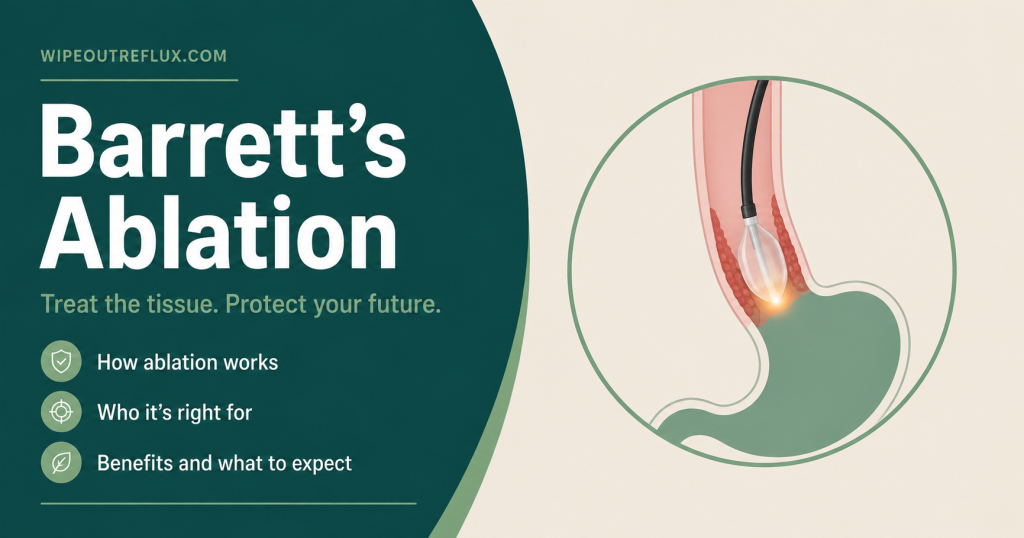
Barrett’s oesophagus ablation is a procedure that deliberately destroys the abnormal cells lining your lower oesophagus so healthy tissue can grow back in their place. It’s done through an endoscope, as a day case, and there are two main ways of doing it: radiofrequency ablation (RFA), which burns the lining with controlled heat, and cryotherapy, which freezes it. Both destroy roughly the same depth of tissue and both let normal squamous cells regenerate.
RFA is the established option. It’s what NICE recommends, it’s what the ACG recommends, and it’s the one with randomised trial evidence behind it. In the landmark trial, RFA eradicated dysplasia in 90.5% of low-grade cases and 81% of high-grade cases, versus 22.7% and 19% with a sham procedure, and cut progression to cancer from 9.3% to 1.2% [Shaheen et al., New England Journal of Medicine, 2009].
Cryotherapy is the newer, less established option. It appears to work about as well, and it hurts less afterwards — but there has never been a randomised head-to-head trial against RFA, and in the UK it isn’t a standard NHS pathway.
The other thing you need to know upfront: ablation is not a one-and-done cure. Barrett’s comes back in a meaningful proportion of people, which is why surveillance endoscopies continue for years afterwards.
Key Takeaways
- Ablation is only for Barrett’s with dysplasia (pre-cancerous change) or very early cancer. Plain non-dysplastic Barrett’s is monitored, not ablated.
- RFA is the standard of care. In the AIM Dysplasia trial it eradicated intestinal metaplasia in 77.4% of patients versus 2.3% with sham [Shaheen et al., New England Journal of Medicine, 2009].
- For low-grade dysplasia, RFA cut three-year progression to high-grade dysplasia or cancer from 26.5% to 1.5% — an absolute risk reduction of 25%, meaning four people treated to prevent one progression [Phoa et al., Journal of the American Medical Association, 2014].
- Cryotherapy achieves pooled dysplasia eradication of 84.2%, with no statistically significant difference from RFA — but the comparison comes from meta-analysis, not a randomised trial [Papaefthymiou et al., Cancers, 2024].
- Strictures are the main complication: 5.6% after RFA, and 6.5% after cryotherapy in pooled data.
- Recurrence is real. After RFA, intestinal metaplasia comes back at around 9.5% per patient-year, though 97% of recurrences are retreatable endoscopically [Krishnamoorthi et al., Gastrointestinal Endoscopy, 2016].
- Any visible lump or nodule must be resected (EMR or ESD) before ablation, so it can be properly staged.
- Aggressive acid suppression continues indefinitely after ablation — the reflux that caused Barrett’s in the first place hasn’t gone anywhere.
First, Do You Actually Need Ablation?
This is the question that matters most, and a lot of people arrive at it terrified after reading the word “pre-cancerous” in a report.
Barrett’s oesophagus is what happens when years of acid and pepsin exposure cause the normal squamous lining of your lower oesophagus to be replaced by intestinal-type columnar cells. It’s an adaptation — that tissue is tougher and copes better with acid. The problem is that it’s also the soil from which oesophageal adenocarcinoma grows.
But the rate at which that happens depends enormously on whether there’s dysplasia, and how bad it is.
Non-dysplastic Barrett’s
If your biopsies show Barrett’s with no dysplasia, the pooled annual risk of developing adenocarcinoma is 0.33% per year — and for short-segment Barrett’s, 0.19% [Desai et al., Gut, 2012]. A large Danish nationwide cohort of 11,028 patients put it lower still, at 0.12% per year [Hvid-Jensen et al., New England Journal of Medicine, 2011].
That is a small number. It means the overwhelming majority of people with non-dysplastic Barrett’s will never get oesophageal cancer. And it’s why ablation is not recommended for non-dysplastic Barrett’s. The ACG manages it with surveillance instead — endoscopy every three years for segments of 3cm or more, every five years for shorter segments [Shaheen et al., American Journal of Gastroenterology, 2022]. Burning the lining of someone’s oesophagus, with a one-in-eighteen chance of a stricture, to prevent an event that has a 99.7% chance of not happening this year, doesn’t add up.
Low-grade dysplasia
Here the annual cancer risk rises to 0.54% per year, and the risk of cancer or high-grade dysplasia combined to 1.73% per year [Singh et al., Gastrointestinal Endoscopy, 2014].
This is the group where practice has genuinely shifted, and the SURF trial is why. It randomised 136 patients with confirmed low-grade dysplasia to RFA or ongoing surveillance. Over three years, 26.5% of the surveillance group progressed to high-grade dysplasia or cancer, against 1.5% of the ablation group. Progression to cancer specifically was 8.8% versus 1.5% [Phoa et al., Journal of the American Medical Association, 2014].
A number needed to treat of four is a striking result for any preventive intervention.
There is one enormous caveat, and it’s about the pathology rather than the treatment. Low-grade dysplasia is notoriously difficult to diagnose — inflammation from active reflux can make ordinary cells look dysplastic, and when expert pathologists re-review community diagnoses, most get downgraded. This is why NICE is specific about it. Recommendation 1.5.3 of NG231 says to offer RFA to people with low-grade dysplasia “diagnosed from biopsies taken at 2 separate endoscopies,” with “two gastrointestinal pathologists” confirming the diagnosis [NICE Guideline NG231, 2023].
If you’ve been told you have low-grade dysplasia from a single set of biopsies read by one pathologist, the correct next step is confirmation, not ablation.
High-grade dysplasia and intramucosal cancer
No real debate here. For high-grade dysplasia and T1a intramucosal adenocarcinoma, the ACG recommends endoscopic eradication therapy over oesophagectomy [Shaheen et al., American Journal of Gastroenterology, 2022]. Twenty years ago the answer would have been major surgery to remove the oesophagus. Being able to treat this through an endoscope instead is one of the genuine successes of modern gastroenterology.
Resection Comes Before Ablation
One point that gets glossed over in patient information, and shouldn’t be.
Ablation destroys tissue. It doesn’t produce a specimen. So if there’s any visible lesion in your Barrett’s segment — a nodule, a plaque, an irregularity — it has to be removed first, by endoscopic mucosal resection (EMR) or endoscopic submucosal dissection (ESD), so a pathologist can look at it under a microscope and see how deep it goes. Both the ACG and NICE make resection of visible lesions the first step [Shaheen et al., American Journal of Gastroenterology, 2022].
This matters because resection frequently upstages the diagnosis. Something biopsied as high-grade dysplasia turns out on full resection to be invasive cancer, and that changes the whole treatment plan. If you ablate it, you burn away the evidence.
Only once visible lesions are gone and properly staged does the remaining flat Barrett’s tissue get ablated.
Radiofrequency Ablation: How It Works and What It Delivers
RFA uses electrodes to deliver a precisely controlled burst of radiofrequency energy to the oesophageal lining. The depth is the clever part — it’s calibrated to destroy the mucosa without reaching the submucosa, which is what keeps stricture rates manageable.
There are two delivery formats. A balloon catheter with a circumferential electrode treats a whole ring of oesophagus at once, used for long or circumferential segments. A focal device mounted on the endoscope tip treats small patches and islands, used for touch-ups.
Treatment is staged. You’ll typically need three sessions, spaced two to three months apart, sometimes more for long segments — the AIM Dysplasia trial averaged 3.5 treatments per patient. Each is done as a day case under conscious sedation (midazolam and fentanyl) or propofol. General anaesthetic isn’t routine. You’re in the endoscopy unit for a few hours and home the same day.
The results
The AIM Dysplasia trial randomised 127 patients 2:1 to RFA or a sham procedure. Complete eradication of dysplasia was 90.5% versus 22.7% for low-grade and 81% versus 19% for high-grade. Complete eradication of intestinal metaplasia was 77.4% versus 2.3%. Disease progression occurred in 3.6% versus 16.3%, and cancer in 1.2% versus 9.3% [Shaheen et al., New England Journal of Medicine, 2009].
Real-world UK data backs this up, with the honesty that registries bring. The UK national HALO RFA registry followed 2,535 patients across 28 hospitals. Complete clearance of dysplasia was 88% and clearance of intestinal metaplasia 62.6% within two years — lower than the trial figure, which is what you’d expect outside a trial setting. The ten-year Kaplan-Meier cancer rate was 4.1% [Wolfson et al., Gastrointestinal Endoscopy, 2022].
The complications
A meta-analysis of 37 studies and 9,200 patients found an overall adverse event rate of 8.8%, made up of strictures 5.6%, bleeding 1%, and perforation 0.6% [Qumseya et al., Clinical Gastroenterology and Hepatology, 2016].
A stricture is a scarred narrowing of the oesophagus that makes swallowing difficult. It’s treatable with endoscopic dilatation, usually over a few sessions, but it’s an unwelcome addition to a treatment course.
The most useful finding in that paper is that combining RFA with EMR raised the adverse event risk more than fourfold (relative risk 4.4). If you need both, your risk profile is meaningfully different from someone having ablation alone — worth asking your endoscopist about directly.
Cryotherapy: Freezing Instead of Burning
Cryotherapy destroys the same tissue by taking it to extreme cold instead. Rapid freezing crystallises water inside the cells and ruptures them; the thaw does further damage through vascular injury. There are two systems in use.
Liquid nitrogen spray cryotherapy sprays nitrogen at around −196°C through a catheter onto the Barrett’s segment, with a decompression tube to vent the expanding gas from the stomach. It’s flexible for irregular anatomy but the dose is operator-dependent — how long you spray and how close you hold the catheter.
Cryoballoon focal ablation inflates a compliant balloon against the oesophageal wall and delivers nitrous oxide to a defined circular area for a set number of seconds. More reproducible, and the newer of the two.
The results
A 2024 meta-analysis of 23 studies and 1,604 patients found pooled complete eradication of dysplasia of 84.2% and complete eradication of intestinal metaplasia of 64.1%, with recurrence at 8.3%, overall adverse events at 14.5% and strictures at 6.5%. The cryoballoon subgroup did better than spray: dysplasia eradication 94%, intestinal metaplasia eradication 87.2%, recurrence 3.9% [Papaefthymiou et al., Cancers, 2024].
The largest cryoballoon trial enrolled 120 patients. On an intention-to-treat basis, complete eradication of dysplasia was 76% and of intestinal metaplasia 72%. In the 94 patients who completed the full protocol, those figures were 97% and 91% — but strictures needing dilatation occurred in 12.5% [Canto et al., American Journal of Gastroenterology, 2020].
Be careful with cryoballoon numbers you see quoted. The 97% figure is per-protocol — it excludes people who dropped out or didn’t complete treatment. The 76% intention-to-treat figure is the more honest one for deciding whether to have the procedure.
Where cryotherapy is clearly useful
Salvage. When RFA has been tried and hasn’t cleared the Barrett’s, cryotherapy is a genuine second line. A meta-analysis of 148 patients with dysplasia or metaplasia persisting after RFA found cryotherapy achieved complete eradication of dysplasia in 76% and of intestinal metaplasia in 45.9%, with adverse effects in 6.7% [Visrodia et al., Gastrointestinal Endoscopy, 2018].
Turning three-quarters of RFA failures into dysplasia-free patients is a real contribution, and it’s the clearest indication for cryotherapy right now.
RFA vs Cryotherapy: The Honest Comparison
Let me be blunt about the state of the evidence: there has never been a randomised controlled trial comparing RFA with cryotherapy for Barrett’s oesophagus. Anyone telling you one is definitively better than the other is going beyond what’s been shown.
What we have is a meta-analysis that pooled both and found no statistically significant difference in either dysplasia eradication (odds ratio 0.95) or intestinal metaplasia eradication (odds ratio 0.57) — with the caveat that only 4 of its 23 studies were comparative [Papaefthymiou et al., Cancers, 2024]. And we have a non-randomised cohort of 46 patients with short Barrett’s segments that found no efficacy difference after a single treatment, but less post-procedural pain with cryoballoon [van Munster et al., Gastrointestinal Endoscopy, 2018].
So, practically:
- Evidence quality: RFA wins comfortably. Two randomised trials, a 2,535-patient national registry, ten-year follow-up. Cryotherapy’s evidence is almost entirely single-arm cohorts.
- Efficacy: No demonstrated difference.
- Strictures: Similar in pooled data — 5.6% RFA, 6.5% cryotherapy. The Canto cryoballoon trial’s 12.5% is higher than both, so this isn’t settled.
- Pain afterwards: Cryotherapy appears easier, and this is consistently reported.
- Availability: This is the decider for most people. In the UK, RFA is NICE-recommended and NHS-funded; cryotherapy is not an established NHS pathway. In the US both are available, RFA is dominant, and insurers treat cryoablation more restrictively.
For most people the choice isn’t really a choice: you’ll be offered RFA. Cryotherapy comes into the conversation if RFA has failed, if you couldn’t tolerate the pain of RFA, or if you’re at a centre with specific expertise in it.
Recurrence: The Part Nobody Warns You About Enough
Getting a “complete eradication” result is not the end. Barrett’s comes back.
A meta-analysis of 41 studies, 4,443 patients and 10,427 patient-years found that after RFA, intestinal metaplasia recurred at 9.5% per patient-year, dysplastic Barrett’s at 2.0% per patient-year, and high-grade dysplasia or cancer at 1.2% per patient-year [Krishnamoorthi et al., Gastrointestinal Endoscopy, 2016]. The UK registry found Kaplan-Meier relapse at eight years of 5.9% from dysplasia clearance and 18.7% from metaplasia clearance, with most relapses in the first two years [Wolfson et al., Gastrointestinal Endoscopy, 2022].
Two things soften that. Most recurrence is non-dysplastic — the Barrett’s tissue comes back, not the pre-cancer. And 97% of recurrences were successfully retreated endoscopically. Retreatment is normal, not a disaster.
The practical consequence is that surveillance continues. Because most recurrence clusters early, the intervals are front-loaded: after high-grade dysplasia or intramucosal cancer, endoscopy at 6, 12, 18 and 24 months then annually; after low-grade dysplasia, at 1, 2 and then 4 years.
Why Acid Control Still Matters After Ablation
This is the part I think gets underplayed, and it’s the part you have most control over.
Ablation removes the abnormal tissue. It does absolutely nothing to the reflux that produced it. If acid and pepsin keep washing over the newly regenerated squamous lining, you’ve recreated the exact conditions that grew Barrett’s in the first place — which is a reasonable mechanistic explanation for why recurrence rates look the way they do.
Everyone gets put on a PPI after ablation, usually twice daily during the healing phase and indefinitely afterwards. The evidence that better acid control reduces recurrence is observational rather than randomised, so I won’t overstate it, but the logic is hard to argue with and it’s universal practice. If you’re on a PPI for this reason, this is not a drug to come off casually — acid rebound after stopping is real and the stakes here are higher than ordinary heartburn.
But PPIs only suppress acid. They don’t stop reflux happening, and they don’t touch pepsin, which stays in refluxate regardless of pH and reactivates on contact with acidic food and drink. Which is exactly why what you eat and when you eat it still matters after ablation — the Wipeout Diet Plan works on reducing the reflux events themselves rather than just neutralising what’s in them.
Conclusion
Ablation for Barrett’s oesophagus is one of the clearest wins in gastroenterology. For high-grade dysplasia it replaced removing the oesophagus with a day-case endoscopy. For confirmed low-grade dysplasia it cuts three-year progression from 26.5% to 1.5%. RFA is the evidence-backed default; cryotherapy is a credible, probably comparable and less painful alternative that hasn’t been properly tested against it, and whose clearest role today is rescuing people RFA didn’t clear. If you have non-dysplastic Barrett’s, you almost certainly don’t need either — surveillance is the right answer, and the numbers behind that are reassuring. And if you’ve been told you have low-grade dysplasia off a single endoscopy, ask for it to be confirmed before you agree to anything.
Whichever route you take, the underlying problem is unchanged the day after the procedure. Barrett’s is reflux damage. The tissue has been reset, but the acid and pepsin that caused it are still there, and the recurrence figures are the evidence of what happens next. This is where the Wipeout Diet Plan earns its place — it’s a complete structured programme for reducing reflux at source rather than just masking the acid, which is the one lever you hold yourself between surveillance appointments. I built it primarily around LPR, the stubborn throat-based form that responds worst to medication, but because it targets the same underlying reflux mechanisms it works just as well for GERD, heartburn and the classic acid reflux that drives Barrett’s.
The Wipeout Food Reference Guide is the essential companion to it — the everyday lookup for which foods and drinks are safe with acid reflux and LPR, with the pH of each one, so you can make the right call in a supermarket or a restaurant without guessing. Given that pepsin sitting in your oesophageal tissue reactivates the moment something acidic goes past it, knowing those pH values is more useful after ablation than before.
Have the procedure if you need it. Then do the work that stops you needing it again.
Frequently Asked Questions
Does ablation cure Barrett’s oesophagus?
It eradicates it, but “cure” overstates it. Complete eradication of intestinal metaplasia is achieved in most people, but Barrett’s recurs at around 9.5% per patient-year after RFA, which is why surveillance endoscopy continues indefinitely. The good news is that 97% of recurrences are dealt with endoscopically, and most are non-dysplastic.
How many ablation sessions will I need?
Usually about three, spaced two to three months apart. The AIM Dysplasia trial averaged 3.5 treatments per patient. Longer Barrett’s segments need more, and cryoballoon protocols allow up to five. You’ll have a check endoscopy with biopsies between sessions to see what’s left.
Is Barrett’s ablation painful?
The procedure itself isn’t — you’re sedated. Afterwards, chest discomfort and pain on swallowing for several days is normal and usually managed with liquid analgesia and a soft diet. Cryotherapy is consistently reported as less painful afterwards than RFA.
Should I have ablation if my Barrett’s has no dysplasia?
Generally no. Non-dysplastic Barrett’s carries an annual cancer risk of roughly 0.12–0.33% and is managed with surveillance endoscopy every three to five years depending on segment length. Given that ablation carries around a 5.6% stricture rate, the balance doesn’t favour treatment. Some centres will consider it in younger patients with long segments and other risk factors, but that’s an individual discussion, not standard practice.
What’s the difference between EMR and ablation?
EMR (endoscopic mucosal resection) cuts out and physically removes a piece of tissue, which can then be examined under a microscope. Ablation destroys tissue in place, leaving nothing to examine. That’s why visible lesions get resected first — you need to know how deep they go before you burn or freeze the rest. Many people have both in the same treatment course.
Will I still need a PPI after ablation?
Yes, and probably for life. High-dose acid suppression is standard during healing and continues afterwards, on the reasoning that ongoing acid exposure is what drives recurrence. Don’t stop it without talking to your gastroenterologist.
Can I get cryotherapy for Barrett’s on the NHS?
Not routinely. NICE recommends RFA, and cryotherapy isn’t an established NHS pathway for Barrett’s in the UK. It may be available at specialist centres, in a trial, or privately. In the US, both liquid nitrogen spray and cryoballoon are available, mostly at academic centres, though insurers cover cryoablation less readily than RFA.
Does having Barrett’s mean I’m going to get cancer?
Almost certainly not. In a Danish nationwide cohort of 11,028 people with Barrett’s, the annual risk of adenocarcinoma was 0.12%. The relative risk compared with the general population is high, which is why surveillance exists, but the absolute risk for any individual in any given year is low. It’s a reason to be monitored, not a reason to panic. There’s more on this in my article on whether acid reflux can cause cancer.
Research & References
- Shaheen et al., New England Journal of Medicine, 2009 — The AIM Dysplasia randomised sham-controlled trial of 127 patients. RFA eradicated dysplasia in 90.5% of low-grade and 81% of high-grade cases (vs 22.7% and 19% sham), eradicated intestinal metaplasia in 77.4% (vs 2.3%), and reduced progression to cancer from 9.3% to 1.2%. Strictures occurred in 6%.
- Phoa et al., Journal of the American Medical Association, 2014 — The SURF trial randomised 136 patients with confirmed low-grade dysplasia to RFA or surveillance. Progression to high-grade dysplasia or cancer at three years was 1.5% vs 26.5%, an absolute risk reduction of 25%. Strictures occurred in 11.8%.
- Krishnamoorthi et al., Gastrointestinal Endoscopy, 2016 — Meta-analysis of 41 studies, 4,443 patients and 10,427 patient-years. After RFA, intestinal metaplasia recurred at 9.5% per patient-year, dysplasia at 2.0% and high-grade dysplasia/cancer at 1.2%. 97% of recurrences were treated endoscopically.
- Wolfson et al., Gastrointestinal Endoscopy, 2022 — The UK national HALO RFA registry, 2,535 patients across 28 hospitals. Clearance of dysplasia 88% and of intestinal metaplasia 62.6% within two years; ten-year Kaplan-Meier cancer rate 4.1%; eight-year relapse 5.9% from dysplasia clearance and 18.7% from metaplasia clearance.
- Qumseya et al., Clinical Gastroenterology and Hepatology, 2016 — Meta-analysis of 37 studies and 9,200 patients. Overall adverse events after RFA 8.8%, strictures 5.6%, bleeding 1%, perforation 0.6%. Combining RFA with EMR raised the risk more than fourfold (relative risk 4.4).
- Papaefthymiou et al., Cancers, 2024 — Meta-analysis of 23 cryoablation studies and 1,604 patients. Pooled dysplasia eradication 84.2%, intestinal metaplasia eradication 64.1%, recurrence 8.3%, strictures 6.5%. No significant difference from RFA, though only four studies were comparative.
- Canto et al., American Journal of Gastroenterology, 2020 — Multicentre cryoballoon trial in 120 patients. Intention-to-treat dysplasia eradication 76% and metaplasia eradication 72%; per-protocol 97% and 91%. Strictures requiring dilatation in 12.5%.
- Visrodia et al., Gastrointestinal Endoscopy, 2018 — Meta-analysis of 11 studies and 148 patients with Barrett’s persisting after RFA. Salvage cryotherapy achieved dysplasia eradication in 76% and metaplasia eradication in 45.9%, with adverse effects in 6.7%.
- van Munster et al., Gastrointestinal Endoscopy, 2018 — Non-randomised multicentre comparison of focal cryoballoon and RFA in 46 patients with short Barrett’s segments. No difference in response after a single treatment, but significantly less post-procedural pain with cryoballoon.
- Desai et al., Gut, 2012 — Meta-analysis of 57 studies, 11,434 patients and 58,547 patient-years. Annual adenocarcinoma incidence in non-dysplastic Barrett’s 0.33%, falling to 0.19% for short-segment disease.
- Hvid-Jensen et al., New England Journal of Medicine, 2011 — Danish nationwide cohort of 11,028 patients with Barrett’s. Annual adenocarcinoma risk 0.12%, substantially lower than earlier estimates, though the standardised incidence ratio versus the general population was 11.3.
- Singh et al., Gastrointestinal Endoscopy, 2014 — Meta-analysis of 24 studies and 2,694 patients with low-grade dysplasia. Annual adenocarcinoma incidence 0.54%, and 1.73% for adenocarcinoma or high-grade dysplasia combined.
- Shaheen et al., American Journal of Gastroenterology, 2022 — The ACG clinical guideline. Recommends endoscopic eradication therapy over oesophagectomy for high-grade dysplasia and intramucosal cancer, suggests endoscopic therapy for confirmed low-grade dysplasia with surveillance as an acceptable alternative, manages non-dysplastic Barrett’s by surveillance, and advises resection of visible lesions before ablation.
- NICE Guideline NG231, 2023 — UK guidance on monitoring and managing Barrett’s oesophagus and stage 1 adenocarcinoma. Recommends offering RFA for low-grade dysplasia diagnosed from biopsies at two separate endoscopies and confirmed by two gastrointestinal pathologists, with endoscopic resection of visible lesions first.

David Gray
12 years living with LPR · Consultant & researcher
I've lived with LPR for twelve years — the misdiagnoses, the PPI courses that did nothing, the slow work of figuring out what actually helps. Wipeout Reflux is where I translate the research into plain terms for people stuck in the same place. Every claim here is sourced to peer-reviewed work, and I consult one-to-one with LPR sufferers.