
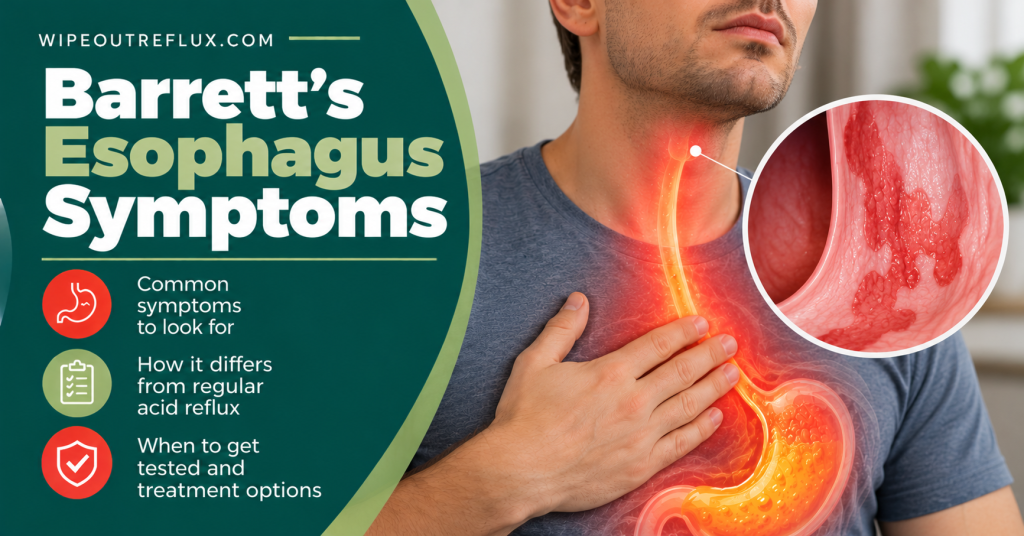
Barrett’s esophagus itself doesn’t cause any symptoms. The cell changes in the lining of the lower esophagus can’t be felt, so the “symptoms of Barrett’s esophagus” are really the symptoms of the long-standing acid reflux (GERD) that usually causes it: frequent heartburn, regurgitation of acid or food, a sour taste, chest discomfort, and sometimes trouble swallowing.
That’s also why Barrett’s is easy to miss. Some people with it have had obvious heartburn for years, while others have mild or no reflux symptoms at all. The only way to diagnose Barrett’s esophagus is an endoscopy with biopsies.
The reassuring part is that most people with reflux never develop Barrett’s, and most people with Barrett’s never develop cancer. Knowing your risk factors and the few warning signs that need prompt attention is what matters most.
Key Takeaways
- Barrett’s esophagus has no symptoms of its own; the symptoms people notice come from the underlying reflux.
- Typical associated symptoms are frequent heartburn, regurgitation, sour taste, chest discomfort and, in some people, difficulty swallowing.
- Barrett’s can be present with little or no reflux: in one population study, 1.2% of people without reflux symptoms had it.
- About 1.6% of the general adult population has Barrett’s, rising in people with long-standing reflux.
- The biggest risk factors are years of reflux, male sex, age over 50, white ethnicity, smoking, central obesity and a family history.
- Diagnosis requires an endoscopy and a biopsy showing intestinal-type cells in the esophagus.
- The yearly risk of Barrett’s turning into cancer is low, around 0.12% in a large study.
- Difficulty swallowing, food sticking, weight loss, vomiting blood or black stools need prompt medical attention.
What Is Barrett’s Esophagus?
The esophagus is normally lined with flat, layered cells (squamous cells), a bit like the skin inside your mouth. They cope well with food and drink but poorly with repeated exposure to stomach acid and bile.
In Barrett’s esophagus, years of reflux damage cause the lining at the bottom of the esophagus to be replaced by a different type of cell, one that looks more like the lining of the intestine (doctors call this intestinal metaplasia). This is thought to be an adaptation: the new cells are more resistant to acid. The downside is that this tissue has a small but real potential to develop precancerous changes (dysplasia) and, rarely, a type of cancer called esophageal adenocarcinoma.
Barrett’s is a recognized complication of GERD in the international definition of reflux disease [Vakil et al., American Journal of Gastroenterology, 2006], and US guidelines describe it as the only known precursor to esophageal adenocarcinoma [Shaheen et al., American Journal of Gastroenterology, 2022].
Barrett’s Esophagus Symptoms
Because the changed cells don’t send any pain signals, Barrett’s esophagus is silent in itself. What people experience are the symptoms of the reflux that caused it, and sometimes of complications that develop alongside it.
Symptoms of the underlying reflux
- Frequent heartburn: a burning feeling behind the breastbone, often after meals or at night
- Regurgitation: acid, bile or food coming back up into the throat or mouth
- A sour or bitter taste, especially in the morning
- Chest discomfort or pressure after eating
- Night-time symptoms: waking with heartburn, coughing or acid in the throat
- Burping, bloating or nausea
- Throat symptoms such as hoarseness, chronic cough or throat clearing in some people
If you want to understand what these feel like in more detail, see my guide to heartburn or heart attack, which also explains the chest pain warning signs that need urgent help.
Symptoms that can suggest complications
These aren’t caused by Barrett’s itself, but they can signal something that needs checking, such as a narrowing (stricture), severe inflammation or, rarely, cancer:
- Difficulty swallowing or food feeling like it sticks in the chest
- Pain when swallowing
- Unintentional weight loss
- Vomiting, especially vomiting blood or material that looks like coffee grounds
- Black, tarry stools
- Anemia or unexplained tiredness
Any of these deserves a prompt appointment with your doctor. My guide to dysphagia explains swallowing problems in more depth.
Can You Have Barrett’s Esophagus Without Symptoms?
Yes, and this is the part most people don’t realize. In a Swedish study, researchers scoped a random sample of 1,000 ordinary adults rather than patients. Barrett’s esophagus was found in 1.6% of them. Among those who reported reflux symptoms the figure was 2.3%, but it was still 1.2% in people with no reflux symptoms at all, a difference that wasn’t statistically significant [Ronkainen et al., Gastroenterology, 2005].
The same research group found that more than a third of people with visible inflammation of the esophagus didn’t report reflux symptoms either [Ronkainen et al., Scandinavian Journal of Gastroenterology, 2005]. Symptoms and damage don’t always line up.
There are a few reasons for this. Some people’s esophagus is simply less sensitive. Others have reflux mainly at night while asleep. And the Barrett’s lining itself may be less sensitive to acid than the normal lining, so heartburn can actually ease as Barrett’s develops. That’s why risk factors matter as much as symptoms when deciding who should be checked.
If your reflux mainly affects your throat rather than your chest, you may also wonder about your risk. I cover that in can silent reflux cause Barrett’s esophagus.
Who Gets Barrett’s Esophagus? Risk Factors
US guidelines suggest that people with chronic reflux symptoms plus three or more of the following risk factors should be considered for screening [Shaheen et al., American Journal of Gastroenterology, 2022]:
- Male sex
- Age over 50
- White ethnicity
- Current or past smoking
- Obesity, particularly around the waist
- A close family member (parent, sibling or child) with Barrett’s esophagus or esophageal adenocarcinoma
Other factors also raise the risk:
- Long-standing reflux. The longer and more severe your reflux, the higher the risk. In a large Swedish study, recurrent reflux symptoms were associated with about 7.7 times the odds of esophageal adenocarcinoma, and long-standing, severe symptoms with a far higher risk [Lagergren et al., New England Journal of Medicine, 1999].
- Erosive esophagitis. In a five-year follow-up study, people with erosive esophagitis at the start had about five times the risk of developing Barrett’s [Ronkainen et al., American Journal of Gastroenterology, 2011]. More in erosive esophagitis.
- A hiatal hernia, which makes reflux more frequent. See hiatal hernia and reflux.
- Alcohol and smoking, both independent risk factors in the Swedish population study [Ronkainen et al., Gastroenterology, 2005].
How Barrett’s Esophagus Is Diagnosed
Barrett’s can only be diagnosed with an upper endoscopy. A thin, flexible camera is passed through the mouth into the esophagus, usually under sedation. Normal esophageal lining looks pale pink, while Barrett’s tissue looks salmon-colored and extends up from where the stomach joins the esophagus. The doctor takes small biopsies, and a pathologist confirms the diagnosis by finding intestinal-type cells under the microscope [Shaheen et al., American Journal of Gastroenterology, 2022].
The biopsies also show whether there’s any dysplasia (precancerous change), which is graded as none, low-grade or high-grade. That grade determines what happens next. If you’ve been booked for a scope, my guide to endoscopy for acid reflux explains what to expect.
The latest guidelines also accept some non-endoscopic screening tools, such as swallowed sponge-on-a-string devices, as an alternative screening option for some people [Shaheen et al., American Journal of Gastroenterology, 2022].
Does Barrett’s Esophagus Turn Into Cancer?
Usually not. This is worth saying clearly, because a Barrett’s diagnosis can feel frightening.
In a nationwide Danish study of more than 11,000 people with Barrett’s, the risk of developing esophageal adenocarcinoma was about 0.12% per year [Hvid-Jensen et al., New England Journal of Medicine, 2011]. That’s higher than the general population, but it means roughly 1 in 860 people with Barrett’s develops cancer in a given year. The great majority never do.
The risk is lower still if there’s no dysplasia, and higher if there’s high-grade dysplasia, which is why regular surveillance scopes and treatment of dysplasia matter. My guide on whether acid reflux can cause cancer covers the bigger picture.
What Happens If You’re Diagnosed With Barrett’s?
Controlling reflux
Almost everyone with Barrett’s is advised to take a proton pump inhibitor (PPI) to control acid. Alongside medication, the lifestyle changes with the strongest evidence for reflux are losing weight if you’re carrying extra, stopping smoking, avoiding late evening meals and raising the head of your bed [Ness-Jensen et al., Clinical Gastroenterology and Hepatology, 2016]. If you smoke, see can smoking cause acid reflux.
Diet matters too. Reducing reflux triggers, eating smaller meals and finishing dinner well before bed all lower how much acid reaches the esophagus. My Wipeout Diet Plan lays out exactly what to eat and when, so you can calm reflux day to day alongside whatever your doctor prescribes.
Surveillance
People with Barrett’s are usually offered repeat endoscopies to check for changes. Without dysplasia, US guidelines suggest a scope every three to five years depending on the length of the Barrett’s segment, with shorter intervals if dysplasia is found [Shaheen et al., American Journal of Gastroenterology, 2022].
Treatment of dysplasia
If low-grade or high-grade dysplasia is found, guidelines recommend endoscopic eradication therapy, such as radiofrequency ablation, which removes the abnormal lining so healthy tissue can grow back [Shaheen et al., American Journal of Gastroenterology, 2022]. Whether Barrett’s can go away on its own is a common question, and I cover it in is Barrett’s esophagus reversible.
Surgery
Anti-reflux surgery such as fundoplication may be considered for people whose reflux isn’t controlled by medication or who don’t want long-term tablets. It controls reflux well, though it hasn’t been shown to reliably reverse Barrett’s. See Nissen vs Toupet fundoplication.
Should You Be Checked for Barrett’s Esophagus?
Talk to your doctor about an endoscopy if:
- You’ve had reflux symptoms most weeks for five years or more, especially with any of the risk factors above
- You’ve relied on antacids or acid-suppressing medicine for years without ever being assessed
- A close relative has had Barrett’s esophagus or esophageal cancer
- Your heartburn has changed character or stopped responding to treatment
See a doctor promptly if you have difficulty swallowing, food sticking, weight loss you can’t explain, vomiting blood, black stools, or anemia. These alarm symptoms need investigation regardless of your other risk factors. My guide on whether difficulty swallowing is a sign of cancer explains what doctors look for.
Conclusion
Barrett’s esophagus doesn’t produce symptoms of its own. What people notice is the reflux behind it: frequent heartburn, regurgitation, a sour taste and, sometimes, swallowing problems. Because Barrett’s can also turn up in people with mild or no reflux symptoms, your risk factors (years of reflux, being male, over 50, a smoker, carrying weight around the middle, or a family history) are just as important as how you feel. The good news is that Barrett’s rarely progresses to cancer, and with good reflux control and regular surveillance most people live with it without serious problems.
Whether you’ve been diagnosed with Barrett’s or simply want to protect your esophagus from years of reflux, the Wipeout Diet Plan is the most complete tool I can offer. It’s my step-by-step approach to calming reflux through what you eat, what you drink and when you eat, built on twelve years of managing reflux myself. I first designed it for silent reflux, the throat-based kind, but since it tackles the same underlying mechanisms it works just as well for GERD and long-standing heartburn.
If you’d prefer to start smaller, the Wipeout Food Reference Guide is the essential companion. It lists the foods and drinks that are safe for acid reflux and LPR, along with their pH values, so every meal works with your esophagus rather than against it.
Frequently Asked Questions
What are the symptoms of Barrett’s esophagus?
Barrett’s itself has no symptoms. People usually notice the symptoms of the reflux that causes it: frequent heartburn, regurgitation, a sour taste, chest discomfort and night-time symptoms. Difficulty swallowing, weight loss, vomiting blood or black stools can signal complications and need prompt attention.
Can you have Barrett’s esophagus without heartburn?
Yes. In a population study, 1.2% of adults without reflux symptoms had Barrett’s esophagus, compared with 2.3% of those with symptoms. Some people have reduced sensitivity or reflux mainly at night, and heartburn can even ease as Barrett’s develops.
How do I know if I have Barrett’s esophagus?
The only way to know is an upper endoscopy with biopsies. Symptoms alone can’t confirm or rule it out. If you’ve had reflux for years and have risk factors such as being male, over 50, a smoker or overweight, ask your doctor whether screening makes sense for you.
How common is Barrett’s esophagus?
About 1.6% of the general adult population had Barrett’s in a Swedish endoscopy study. It’s more common in people with long-standing reflux and erosive esophagitis.
Is Barrett’s esophagus cancer?
No. Barrett’s is a change in the type of cells lining the esophagus, not cancer. It carries a small increased risk of esophageal adenocarcinoma, about 0.12% per year in a large Danish study, which is why surveillance scopes are recommended.
Does Barrett’s esophagus cause pain?
Not directly. Any pain usually comes from reflux, inflammation (esophagitis) or complications such as an ulcer or narrowing. Pain or difficulty when swallowing should always be checked by a doctor.
Can Barrett’s esophagus be cured?
Barrett’s with dysplasia can often be removed with endoscopic treatments such as radiofrequency ablation, allowing normal lining to grow back. For Barrett’s without dysplasia, the focus is on controlling reflux and regular surveillance, and the outlook is very good for most people.
Research & References
- [Vakil et al., American Journal of Gastroenterology, 2006] — The Montreal global consensus defining GERD and its complications, including a definition for suspected and proven Barrett’s esophagus.
- [Shaheen et al., American Journal of Gastroenterology, 2022] — Updated ACG guideline on Barrett’s esophagus covering its definition as the only known precursor of esophageal adenocarcinoma, screening criteria including nonendoscopic methods, surveillance intervals, and endoscopic eradication therapy for low- and high-grade dysplasia.
- [Ronkainen et al., Gastroenterology, 2005] — Population-based endoscopic study of 1,000 Swedish adults finding Barrett’s esophagus in 1.6%, including 2.3% of those with reflux symptoms and 1.2% of those without, with alcohol and smoking as independent risk factors.
- [Ronkainen et al., Scandinavian Journal of Gastroenterology, 2005] — Kalixanda study finding reflux symptoms in 40% of adults and erosive esophagitis in 15.5%, with 36.8% of those with esophagitis reporting no reflux symptoms.
- [Lagergren et al., New England Journal of Medicine, 1999] — Swedish population-based case-control study finding recurrent reflux symptoms associated with 7.7 times the odds of esophageal adenocarcinoma, rising to 43.5 with long-standing, severe symptoms.
- [Ronkainen et al., American Journal of Gastroenterology, 2011] — Five-year community-based endoscopic follow-up finding erosive esophagitis at baseline associated with a fivefold increased risk of developing Barrett’s esophagus.
- [Hvid-Jensen et al., New England Journal of Medicine, 2011] — Danish nationwide cohort of more than 11,000 Barrett’s patients showing an annual adenocarcinoma risk of 0.12%, about 11 times the general population risk but low in absolute terms.
- [Ness-Jensen et al., Clinical Gastroenterology and Hepatology, 2016] — Systematic review finding weight loss, smoking cessation, avoiding late evening meals and head-of-bed elevation were the lifestyle measures with the best evidence in GERD.

David Gray
12 years living with LPR · Consultant & researcher
I've lived with LPR for twelve years — the misdiagnoses, the PPI courses that did nothing, the slow work of figuring out what actually helps. Wipeout Reflux is where I translate the research into plain terms for people stuck in the same place. Every claim here is sourced to peer-reviewed work, and I consult one-to-one with LPR sufferers.