
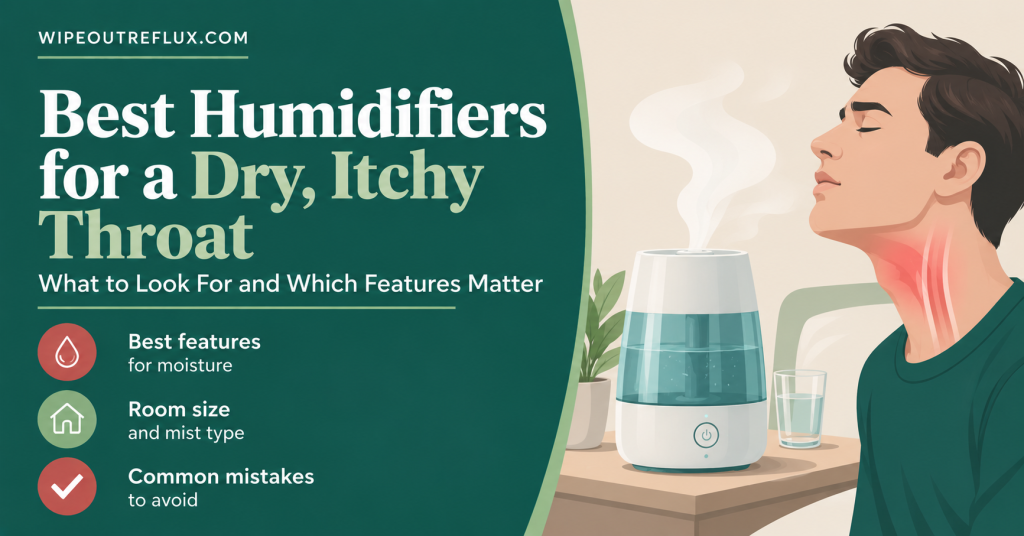
If you wake up with a dry, scratchy or itchy throat, a bedroom humidifier is one of the cheapest fixes you can try. The goal is simple: keep the air in your bedroom at about 40 to 50% humidity overnight, so your throat isn’t losing moisture with every breath while your saliva production is at its lowest.
For most people, my top pick is the LEVOIT LV600HH. It has a large tank that lasts all night, both warm and cool mist, and a built-in humidity sensor so it holds your target level instead of guessing. If you want no white dust and as little upkeep worry as possible, an evaporative model like the Honeywell HCM-350 is the safer choice.
Below I explain why dry air hits your throat so hard at night, which type of humidifier to choose, my six picks, and the honest limits. A humidifier won’t fix a dry throat caused by reflux on its own.
Disclosure: As an Amazon Associate, WipeoutReflux earns from qualifying purchases made through the links on this page, at no extra cost to you. I only recommend products I’d genuinely suggest.
Key Takeaways
- Aim for 40 to 50% humidity in your bedroom. Too dry irritates your throat. Above 60% encourages dust mites and mold.
- Your throat is most vulnerable at night because saliva production drops sharply during sleep, and mouth breathing dries it further.
- Evaporative humidifiers can’t over-humidify a room and don’t release mineral dust, but they need wick changes.
- Ultrasonic humidifiers are quiet and efficient, but use distilled water. Tap water can fill the air with fine mineral particles.
- Warm mist humidifiers boil the water, so the mist is cleaner, but they’re a burn risk around kids and pets.
- Best overall: LEVOIT LV600HH. Best evaporative: Honeywell HCM-350.
- Clean your humidifier regularly. A dirty one can spray bacteria and mold into the air you breathe all night.
- If your throat stays dry and hoarse even with good humidity, look at reflux, medications or a blocked nose.
Why Dry Air Hits Your Throat So Hard at Night
During the day, you make saliva constantly and swallow it hundreds of times, which keeps your throat coated. When you fall asleep, saliva production drops to a trickle and you swallow far less often. Your throat spends 7 or 8 hours with very little moisture of its own, so the air around you matters a lot more at night than during the day.
Dry air pulls moisture from the lining of your nose, mouth and throat with every breath. Winter heating, air conditioning and living somewhere dry all lower indoor humidity, sometimes well below 30%. That’s when you wake up with a throat that feels like sandpaper.
Mouth breathing makes it much worse, because it skips your nose, the body’s built-in humidifier. In a sleep study, mouth breathing made the mouth noticeably more acidic overnight compared with nose breathing, because there wasn’t enough saliva to buffer it [Choi et al., Journal of Oral Rehabilitation, 2016]. And in a voice study, just 15 minutes of mouth breathing dried the vocal folds enough to make speaking more effortful [Sivasankar and Fisher, Journal of Speech, Language, and Hearing Research, 2003]. That’s why so many people wake up with a dry throat and a croaky voice.
For the full list of causes, including reflux, medications and sleep apnea, see my guide to dry throat at night. If your main symptom is itching rather than dryness, see itchy throat.
Does a humidifier actually help?
The clearest evidence comes from people using CPAP machines for sleep apnea, where the constant airflow is very drying. In a trial of people starting CPAP, a heated humidifier significantly reduced dry mouth, dry throat and dry nose compared with no humidification, and people used their machines for longer each night [Massie et al., Chest, 1999]. A room humidifier works on the same principle: wetter air means less moisture pulled from your airways.
Which Type of Humidifier Is Best for a Dry Throat?
Evaporative (cool)
A fan blows room air through a wet wick or filter, and the water evaporates into the room. Because evaporation slows as the air gets more humid, these naturally regulate themselves and are hard to overdo. They don’t spray water droplets, so there’s no white mineral dust.
- Good for: people who want low maintenance worry, hard-water areas, homes with kids
- Downsides: fan noise, and wicks need replacing every few months
Ultrasonic (cool mist)
A plate vibrating at ultrasonic speed breaks water into a fine mist. They’re very quiet, which makes them popular for bedrooms, and they use little power. The catch is the water. Whatever minerals are in your water get thrown into the air with the mist. Researchers at the University of Alberta found that running an ultrasonic humidifier with tap water produced fine particle levels comparable to a polluted city, while distilled water produced essentially none [Lau et al., Indoor Air, 2020]. Those particles are small enough to reach deep into the airways, which is the last thing an irritated throat needs.
- Good for: light sleepers, if you’re happy to use distilled or demineralized water
- Downsides: white dust and fine particles with tap water, and they can over-humidify without a humidity sensor
Warm mist (steam)
These boil the water and release it as steam, which kills germs in the water and leaves minerals behind in the tank. The mist feels soothing on a dry throat.
- Good for: adults who like warm, soothing air in winter
- Downsides: hot water is a burn risk around children and pets, they use more electricity, and mineral scale builds up in the heating chamber
My take
If you can commit to distilled water, a good ultrasonic or hybrid model with a humidity sensor is the most pleasant to live with. If you won’t buy distilled water, go evaporative. Avoid running an ultrasonic model on tap water in the room you sleep in.
What to Look For
- A humidity sensor (humidistat): lets you set a target such as 45% and holds it. Without one, it’s easy to overshoot and end up with a damp, musty room.
- Tank size: big enough to run 8 hours or more on your chosen setting, so it doesn’t run dry at 3 a.m.
- Easy to clean: a wide opening, few nooks, and ideally parts you can scrub or put in the dishwasher. A humidifier you won’t clean is worse than none.
- Quiet operation: important in a bedroom. Look for a sleep mode and a display you can turn off.
- Room size rating: match it to your bedroom, not your whole home.
- Auto shut-off: turns off when the tank is empty.
One thing I’d skip: scent pads and essential oil trays. Menthol, mint and strong essential oils can irritate a sensitive throat, and mint is known to relax the valve at the top of the stomach, which is the opposite of what you want if you have reflux.
Best Humidifiers for a Dry, Itchy Throat
My picks cover the main types and budgets. Prices and models change, so confirm the current listing on Amazon before you buy.
LEVOIT LV600HH Hybrid Humidifier — best overall
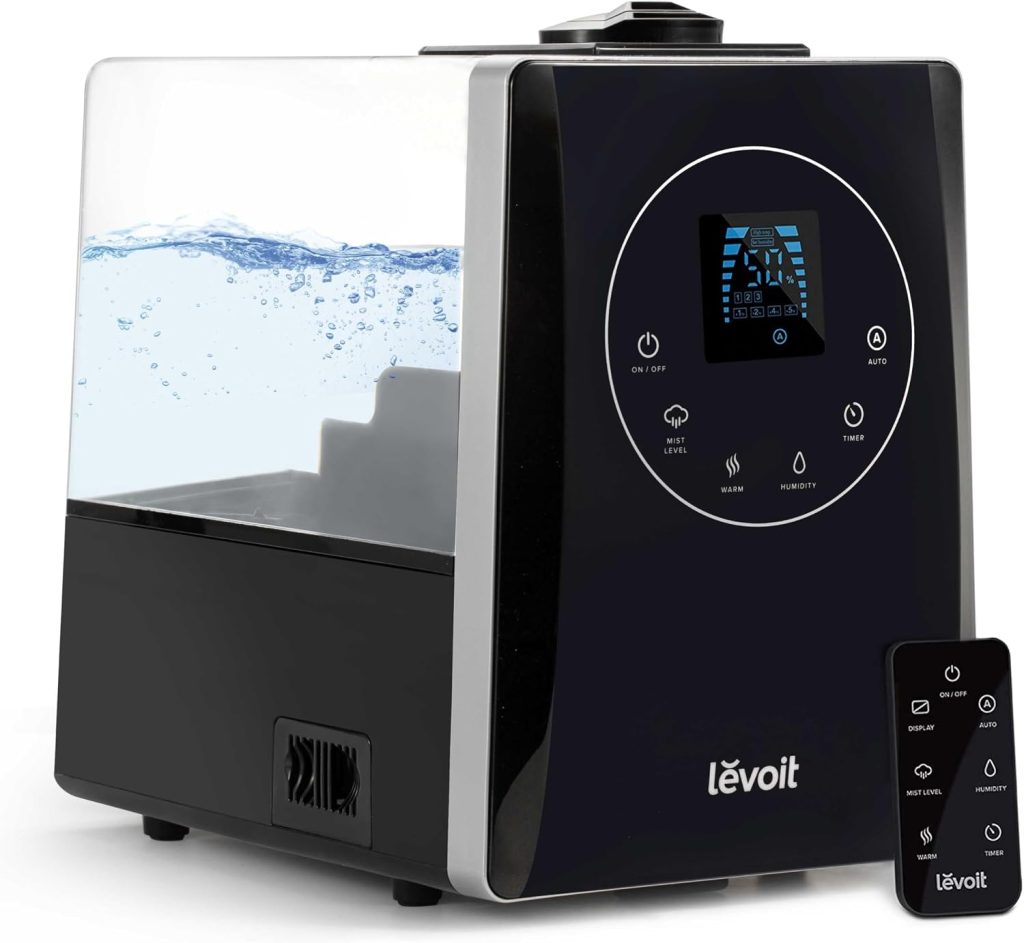
This is the one I’d point most people to. It offers both cool mist and warm mist, so you can switch to warm in winter for a more soothing feel. The 6-liter tank comfortably lasts through the night, and the built-in humidity sensor means you can set your target and let it hold steady rather than flooding the room.
- Type: ultrasonic with a warm mist option
- Best for: bedrooms, all-night use, people who want set-and-forget humidity control
- Watch out for: use distilled water in cool mode to avoid white dust
Honeywell HCM-350 Cool Moisture Humidifier — best evaporative
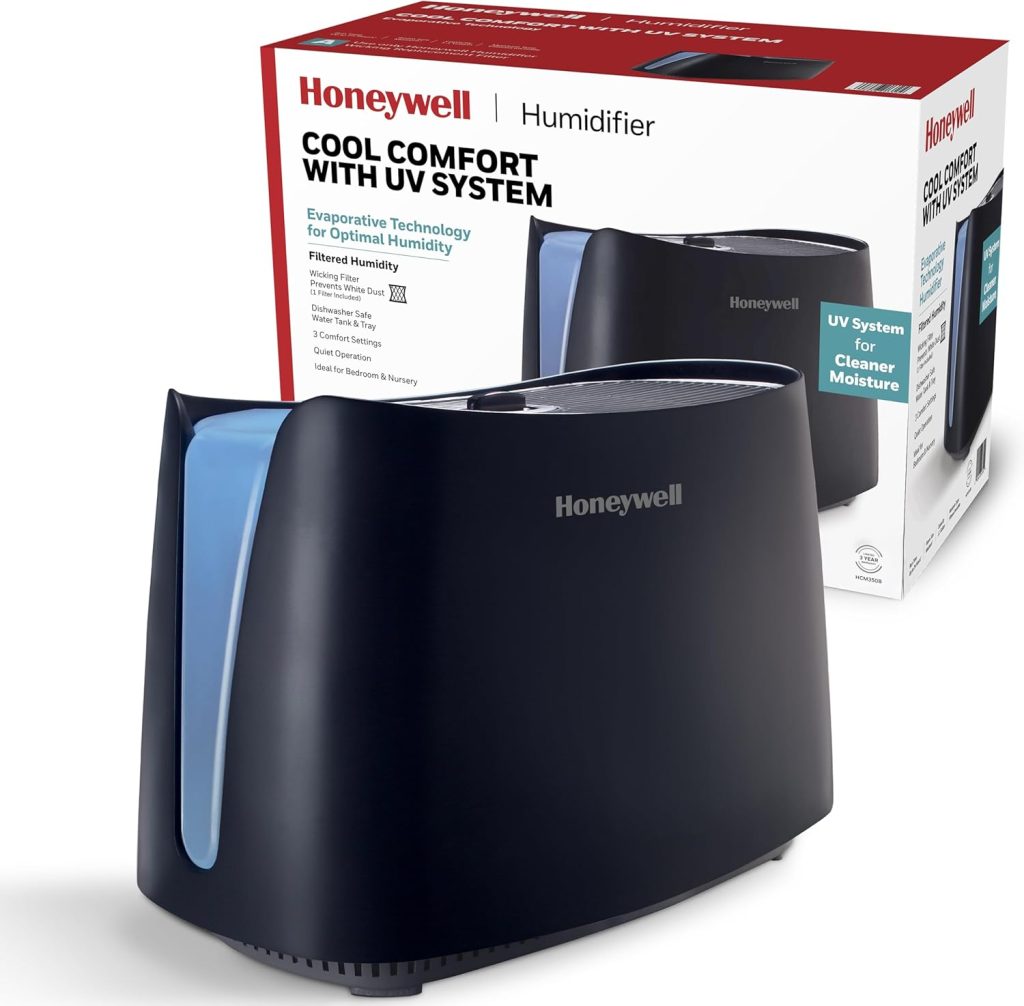
A long-standing evaporative model with UV technology designed to help keep the water clean. Because it’s evaporative, it can’t push your room into soggy territory, and it won’t throw mineral dust into the air even if you use tap water. If you’re in a hard-water area or don’t want to buy distilled water, this is the one I’d choose.
- Type: evaporative
- Best for: hard water, people who want a self-regulating humidifier
- Watch out for: some fan noise, and you’ll need replacement wicks
Canopy Bedside Humidifier — best for easy cleaning
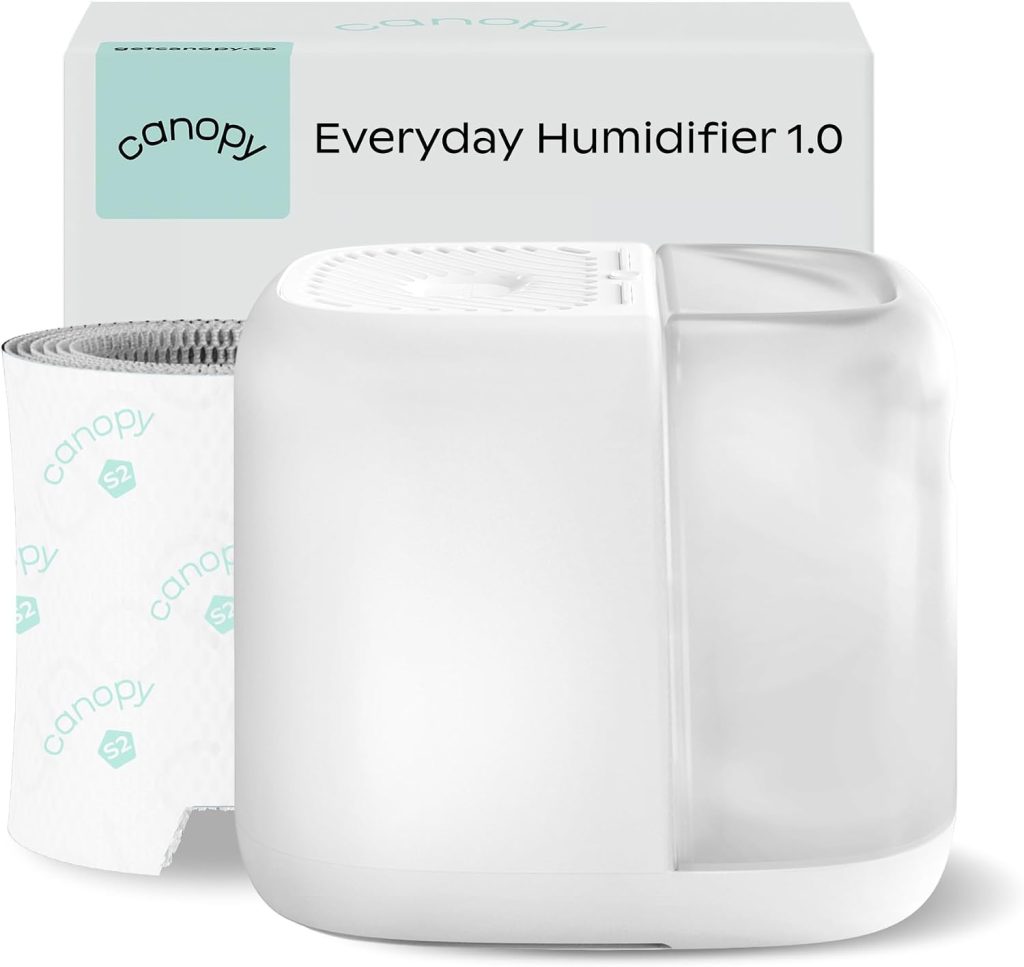
Canopy built this around the problem that ruins most humidifiers: people don’t clean them. It uses a mist-free evaporative design and comes apart easily so you can wash the parts. It’s compact enough for a nightstand and looks better than most. It costs more than the others here, and you’ll need to buy replacement filters.
- Type: evaporative
- Best for: people who know they won’t scrub a humidifier every few days
- Watch out for: higher price and ongoing filter costs
Vicks Warm Mist Humidifier (V745A) — best warm mist on a budget
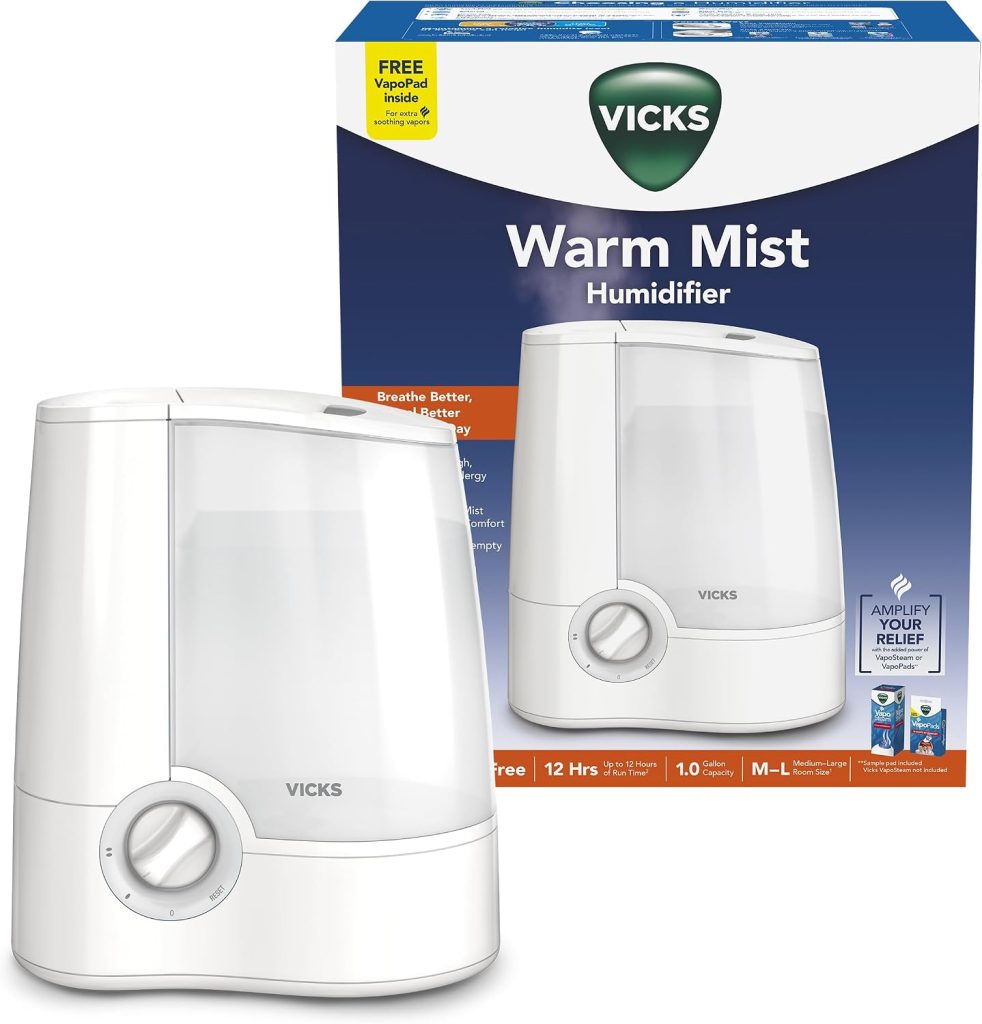
A simple, inexpensive warm mist humidifier. Boiling the water means the steam is clean, and many people find warm, moist air especially soothing on a raw throat in winter. It comes with a scent pad tray, but I’d leave it empty if you have reflux or a sensitive throat, since menthol can irritate it.
- Type: warm mist
- Best for: adults who want soothing warm air without spending much
- Watch out for: hot water and steam, so keep it away from children and pets, and descale it regularly
Pure Enrichment MistAire Ultrasonic Humidifier — best budget cool mist
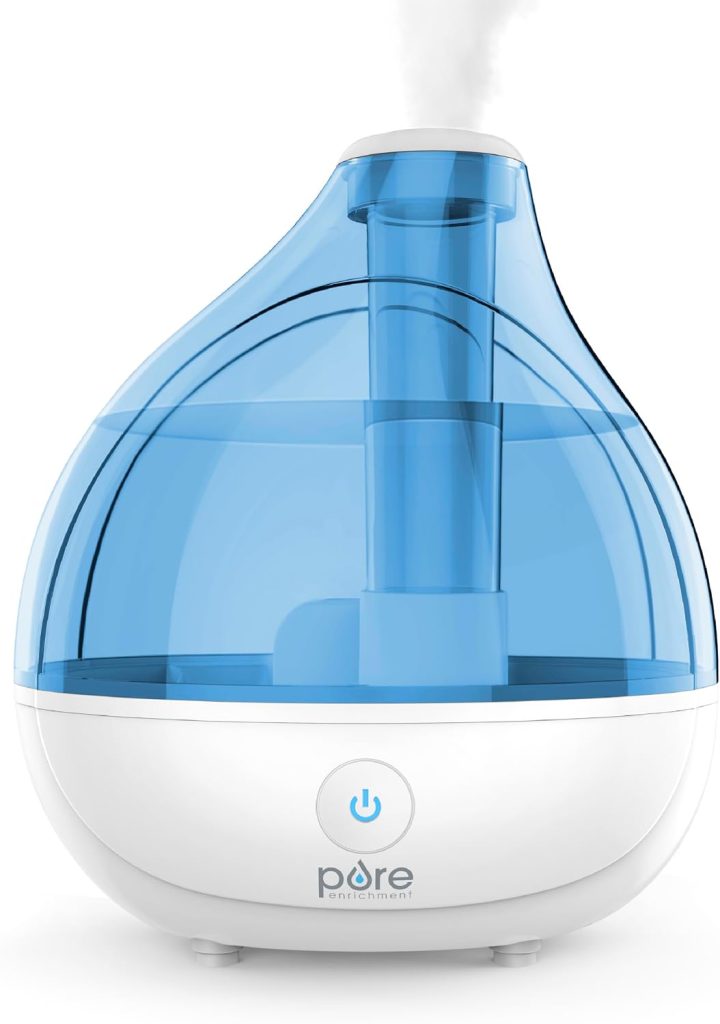
A compact, quiet cool mist humidifier that’s popular for good reason. It’s small enough for a bedside table and is a good value way to take the edge off dry winter air in a smaller bedroom. It doesn’t have the humidity sensor of the LEVOIT, so pair it with a cheap hygrometer and adjust the output yourself.
- Type: ultrasonic
- Best for: small bedrooms and tight budgets
- Watch out for: use distilled water, and keep an eye on humidity so it doesn’t creep too high
Pure Enrichment MistAire Travel Humidifier — best for travel
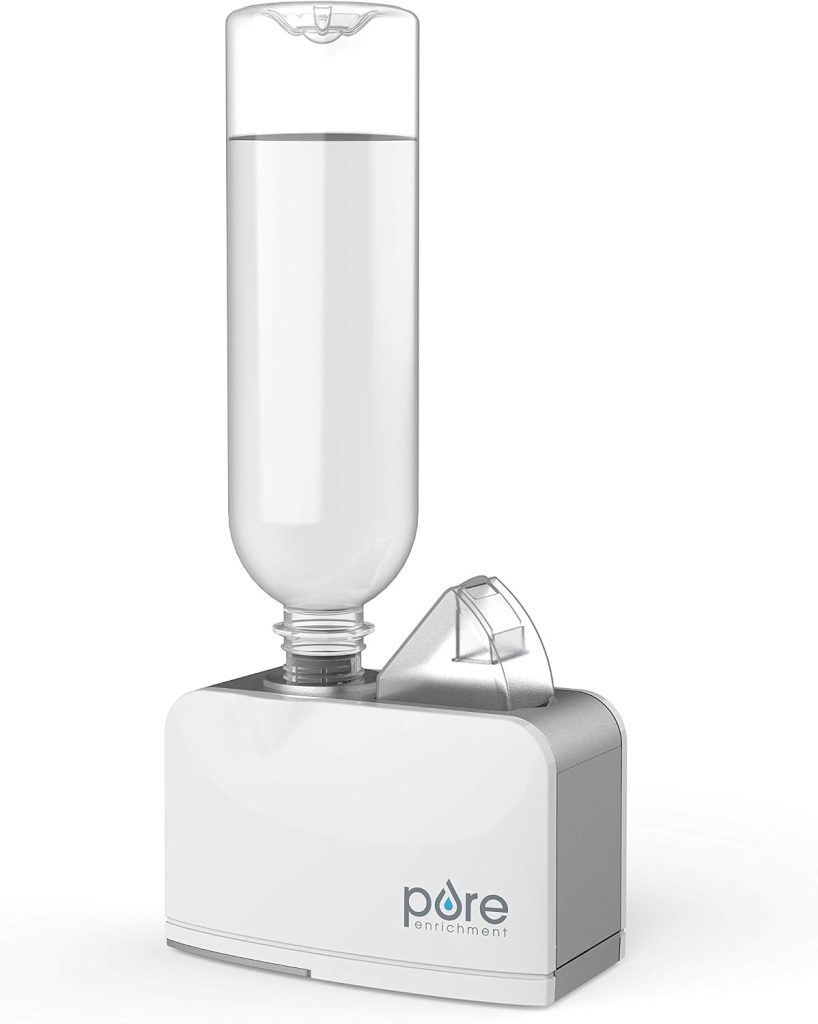
Hotel rooms are often very dry, and that’s when many people find their throat at its worst. This small portable humidifier works with a bottle of water, so you can use it on trips, in an office or on a desk. It’s only meant for a small space close to you, but it’s far better than nothing in a dry hotel room.
- Type: portable ultrasonic
- Best for: hotels, travel and desks
- Watch out for: small output, so keep it close to your bed
Don’t forget a hygrometer
Whichever humidifier you buy, add a cheap digital hygrometer such as the ThermoPro TP50. It tells you whether your bedroom is actually dry before you start, and whether your humidifier is overdoing it once you do. It’s the easiest way to keep to 40 to 50%.
How to Use a Humidifier for the Best Results
- Set it to 40 to 50%. Check with a hygrometer. If you see condensation on windows or a musty smell, turn it down.
- Use distilled or demineralized water in ultrasonic models. In evaporative models, tap water is fine.
- Empty and refill daily. Don’t just top up old water. Let the tank dry out when you’re not using it.
- Clean it at least weekly. Follow the manufacturer’s instructions. White vinegar removes scale. Rinse thoroughly afterward.
- Place it well. Put it a few feet from your bed, on a raised surface, away from walls, curtains and wooden furniture.
- Skip scents. Don’t add essential oils unless the manufacturer allows it, and avoid menthol and mint if you have reflux.
- Close the bedroom door. It’s much easier to humidify one room than a whole floor.
The Honest Limits of a Humidifier
A humidifier fixes dryness caused by dry air. It won’t fix a dry or itchy throat that comes from somewhere else, and in my experience that’s often the case.
Reflux is the big one. When you lie down, stomach contents can reach your throat more easily, and with less saliva and swallowing overnight, they’re cleared more slowly. Pepsin from the stomach then irritates the throat lining, which feels dry, scratchy or itchy by morning. The tell-tale signs are a hoarse voice on waking, throat clearing, mucus, and water that only helps for a minute. If that’s you, a humidifier will help a bit, but the real fix is stopping reflux overnight: eating 3 hours before bed, raising the head of your bed, and cutting the acidic and fatty foods that set it off. That’s exactly what the Wipeout Diet Plan is built to do. See also acid reflux at night and acid reflux and dry mouth.
Other causes a humidifier won’t fix:
- A blocked nose that forces you to mouth-breathe. Treat the congestion. See LPR vs allergies.
- Snoring and sleep apnea. See sleep apnea and acid reflux. If you use CPAP, ask about its heated humidifier instead.
- Drying medications such as antihistamines, some antidepressants and blood pressure tablets.
- Medical causes like diabetes or Sjögren’s syndrome, especially if your mouth and eyes are dry all day.
Conclusion
A bedroom humidifier is a simple, inexpensive way to stop dry air stripping moisture from your throat overnight, when your saliva is at its lowest and mouth breathing makes things worse. Keep the room at 40 to 50% humidity, use distilled water in ultrasonic models, and clean it every week. For most people, the LEVOIT LV600HH is the best all-round choice. If you’d rather avoid mineral dust and distilled water altogether, go for the Honeywell HCM-350.
But if you’ve got the humidity right and still wake up dry, hoarse and clearing your throat, reflux is the more likely culprit, and that’s where the Wipeout Diet Plan comes in. It’s my complete, step-by-step plan for the evening habits and low-acid foods that keep reflux away from your throat overnight. It was designed mainly for silent reflux, the throat-based kind behind most dry, scratchy mornings, but because it tackles the same root causes, it works just as well for GERD and classic heartburn.
For a lighter starting point, the Wipeout Food Reference Guide is the essential companion. It lists the foods and drinks that are safe for acid reflux and LPR, along with their pH values, so you can pick an evening meal that won’t leave your throat raw by morning.
Frequently Asked Questions
Does a humidifier help a dry throat?
Yes, if dry air is part of the cause. Keeping your bedroom at 40 to 50% humidity means less moisture is pulled from your throat overnight. It helps less if the dryness comes from reflux, medications or a blocked nose.
Is a cool mist or warm mist humidifier better for a dry throat?
Both add the same moisture to the air. Warm mist can feel more soothing and produces cleaner mist, but is a burn risk around children and pets. Cool mist is safer and cheaper to run. Evaporative cool models are the lowest-maintenance option.
Can a humidifier help an itchy throat?
It can if the itch is caused by dry air or mouth breathing. If it’s allergies, keep humidity below 50%, because higher humidity encourages dust mites and mold. If the itch comes from reflux, a humidifier won’t fix it on its own.
What humidity is best for sleeping with a dry throat?
Around 40 to 50% relative humidity. Below about 30% the air is dry enough to irritate your throat, and above 60% you risk dust mites, mold and condensation.
Should I use tap water or distilled water in my humidifier?
Use distilled or demineralized water in ultrasonic humidifiers, because tap water minerals get thrown into the air as fine dust. Evaporative and warm mist models are fine with tap water, but warm mist units need regular descaling.
Can a dirty humidifier make my throat worse?
Yes. Standing water can grow bacteria and mold, which a humidifier then sprays into the air. Empty and refill it daily, let it dry out between uses, and clean it at least once a week.
Where should I put a humidifier in my bedroom?
A few feet from your bed, on a raised surface, and away from walls, curtains and wooden furniture. Close the door so it only has to humidify one room.
Research & References
- [Choi et al., Journal of Oral Rehabilitation, 2016] — In healthy volunteers, mouth breathing during sleep lowered intraoral pH compared with nasal breathing, with prolonged drops into the acidic range.
- [Sivasankar and Fisher, Journal of Speech, Language, and Hearing Research, 2003] — 15 minutes of mouth breathing, but not nasal breathing, increased vocal effort and phonation threshold pressure, attributed to surface drying of the vocal folds.
- [Massie et al., Chest, 1999] — In people starting CPAP, heated humidification reduced dry mouth, throat and nose and increased nightly CPAP use, while cold passover humidification did not improve use.
- [Lau et al., Indoor Air, 2020] — Running an ultrasonic humidifier with tap water generated high indoor fine particle (PM2.5) levels that spread through the home, while distilled water produced essentially none.

David Gray
12 years living with LPR · Consultant & researcher
I've lived with LPR for twelve years — the misdiagnoses, the PPI courses that did nothing, the slow work of figuring out what actually helps. Wipeout Reflux is where I translate the research into plain terms for people stuck in the same place. Every claim here is sourced to peer-reviewed work, and I consult one-to-one with LPR sufferers.