
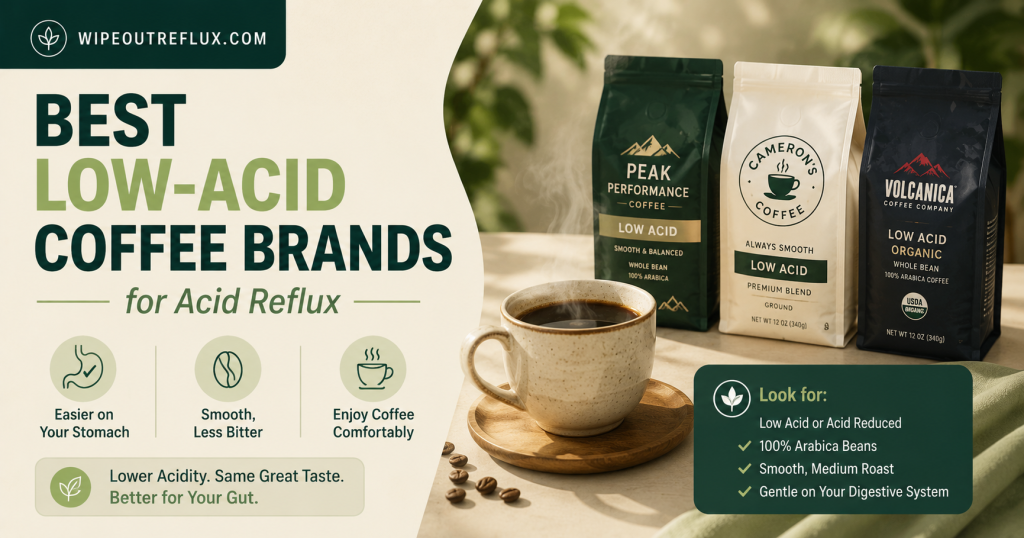
If coffee gives you heartburn but you’re not ready to give it up, low-acid coffee is the compromise worth trying. The best US brands for reflux-prone drinkers are Lifeboost, Puroast, Volcanica, trücup, Tieman’s and Java Planet — each getting to “low acid” a different way, from slow roasting to careful origin selection.
One honest caveat up front, because it changes how you should use this list: “low acid” mostly refers to a gentler, less sour taste and, for some brands, less stimulation of stomach acid. It doesn’t mean the coffee won’t affect reflux at all — coffee still nudges acid production and can relax the valve at the top of your stomach. So these brands genuinely help a lot of people drink coffee comfortably again, but they’re a smarter choice rather than a cure.
Here are the brands worth your money, what makes each one gentler, and how to brew for the least reflux.
Key Takeaways
- Top US low-acid coffee brands for reflux: Lifeboost, Puroast, Volcanica, trücup, Tieman’s and Java Planet.
- Coffee becomes “low acid” three ways — darker/slower roasting, naturally low-acid origins, or a special de-acidifying process.
- Dark roasts are gentler on the stomach than lighter ones: a dark roast stimulated significantly less gastric acid than a medium roast in a clinical study, thanks to a compound called N-methylpyridinium.
- Low-acid coffee helps with taste and, for some, acid stimulation — but coffee can still trigger reflux by relaxing the lower esophageal valve.
- Decaf is worth considering, since caffeine itself stimulates acid.
- How you brew matters as much as the brand: cold brew and darker roasts are typically the easiest on reflux.
- If even low-acid coffee still triggers you, the problem may be coffee itself rather than its acidity.
First, what actually makes coffee “low acid”?
It helps to know what you’re buying, because brands use the term to mean slightly different things. There are three legitimate routes to a lower-acid cup:
- Roast level. The longer and darker the roast, the more of coffee’s acids are broken down — and, importantly, the more of a stomach-friendly compound is created (more on that below). Dark roasts are generally the gentlest.
- Origin and growing conditions. Beans grown at lower altitudes, or in volcanic soil, or in certain regions (Brazil, Sumatra, Nicaragua) are naturally lower in acidity before roasting even begins.
- Special processing. Some brands use a proprietary roasting or treatment process specifically designed to strip out the acids and compounds that irritate sensitive stomachs.
None of these is “better” in the abstract — they just suit different priorities. If you want the science on coffee’s actual pH and why it varies, I go deep on it in is coffee acid or alkaline.
The science: why dark roast is gentler
This is the single most useful thing to understand, and it applies no matter which brand you pick.
During roasting, a compound called N-methylpyridinium (NMP) forms, and it appears to actually turn down the stomach’s acid production. The longer the roast, the more of it there is — dark roasts contain roughly three times as much as medium roasts. In a clinical study measuring stomach pH in real time, a dark roast blend stimulated significantly less gastric acid than a medium roast with near-identical caffeine, and the researchers linked the effect to that higher NMP content Rubach et al., Molecular Nutrition & Food Research, 2014.
A broader review of coffee and the gut reached the same theme — NMP at coffee-brew concentrations reduces the machinery cells use to secrete acid — while also noting the honest complication: coffee as a whole still stimulates gastric acid secretion, so roast chemistry shifts the balance rather than switching the effect off entirely Nehlig, Nutrients, 2022. The practical takeaway is simple: lean dark. It’s the most evidence-backed lever you have, and it’s why most of the brands below emphasise darker roasts. There’s more on this in is coffee bad for acid reflux.
The best low-acid coffee brands (US)
Lifeboost — best overall for sensitive stomachs
Lifeboost is the brand reflux drinkers mention most. Its beans are shade-grown in the Nicaraguan mountains, hand-picked and spring-water washed, and it’s frequently ranked among the least acidic coffees on the market by pH. The dark roast in particular is a popular daily choice for people who thought they’d had to quit coffee. It’s a premium product with a price to match, but if you want the best odds of a comfortable cup, it’s the safe first bet.
Puroast — best value and widest availability
Puroast uses a slow, indirect wood-fire roasting process and claims it produces coffee around 70% less acidic than standard brands, with references to University of California testing behind its antioxidant and acid claims. It’s affordable, easy to find in ordinary supermarkets, and a sensible entry point if you want to test whether low-acid coffee helps you before spending more.
trücup — best for the most sensitive stomachs
trücup is built specifically around a proprietary process that removes many of the compounds that irritate sensitive stomachs, not just lowering the sour taste. It has a devoted following among people with genuinely reflux-prone or ulcer-prone stomachs who react to almost everything else, and it offers a range of roasts including decaf.
Volcanica — best for variety and single origins
Volcanica sources from volcanic regions, where the soil tends to yield naturally lower-acid beans, and offers a dedicated low-acid line alongside a big catalogue of single origins. Because the acid reduction comes from origin rather than a uniform process, levels vary a little between offerings — but for coffee lovers who want choice and quality rather than a one-size product, it’s the pick.
Tieman’s — best naturally low-acid Arabica
Tieman’s uses careful bean selection from Arabica regions like Ecuador, Guatemala and Colombia, medium-roasted for lower acidity, and lands among the higher-pH (gentler) coffees available. A solid, straightforward option if you prefer a lighter cup than a heavy dark roast but still want low acidity.
Java Planet — best organic
Java Planet is USDA-certified organic and focuses on low-acid beans from specific origins, usually offered in medium-dark to dark roasts. The choice if organic certification matters to you alongside gentleness.
Brew it for the least reflux
The brand is only half the equation — how you make it matters just as much:
- Go dark. Whatever brand you choose, the darker roast in their range is usually the gentlest, for the NMP reason above.
- Try cold brew. Cold-water extraction pulls out noticeably less acid than hot brewing, and many reflux sufferers tolerate cold brew best of all.
- Consider decaf. Caffeine stimulates acid and can relax the lower esophageal valve, so decaffeinated versions are worth trialling — I weigh this up in is decaf coffee bad for acid reflux.
- Never drink it on an empty stomach. Coffee with or after food is far gentler than coffee first thing on nothing.
- Don’t oversize it. A smaller cup of gentle coffee beats a giant mug of it. Volume matters.
- Skip the reflux-triggering add-ins. Very rich, fatty or heavily sweetened additions can undo the benefit.
When low-acid coffee still isn’t enough
Be honest with yourself about the results. If you switch to a good dark low-acid brew, drink it after food, and still get symptoms, that’s useful information: for you, the trigger may be coffee itself — its caffeine and its relaxing effect on the valve — rather than its acidity. Low-acid coffee can only address the acid part of the equation.
If that’s where you land, it’s worth exploring genuinely gentle coffee alternatives, or looking more broadly at what to drink with acid reflux. This is especially true for throat-based silent reflux, where even small triggers can keep symptoms simmering.
Conclusion
For reflux-prone coffee lovers, low-acid brands are a genuinely good middle path — and the standouts in the US are Lifeboost for all-round gentleness, Puroast for value and availability, trücup for the most sensitive stomachs, Volcanica for variety, and Tieman’s or Java Planet for naturally low-acid and organic options. Whichever you choose, the highest-impact move is the same one the science points to: go for the darker roast, brew it cold if you can, keep the cup modest, and never drink it on an empty stomach.
Just keep the expectation right. Low-acid coffee lowers the acidity and, with dark roasts, the acid stimulation — but coffee can still provoke reflux by relaxing the valve at the top of your stomach, so this is about drinking smarter, not about a magic bean. If coffee is one of several triggers keeping your reflux going, the real progress comes from getting the whole picture of what you eat and drink under control.
That’s exactly what the Wipeout Food Reference Guide is for — the essential reference for which foods and drinks are safe with acid reflux and LPR, with their pH values, so coffee sits within a full picture rather than being guessed at in isolation. And for the complete, structured approach, the Wipeout Diet Plan goes much deeper. It was built first and foremost around LPR — the stubborn, throat-based form of reflux where drinks like coffee matter most — but because it works on the same underlying mechanisms, it’s just as effective for classic GERD and heartburn. Switch to a gentler cup, brew it kindly, and let the diet handle the bigger picture.
Frequently Asked Questions
What is the best low-acid coffee for acid reflux?
Lifeboost is the most consistently recommended all-rounder for sensitive stomachs, thanks to naturally low-acid beans and gentle dark roasts. Puroast is the best value and most widely available, and trücup is worth trying if your stomach reacts to almost everything. The best choice is partly personal, so it’s worth trialling one or two.
Does low-acid coffee really help reflux?
For many people, yes — it reduces the sour acidity and, with dark roasts, stimulates less stomach acid. But it isn’t a guaranteed fix, because coffee can still trigger reflux by relaxing the lower esophageal valve. It’s a smart swap that helps a lot of drinkers, not a cure.
Is dark roast or light roast better for acid reflux?
Dark roast, generally. Darker roasting breaks down more of coffee’s acids and produces more N-methylpyridinium, a compound shown to reduce stomach acid stimulation. In a clinical study, a dark roast stimulated significantly less gastric acid than a medium roast with similar caffeine.
Is decaf better than regular coffee for reflux?
Often, yes. Caffeine stimulates acid secretion and can relax the valve at the top of the stomach, so decaffeinated coffee removes one of coffee’s reflux triggers. Pairing a low-acid brand with decaf and a dark roast stacks the odds in your favour.
Is cold brew lower in acid than hot coffee?
Cold-brewing extracts less acid than hot brewing, so cold brew tends to taste smoother and sit more easily on a sensitive stomach. Many reflux sufferers tolerate cold brew best, especially made from a low-acid dark roast.
What if low-acid coffee still gives me heartburn?
Then the trigger may be coffee itself rather than its acidity — caffeine and coffee’s relaxing effect on the lower esophageal valve can provoke reflux regardless of acid level. In that case, gentle coffee alternatives or cutting back may help more than switching brands again.
Research & References
- Clinical study measuring real-time intragastric pH in healthy volunteers, showing a dark roast coffee blend stimulated significantly less gastric acid secretion than a medium roast with similar caffeine, attributed to higher levels of N-methylpyridinium Rubach et al., Molecular Nutrition & Food Research, 2014.
- Narrative review of coffee’s effects on the gastrointestinal tract, noting that N-methylpyridinium at coffee-brew concentrations reduces gastric acid secretion machinery, while coffee overall still stimulates gastric acid secretion Nehlig, Nutrients, 2022.

David Gray
12 years living with LPR · Consultant & researcher
I've lived with LPR for twelve years — the misdiagnoses, the PPI courses that did nothing, the slow work of figuring out what actually helps. Wipeout Reflux is where I translate the research into plain terms for people stuck in the same place. Every claim here is sourced to peer-reviewed work, and I consult one-to-one with LPR sufferers.