
If you’re buying mastic gum for reflux or gut health, the first decision is which form you want: convenient capsules with a standardised dose, or authentic Chios mastiha tears you chew like the traditional remedy. Both work — capsules are easier for a daily protocol, while the raw resin is the closest thing to how mastic has been used for centuries.
Whichever you choose, one thing matters above all: it should be genuine Chios mastic (from the resin of the Pistacia lentiscus tree on the Greek island of Chios), because that’s the material behind the actual research. On that basis my top pick for most people is Jarrow Formulas Mastic Gum 1000 mg for the capsule route, or genuine Chios Mastiha Tears from the growers’ association if you’d rather chew the real thing.
Here’s what mastic gum is, what the evidence actually supports, and my full picks by form and budget — with the honest caveats.
Key Takeaways
- Mastic gum is a tree resin from Chios, Greece, used for centuries for stomach complaints — and the research uses genuine Chios mastic specifically.
- It comes as capsules (easy, standardised) or authentic mastiha tears you chew (traditional); both are valid.
- Best overall capsule: Jarrow Formulas Mastic Gum 1000 mg — trusted brand, solid dose, good value.
- Best authentic resin: Chios Mastiha Tears from the growers’ association, the protected-origin real deal.
- The best evidence is for H. pylori and functional dyspepsia — both of which overlap with reflux — rather than reflux directly.
- Look for “Chios” or the PDO mark, a clear dose (around 1000 mg/day in the studies), and a clean capsule or pure tears with no fillers.
- It’s a promising adjunct to try alongside diet, not a proven standalone reflux cure.
What mastic gum is
Mastic gum is the dried resin (“tears”) of the mastic tree, Pistacia lentiscus var. chia, grown almost exclusively on the southern part of the Greek island of Chios. It’s been used around the Mediterranean for thousands of years as a natural remedy for stomach and digestive complaints, and it’s protected as a Chios product — which is why the origin on the label genuinely matters. The compounds in the resin have antibacterial and anti-inflammatory activity, which is the basis for its modern interest in gut health. I cover the background in full in mastic gum for acid reflux.
For reflux specifically, mastic isn’t an acid blocker or a coating agent — it works on a different part of the picture, mainly the health of the stomach environment. That makes it a companion to soothers like DGL and slippery elm rather than a replacement for them, and it earns a place in my wider list of supplements for LPR.
What the evidence shows (and doesn’t)
Here’s the honest state of play, because mastic is easy to over-hype.
The strongest evidence is for two upper-gut conditions that overlap heavily with reflux. First, H. pylori: in a randomised study, Chios mastic gum reduced H. pylori bacterial load, supporting its traditional antibacterial reputation Dabos et al., Phytomedicine, 2010. That’s relevant because H. pylori sits behind a lot of gastritis and ulcer disease and interacts with reflux. Second, functional dyspepsia: a randomised, double-blind, placebo-controlled trial found Chios mastic gum significantly improved symptoms of functional dyspepsia — the indigestion-type discomfort that frequently coexists with reflux Dabos et al., Journal of Ethnopharmacology, 2010.
What we don’t have is strong direct evidence that mastic gum treats reflux or LPR on its own. So the fair read is: mastic is a promising adjunct that may help the upper-gut picture reflux sits within — especially if H. pylori or dyspepsia is part of your story — rather than a proven anti-reflux treatment. Useful, worth trying, but not a magic bullet.
What to look for in mastic gum
- Genuine Chios origin. The research is on Chios mastic; look for “Chios,” “Chios mastiha,” or the PDO (protected designation of origin) mark. Avoid vague “mastic” with no source.
- A meaningful dose. The trials used roughly 350 mg to 1000 mg a day, so aim for a product that lets you reach that comfortably.
- The right form for you. Capsules for convenience and a standardised dose; authentic tears if you want to chew the traditional way.
- Purity. With capsules, minimal fillers; with tears, 100% pure resin and nothing added.
- A reputable brand with third-party testing, since resin quality and authenticity vary.
Best mastic gum supplements for reflux and gut health
My picks cover both forms and a range of budgets. Prices and pack sizes change, so confirm the current details on Amazon.
Jarrow Formulas Mastic Gum 1000 mg — best overall
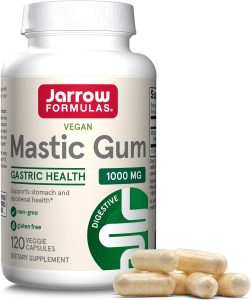
Jarrow is the default mastic gum for good reason: a reputable, third-party-tested brand, a full 1000 mg serving that matches the higher end of the research, and vegetarian capsules at a fair price. It’s the easiest way to run a consistent daily dose without fuss. For most people wanting to try mastic for gut health, this is the one to start with.
NutriCology / Allergy Research Group Mastic Gum — best premium capsule
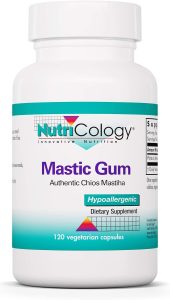
Allergy Research Group is a practitioner-favourite brand built around purity and hypoallergenic formulations. This delivers 1000 mg of Chios mastic resin per serving with a clean, minimal-filler capsule — the pick if you’re sensitive to additives or simply want a higher-end product. It usually costs more than Jarrow, but the quality focus justifies it for those who want it.
Chios Mastiha Tears (Growers’ Association) — best authentic resin
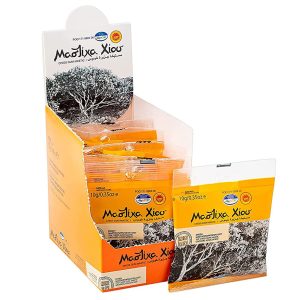
This is the real thing: 100% authentic Chios mastiha tears from the growers’ association, the protected-origin resin exactly as tradition (and the research) intends. You chew a few tears to release the resin — it’s firm and a little bitter at first, then softens into a distinctive pine-cedar gum. It’s the purest way to take mastic, with no capsule or fillers, and appeals to anyone who wants the traditional method over a pill. The trade-off is that chewing it is an acquired habit.
Greco Gum Mastic Droplets — best for chewing on the go
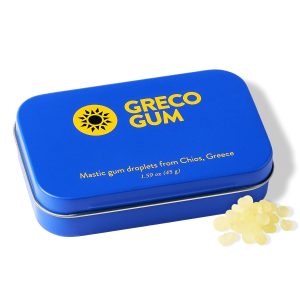
Small, pre-sized Chios mastic droplets in a handy tin, made for chewing throughout the day. They’re a tidier, more portable way to get authentic mastic than loose tears, and they’ve picked up a following for the jawline-training trend too — but for our purposes it’s the digestive-support angle and the genuine Chios origin that count. A nice middle ground between raw tears and capsules.
Jarrow Formulas Mastic Gum 500 mg — best for starting out
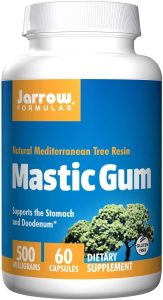
The lower-dose version of the overall pick, and a sensible way to trial mastic gum before committing. A 500 mg capsule lets you start gently and build up, or keep a lower maintenance dose, from the same trusted brand. If you’re cautious with new supplements, begin here.
How to take mastic gum for reflux and gut health
For capsules, a common approach mirrors the research: around 1000 mg a day, often taken between meals or on an empty stomach, for a course of a few weeks. If you’re using authentic tears or droplets, chew a small amount (a few tears) at a time, once or twice a day. Start low, see how your stomach responds, and build up.
As with any supplement, treat it as an adjunct. Mastic may help the upper-gut environment — particularly if H. pylori or indigestion is part of your picture — but it doesn’t replace the dietary work that actually reduces reflux episodes. If you suspect H. pylori, get it tested and treated properly rather than relying on mastic alone, and check with a pharmacist if you’re pregnant, breastfeeding, or on other medication. It pairs naturally with soothers like DGL and with the core anti-reflux approach.
Conclusion
The best mastic gum for reflux and gut health is genuine Chios mastic in whichever form suits you — Jarrow Formulas 1000 mg for an easy, well-priced capsule, or authentic Chios mastiha tears if you want to chew the traditional resin. Insist on the Chios origin, aim for a dose in the studied range, and keep your expectations calibrated: the real evidence is for H. pylori and functional dyspepsia, both of which overlap with reflux, so mastic is a promising adjunct to the upper-gut picture rather than a standalone reflux cure.
Because the foundation is still diet, a supplement only takes you part of the way. The Wipeout Food Reference Guide is the essential reference for which foods and drinks are safe for acid reflux and LPR, with their pH values laid out — the base that a soother like mastic gum sits on top of.
And if you want the full, structured method instead of a cupboard of supplements, the Wipeout Diet Plan is the complete, in-depth system for calming reflux at the source. I built it first and foremost around LPR — the stubborn, throat-based form that responds worst to medication — but because it works on the same underlying reflux mechanisms, it’s just as effective for GERD, heartburn and everyday acid reflux. Let mastic support the gut while the plan does the deeper work.
Frequently Asked Questions
What is the best mastic gum to buy?
For most people, Jarrow Formulas Mastic Gum 1000 mg is the best all-round choice — a trusted, third-party-tested brand with a dose matching the research, at a fair price. If you’d rather chew the authentic resin, Chios Mastiha Tears from the growers’ association are the protected-origin real thing. In both cases, genuine Chios origin is what matters most.
Capsules or mastic tears — which is better?
Both are valid; it comes down to preference. Capsules are convenient and give a standardised dose, which suits a daily protocol. Authentic tears are the traditional form and the purest option, but chewing them is an acquired habit. If you’re unsure, start with capsules and try the tears later.
Does mastic gum help acid reflux?
Indirectly, and the evidence is promising rather than definitive. The strongest trials are for H. pylori and functional dyspepsia, both of which overlap with reflux, rather than for reflux itself. Mastic is best seen as an adjunct that supports the upper-gut environment, used alongside diet and lifestyle changes, not as a standalone reflux treatment.
How much mastic gum should I take?
The studies generally used around 350 mg to 1000 mg a day, often for a few weeks. With capsules, roughly 1000 mg daily between meals is a common approach; with tears or droplets, chew a few at a time once or twice a day. Start low, see how you tolerate it, and build up gradually.
Is mastic gum safe?
Mastic gum is generally well tolerated and has a long history of traditional use. As with any supplement, start with a lower amount, and check with a pharmacist or doctor first if you’re pregnant, breastfeeding, taking other medication, or managing a health condition. If you suspect H. pylori, get properly tested and treated rather than relying on mastic alone.
Research & References
- A randomised study found that Chios mastic gum reduced Helicobacter pylori bacterial load in infected patients, supporting its traditional antibacterial use in the stomach Dabos et al., Phytomedicine, 2010.
- A prospective randomised, double-blind, placebo-controlled trial found that Chios mastic gum significantly improved symptoms of functional dyspepsia compared with placebo over three weeks Dabos et al., Journal of Ethnopharmacology, 2010.

David Gray
12 years living with LPR · Consultant & researcher
I've lived with LPR for twelve years — the misdiagnoses, the PPI courses that did nothing, the slow work of figuring out what actually helps. Wipeout Reflux is where I translate the research into plain terms for people stuck in the same place. Every claim here is sourced to peer-reviewed work, and I consult one-to-one with LPR sufferers.