
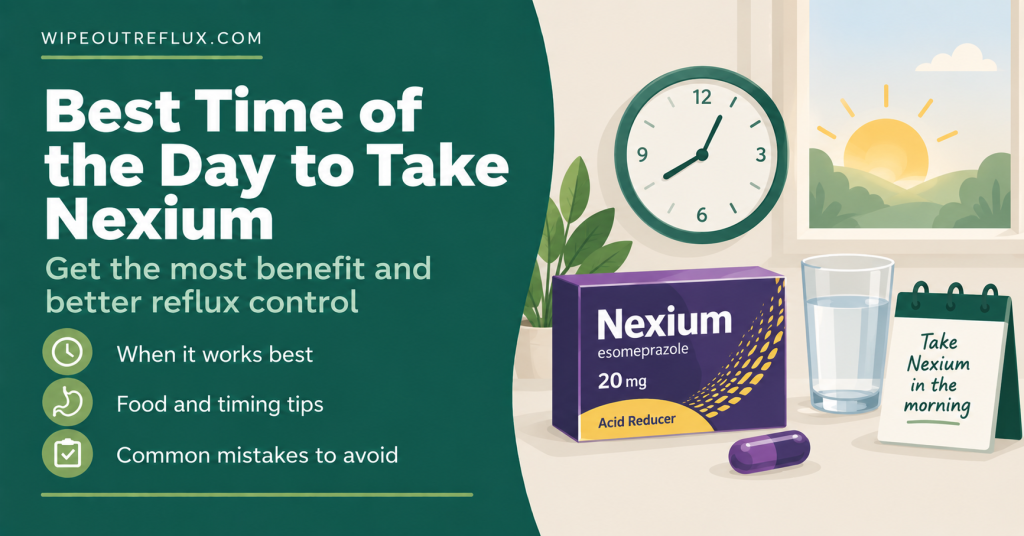
The best time to take Nexium is in the morning, at least one hour before breakfast — on an empty stomach, with the meal following. That’s not a vague “take it in the morning” recommendation; the one-hour gap is written into the prescribing information, and it exists for a specific mechanical reason.
If your symptoms are mainly at night, an evening dose taken an hour before your last meal is a reasonable alternative. And if you’ve been prescribed Nexium twice daily, that means one hour before breakfast and one hour before your evening meal — not breakfast and bedtime.
The single most common mistake I see, after 12 years of dealing with this myself and a lot of conversations with readers, is taking Nexium with food or straight after it. Done that way, you can lose a large share of the dose before it ever reaches your acid pumps. Here’s exactly why, and how to build the timing into a normal day.
Key Takeaways
- Take Nexium at least one hour before a meal — the label is more specific than the 30–60 minutes usually quoted for omeprazole.
- It has to be before food because the drug only disables acid pumps that are actively switched on, and a meal is what switches them on.
- Taking esomeprazole with food substantially reduces how much is absorbed, so “with breakfast” is the worst common option.
- Morning dosing gives better daytime control; evening dosing suits people whose symptoms are mostly nocturnal.
- Twice daily means before breakfast and before your evening meal — a bedtime dose with no meal after it is largely wasted.
- Most people on twice-daily PPIs still get a period of nocturnal acid recovery; that’s normal physiology, not treatment failure.
- Nexium takes several days to reach full effect, so don’t judge the timing change on day one.
- For throat symptoms, twice-daily dosing hasn’t been shown to beat once-daily — and timing won’t fix what PPIs can’t reach.
Why timing matters far more with Nexium than with most drugs
With most medications, timing is about convenience or tolerability. With a proton pump inhibitor it’s about whether the drug does anything at all.
Nexium (esomeprazole) is a prodrug. Swallowed, it travels through the bloodstream in an inactive form. It only becomes active when it concentrates inside the acid-secreting channels of a parietal cell, where the environment is strongly acidic. And it can only bind and disable pumps that are actively pumping at that moment. Dormant pumps are invisible to it.
So a dose of Nexium is really a window of opportunity. While the drug is circulating, whichever pumps happen to fire get shut down permanently — your stomach has to build new ones, which takes a day or two. Pumps that stay quiet during that window survive untouched.
Now add the other half of the equation: esomeprazole’s plasma half-life is only about one to one and a half hours [Nexium Prescribing Information, U.S. Food and Drug Administration, 2021]. The window is short. Your job is to make sure the biggest meal-driven surge of pump activity lands inside it.
That’s the whole logic. Dose, wait roughly an hour, eat. Drug levels peak, the meal fires the pumps, the pumps get switched off.
The one-hour rule — and why it differs from omeprazole
Nexium’s prescribing information is explicit: take it “at least one hour before meals” [Nexium Prescribing Information, U.S. Food and Drug Administration, 2021]. The over-the-counter version is phrased more simply: “swallow 1 capsule with a glass of water before eating in the morning,” once daily for a 14-day course [Nexium 24HR Drug Facts Label, DailyMed, U.S. National Library of Medicine].
Omeprazole is conventionally taken 30–60 minutes before eating. The gap is a little wider for Nexium, and the reason is food interference rather than anything exotic: taken alongside a meal, esomeprazole’s absorption drops sharply — area under the curve falls by roughly half and peak concentration falls further still compared with fasting conditions [Wiesner et al., International Journal of Environmental Research and Public Health, 2021].
Practically: an hour is the target. Forty-five minutes is fine. Thirty is workable. Ten minutes before eating, or with the meal, is where you start giving away real drug. If you genuinely can’t manage an hour every day, a consistent 30 minutes beats an inconsistent 60.
The broader principle is well established across the class — PPIs give better acid suppression taken before a meal than taken without one at all [Hatlebakk et al., Alimentary Pharmacology & Therapeutics, 2000]. Taking it “on an empty stomach” and then skipping breakfast is not the win it sounds like. The meal is part of the mechanism.
Morning or night? How to choose
Both work. Which is better depends on when your symptoms actually occur.
Morning dosing — one hour before breakfast — is the default, and it gives the best control across the day, when most people eat most of their food and generate most of their reflux. A review of dosing regimens found morning intake generally provides better daytime control of gastric acidity for esomeprazole [Wiesner et al., International Journal of Environmental Research and Public Health, 2021].
Evening dosing — one hour before your evening meal — makes sense if your problem is overwhelmingly nocturnal: waking with a sour taste, a burning throat first thing, a cough that starts when you lie down. The same review found evening regimens benefit patients with predominantly nocturnal symptoms.
Note the wording carefully: evening dosing means before your evening meal, not at bedtime. A bedtime dose with no meal afterwards misses the mechanism entirely — you’ll be at peak plasma levels with your pumps idle.
If you’re not sure which camp you’re in, start with mornings and give it a fortnight. It’s the better-supported default, and it’s easier to build into a routine. For the nocturnal picture more broadly, I go through it in acid reflux at night.
Once a day or twice a day?
Standard treatment is once daily. Twice-daily dosing is a step-up option, usually reserved for erosive disease that hasn’t healed, persistent symptoms on a single dose, or on the assumption — more on this below — that throat symptoms need heavier suppression.
If you are on twice daily, the placement is: one hour before breakfast, and one hour before your evening meal. Two doses tied to two meals. Splitting them as “morning and bedtime” is the classic error, and it wastes the second dose.
Before escalating to twice daily, it’s worth making sure a single dose has had a fair run: correct timing, taken every day rather than only on bad days, and given long enough to reach steady state. The effect accumulates over several days, which I cover in how long Nexium takes to work. A lot of apparent failures are really timing and adherence problems.
Nocturnal acid breakthrough: why nights can still be rough
Here’s something that reassures a lot of people. Even on twice-daily PPI therapy, the majority of patients have a period overnight where stomach acid comes back. In the classic study of this, acid breakthrough occurred in most subjects within 12 hours of the evening dose, at a median of around 7.5 hours [Peghini et al., The American Journal of Gastroenterology, 1998].
This is called nocturnal acid breakthrough, and it’s normal pharmacology rather than a sign your medication has stopped working. New pumps are continuously manufactured; overnight your drug levels have long since fallen; those fresh pumps have nothing to stop them.
What actually helps with it:
- Stop eating earlier. Three hours between your last meal and lying down does more for nocturnal reflux than most drug adjustments — see how long before bed to stop eating.
- Raise the head of the bed. Gravity works all night for free. Details in how to raise the head of your bed.
- An alginate at bedtime. It forms a physical raft on the stomach contents rather than suppressing acid, so it covers exactly the gap a PPI leaves — Gaviscon Advance is the version worth having.
- A bedtime H2 blocker, in some cases. This is a genuine strategy for nocturnal breakthrough, but tolerance can develop, so it’s one to agree with your doctor rather than self-manage indefinitely — background in famotidine vs omeprazole.
If your symptoms are in your throat
This is where I’d rather be honest than encouraging.
The standard advice for silent reflux has long been twice-daily PPI dosing, on the logic that the larynx is far more sensitive than the esophagus and therefore needs deeper acid suppression. It’s a reasonable theory. The trial evidence is less supportive than the advice implies: a randomized comparison of twice-daily versus once-daily PPI dosing in laryngopharyngeal reflux found no advantage for the twice-daily regimen on symptom index response at either 8 or 16 weeks [Ji et al., Journal of Neurogastroenterology and Motility, 2024].
The mechanistic reason is the one I keep coming back to. In LPR, the agent damaging your throat isn’t only acid — it’s pepsin, which binds to laryngeal tissue and sits there, reactivated by anything acidic you subsequently eat or drink. A PPI makes refluxate less acidic. It doesn’t stop reflux events happening, and it does nothing about pepsin that’s already deposited. Doubling the dose doubles your attack on the one variable that isn’t limiting. That’s the argument in full in why PPIs don’t work for LPR, with the mechanism in how pepsin reactivates in the throat.
Get your timing right — it costs nothing and it’s the difference between a real dose and a partial one. Then put your energy into the things that do move LPR: cutting the acidic dietary load that reactivates deposited pepsin, and reducing reflux events themselves. That’s the whole basis of the Wipeout Diet Plan.
A simple daily schedule
What this looks like in an ordinary morning:
- 7:00 am — Nexium with a glass of water, on waking. Swallow the capsule whole.
- 7:00–8:00 am — shower, get ready, walk the dog. Water is fine; coffee is not a great idea on an empty stomach if you have reflux.
- 8:00 am — breakfast.
- 6:30 pm — evening meal, finished at least three hours before bed.
- 9:30 pm — alginate if you use one, after your last intake of the day.
Two practical notes. If you struggle to swallow capsules, Nexium delayed-release capsules can be opened and the granules sprinkled on applesauce and taken immediately — they must not be chewed or crushed [Nexium Prescribing Information, DailyMed, U.S. National Library of Medicine]. And if you miss a dose, take it as soon as you remember provided you can still put a meal an hour behind it; if that’s not possible, skip it and resume tomorrow rather than doubling up.
Conclusion
Nexium’s timing rule is simple and it isn’t negotiable if you want the full dose to work: one hour before a meal, on an empty stomach, every day rather than only on bad days. Morning before breakfast is the default; before your evening meal is the alternative if your trouble is overwhelmingly nocturnal. Twice daily means two meals, not one meal and bedtime. And expect a few days for the effect to build — judging a timing change on day one tells you nothing.
But even taken perfectly, Nexium only addresses one variable. It lowers the acidity of what refluxes. It doesn’t reduce how often reflux happens, it doesn’t restore the barrier that’s letting it through, and in silent reflux it doesn’t touch the pepsin already bound to your throat tissue. Nocturnal acid breakthrough on twice-daily dosing is the clearest illustration of the ceiling: you can be doing everything right and still have hours of unprotected time.
Closing that gap is what the Wipeout Diet Plan is for. It’s the full structured approach — what to eat and when, how to order your day so meals and lying down stop working against you, how to bring pepsin reactivation down week by week, and how to taper acid suppression safely once things have genuinely settled. I built it around LPR first, the throat-based form that responds worst to medication, but it works on the same underlying reflux mechanisms, so it does just as much for classic heartburn and GERD.
If you’d rather start small, the Wipeout Food Reference Guide is the essential companion — every food and drink that matters for acid reflux and LPR, with its pH, so you can stop reading labels blind while you work out your own triggers.
Frequently Asked Questions
Should I take Nexium in the morning or at night?
Morning, one hour before breakfast, unless your symptoms are overwhelmingly nocturnal — in which case take it one hour before your evening meal. Morning dosing gives better daytime acid control for most people.
Can I take Nexium at bedtime?
It’s the least effective option. Nexium only disables acid pumps that are actively working, and a meal is what activates them. At bedtime, with no meal to follow, your pumps are largely idle while drug levels peak — so much of the dose is wasted.
How long before breakfast should I take Nexium?
At least one hour, per the prescribing information. Forty-five minutes is fine in practice; thirty is workable. Taking it with food substantially reduces absorption.
Can I take Nexium with food if it upsets my stomach?
You can, but you’ll lose a meaningful share of the dose. If the empty-stomach dose is genuinely uncomfortable, that’s worth raising with your prescriber — switching PPI or adjusting the dose is usually a better answer than permanently taking it with meals.
What if I take Nexium twice a day?
One hour before breakfast and one hour before your evening meal. Both doses need a meal behind them. Pairing the second dose with bedtime instead is the most common way twice-daily dosing gets wasted.
Does the time of day affect side effects?
Not meaningfully. The side effect profile is the same whenever you take it — see esomeprazole side effects. What timing changes is how much acid suppression you get from each dose.
I’ve changed my timing and nothing’s improved. Now what?
Give it at least two weeks — the effect builds over several days. If there’s still nothing, the issue is probably not acid quantity. Non-acid reflux, motility, a hiatal hernia and pepsin-driven throat symptoms all present as “PPI failure,” and none of them are solved by a better-timed dose. Here’s how to work through that.
Research & References
- [Nexium Prescribing Information, U.S. Food and Drug Administration, 2021] — States that Nexium should be taken at least one hour before meals, and gives esomeprazole’s plasma half-life as approximately one to one and a half hours.
- [Nexium 24HR Drug Facts Label, DailyMed, U.S. National Library of Medicine] — Over-the-counter directions: one 20 mg capsule with water before eating in the morning, daily for 14 days.
- [Wiesner et al., International Journal of Environmental Research and Public Health, 2021] — Review of food and dosing-regimen effects on PPIs; esomeprazole absorption falls substantially when taken with food, and morning dosing gives better daytime acid control while evening dosing suits nocturnal symptoms.
- [Hatlebakk et al., Alimentary Pharmacology & Therapeutics, 2000] — Showed that proton pump inhibitors produce better acid suppression when taken before a meal than when taken without one.
- [Peghini et al., The American Journal of Gastroenterology, 1998] — Found nocturnal gastric acid recovery in the majority of subjects on twice-daily PPI dosing, with breakthrough occurring at a median of around 7.5 hours after the evening dose.
- [Ji et al., Journal of Neurogastroenterology and Motility, 2024] — Randomized controlled trial in laryngopharyngeal reflux finding no higher response rate for twice-daily versus once-daily PPI dosing at 8 or 16 weeks.
- [Nexium Prescribing Information, DailyMed, U.S. National Library of Medicine] — Confirms capsules may be opened and the granules sprinkled on applesauce and taken immediately, without chewing or crushing.
- [Katz et al., The American Journal of Gastroenterology, 2022] — ACG clinical guideline for GERD, covering PPI dosing before meals, step-up to twice-daily therapy and management of persistent symptoms.

David Gray
12 years living with LPR · Consultant & researcher
I've lived with LPR for twelve years — the misdiagnoses, the PPI courses that did nothing, the slow work of figuring out what actually helps. Wipeout Reflux is where I translate the research into plain terms for people stuck in the same place. Every claim here is sourced to peer-reviewed work, and I consult one-to-one with LPR sufferers.