
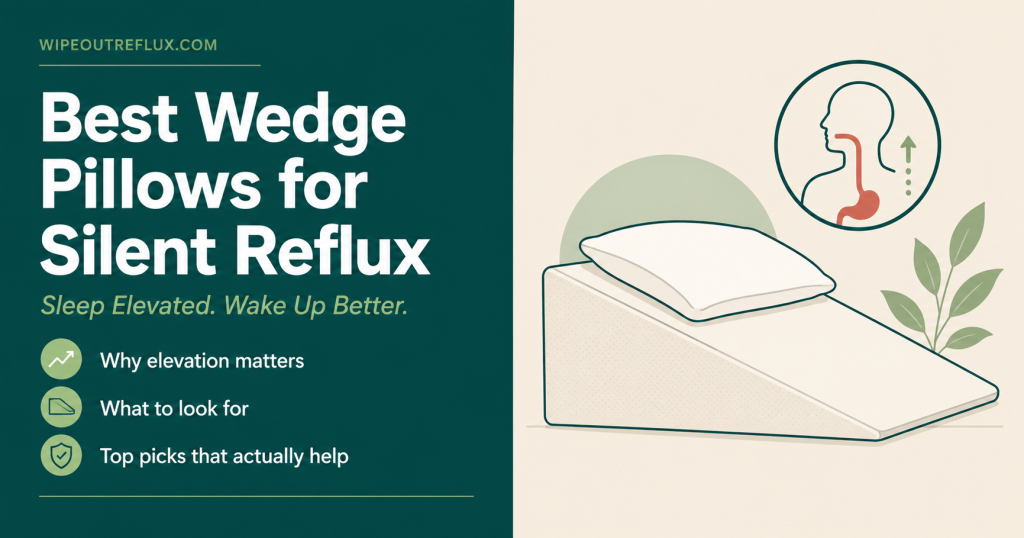
If silent reflux (LPR) is at its worst when you wake up — a raw throat, hoarseness, mucus, that first morning throat clear — the way you sleep is almost certainly part of the problem. When you lie flat, gravity stops protecting your throat, and even small amounts of reflux can reach the larynx and sit there for hours.
A wedge pillow is the simplest fix. By elevating your head and torso by 6–8 inches, you keep refluxed stomach contents lower down where they belong, and anything that does come up clears far more quickly. Head-of-bed elevation is one of the few lifestyle measures with genuine clinical evidence behind it for night-time reflux.
After 12 years of managing my own LPR, I’ve slept on more wedges than I’d like to admit. Below are the five I’d actually recommend, who each one suits, and the mistakes to avoid when choosing one.
Key Takeaways
- Lying flat removes gravity’s protection, so reflux reaches the throat more easily at night — this is why silent reflux symptoms are so often worst in the morning.
- Clinical studies show head-of-bed elevation reduces night-time oesophageal acid exposure and speeds up acid clearance [Khan et al., Journal of Gastroenterology and Hepatology, 2012].
- Aim for 6–8 inches of elevation at the upper back — roughly a 30–40 degree incline. Stacking normal pillows doesn’t work and can make reflux worse.
- The most effective sleeping set-up for reflux combines incline with sleeping on your left side, which is exactly what the MedCline system is designed to do.
- My top picks: MedCline Reflux Relief System (best for LPR overall), Kolbs 7.5″ (best value), InteVision 12″ (best traditional wedge), Kolbs Extra Wide 12″ (best for restless sleepers), and Lunix LX5 (most adjustable).
- A wedge pillow works best alongside a low-acid diet and earlier evening meals — elevation manages night-time reflux, but it doesn’t address why you’re refluxing in the first place.
Why Lying Flat Makes Silent Reflux Worse
During the day, gravity is constantly working in your favour. When a reflux event happens while you’re upright, the refluxate drains back down quickly, and swallowing plus saliva neutralise what’s left. Your throat gets a brief exposure at most.
At night, all three of those defences switch off. You lie flat, so there’s no gravity drainage. You stop swallowing regularly. And saliva production drops dramatically during sleep. That means refluxed material — including pepsin, the stomach enzyme that does most of the damage in LPR — can travel to the throat more easily and stay in contact with the tissue for far longer.
This is why so many people with silent reflux wake up with their worst symptoms: hoarseness, throat clearing, a lump-in-the-throat feeling, and post-nasal-drip-like mucus. If that sounds familiar, my guide to the best sleeping position for silent reflux covers the positioning side in more depth, and my article on acid reflux at night explains the night-time reflux mechanism more fully.
Elevation directly counters this. In one study of patients with confirmed night-time reflux, raising the head of the bed by 20 cm reduced oesophageal acid exposure, shortened acid clearance time, and improved both heartburn and sleep disturbance within a week [Khan et al., Journal of Gastroenterology and Hepatology, 2012]. A systematic review of controlled trials reached a similar conclusion: the evidence base is small and imperfect, but head-of-bed elevation consistently improved reflux symptoms across studies, making it a sensible low-risk intervention [Albarqouni et al., BMC Family Practice, 2021].
Why Stacking Normal Pillows Doesn’t Work
The instinctive move — piling up two or three ordinary pillows — is actually counterproductive. Regular pillows only lift your head and neck, not your torso. Your stomach and oesophagus stay flat, so the reflux still happens, and bending sharply at the neck can increase abdominal pressure, which pushes more stomach contents upward.
A proper wedge elevates you from roughly the mid-back upward in a straight, gradual incline. Your oesophagus sits above your stomach along its whole length, which is the geometry you actually need.
What to Look For in a Wedge Pillow for Silent Reflux
Height and angle
The clinical studies generally used 15–20 cm (6–8 inches) of elevation. In wedge pillow terms, that means a 7–12 inch wedge depending on the slope length. A 7.5-inch wedge is the sweet spot for most people — enough elevation to matter, gentle enough to actually sleep on. Go higher (10–12 inches) if your symptoms are severe or you also snore, but expect a longer adjustment period.
Length
Longer is better. A short, steep wedge kinks you at the waist; a longer slope (24 inches or more) supports the whole torso and is far more comfortable.
Foam quality
Cheap foam compresses within months, quietly reducing your incline. Look for a high-density foam core with a memory foam top layer — the core holds the angle, the memory foam makes it sleepable.
Washable cover
Non-negotiable. You’ll be sleeping on this every night.
Sleeping position
Here’s the detail most wedge pillow guides miss: position matters as much as elevation. Research consistently shows that sleeping on your left side produces less reflux than sleeping on your back or right side, because of the way the stomach sits relative to the oesophagus. One randomised trial found that an inclined, left-side-down position produced significantly less oesophageal acid exposure than a standard wedge alone — and the worst results of all came from lying right-side down [Person et al., Journal of Clinical Gastroenterology, 2015]. If you’re a committed side sleeper, factor that into your choice below.
1. MedCline Reflux Relief System — Best for Silent Reflux Overall
Check the MedCline Reflux Relief System on Amazon
The MedCline isn’t a normal wedge — it’s a two-part system: an inclined base with an arm pocket, plus a body pillow that holds you on your left side through the night. That combination of incline plus left-lateral positioning is precisely the set-up the research supports, and MedCline is the only product here that’s been tested in clinical studies on reflux patients specifically.
In a Cleveland Clinic trial of patients whose night-time reflux persisted despite PPIs, two weeks on the device significantly improved nocturnal reflux symptoms and quality of life [Allampati et al., Diseases of the Esophagus, 2017]. More relevant still for readers of this site, a prospective study in diagnosed LPR patients found that 28 nights on the device significantly improved Reflux Symptom Index scores — the standard LPR symptom measure [Tierney et al., American Journal of Otolaryngology, 2017].
Pros: the only option with clinical evidence in LPR patients; keeps you on your left side all night; the arm pocket solves the dead-arm problem of side sleeping on an incline; sized to your height (small, medium and large).
Cons: expensive — several times the price of a standard wedge; takes 2–4 weeks to fully adjust to; bulky, and takes up a lot of bed space.
Best for: people with diagnosed LPR or stubborn night-time symptoms who want the most evidence-backed option and are willing to pay for it.
2. Kolbs Bed Wedge 7.5″ — Best Value
Check the Kolbs Bed Wedge on Amazon
If you just want a well-made, sensibly priced wedge to test whether elevation helps your symptoms, this is the one I’d point you to first. The Kolbs pairs a firm, high-density foam core with a 1.5-inch memory foam top layer, so it holds its angle without feeling like sleeping on a ramp. It’s one of the best-reviewed wedges on Amazon, with tens of thousands of ratings, and the jacquard cover is removable and machine washable.
The 7.5-inch height is the right starting point for most people — meaningful elevation with a manageable adjustment period. A 12-inch version exists if you need more.
Pros: excellent price-to-quality ratio; comfortable memory foam top; washable cover that doesn’t look clinical; ideal starter height.
Cons: at 24 inches long it’s a little short for very tall sleepers; back-and-side positioning is up to you — nothing holds you on your left side.
Best for: first-time wedge buyers and anyone testing elevation before committing to something more expensive.
3. InteVision 12″ Wedge + Headrest — Best Traditional Wedge
Check the InteVision Wedge Pillow on Amazon
The InteVision is the long-standing benchmark in this category and the most-reviewed wedge on Amazon. It’s a two-layer design — a resilient firm base with a 2-inch memory foam top and air channels between the layers — and it comes with a separate height-adjustable headrest pillow, which solves the neck-support problem that plagues single-piece wedges.
At 12 inches, it delivers serious elevation. That’s a genuine advantage if your symptoms are severe or you also deal with snoring or sleep apnoea (which frequently overlaps with reflux), but it’s a steeper adjustment than a 7.5-inch wedge, and restless sleepers may find it takes a couple of weeks to settle.
Pros: proven design with a huge review base; the included headrest makes a real comfort difference; maximum meaningful elevation; quality foam that keeps its shape.
Cons: 12 inches is aggressive for beginners; you can slide down slightly until you adjust.
Best for: people with severe night-time symptoms, or reflux plus snoring, who want the maximum elevation a pillow can provide.
4. Kolbs Extra Wide 12″ — Best for Restless Sleepers
Check the Kolbs Extra Wide Wedge on Amazon
The most common complaint about standard wedges is rolling off them. Most are around 24 inches wide — narrower than your usual sleeping space — so combination sleepers who shift position through the night end up half on, half off the incline by morning, which defeats the entire purpose.
The Kolbs Extra Wide fixes this with a 31 x 33 inch footprint: wide enough to turn over on without leaving the slope, and long enough to support taller sleepers properly. It’s the same build quality as the standard Kolbs — high-density core, memory foam top, washable jacquard cover — just supersized.
Pros: genuinely stays under you when you change position; long slope suits taller people; also available in 7.5-inch height if 12 is too much.
Cons: dominates a good chunk of the bed; awkward for couples on smaller mattresses.
Best for: combination sleepers, taller people, and anyone who’s already fallen off a standard-width wedge.
5. Lunix LX5 4-Piece Set — Most Adjustable
Check the Lunix LX5 Set on Amazon
The Lunix LX5 is a modular four-piece memory foam system — base, back wedge, head pillow and leg wedge — that you can reconfigure to change the angle and position. That flexibility is genuinely useful: you can start at a gentler incline while you adjust, steepen it later, raise your knees to stop yourself sliding down (a classic wedge problem), and sit fully upright for reading or for post-meal evenings when lying down too soon would trigger symptoms.
Pros: adjustable angle as your needs change; leg elevation stops the sliding-down problem; doubles as a sit-up support for evenings and recovery; washable covers.
Cons: more pieces means more faff to arrange nightly; softer memory foam feel won’t suit those who want a firm, fixed ramp; takes up storage space.
Best for: people who want one system for sleeping, reading and post-meal lounging, or who aren’t yet sure what incline suits them.
How to Get the Best Results From a Wedge Pillow
A wedge on its own helps, but it works dramatically better as part of a wider approach:
- Sleep on your left side where possible. Left-side sleeping plus incline consistently beats incline alone in the research [Person et al., Journal of Clinical Gastroenterology, 2015]. Even a simple positional nudge helps — a sham-controlled trial found that training patients to avoid right-side sleeping halved nocturnal reflux scores for many of them [Schuitenmaker et al., Clinical Gastroenterology and Hepatology, 2022].
- Finish eating 3–4 hours before bed. An empty stomach at bedtime means far less to reflux. This single habit rivals the wedge itself for impact.
- Consider an alginate before bed. A raft-forming alginate like Gaviscon Advance taken after your evening meal creates a physical barrier on top of the stomach contents, which pairs naturally with elevation.
- Address the daytime side too. Night-time management protects your throat while it heals, but a low-acid approach to eating — the foundation of the Wipeout Diet Plan — is what reduces the refluxing and pepsin activation in the first place. My guide on neutralising pepsin in the throat explains why keeping pepsin inactive matters so much for LPR specifically.
Conclusion
If your silent reflux symptoms are worst in the morning, night-time reflux is almost certainly a major driver — and a wedge pillow is one of the cheapest, most evidence-supported changes you can make. Elevation restores the gravity protection you lose when you lie flat, reduces how much refluxate reaches your throat, and shortens how long it stays there.
For most people, I’d start with the Kolbs 7.5″ — it’s affordable, comfortable, and the right height to test whether elevation moves the needle for you. If your LPR is diagnosed and stubborn, the MedCline system is the option with actual clinical data in LPR patients, and in my view it’s worth the investment if standard wedges haven’t been enough.
Just remember that a wedge manages the night-time symptom — it doesn’t fix the underlying reflux. The bigger wins come from combining elevation with earlier evening meals and a properly low-acid, pepsin-aware way of eating. That’s exactly what the Wipeout Diet Plan walks you through step by step — it’s the complete system I built from my own recovery, covering the diet, the supporting habits (including sleep positioning), and how to phase foods back in as your throat heals.
And if you want a quick everyday reference for what’s safe to eat and drink, the Wipeout Food Reference Guide is an essential companion — it covers the foods and drinks that are allowed for acid reflux and LPR along with their pH values, so you can check anything at a glance.
Combine the right wedge with the right diet, and morning throat symptoms usually start improving within a few weeks. That was certainly my experience — you can read how I cured my silent reflux for the full story.
Frequently Asked Questions
Do wedge pillows really help silent reflux?
Yes — with realistic expectations. Elevation reduces how much reflux reaches the throat overnight and how long it lingers, and clinical studies show it reduces oesophageal acid exposure and improves symptoms. For LPR specifically, an incline-plus-left-side system improved standard LPR symptom scores within 28 nights in one study. It manages night-time exposure rather than curing the underlying reflux, so combine it with dietary changes.
What height of wedge pillow is best for silent reflux?
Aim for 6–8 inches of elevation at your upper back, which matches what the clinical studies used. A 7.5-inch wedge suits most people starting out; 10–12 inches gives more protection for severe symptoms but takes longer to get used to.
Is it better to sleep on my left side or my back with a wedge?
Left side, if you can manage it. Research shows incline plus left-side-down produces less acid exposure than a wedge alone, while right-side-down is the worst position for reflux. Back sleeping on a wedge is still far better than lying flat.
Can I just use extra pillows instead?
No — stacked pillows lift only your head and neck, leave your stomach and oesophagus flat, and the sharp bend at the waist can actually increase pressure on your stomach. You need a gradual incline that starts from the mid-back.
How long does it take to adjust to sleeping on a wedge?
Most people need one to two weeks for a 7.5-inch wedge and two to four weeks for taller wedges or the MedCline system. Slightly disrupted sleep in the first week is normal — persist, because comfort improves noticeably once your body adapts.
Are bed risers or an adjustable bed better than a wedge pillow?
They achieve the same goal in different ways. Risers under the bed head legs (15–20 cm) are what several clinical studies used and work well, though they affect a partner sharing the bed. Adjustable bases are the most comfortable long-term option but cost far more. A wedge is the cheapest, most flexible starting point.
How long until I notice my throat symptoms improving?
Night-time reflux reduction starts immediately, but throat tissue heals slowly. Most people need several weeks of consistent elevation — ideally alongside dietary changes — before morning hoarseness and throat clearing noticeably ease. If nothing has changed after six to eight weeks, look harder at daytime reflux and diet.
Research Sources
- [Khan et al., Journal of Gastroenterology and Hepatology, 2012] — In patients with confirmed nocturnal reflux, raising the bed head by 20 cm reduced supine acid exposure, shortened acid clearance time, and improved heartburn and sleep disturbance within one week.
- [Albarqouni et al., BMC Family Practice, 2021] — Systematic review of five controlled trials of head-of-bed elevation (bed blocks and wedge pillows); the trials reporting symptoms all found improvement, supporting elevation as a cheap, low-risk intervention despite limited trial quality.
- [Person et al., Journal of Clinical Gastroenterology, 2015] — Randomised controlled trial showing an inclined, left-side-down sleep positioning device produced significantly less oesophageal acid exposure than a standard wedge, lying flat, or inclined right-side-down.
- [Allampati et al., Diseases of the Esophagus, 2017] — Prospective trial in patients with PPI-refractory nocturnal GERD; two weeks of sleeping on a positional therapy device significantly improved nocturnal reflux symptom severity and quality of life.
- [Tierney et al., American Journal of Otolaryngology, 2017] — Prospective cohort study in diagnosed LPR patients; 28 nights on an incline-plus-left-lateral sleep positioning device significantly improved Reflux Symptom Index and nocturnal reflux scores.
- [Schuitenmaker et al., Clinical Gastroenterology and Hepatology, 2022] — Double-blind, sham-controlled trial showing that positional therapy promoting left-side sleeping and discouraging right-side sleeping significantly reduced nocturnal reflux symptoms.

David Gray
Content Researcher & Author
David Gray founded Wipeout Reflux to address a critical gap in reflux management. His research synthesizes over 100 peer-reviewed studies on laryngopharyngeal reflux (LPR), pepsin biology, and GERD pathophysiology. For LPR specifically—a condition most physicians misdiagnose—his work focuses on pepsin reactivation and why standard PPI therapy fails most patients. He develops evidence-based protocols targeting root causes of both LPR and GERD, integrating emerging research on sphincter dysfunction, dietary interventions, and newer clinical approaches. Wipeout Reflux represents practical application of clinical science for patients seeking real solutions.