
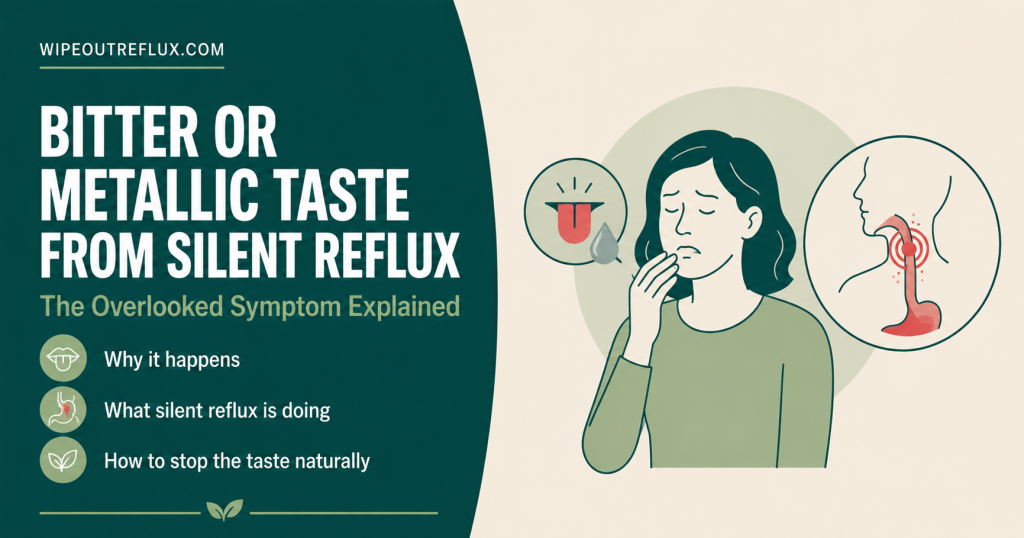
That persistent bitter or metallic taste in your mouth can absolutely come from silent reflux. When stomach contents rise all the way up to the back of your throat and mouth — as they do in LPR — they leave behind a sour, bitter, or metallic tang. But there’s a second, less obvious cause too: the acid and pepsin in reflux actually irritate and dull your taste buds, so your sense of taste itself gets distorted, with bitter taste hit hardest.
So the strange taste is really two things at once. It’s the residue of what came up, and it’s the effect of that residue on the taste receptors on your tongue. That’s why the taste can linger long after any obvious reflux, why it’s often worst in the morning, and why brushing your teeth only helps for a little while.
Here’s why silent reflux causes a bitter or metallic taste, how to tell it apart from other causes, and what actually clears it.
Key Takeaways
- A bitter, sour, or metallic taste is a common symptom of silent reflux (LPR), caused by refluxed stomach contents reaching the back of the mouth.
- Reflux also distorts taste directly: acid and pepsin irritate the taste buds, and research shows bitter taste in particular is impaired in people with LPR.
- The taste is often worst in the morning or after lying down, because reflux pools in the throat overnight when you’re horizontal.
- Pepsin — a stomach enzyme carried up with reflux — is a key player, clinging to the mouth and throat and contributing to taste changes, coating and bad breath.
- Because it’s a taste-receptor problem as much as a residue problem, rinsing and brushing only help briefly; the lasting fix is reducing the reflux itself.
- Treating the underlying reflux has been shown to improve taste perception, including bitter taste.
- A metallic taste has other possible causes too — medications, dental issues, deficiencies — so persistent or isolated metallic taste is worth checking with a professional.
Why silent reflux leaves a bitter or metallic taste
The most direct reason is simple geography. In silent reflux, stomach contents don’t just reach the lower esophagus — they travel all the way up past the throat to the back of the mouth. Along the way they carry acid, the enzyme pepsin, and sometimes bile, and when that mixture reaches your tongue it tastes exactly as unpleasant as it sounds: sour, bitter, sometimes distinctly metallic.
This is one of the quieter symptoms of LPR, and it often shows up without any heartburn to explain it. In its more obvious form it arrives as a sudden flood of sour fluid and saliva — the classic water brash and regurgitation of reflux — but far more often it’s a low-grade taste that just won’t go away, because the cause keeps topping itself up.
The part people miss: reflux distorts your taste buds
Here’s the mechanism that explains why the taste is so stubborn. It isn’t only the residue you’re tasting — the reflux is actually damaging how your taste buds work. Repeated exposure to acid and pepsin irritates the papillae on your tongue, blunting and distorting taste perception in a way that outlasts any single reflux event.
This is well documented. A study using proper taste testing found that people with LPR had significantly worse taste and smell function than healthy controls, with bitter taste the most affected while sweet, salty and sour were relatively spared Altundag et al., Otolaryngology–Head and Neck Surgery, 2016. Taste and smell disturbances are also more common generally in people with reflux than in those without Kabadi et al., Journal of Neurogastroenterology and Motility, 2017. So a persistent bitter taste isn’t your imagination — it’s a measurable change in how your tongue is registering flavour.
Why pepsin matters so much here
If there’s one culprit worth understanding, it’s pepsin. Pepsin is a digestive enzyme that belongs in your stomach, but in reflux it gets carried up and deposited on the delicate tissues of your throat and mouth, where it clings and keeps causing trouble long after the reflux moment has passed.
That lingering pepsin is a big reason the taste persists between reflux events, and it ties the taste in with the other oral signs of silent reflux — a white or coated tongue and bad breath often show up alongside the bitter taste, because they share the same cause. Getting to grips with what pepsin is and how to neutralise pepsin in the throat and mouth is central to clearing the taste for good rather than just masking it.
Why it’s usually worst in the morning
Most people notice the taste most on waking, and there’s a clear reason. When you lie down to sleep, you lose the help of gravity, you swallow far less, and you produce less saliva — so any reflux that comes up overnight pools in the throat and mouth and sits there for hours instead of being cleared away.
That’s why reflux at night tends to leave the strongest morning taste, often paired with a dry or coated mouth and a throat that needs clearing. It’s also a useful clue: if the taste is reliably worst first thing and eases as the day goes on, night-time reflux is very likely behind it, which points straight to where the fix should start.
Is it definitely reflux? Other causes of a metallic taste
Reflux is a common cause, but a bitter or especially metallic taste can come from other places, and it’s worth being honest about that. Certain medications and supplements (including some antibiotics and iron or zinc supplements), dental problems and gum disease, sinus infections, pregnancy, and some nutritional deficiencies can all produce a metallic taste of their own.
A few pointers help you tell them apart. Reflux-related taste tends to travel with other reflux clues — throat clearing, a lump sensation, hoarseness, a cough, or symptoms that worsen after meals or lying down — and is often worst in the morning. A metallic taste that appears in isolation, starts right after a new medication, or comes with mouth or gum soreness points elsewhere. If the taste is persistent, isolated, or you’re unsure, it’s worth getting checked — both to confirm reflux and to rule the rest out. A pepsin (Peptest) test can help confirm whether reflux is reaching your mouth.
How to get rid of the taste
Because the taste is driven by reflux reaching your mouth and irritating your taste buds, the lasting solution is to reduce the reflux — not just rinse the taste away. Encouragingly, studies show that when the underlying reflux is treated, taste perception improves, including for bitter taste Suzuki et al., Tohoku Journal of Experimental Medicine, 2019. Here’s where to focus:
- Protect your nights. Since morning taste comes from overnight reflux, controlling night-time reflux is the highest-value move — start with the best sleeping position for silent reflux.
- Stop eating well before bed. An empty stomach at bedtime means less to reflux overnight — here’s how long before bed to stop eating.
- Target the pepsin. Since pepsin lingering in the mouth keeps the taste going, strategies to neutralise pepsin help clear it between events.
- Protect your teeth. The same acid that alters your taste can erode enamel, so it’s worth reading about reflux and tooth erosion — and not brushing immediately after an acid episode, which can rub softened enamel away.
- Reduce reflux at the source. Meal size, trigger foods and drinks, and your overall reflux burden are where a structured silent reflux treatment approach does the real work.
Conclusion
A bitter or metallic taste from silent reflux is really the sum of two things: stomach contents reaching the back of your mouth, and the acid and pepsin in them dulling and distorting your taste buds — with bitter taste taking the biggest hit. That second part is why the taste hangs around between reflux events, why it’s usually worst in the morning after a night lying flat, and why mouthwash and brushing only buy you a short reprieve. It’s a genuine, measurable effect of reflux, not something you’re imagining.
The good news is that it responds to the same thing that settles the rest of silent reflux: reducing how much you reflux, especially overnight. Fewer reflux events mean less residue reaching your mouth and less irritation to your taste buds, and taste perception tends to recover as the reflux calms. It’s worth ruling out the other causes of a metallic taste too — medications, dental issues and the like — but if the taste travels with other silent reflux signs, that’s where to aim first.
Since the taste is downstream of the reflux, the fix comes down to what you eat and drink. The Wipeout Food Reference Guide is the essential reference for which foods and drinks are safe with acid reflux and LPR, along with their pH values, so you can strip out what’s driving the reflux that reaches your mouth. And for the complete, step-by-step method, the Wipeout Diet Plan goes much deeper — it was built first and foremost around LPR, the throat-based reflux behind that bitter morning taste, but because it works on the same underlying mechanisms it’s just as effective for classic GERD and heartburn. Calm the reflux, protect your nights, and the taste usually clears with it.
Frequently Asked Questions
Can silent reflux cause a bitter or metallic taste?
Yes. Silent reflux (LPR) is a common cause of a bitter, sour, or metallic taste, because refluxed stomach contents reach the back of the mouth. On top of the residue itself, the acid and pepsin in reflux irritate and distort the taste buds — with bitter taste the most affected — which is why the taste can linger between reflux episodes.
Why is the taste worse in the morning?
Because reflux pools in your throat and mouth overnight. When you lie down you lose gravity’s help, swallow less, and make less saliva, so anything that refluxes sits there for hours rather than being cleared. That overnight pooling leaves the strongest taste on waking, often alongside a dry or coated mouth.
How do I get rid of a reflux taste in my mouth?
Rinsing and brushing only help briefly because the cause keeps topping up. The lasting fix is reducing the reflux itself — especially at night — through better sleep positioning, an earlier last meal, targeting lingering pepsin, and cutting reflux triggers in your diet. Studies show taste perception improves when the underlying reflux is treated.
Is a metallic taste always from reflux?
No. A metallic taste can also come from certain medications and supplements, dental or gum problems, sinus infections, pregnancy, and some deficiencies. Reflux is more likely if the taste travels with other reflux symptoms and is worst in the morning. An isolated or persistent metallic taste, or one that started with a new medication, is worth getting checked.
Does the taste mean reflux is damaging my teeth?
It can be a warning sign, because the same acid that alters your taste can erode tooth enamel over time. If you’re getting a regular reflux taste, it’s worth protecting your teeth — and avoid brushing right after an acid episode, since enamel is softened then and brushing can wear it away. Reducing the reflux protects both your taste and your teeth.
Research & References
- Study using olfactory and gustatory testing that found patients with laryngopharyngeal reflux had significantly poorer taste and smell function than healthy controls, with bitter taste the most impaired while other tastes were relatively preserved Altundag et al., Otolaryngology–Head and Neck Surgery, 2016.
- Study reporting that taste and smell disturbances are more prevalent in patients with gastroesophageal reflux disease (and gastroparesis) than would be expected, and relate to gastrointestinal symptom severity Kabadi et al., Journal of Neurogastroenterology and Motility, 2017.
- Randomized controlled study showing that treating the underlying reflux with a proton pump inhibitor improved taste disturbance in patients with laryngopharyngeal reflux, including lowering recognition thresholds for bitter, salty and sour taste Suzuki et al., Tohoku Journal of Experimental Medicine, 2019.

David Gray
12 years living with LPR · Consultant & researcher
I've lived with LPR for twelve years — the misdiagnoses, the PPI courses that did nothing, the slow work of figuring out what actually helps. Wipeout Reflux is where I translate the research into plain terms for people stuck in the same place. Every claim here is sourced to peer-reviewed work, and I consult one-to-one with LPR sufferers.