
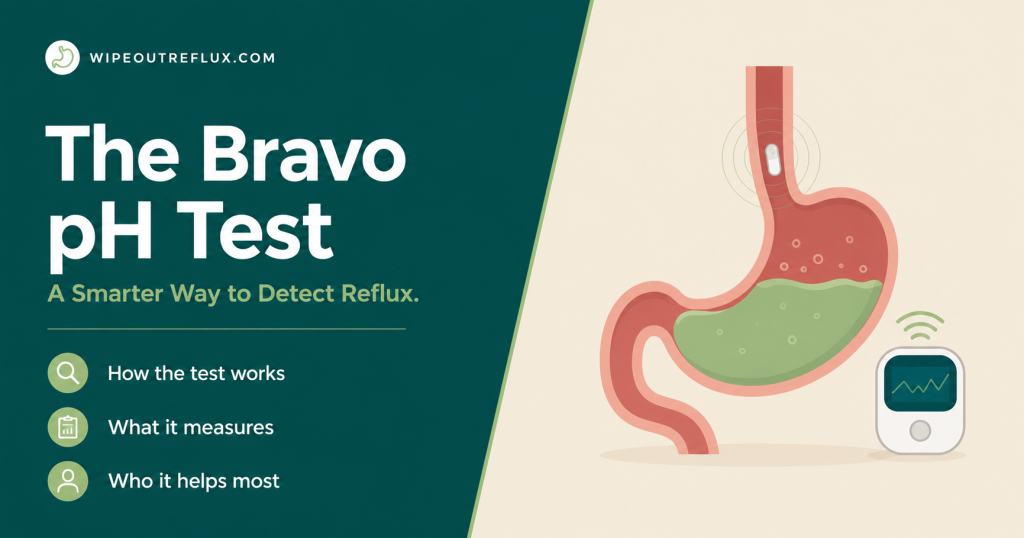
If your doctor has booked you in for a Bravo pH test, here’s the plain-English version of what it is: it’s the most accurate way to measure how much acid is actually refluxing into your oesophagus, using a tiny wireless capsule instead of the old-fashioned tube down your nose. The capsule is clipped to the wall of your oesophagus during a quick endoscopy, and over the next two to four days it beams pH readings to a small recorder you clip to your belt. It then falls off on its own and passes harmlessly in your stool.
The whole point of the test is to answer one question with real data rather than guesswork: is acid reflux genuinely happening, how much, and does it line up with your symptoms? That matters when the diagnosis isn’t obvious, when medication isn’t working, or before any decision about reflux surgery.
Below I’ll walk you through exactly what to expect — how to prepare, what the placement feels like, what the days wearing it are like, what the results mean, and which sensations are normal versus worth a phone call.
Key Takeaways
- The Bravo test measures acid exposure in your oesophagus using a wireless capsule, with no catheter taped to your face.
- The capsule is attached during a brief endoscopy, usually under sedation, and takes about a minute to place.
- It records for 48 to 96 hours — far longer than the old 24-hour catheter test, which improves how much reflux it catches.
- You wear a small recorder and press buttons to log symptoms, meals, and lying down, so your doctor can match symptoms to reflux events.
- You eat and go about normal life during the test; a mild “something’s there” chest sensation is common and usually settles.
- The capsule detaches by itself after a few days to a couple of weeks and passes in your stool — you don’t need to retrieve it.
- Results are reported mainly as acid exposure time (how long your oesophagus sat below pH 4) and how well your symptoms correlated with reflux.
What the Bravo pH Test Actually Is
Your stomach is acidic by design; your oesophagus is not built to cope with that acid. Reflux disease is essentially acid spending too much time where it shouldn’t. To prove that’s happening, doctors need to measure the pH (acidity) inside your oesophagus over time — and that’s what the Bravo capsule does.
The capsule is roughly the size of a gel-cap. Inside it is a pH sensor, a tiny battery, and a radio transmitter. Once it’s attached to the lining of your lower oesophagus, it samples the acidity around it many times a minute and wirelessly transmits each reading to an external recorder you carry with you. When the study is over, your doctor downloads those readings and sees a minute-by-minute picture of how acidic your oesophagus was across several days — including overnight and after meals, when reflux is often at its worst.
It’s considered a very reliable way to capture this. Studies establishing normal values for the Bravo system found it gives accurate, reproducible measurements of oesophageal acid exposure Ayazi et al., Clinical Gastroenterology and Hepatology, 2009.
Why Doctors Use It (and Why the Capsule Beats the Old Tube)
For decades, the standard way to measure oesophageal acid was a thin catheter passed through your nose and left dangling for 24 hours. It worked, but it was uncomfortable, obvious, and only captured a single day — which could easily be an atypical one. The Bravo capsule solves both problems.
First, comfort: there’s no tube taped to your cheek and no wire hanging out of your nose, so most people can carry on with a fairly normal routine. Second, and more importantly, it records for much longer. The old catheter gave you one day; Bravo commonly runs 48 hours and can extend to 96. That extra time genuinely matters, because reflux varies from day to day — extending the recording to a second day catches abnormal reflux and symptom links that a single day would miss Prakash & Clouse, Clinical Gastroenterology and Hepatology, 2005. Overall, the wireless system is comparable to the catheter test for diagnostic yield while being far more comfortable to wear Lawenko & Lee, Journal of Neurogastroenterology and Motility, 2016.
Doctors typically reach for it when the picture is unclear: when symptoms don’t respond to acid-suppressing medication, when the diagnosis is in doubt, or before committing to anti-reflux surgery. If your reflux meds aren’t helping, objective testing like this is often the sensible next step — here’s more on what to do when acid reflux medication isn’t working.
How to Prepare
Your clinic will give you exact instructions, but a few things are standard.
Fasting
You’ll usually be asked not to eat or drink for about six hours before the procedure, so your stomach is empty for the endoscopy and sedation.
Medications — the important one
Because the test measures acid, acid-suppressing drugs can mask the very thing it’s looking for. Your doctor will often ask you to stop proton pump inhibitors (PPIs) for around 7 days, and H2 blockers and antacids for a shorter window, before the test — but only ever do this on your doctor’s instruction, never on your own. Coming off PPIs can cause a temporary rebound in acid, so it helps to know what to expect; this guide to getting off PPIs and acid rebound explains why. In some cases a doctor deliberately runs the test on medication to check whether it’s controlling the acid — so always follow your own clinic’s plan.
Other basics
Tell your team about blood thinners, allergies, and any pacemaker or implanted device, and arrange a lift home, since you’ll have had sedation and shouldn’t drive for the rest of the day.
What Happens During Placement
The placement itself is quick and, for most people, uneventful. You’ll usually be given sedation through a vein to make you drowsy and relaxed, and a mouth guard protects your teeth. Lying on your left side, your gastroenterologist passes a thin endoscope down into your oesophagus, positions the Bravo capsule against the wall a set distance above the junction with your stomach, and uses gentle suction to draw a small amount of tissue into the capsule so a tiny clip can hold it in place. Attaching it takes only about a minute, and then the delivery device is removed.
Because you’re sedated, you typically won’t feel the attachment. Many centres combine this with a diagnostic endoscopy, so your doctor also gets a direct look at your oesophagus and stomach at the same time.
What the Next Few Days Are Like
This is the part people are most curious about, and the reassuring answer is: fairly normal. You’ll carry a small recorder — about the size of a chunky phone — on your belt or waistband, keeping it within arm’s reach of your chest so it can pick up the capsule’s signal. You’re asked to eat your usual meals and keep your usual routine, because the whole point is to capture reflux under real-life conditions rather than an artificial “test day.”
You’ll also keep a simple diary using buttons on the recorder, marking when you eat, when you lie down, and when you feel symptoms like heartburn, regurgitation, cough, or chest discomfort. This diary is what lets your doctor line up your symptoms with actual reflux events — the difference between “I feel like I reflux” and “here’s the acid, at the exact minute you felt it.”
A mild sensation that something is stuck in your chest, or slight discomfort when swallowing, is common at first and usually eases over the first day. Most people find it very manageable and are surprised how little it interferes with normal life.
What the Results Mean
Once the recording is done, you return the recorder and your doctor downloads the data. A few numbers do most of the work.
The headline figure is acid exposure time — the percentage of the recording during which your oesophagus sat below pH 4 (the threshold for “acidic”). Sit below that for too long and it points to reflux disease; stay under it and reflux is unlikely to be your problem. Your doctor also looks at symptom association: when you pressed the symptom button, was acid actually present? Strong correlation suggests your symptoms really are reflux-driven; poor correlation may point elsewhere, such as a functional or hypersensitivity issue. Because the Bravo runs over multiple days, your doctor can also see how consistent your reflux is from one day to the next, which adds confidence to the diagnosis.
One thing worth knowing: a standard Bravo capsule measures acid in the oesophagus, which is ideal for classic GERD. If your problem is throat-based silent reflux (LPR), your doctor may use or add a different tool aimed higher up, such as Restech pharyngeal pH monitoring or a saliva-based Peptest, since throat reflux doesn’t always show up the same way on an oesophageal probe. It’s also worth understanding the difference between GERD and LPR so you know which test fits your symptoms.
Side Effects: What’s Normal and What Isn’t
The Bravo capsule is generally well tolerated, and successful placement happens in almost everyone. The most common side effect is chest discomfort — a foreign-body feeling or mild pain that can range from barely noticeable to occasionally more bothersome, and which usually settles as you get used to it. Some people notice a little discomfort on swallowing for a day or so.
Less commonly, the capsule can detach earlier than planned, which simply shortens the recording. Rarely, people get more significant chest pain or painful swallowing that doesn’t settle; if that happens, contact your clinic, because in a very small number of cases they’ll want a chest X-ray to check the capsule and rule out any injury to the oesophageal wall. And if you ever develop severe chest pain, trouble breathing, black stools, or signs of the capsule not passing as expected, seek medical advice promptly. These serious events are uncommon, but it’s worth knowing the line between “normal” and “call someone.”
You don’t need to do anything to remove the capsule — it lets go on its own, usually within several days to two weeks, and passes out naturally in your stool. If you have an MRI scheduled, tell your doctor, as you’ll generally need to confirm the capsule has passed first.
The Bottom Line
The Bravo pH test is one of the most useful tools in reflux medicine because it replaces guesswork with data. Instead of assuming reflux from symptoms alone, it measures exactly how much acid reaches your oesophagus and whether that acid lines up with what you’re feeling — and it does so over several real-world days, without a tube down your nose. For most people it’s a straightforward experience: a quick sedated placement, a few days carrying a small recorder and keeping a symptom diary, then a capsule that quietly falls away on its own. Mild chest awareness is the usual trade-off, and it’s generally very manageable.
Whatever your results show, the test is a means to an end — the end being fewer symptoms and a calmer oesophagus. And here’s the part testing can’t do for you: even a clear reflux diagnosis still comes down to reducing how much acid and pepsin you generate day to day, which is mostly about what and when you eat. A great starting point is the Wipeout Food Reference Guide, the essential reference to which foods and drinks are safe for acid reflux and LPR along with their pH values, so you can build a low-reflux diet with confidence. And if you want the complete, step-by-step system for calming reflux at its source, the Wipeout Diet Plan goes much deeper — it’s the ultimate guide to healing the underlying reflux so your test results, and your symptoms, keep improving.
Frequently Asked Questions
Does the Bravo pH test hurt?
The placement is done under sedation during an endoscopy, so you typically won’t feel the capsule being attached. Afterward, the most common sensation is a mild feeling that something is in your chest, sometimes with slight discomfort on swallowing. For most people this is easily tolerated and eases over the first day, though a small number find it more bothersome.
How long does the capsule stay in and how does it come out?
The capsule records for 48 to 96 hours, then naturally detaches from the oesophageal wall — usually within several days to a couple of weeks — and passes out of your body in your stool. You don’t need to retrieve it or do anything special.
Can I eat and work normally during the test?
Yes, and you’re actually encouraged to. Eating your usual meals and keeping your normal routine is the whole point, because the test is designed to capture reflux under real-life conditions. You just carry the recorder, keep it near your chest, and log meals, lying down, and symptoms using its buttons.
Do I need to stop my reflux medication first?
Often yes. Because the test measures acid, PPIs and other acid-suppressing drugs can hide reflux, so doctors frequently ask you to pause them for a set period beforehand — but only ever on their instruction. Sometimes the test is deliberately run while you stay on medication to check whether it’s controlling your acid. Always follow your own clinic’s specific plan.
What’s the difference between the Bravo test and the tube-in-the-nose test?
Both measure oesophageal acid, but the older catheter method threads a thin tube through your nose for 24 hours, while the Bravo uses a wireless capsule with nothing hanging out. The capsule is more comfortable and records for longer — up to 96 hours — which helps catch reflux that a single day might miss.
Will the Bravo test detect throat (silent) reflux?
A standard Bravo capsule measures acid in the oesophagus, which is ideal for classic GERD. Silent reflux (LPR) affects the throat and doesn’t always show up the same way, so for suspected LPR your doctor may use or add a test aimed higher, such as pharyngeal pH monitoring or a saliva pepsin test.
Research & References
- Ayazi et al., Clinical Gastroenterology and Hepatology, 2009 — Established normal values, diagnostic thresholds, and accuracy for the catheter-free Bravo pH system, confirming it as a reliable measure of oesophageal acid exposure.
- Prakash & Clouse, Clinical Gastroenterology and Hepatology, 2005 — Showed that extending wireless pH recording to a second day increases detection of abnormal acid exposure and improves symptom-reflux association compared with 24 hours alone.
- Lawenko & Lee, Journal of Neurogastroenterology and Motility, 2016 — Review of the Bravo capsule system describing its prolonged monitoring advantage and comparable diagnostic yield to catheter-based pH testing, with better patient tolerance.

David Gray
Content Researcher & Author
David Gray founded Wipeout Reflux to address a critical gap in reflux management. His research synthesizes over 100 peer-reviewed studies on laryngopharyngeal reflux (LPR), pepsin biology, and GERD pathophysiology. For LPR specifically—a condition most physicians misdiagnose—his work focuses on pepsin reactivation and why standard PPI therapy fails most patients. He develops evidence-based protocols targeting root causes of both LPR and GERD, integrating emerging research on sphincter dysfunction, dietary interventions, and newer clinical approaches. Wipeout Reflux represents practical application of clinical science for patients seeking real solutions.