
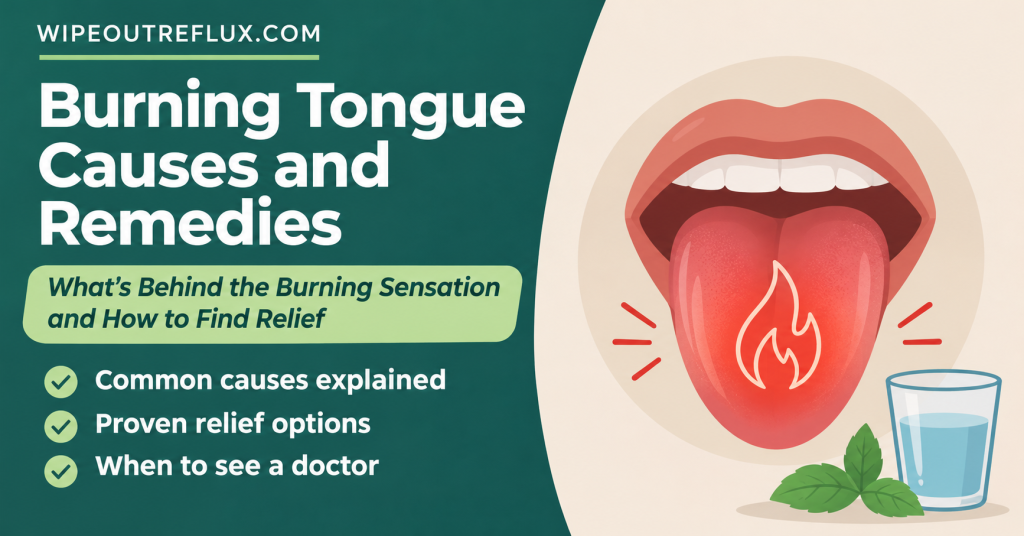
A burning tongue is usually caused by something irritating the surface of the tongue or the nerves just under it. The common culprits are a scald from hot food or drink, acidic or spicy foods, toothpaste ingredients like sodium lauryl sulfate, dry mouth, oral thrush, low vitamin B12 or iron, certain medications, and reflux reaching the mouth. When the burning lasts for months and nothing shows up on examination, it’s called burning mouth syndrome (BMS), also known as burning tongue syndrome or glossodynia.
Burning mouth syndrome is a chronic burning, scalding or tingling feeling in the mouth. It most often hits the tongue, but it can also affect the gums, lips, inner cheeks and roof of the mouth, sometimes with a dry feeling or a bitter, metallic taste. It’s hard to manage because the cause isn’t always obvious. For a lot of people, acid reflux and LPR (laryngopharyngeal reflux) are directly involved, and most doctors miss that link.
This guide covers every common cause of a burning tongue, how to tell a short-term irritation from true burning mouth syndrome, what the research says about reflux, and the remedies that actually help.
Key Takeaways
- A burning tongue has many possible causes: scalds, acidic or spicy food, toothpaste ingredients, dry mouth, thrush, vitamin B12 or iron deficiency, medications, hormonal changes and reflux.
- Burning mouth syndrome is diagnosed when the burning recurs daily for more than two hours a day, lasts at least three months and has no visible cause in the mouth. It often starts mild in the morning and worsens through the day.
- LPR was found in up to 93.8% of BMS patients when they were tested with proper impedance-pH monitoring, making reflux one of the most common hidden causes.
- Pepsin, the digestive enzyme carried up in reflux, can sit in oral tissue and be reactivated by acidic food and drink, which keeps the burning cycle going.
- PPIs alone often fail. In one study, 60.5% of BMS patients with GERD got no benefit from PPIs, while alginate therapy helped about half.
- Quick home remedies include cool water, avoiding acidic, spicy and cinnamon- or mint-flavored products, switching to an SLS-free toothpaste and treating dry mouth.
- A burning tongue that lasts more than two weeks, or comes with a sore, red, smooth tongue, white patches, ulcers or numbness, should be checked by a doctor or dentist.
What Causes a Burning Tongue?
Before getting into burning mouth syndrome itself, it’s worth separating out the everyday causes. Most burning tongues have a clear trigger, and fixing that trigger fixes the burning.
1. Scalds from hot food or drink
The most common cause by far. A sip of coffee or a mouthful of pizza that’s too hot damages the surface cells of the tongue. It feels raw, rough and tingly, and taste can be dulled for a few days. This heals on its own, usually within a week, because the tongue’s surface renews quickly.
2. Acidic, spicy and strongly flavored foods
Citrus, tomatoes, vinegar, pineapple, chili, carbonated drinks and alcohol all sting an already sensitive tongue. If your tongue burns after eating, look at what you ate first. In people with reflux, acidic foods matter twice over, because they also reactivate any pepsin already sitting in the mouth and throat (more on that below).
3. Toothpaste and mouthwash ingredients
This one gets overlooked. Sodium lauryl sulfate (SLS), the foaming agent in most toothpastes, has been linked to peeling, irritation and inflammation of the oral lining and the top of the tongue [Kasi et al., American Journal of Dentistry, 2022]. Cinnamon flavoring, strong mint, whitening agents and alcohol-based mouthwashes can do the same. If your tongue burns most after brushing, try an SLS-free, mild-flavored toothpaste for two weeks. I cover options in my guide to the best toothpaste for acid reflux.
4. Dry mouth
Saliva protects and buffers the tongue. When it drops, from medications, dehydration, mouth breathing or conditions like Sjögren’s syndrome, the tongue becomes far more sensitive to heat, acid and friction. Dry mouth and burning mouth often show up together. If that sounds familiar, see my article on acid reflux and dry mouth.
5. Oral thrush
A yeast overgrowth that causes soreness, burning and often creamy white patches that wipe off to reveal red tissue underneath. It’s more common after antibiotics, with inhaled steroids, dentures, diabetes or a weakened immune system. A dentist or doctor can confirm it quickly and it responds well to antifungal treatment. If your main symptom is coating rather than burning, my guide to white coating on the tongue goes into more detail.
6. Vitamin B12, iron and folate deficiency
Low B12 is a classic cause of a sore, burning tongue, sometimes with a smooth, red, shiny surface (atrophic glossitis). In one series of patients with previously undiagnosed B12 deficiency, mouth symptoms like a burning tongue showed up before any obvious anemia [Field et al., Journal of Oral Pathology and Medicine, 1995]. In a large group of BMS patients, about 4.8% turned out to be B12 deficient, and over a quarter of those were also low in iron [Chiang et al., Journal of Dental Sciences, 2020]. This is relevant if you’ve been on long-term acid suppression, since PPIs can lower B12 absorption. A simple blood test checks this.
7. Medications
ACE inhibitors, used for blood pressure, are the best-known drug cause of a burning tongue and altered taste. Some antiretrovirals, anticonvulsants and antidepressants have also been linked to it. If the burning started soon after a new prescription, raise it with your doctor rather than stopping the drug yourself.
8. Hormonal changes
Burning mouth is much more common in women around and after menopause. Falling estrogen affects the oral lining and can lower pain thresholds, so sensations that never bothered you before start to feel like burning.
9. Acid reflux and LPR
Reflux that reaches the throat and mouth is one of the most common hidden causes, especially when the burning is long-term and nothing visible is wrong. That’s the focus of the rest of this article. If your tongue changes also include coating or taste changes, my guide to silent reflux and the tongue covers those too.
Burning Tongue vs Burning Mouth Syndrome: What’s the Difference?
A burning tongue is a symptom. Burning mouth syndrome is a diagnosis.
Burning mouth syndrome is classified as a chronic orofacial pain disorder. The diagnostic hallmarks are a burning or abnormal sensation in the mouth that recurs daily, lasts more than two hours per day, persists for at least three months, and occurs without any visible lesion explaining it, meaning no wound, ulcer or infection [Mun et al., Journal of Oral Medicine and Pain, 2022].
When the tongue is the main site, it’s often called burning tongue syndrome or glossodynia. The burning can stay on the tongue or spread to the whole mouth and throat. Some people feel tingling or numbness more than burning. A telling pattern is that symptoms are mild or absent in the morning and build through the day.
BMS affects an estimated 0.7% to 5% of the population, with the highest rates in postmenopausal women aged 50 to 70 [Mun et al., Journal of Oral Medicine and Pain, 2022]. But it occurs across ages and genders, and it’s frequently missed or misdiagnosed, which means long diagnostic delays are common.
At the nerve level, BMS is now understood as mainly a neuropathic pain condition. Damage to the small nerve fibers in the lining of the mouth leads to abnormal signaling. The nerves send burning signals even without an obvious trigger. Think of it as a damaged alarm system that goes off without a fire. The damage also lowers the pain threshold, so things that used to feel neutral, like warm food, mild acidity or even normal saliva, start to burn [Klasser et al., Oral Surgery, Oral Medicine, Oral Pathology and Oral Radiology, 2017].
How Acid Reflux and LPR Cause Burning Mouth Syndrome
The link between reflux and BMS has been suspected for a long time, but the evidence has grown a lot in recent years, mainly thanks to impedance-pH monitoring that can detect all types of reflux, including the weakly acidic and non-acid events older tests missed.
A prospective study by Lechien and colleagues enrolled 81 patients with primary BMS and tested them with hypopharyngeal-esophageal impedance-pH monitoring (HEMII-pH). 76 of the 81 patients (93.8%) had at least one pharyngeal reflux event. Of these, 46.1% were acid events, 31.6% mixed and 22.3% non-acid. Reflux, including types PPIs don’t touch, was present in nearly everyone properly tested [Lechien et al., Laryngoscope, 2021]. Patients treated for their reflux type with diet, PPI and alginate saw significant improvement at three months, with 62.5% reporting meaningful improvement in mouth and tongue burning.
A 2024 scoping review of 18 studies found LPR in 50% to 93.8% of burning mouth patients, compared with only 3.39% to 23.4% for GERD alone [Li et al., Oral Diseases, 2024]. In other words, it’s reflux reaching the throat and mouth that matters here, not just acid in the esophagus.
Why Pepsin Is the Key Driver
Pepsin is the protein-digesting enzyme made in the stomach. When reflux carries it past the upper esophageal sphincter into the throat and mouth, it doesn’t just irritate. It damages the lining and the small nerve fibers inside it.
Pepsin doesn’t need strongly acidic reflux to do this. It sticks to the tissue surface and sits there in an inactive state. Every later exposure to acidic food or drink, even mildly acidic, can reactivate it and trigger another round of inflammation. That cycle can continue even when stomach acid has been lowered by medication, because the pepsin is already in the tissue. I explain this process in more detail in how pepsin reactivates in the throat.
A 2024 study measured salivary pepsin in BMS patients using Peptest. Patients with higher salivary pepsin reported significantly worse burning, and 86.8% of the BMS patients tested were Peptest-positive [Lechien et al., European Archives of Oto-Rhino-Laryngology, 2024]. That makes salivary pepsin a promising, non-invasive marker for spotting which BMS patients have a reflux component.
This explains a pattern many people with a burning tongue will recognize: symptoms that change with diet, flare after acidic foods and drinks, and don’t respond to standard pain treatments, because those treatments aren’t addressing the pepsin.
Why PPIs Often Don’t Help
One of the most important findings is that PPIs alone usually don’t fix BMS, even when reflux is the cause. In a 2022 study, 60.5% of BMS patients with confirmed GERD reported no benefit from PPIs. By contrast, 49.2% benefited from alginate therapy (sodium alginate with sodium bicarbonate), and 28% had near-complete remission on alginate alone [Russo et al., Acta Biomedica, 2022].
That makes sense. PPIs reduce acid production, but they don’t stop reflux happening. They don’t clear pepsin already in the mouth, and they don’t stop weakly acidic and non-acid reflux, which made up over half of the events in the Lechien study. An alginate forms a physical raft on top of the stomach contents, which limits how much refluxate reaches the throat and mouth in the first place. It’s the same reason acid reflux medication often stops working for people with LPR.
How to Tell If Reflux Is Behind Your Burning Tongue
These signs point toward reflux as a driver:
- Throat symptoms alongside the burning. Chronic throat clearing, cough, hoarseness, post-nasal drip or a lump-in-the-throat feeling. Most people with reflux-driven BMS have some throat involvement.
- Burning that changes with diet. If it flares after acidic food, coffee, alcohol or fizzy drinks, that fits pepsin reactivation.
- A sour or bitter taste. Tasting acid or something bitter, especially after meals or on waking. See my guide to sour taste in the mouth.
- No response to standard BMS treatments. If clonazepam or capsaicin haven’t helped and no dental or nutritional cause has turned up, reflux should be looked at properly.
- Worse after lying down. Burning that’s worse at night or first thing in the morning fits nighttime reflux reaching the throat and mouth.
A practical first step is my Reflux Symptom Index (RSI) test, which shows whether your overall symptom pattern matches LPR. For a formal diagnosis, HEMII-pH monitoring is the gold standard. It’s the test used in the research above.
Burning Tongue Remedies: What Helps at Home
Whatever the cause, these steps calm a burning tongue and remove the most common irritants. They’re a good starting point while you work out the underlying cause.
- Cool it down. Sip cool water, or let ice chips melt slowly in your mouth. This eases burning for many people, especially after a scald.
- Cut the irritants for two weeks. Avoid acidic foods and drinks (citrus, tomatoes, vinegar, coffee, soda, alcohol), chili and spicy food, and very hot drinks.
- Switch your toothpaste and mouthwash. Use an SLS-free, mildly flavored toothpaste with no cinnamon or whitening agents, and an alcohol-free mouthwash or none at all.
- Keep your mouth moist. Drink water steadily through the day, chew sugar-free gum to boost saliva, and use a bedroom humidifier if you wake with a dry mouth.
- Stop smoking and vaping. Both irritate the tongue and reduce saliva.
- Don’t eat late. Finishing food three hours before bed reduces nighttime reflux reaching the mouth.
- Get bloods checked. Ask for B12, iron (ferritin), folate, zinc and vitamin D, plus blood sugar if you haven’t had it checked recently.
A burning tongue from a scald or a single irritant should settle within a week or two. If it doesn’t, or it keeps coming back, that’s when it’s worth looking at the deeper causes below.
Treatment for Reflux-Related Burning Mouth Syndrome
Treatment works best when it targets the confirmed cause. There’s no one-size-fits-all fix, which is partly why BMS has such a poor track record in general practice. For reflux-driven BMS, the approach follows the same principles as LPR treatment.
Reduce pepsin exposure in the mouth
Since pepsin reactivation by dietary acid is what keeps the damage going, cutting low-pH foods and drinks (below about pH 5) removes the trigger. That includes citrus fruits and juices, tomatoes, vinegar, coffee, alcohol and carbonated drinks. Alkaline water with a pH of 8.8 or higher is a useful addition, since at that pH it can deactivate the pepsin it contacts rather than just diluting it.
Use an alginate
Given that PPIs largely fail in these patients while alginate works more consistently, an alginate after meals and before bed is a more logical approach than simply increasing your PPI dose. Gaviscon Advance (UK formulation) forms a raft that physically limits pepsin-containing reflux escaping upward.
Follow an LPR-appropriate diet
The same diet that settles LPR throat symptoms applies here: smaller meals, cutting foods that relax the lower esophageal sphincter, not eating within three hours of bed, and keeping a food and symptom diary for the first few weeks to find your personal triggers. My LPR foods to avoid list is a good starting reference, and the Wipeout Diet Plan takes you through the full low-acid approach step by step, with meal plans and the pH of the foods you’ll actually eat.
Correct deficiencies at the same time
Even when reflux is the main driver, low B vitamins, iron, zinc or vitamin D can add to nerve dysfunction and slow recovery. Testing and correcting any confirmed deficiencies is worth doing alongside the diet. For the vitamin D side, see vitamin D and silent reflux.
If there’s a primary nerve component
If reflux has been properly investigated and treated but burning continues, or testing doesn’t support reflux, the neuropathic side of BMS needs its own treatment. The best current evidence supports topical clonazepam (held in the mouth and spat out, not swallowed) and topical capsaicin. Some antidepressants (particularly TCAs and SNRIs) and anticonvulsants may be used for more persistent central sensitization [Canfora et al., Journal of Oral and Facial Pain, 2026]. Cognitive behavioral therapy (CBT) has also helped with the pain and the psychological load of living with chronic BMS.
When to See a Doctor or Dentist
Get your burning tongue checked if:
- It lasts longer than two weeks without an obvious cause
- Your tongue looks smooth, red and shiny, or has white patches that don’t wipe off
- You have an ulcer, lump or sore that hasn’t healed within two to three weeks
- You also have numbness, tingling in your hands or feet, tiredness or breathlessness (possible B12 deficiency or anemia)
- You have trouble swallowing, or you’re losing weight without trying
Conclusion
A burning tongue usually has a fixable cause. Scalds, acidic food, toothpaste ingredients, dry mouth, thrush and low B12 or iron cover most cases, and each one has a clear fix. When the burning lasts for months and nothing shows up on examination, it becomes burning mouth syndrome, and that’s where reflux deserves much more attention than it usually gets.
The research is clear that LPR is present in most BMS patients when they’re tested properly, and that pepsin, not just acid, keeps the burning going. That’s why a course of PPIs failing doesn’t rule reflux out. If you’ve had a burning tongue for months and nobody has looked beyond a standard heartburn questionnaire, you probably haven’t had a full investigation yet.
Getting the diet right is the foundation, because it removes the acid that keeps reactivating pepsin in your mouth and throat. If you want a structured plan rather than piecing it together yourself, the Wipeout Diet Plan is the most complete guide I’ve put together. I built it first for LPR, the throat-based kind that’s behind most reflux-related mouth burning, but because it works on the same root causes it’s just as effective for GERD and everyday heartburn. It covers which foods and drinks to cut, what to eat instead, meal timing and a step-by-step plan for calming the tissue down so the burning has a chance to settle.
Frequently Asked Questions
What causes a burning tongue?
The most common causes are scalds from hot food or drink, acidic or spicy foods, toothpaste ingredients like sodium lauryl sulfate, dry mouth, oral thrush, vitamin B12 or iron deficiency, certain medications, menopause and acid reflux reaching the mouth. If the burning lasts more than three months with no visible cause, it’s classed as burning mouth syndrome.
How do I stop my tongue from burning at home?
Sip cool water or let ice chips melt in your mouth, avoid acidic, spicy and very hot food and drink, switch to an SLS-free toothpaste, skip alcohol-based mouthwash and keep your mouth moist. If reflux is a factor, avoid eating within three hours of bed and consider an alginate after meals. If it hasn’t improved after two weeks, see a doctor or dentist.
Can acid reflux cause a burning tongue?
Yes. A 2021 study using impedance-pH monitoring found LPR in 93.8% of people with primary burning mouth syndrome. Pepsin from reflux binds to the lining of the mouth and is reactivated by acidic food and drink, causing ongoing nerve irritation and burning.
Why didn’t PPIs help my burning mouth?
PPIs lower acid production but don’t stop reflux. They don’t touch weakly acidic or non-acid reflux, which made up over half of the reflux events in BMS patients, and they don’t clear pepsin already in the mouth. That’s why research shows PPIs failing in about 60% of BMS patients with GERD, while alginate therapy helps more consistently.
What vitamin deficiency causes a burning tongue?
Vitamin B12 deficiency is the classic one, often with a smooth, red tongue. Low iron, folate, zinc and other B vitamins (B1, B2, B6) have also been linked. A blood test is the only reliable way to check, and deficiencies can exist alongside reflux.
Is burning mouth syndrome permanent?
Not necessarily, especially when the cause is found and treated. In the Lechien study, 62.5% of patients reported meaningful improvement within three months of reflux-targeted treatment. Primary nerve-related BMS is more variable. Some people improve over time, while others need longer-term management.
What’s the difference between burning mouth syndrome and burning tongue?
A burning tongue is a symptom with many possible causes. Burning tongue syndrome (glossodynia) is the term used when the tongue is the main site of chronic, unexplained burning. Burning mouth syndrome is the broader diagnosis when burning affects other areas too, like the gums, lips or palate. The causes and mechanisms are largely the same, and most research treats burning tongue syndrome as a type of BMS.
Research & References
- [Lechien et al., Laryngoscope, 2021] — Impedance-pH monitoring detected pharyngeal reflux in 93.8% of 81 primary BMS patients; 62.5% reported improvement in mouth and tongue burning after reflux-targeted treatment with diet, PPI and alginate.
- [Li et al., Oral Diseases, 2024] — Scoping review of 18 studies finding LPR in 50% to 93.8% of BMS patients, compared with 3.39% to 23.4% for GERD alone.
- [Lechien et al., European Archives of Oto-Rhino-Laryngology, 2024] — Salivary pepsin was positive in 86.8% of BMS patients tested, and higher pepsin levels were linked to worse burning scores.
- [Russo et al., Acta Biomedica, 2022] — In BMS patients with GERD, 60.5% reported no benefit from PPIs, while 49.2% improved on alginate therapy and 28% reached near-complete remission.
- [Klasser et al., Oral Surgery, Oral Medicine, Oral Pathology and Oral Radiology, 2017] — Review of BMS as a neuropathic pain condition involving small-fiber nerve damage and altered pain thresholds.
- [Mun et al., Journal of Oral Medicine and Pain, 2022] — Sets out BMS diagnostic criteria and a prevalence of 0.7% to 5%, highest in postmenopausal women aged 50 to 70.
- [Canfora et al., Journal of Oral and Facial Pain, 2026] — Topical clonazepam and capsaicin have the strongest evidence for primary neuropathic BMS, with antidepressants, anticonvulsants and CBT as supported options for persistent cases.
- [Kasi et al., American Journal of Dentistry, 2022] — Scoping review linking sodium lauryl sulfate in toothpaste to mucosal peeling, irritation and inflammation of the oral lining and the top of the tongue.
- [Field et al., Journal of Oral Pathology and Medicine, 1995] — In 14 patients with undiagnosed vitamin B12 deficiency, oral symptoms including tongue burning appeared without advanced anemia.
- [Chiang et al., Journal of Dental Sciences, 2020] — Of 884 BMS patients, 4.8% were vitamin B12 deficient, and 26.2% of those also had iron deficiency.

David Gray
12 years living with LPR · Consultant & researcher
I've lived with LPR for twelve years — the misdiagnoses, the PPI courses that did nothing, the slow work of figuring out what actually helps. Wipeout Reflux is where I translate the research into plain terms for people stuck in the same place. Every claim here is sourced to peer-reviewed work, and I consult one-to-one with LPR sufferers.