
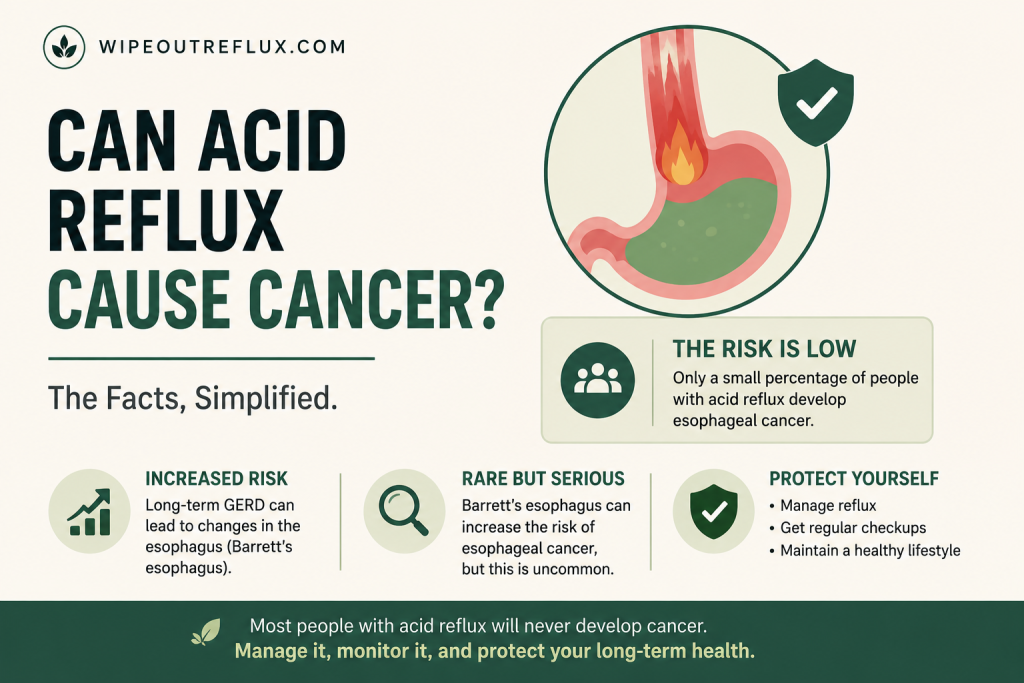
Yes, long-term acid reflux can raise your risk of one specific cancer — oesophageal adenocarcinoma. But before that sentence does any damage, here is the number that actually matters: even among people who have already developed Barrett’s oesophagus, the pre-cancerous change that reflux can cause, the risk of progressing to cancer is around 0.12% per year. That’s roughly one case per 830 patient-years. The overwhelming majority of people with Barrett’s never develop cancer, and the overwhelming majority of people with reflux never develop Barrett’s.
So the honest answer is: yes, there’s a real link, and it’s worth taking seriously enough to act on — but the everyday risk for a typical person with heartburn is very low, and it’s a risk you can actively reduce. This is not a coin flip. It’s a small probability that gets smaller with treatment, monitoring where appropriate, and controlling the things that stack alongside it.
What follows is the actual chain of events, the real numbers on both the relative and absolute scale, who genuinely needs monitoring, what the evidence says about throat cancer specifically, and the warning signs that warrant a prompt appointment rather than a search engine.
Key Takeaways
- Reflux is linked to one cancer specifically: oesophageal adenocarcinoma. Not stomach, not lung, not throat in any settled way.
- The pathway runs reflux → Barrett’s oesophagus → dysplasia → cancer, and most people stop at the first step.
- Among people with Barrett’s, progression to cancer runs at roughly 0.12% per year — about one case per 830 patient-years.
- Relative risk sounds alarming and absolute risk is reassuring; both are true, and the absolute figure is the one that describes your life.
- Weekly symptoms lasting five years or more carry roughly 7.7 times the odds of oesophageal adenocarcinoma versus no symptoms — but a large multiple of a small baseline is still small.
- Risk rises with symptom frequency, severity and duration, and stacks with smoking, obesity and male sex.
- The throat cancer link is genuinely unresolved — an association exists and survives adjustment for smoking and alcohol, but the studies are inconsistent enough that causation isn’t established.
- Red flags — trouble swallowing, unintended weight loss, vomiting blood, black stools, persistent hoarseness — warrant prompt assessment, not reassurance from an article.
- Reducing how often you reflux, not just neutralising the acid, is the part of this you control.
The Chain of Events — and Where Most People Stop
Cancer doesn’t appear out of nowhere from heartburn. There’s a sequence, it takes decades, and there are exits at every stage.
Step one: chronic reflux. Acid and pepsin repeatedly contact the oesophageal lining, which has no protective mucus layer. Over years, that irritation drives cellular stress and repair.
Step two: Barrett’s oesophagus. In some people, the lining adapts by switching to a more intestine-like tissue that tolerates acid better. This is a defensive change, not a disease in itself, but the new cell type is more prone to further mutation. Only a minority of people with chronic reflux ever develop it — and many people with Barrett’s have no idea, because it causes no symptoms of its own. There’s more in can silent reflux cause Barrett’s oesophagus.
Step three: dysplasia. A small fraction of Barrett’s tissue develops genuinely abnormal cells, graded low-grade then high-grade. This is the stage where the risk becomes meaningful — and crucially, it’s also the stage where treatment is highly effective. High-grade dysplasia can be removed endoscopically, without surgery, and that essentially interrupts the sequence.
Step four: adenocarcinoma. Cancer. Reached by a small minority of people who reach step three.
The point of laying it out this way is that the process is slow and observable. Unlike many cancers, this one has a visible precursor that can be found and monitored, and an intervention point that works. That’s why the medical response to reflux-related cancer risk is surveillance rather than alarm.
The Real Numbers, Both Ways Round
Risk statistics get quoted selectively in both directions, so here are both framings honestly.
The relative risk, which sounds frightening. The landmark Swedish population study found that people with recurrent reflux symptoms had 7.7 times the odds of oesophageal adenocarcinoma compared with people without symptoms (95% CI 5.3–11.4). The definition matters and is usually left out: “recurrent” meant symptoms at least weekly and present for at least five years. Six months of weekly heartburn is not what that number describes. For those with long-standing and severe symptoms, the odds ratio reached 43.5 — though with a confidence interval spanning 18.3 to 103.5, which tells you how few people that subgroup contained and how imprecise the estimate is. The authors concluded the relationship was strong and probably causal Lagergren et al., The New England Journal of Medicine, 1999.
A 43-fold increase is a genuinely alarming-sounding number. Which is exactly why the next paragraph matters.
The absolute risk, which is what you actually live with. Relative risk multiplies a baseline, and if the baseline is very small, a large multiple is still small. Oesophageal cancer is uncommon: lifetime risk in the US is roughly 1 in 132 for men and 1 in 437 for women, and that covers both main types — adenocarcinoma, which reflux is linked to, and squamous cell carcinoma, which it isn’t. Lagergren found essentially no association between reflux and the squamous type.
I’m deliberately not multiplying those two figures together, because it would be bad arithmetic dressed up as reassurance — an odds ratio from a case-control study doesn’t convert cleanly into personal lifetime risk, and the multiplier applies to only part of that baseline. What you can take from it is directional and still useful: reflux moves you up from a low baseline to a higher-but-still-low one, and it does so gradually over decades rather than at any identifiable moment.
And the number that matters most. If you’ve been told you have Barrett’s — the group at highest risk, the people with most reason to worry — a nationwide Danish study of more than 11,000 Barrett’s patients, covering every case in the country between 1992 and 2009, found the annual incidence of adenocarcinoma was 0.12% — about one case per 830 patient-years Hvid-Jensen et al., The New England Journal of Medicine, 2011. That was four to five times lower than earlier estimates, and it changed surveillance guidelines internationally.
Put concretely: follow around 830 people with Barrett’s for a year, and on average one of them develops adenocarcinoma. The other 829 don’t. Extend that over a decade and the great majority still won’t.
Two honest caveats on that figure, because it’s the number doing most of the reassuring here. It excludes cancers found within the first year of diagnosis — those are generally cancers that were already present rather than newly developed, but it does mean the number describes ongoing risk from an established Barrett’s diagnosis, not risk at the moment of first discovery. And the median follow-up was about five years, so it’s better evidence about the medium term than about forty years from now. Neither undoes the finding; both are worth knowing.
None of this is a reason to ignore Barrett’s — surveillance exists precisely because catching dysplasia early works — but it’s a very different picture from the one most people carry after reading about reflux and cancer online.
Who Is Actually at Elevated Risk
Risk isn’t evenly spread. These factors matter, and they compound:
- Symptom duration. Years matter more than intensity. Reflux for a decade-plus is the relevant exposure, not a bad few months.
- Symptom frequency and severity. Weekly or more, and severe enough to disturb sleep, sits higher on the curve.
- Male sex. Oesophageal adenocarcinoma is substantially more common in men.
- Age over 50. Risk climbs with age.
- Obesity, especially central obesity — both mechanically, by driving reflux, and through metabolic effects independent of reflux.
- Smoking. An independent risk factor that also worsens reflux. See can smoking cause acid reflux.
- White race, and a family history of Barrett’s or oesophageal adenocarcinoma in a first-degree relative.
Guidelines translate this into something practical: a single screening endoscopy is suggested for people with chronic reflux symptoms plus three or more of those additional risk factors Shaheen et al., The American Journal of Gastroenterology, 2022. If that describes you and it has never been raised, it’s a reasonable thing to ask about — the endoscopy guide covers what’s involved.
Equally, if you’re 34, female, slim, a non-smoker with two years of manageable heartburn, you are not the person these guidelines are written about, and the honest answer to “should I be screened” is almost certainly no.
Does Reflux Cause Throat Cancer?
This is the question silent reflux sufferers ask most, and it deserves a straight answer: we don’t know, and the evidence is weaker than for the oesophagus.
The theoretical case is reasonable. Pepsin reaching laryngeal tissue causes inflammation, and chronic inflammation is a plausible route to malignant change. Studies do find more reflux among people with laryngeal cancer than without, a systematic review and meta-analysis found a pooled odds ratio of 2.47 (95% CI 1.90–3.21) for reflux among people with laryngeal malignancy Parsel et al., Clinical Gastroenterology and Hepatology, 2019.
Notably, that association didn’t vanish when smoking and drinking were accounted for — in the subset of studies adjusting for them it was still 2.07 (1.26–3.41). So I won’t tell you confounding simply explains it away; the honest position is more uncomfortable than that.
But the reasons for caution are substantial. Heterogeneity between studies was extreme, meaning the individual studies disagreed with each other enormously. Reflux was defined inconsistently across them. Most were retrospective and vulnerable to recall bias — people with a cancer diagnosis remember and report symptoms differently. Reverse causation is plausible too, since a laryngeal tumour can itself produce symptoms mistaken for reflux. And residual confounding is very hard to eliminate when smoking and alcohol are both the dominant causes of the cancer and causes of reflux itself. The review’s authors flagged all of this, and the broader literature consistently concludes that causation has not been established.
What I’d take from it practically: if you have LPR and you don’t smoke or drink heavily, your laryngeal cancer risk is low, and the reflux contribution to it — if any — has not been demonstrated. If you have LPR and you smoke, the smoking is the thing to address, urgently and by a wide margin.
One important caveat that has nothing to do with cancer risk statistics: persistent hoarseness lasting more than three weeks should always be assessed by a doctor, regardless of whether you think reflux explains it. That advice exists because early laryngeal cancer is treatable when caught, not because hoarseness usually means cancer — it usually doesn’t. More on the broader question in is silent reflux dangerous.
Does Treating Reflux Reduce the Risk?
Reasonably good news, with honest limits.
The largest trial to test this randomised patients with Barrett’s oesophagus to high-dose or low-dose esomeprazole, with or without aspirin, and followed them for at least eight years. High-dose PPI improved the combined outcome of death, high-grade dysplasia or progression to adenocarcinoma compared with low-dose. Aspirin, by contrast, did not significantly improve outcomes on the main analysis — a result often misreported. It reached significance only in a secondary analysis excluding people taking other anti-inflammatories, which is suggestive rather than conclusive Jankowski et al., The Lancet, 2018. So the solid finding is about acid suppression, not aspirin — and given aspirin carries real bleeding risk, this is emphatically not a reason to start taking it on your own.
The limits worth stating plainly. This was in people who already had Barrett’s, so it doesn’t tell you that PPIs prevent healthy people from getting cancer. The effect sizes were moderate rather than dramatic. And long-term high-dose acid suppression carries its own trade-offs, covered in omeprazole side effects — which is why this is a decision for you and your gastroenterologist based on your actual risk, not a reason for anyone with mild heartburn to start taking double doses.
The other lever is reducing reflux itself. Acid suppression changes what refluxes; it doesn’t stop the refluxing. Weight loss, meal timing, meal size, avoiding late eating and not smoking all reduce how often oesophageal tissue is exposed in the first place, and unlike medication they address the mechanism rather than the contents.
Red Flags: When to Stop Reading and Book an Appointment
These symptoms don’t usually mean cancer — most turn out to be benign — but they all warrant prompt medical assessment rather than watchful waiting:
- Difficulty swallowing, or food sticking — particularly if it’s progressive, or worse with solids than liquids.
- Pain on swallowing.
- Unintended weight loss you can’t explain.
- Vomiting blood, or black tarry stools.
- Persistent vomiting.
- Iron-deficiency anaemia found on a blood test.
- Hoarseness lasting more than three weeks.
- A neck lump.
Guidelines are unambiguous that these warrant endoscopy promptly rather than a trial of medication first Katz et al., The American Journal of Gastroenterology, 2022. If you have any of them, that’s the action — not more reading.
If You’re Frightened by This Topic
Worth saying directly, because chronic reflux and health anxiety travel together more often than either gets discussed.
Living with a daily physical symptom in your chest or throat, in an era where any symptom can be searched, makes cancer worry almost predictable. And reflux is a particularly cruel condition for this, because its symptoms — a lump sensation, difficulty swallowing, throat discomfort — overlap with exactly the symptoms people are told to watch for. Globus sensation in particular feels alarming and is overwhelmingly benign.
A few things that genuinely help. Get assessed once, properly, rather than repeatedly seeking partial reassurance — a clear endoscopy is worth more than a hundred searches, and knowing your actual risk category is more settling than vague worry. Then notice that repeated checking, symptom-monitoring and searching tend to increase anxiety rather than resolve it; each search offers momentary relief and leaves the underlying fear intact. Anxiety also amplifies reflux symptoms physically, through muscle tension and heightened visceral sensitivity, so the loop is real in both directions — something I’ve written about in can LPR be caused by anxiety.
If cancer worry is occupying significant mental space despite reassuring investigations, that is itself worth raising with your doctor. Health anxiety responds well to treatment, and it’s a far more common outcome of chronic reflux than cancer is.
Conclusion
Acid reflux can cause cancer, and pretending otherwise would be dishonest. But the shape of that risk is worth holding accurately: it applies to one specific cancer, it develops over decades through a visible and monitorable precursor, and even in the highest-risk group the annual probability is around one in eight hundred. Most people with reflux never develop Barrett’s. Most people with Barrett’s never develop cancer. Those two sentences are as true as the first one.
What that leaves you with is a small, manageable risk and a clear set of actions: know whether you fall into a screening category and get scoped once if you do, take treatment seriously rather than intermittently, address smoking and weight if they apply, and act promptly on red-flag symptoms instead of waiting them out. That’s the whole of a sensible response, and it’s considerably less than the worry the topic usually generates.
The most useful long-term move is reducing how often reflux happens at all, because that addresses the exposure driving the whole sequence rather than only neutralising it after the fact. That’s the thinking behind the Wipeout Diet Plan — a structured approach to cutting down reflux events themselves. I built it primarily around LPR and silent reflux, the throat-based form that medication tends to disappoint in, but because it works on the same underlying mechanisms it applies equally to GERD and classic heartburn. Alongside it, the Wipeout Food Reference Guide gives you the practical detail — which foods and drinks are safe for acid reflux and LPR, with their actual pH values, so decisions are based on numbers rather than guesswork.
None of this is a substitute for medical advice about your own situation. If you’re worried, the right move is an appointment, not another article — including this one.
Frequently Asked Questions
How likely is it that my acid reflux will become cancer?
For most people, very unlikely. You’d first need to develop Barrett’s oesophagus, which only a minority of chronic reflux sufferers do, and then progress from there — which happens at roughly 0.12% per year. Risk rises with decades of frequent severe symptoms, male sex, age, obesity and smoking, but the everyday probability for a typical person with heartburn is low.
How many years of reflux does it take to be a risk?
The research points to long exposure — typically five to ten years or more of frequent symptoms before risk becomes meaningfully elevated. Guidelines generally define chronic reflux as weekly symptoms for five years or more when assessing whether screening is warranted. A few months of heartburn isn’t the relevant exposure.
Does taking a PPI prevent oesophageal cancer?
In people who already have Barrett’s, a large trial found high-dose PPI improved outcomes compared with low-dose. Aspirin did not significantly help on the trial’s main analysis, despite being widely reported as though it did. That’s real but moderate evidence for acid suppression in a high-risk group. It doesn’t establish that PPIs prevent cancer in people with ordinary heartburn, and long-term high-dose acid suppression has its own trade-offs to weigh with your doctor.
Can silent reflux cause throat cancer?
It hasn’t been established. Meta-analysis finds roughly 2.5 times the odds of reflux among people with laryngeal cancer, and that persists at around 2.1 in studies adjusting for smoking and drinking — so it isn’t purely confounding. But the studies disagree wildly with each other, rely on recall, define reflux inconsistently, and can’t exclude reverse causation. Causation remains unproven. If you don’t smoke or drink heavily, your absolute risk is low regardless.
Should I have an endoscopy just to check?
Not routinely. Guidelines suggest a single screening endoscopy for people with chronic reflux symptoms plus three or more risk factors — male sex, over 50, White race, smoking, obesity, or a first-degree relative with Barrett’s or oesophageal adenocarcinoma. Anyone with red-flag symptoms should be scoped promptly regardless.
Does Barrett’s oesophagus always turn into cancer?
No — the large majority never does. Annual progression sits around 0.12%, and Barrett’s is monitored precisely so that any dysplasia can be found and treated endoscopically well before it becomes cancer.
Is a lump in my throat a sign of cancer?
Globus sensation is one of the most common LPR symptoms and is overwhelmingly benign, particularly if it’s constant, doesn’t interfere with actually swallowing, and eases when you eat. Genuine difficulty swallowing — food physically sticking — is different and should be assessed. If you’re unsure which you have, that uncertainty is itself a good reason to get checked once.
Does reflux cause stomach cancer?
The established reflux link is with oesophageal adenocarcinoma, including cancers at the junction where the oesophagus meets the stomach. Stomach cancer more generally is driven mainly by Helicobacter pylori infection, diet and smoking rather than by reflux.
Research & References
- Lagergren et al., The New England Journal of Medicine, 1999 — Nationwide population-based case-control study in Sweden finding that people with recurrent reflux symptoms had an odds ratio of 7.7 (95% CI 5.3–11.4) for oesophageal adenocarcinoma versus asymptomatic people, rising to 43.5 among those with long-standing and severe symptoms, and concluding the relationship is strong and probably causal.
- Hvid-Jensen et al., The New England Journal of Medicine, 2011 — Nationwide Danish cohort study of all patients with Barrett’s oesophagus from 1992 to 2009, finding an annual incidence of adenocarcinoma of 0.12% (1.2 cases per 1,000 person-years, or about one per 830 patient-years) — four to five times lower than previously reported estimates, prompting international revision of surveillance intervals.
- Shaheen et al., The American Journal of Gastroenterology, 2022 — Updated ACG guideline on Barrett’s oesophagus, suggesting a single screening endoscopy for patients with chronic reflux symptoms plus three or more additional risk factors, and setting out surveillance intervals and management of dysplasia.
- Jankowski et al., The Lancet, 2018 — The AspECT randomised factorial trial in 2,557 patients with Barrett’s oesophagus, comparing high-dose with low-dose esomeprazole, with or without aspirin, over a median 8.9 years. High-dose PPI improved the composite outcome of all-cause mortality, high-grade dysplasia and oesophageal adenocarcinoma (time ratio 1.27, 95% CI 1.01–1.58). The aspirin comparison did not reach significance overall (time ratio 1.24, 95% CI 0.98–1.57, p=0.068), reaching significance only in a sensitivity analysis censoring users of other non-steroidal anti-inflammatories.
- Parsel et al., Clinical Gastroenterology and Hepatology, 2019 — Systematic review and meta-analysis of observational studies on gastro-oesophageal and laryngopharyngeal reflux and laryngeal malignancy, reporting a pooled odds ratio of 2.47 (95% CI 1.90–3.21), and 2.07 (1.26–3.41) in the subset of studies adjusting for smoking and alcohol, while noting very high between-study heterogeneity (I²=94%), inconsistent reflux definitions, recall and selection bias, and the possibility of reverse causation.
- Katz et al., The American Journal of Gastroenterology, 2022 — ACG clinical guideline for the diagnosis and management of gastro-oesophageal reflux disease, recommending prompt endoscopy for patients with alarm features including dysphagia, weight loss, bleeding, vomiting and anaemia.

David Gray
12 years living with LPR · Consultant & researcher
I've lived with LPR for twelve years — the misdiagnoses, the PPI courses that did nothing, the slow work of figuring out what actually helps. Wipeout Reflux is where I translate the research into plain terms for people stuck in the same place. Every claim here is sourced to peer-reviewed work, and I consult one-to-one with LPR sufferers.