
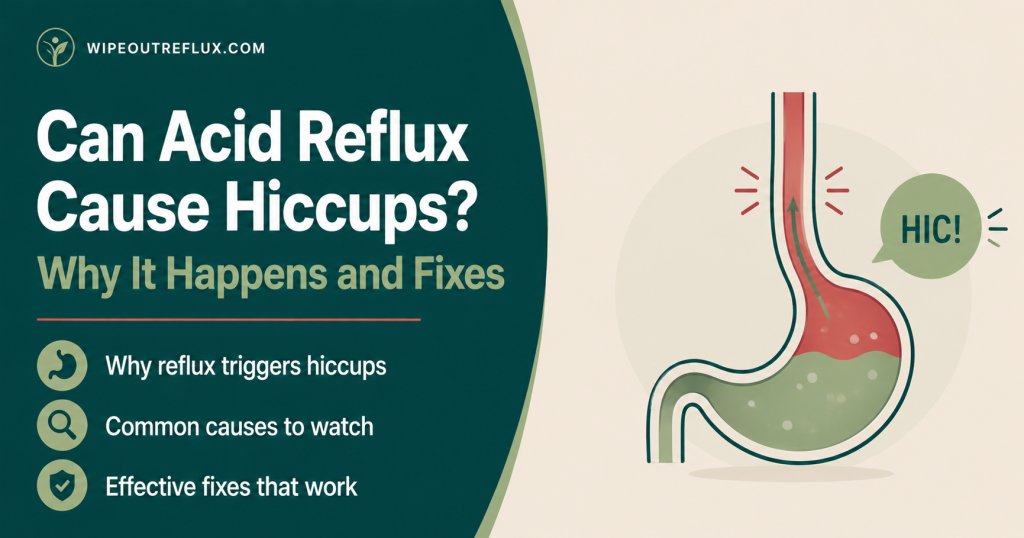
Yes — and the connection is more direct than most people realise. The hiccup reflex is triggered by irritation or stretching along a nerve circuit that runs right past your oesophagus and stomach. Acid sitting where it shouldn’t is exactly the kind of irritation that sets it off.
It’s well enough established that reflux is a recognised cause of persistent hiccups, not just an association. In one case, protracted hiccups were the only symptom a patient had — endoscopy and pH testing confirmed non-erosive reflux disease as the sole cause. And back in 1986, researchers showed they could reproduce a patient’s chronic hiccups on demand by dripping acid into the oesophagus.
Most hiccups are harmless and pass in minutes. But if yours keep coming back, keep going for days, or arrive reliably after meals, reflux belongs high on the list of explanations.
Key Takeaways
- The hiccup reflex arc uses the vagus and phrenic nerves — both of which pass alongside the oesophagus and stomach.
- Gastric and oesophageal distension are among the most commonly accepted triggers of hiccups.
- Acid perfusion of the oesophagus has been used to deliberately reproduce chronic hiccups, showing cause rather than coincidence.
- Hiccups can be the only presenting symptom of reflux, with no heartburn at all.
- Hiccups lasting over 48 hours are “persistent”; over a month, “intractable” — both warrant medical assessment.
- Where reflux is the cause, treating the reflux is the treatment; acid suppression often resolves hiccups that failed neurological drugs.
- For persistent hiccups not caused by reflux, baclofen has the best trial evidence — it completely stopped hiccups significantly more often than placebo.
- Prevention is mostly about volume and swallowed air: smaller meals, slower eating, no fizzy drinks, no straws.
What a hiccup actually is
A hiccup is a sudden, involuntary contraction of the diaphragm and the muscles between your ribs, followed about 35 milliseconds later by the vocal cords snapping shut. The abrupt intake of air hitting a closed glottis makes the sound.
What’s useful here is the wiring, because it explains the reflux link completely.
The hiccup reflex arc has three parts:
- The afferent (incoming) limb — the vagus nerve, the phrenic nerve, and sympathetic fibres from the T6–T12 spinal segments. These carry the “something’s wrong” signal.
- The central processor — the medulla and the C3–C5 spinal segments, with input from several brain regions.
- The efferent (outgoing) limb — the phrenic nerve to the diaphragm, plus branches to the scalene and intercostal muscles and the recurrent laryngeal nerve to the vocal cords.
The vagus nerve is the key player. It runs the length of your oesophagus and innervates your stomach, and it’s the same nerve involved in a great deal of reflux physiology — I’ve written more about that in the vagus nerve and acid reflux. Irritate it anywhere along that route and you can trigger the reflex.
The most commonly accepted causes of hiccups include distension of the oesophagus and stomach, central nervous system disorders, uraemia, and phrenic nerve irritation Steger et al., Alimentary Pharmacology & Therapeutics, 2015. Two of those four sit squarely in reflux territory.
How reflux triggers hiccups
1. Acid irritating the oesophageal lining
This is the most direct route. Acid contacting the oesophageal mucosa stimulates the vagal afferents running through it, and those signals feed straight into the hiccup reflex arc.
The evidence here is unusually clean, because someone tested it deliberately. Researchers used oesophageal acid perfusion as a provocative manoeuvre in a patient with chronic hiccups and were able to reproduce the hiccups on demand Gluck and Pope, Annals of Internal Medicine, 1986.
Drip acid in, hiccups appear. That’s about as close to demonstrating cause as clinical medicine gets outside a trial.
2. Gastric distension stretching the reflex
A stretched stomach is one of the classic hiccup triggers, and it’s also one of the classic reflux triggers. Both mechanisms fire from the same stimulus.
That’s why hiccups so often show up after a large meal, after fizzy drinks, after eating quickly, or after swallowing air. It’s the same physiology that makes overeating trigger reflux and that ties excessive burping so tightly to reflux symptoms. Distension opens the lower esophageal sphincter and irritates the reflex arc at the same time.
3. Inflammation lowering the threshold
Ongoing acid exposure inflames the oesophageal lining, and inflamed tissue is more sensitive. Nerve endings that would normally ignore a mild stimulus start firing at it. This is why chronic reflux tends to produce hiccups that come back repeatedly rather than a single episode — the whole system is set to a hair trigger.
It’s most pronounced with visible damage. Case series describe patients with severe erosive oesophagitis and protracted hiccups who improved on acid suppression after neurological medications had failed.
4. Hiatal hernia and diaphragm irritation
The phrenic nerve controls the diaphragm, and a hiatal hernia means part of the stomach has pushed up through the diaphragm itself. That’s direct mechanical irritation at the exact site the hiccup reflex acts on, and it’s why hernias show up disproportionately in people with recurrent hiccups plus reflux.
Can hiccups be your only reflux symptom?
Yes, and this is the part worth knowing about.
A published case describes a 23-year-old woman with protracted hiccups in whom every other organic cause was excluded, and endoscopy plus conventional pH monitoring identified non-erosive reflux disease as the sole cause de Hoyos et al., Journal of Neurogastroenterology and Motility, 2010.
No heartburn. No regurgitation. Just hiccups.
That fits a broader pattern in reflux, where the loudest symptom often isn’t the burning one. It’s the same reason silent reflux is so frequently missed, and why people get treated for the wrong thing for years. If your hiccups are stubborn and unexplained, reflux is worth investigating even without classic symptoms.
When hiccups need medical attention
The standard classification is straightforward:
- Acute hiccups — under 48 hours. Almost always benign and self-limiting.
- Persistent hiccups — more than 48 hours. Worth investigating.
- Intractable hiccups — more than one month. Needs proper work-up.
See a doctor if hiccups last beyond two days, keep recurring, interfere with eating or sleeping, or come with difficulty swallowing, chest pain, weight loss, vomiting, or any neurological symptoms such as weakness, numbness or coordination problems.
That last point matters. Persistent hiccups can also signal central nervous system problems, phrenic nerve irritation from chest pathology, kidney disease, or medication side effects. Reflux is a common explanation, not the only one, and prolonged hiccups deserve a proper assessment rather than assumption.
What actually helps
If reflux is the cause, treat the reflux
This sounds obvious but it’s routinely missed, because hiccups get treated as a neurological curiosity rather than a digestive symptom. Where acid is the trigger, acid suppression is the treatment — and case reports specifically describe hiccups resolving on PPI therapy after neurological drugs had failed.
A proper trial means an adequate dose, taken correctly (30–60 minutes before a meal), for at least four to eight weeks. If you’re going down this route it’s worth reading when to take omeprazole, because timing changes how well it works.
Alginates are also worth trying, since they form a physical raft on top of the stomach contents rather than just reducing acidity — see alginates for acid reflux.
Reduce distension and swallowed air
These changes address both mechanisms at once:
- Smaller, more frequent meals rather than large ones
- Eat slowly — rushed eating means swallowed air
- Skip carbonated drinks entirely if hiccups are a pattern for you
- Avoid drinking through straws
- Avoid extremes of temperature — very hot or very cold food and drink are recognised hiccup triggers
- Don’t lie down straight after eating; see how long before bed to stop eating
- Alcohol is a double hit — it relaxes the sphincter and irritates the lining
Stopping an episode
Most home remedies work, when they work, by raising carbon dioxide levels or stimulating the vagus nerve to interrupt the reflex:
- Hold your breath for 10–20 seconds, then breathe out slowly
- Sip cold water steadily, or drink from the far side of a glass
- Swallow a teaspoon of granulated sugar — the granular texture stimulates the vagal pathway
- Gargle with cold water
- Pull your knees to your chest and lean forward — though skip this one if it provokes reflux
- Slow diaphragmatic breathing, which is also useful for reflux generally — see breathing exercises for acid reflux
None of these have real trial evidence, but they’re harmless and they’re all working on the same reflex arc.
Medication for persistent hiccups
If hiccups persist after reflux has been properly treated, prescribed options exist. A systematic review of pharmacological treatment concluded that on the available efficacy and safety data, baclofen and gabapentin may be considered first-line for persistent and intractable hiccups, with metoclopramide and chlorpromazine held in reserve — while noting there’s no high-quality evidence base to draw firm recommendations from Steger et al., Alimentary Pharmacology & Therapeutics, 2015.
Baclofen has the strongest trial data. In a randomised, double-blind, placebo-controlled trial in stroke patients with persistent hiccups, complete cessation was significantly more common on baclofen than placebo, with a relative risk of 7.0 Zhang et al., Trials, 2014.
Interestingly, baclofen also reduces transient lower oesophageal sphincter relaxations, so it can help both problems at once — more on that in baclofen for acid reflux. All of these are prescription medications with meaningful side effects, so they’re a conversation with your doctor rather than something to pursue independently.
Conclusion
Acid reflux can absolutely cause hiccups, and the mechanism is straightforward once you see the wiring. The hiccup reflex runs on the vagus and phrenic nerves, both of which travel alongside your oesophagus and stomach, and both acid irritation and gastric distension stimulate them. That’s not a theory — acid dripped into the oesophagus has been used to reproduce chronic hiccups deliberately, and there are documented cases where reflux was the only cause found.
The practical takeaway is that persistent hiccups deserve to have reflux considered, even if you have no heartburn at all, and that where reflux is the cause, treating the reflux is what resolves them. Hiccups lasting more than two days should be assessed by a doctor rather than managed with home remedies, because the other causes on the list are worth excluding.
For the reflux side, most of the benefit comes from meal size, timing and what you’re actually eating — and that last part is where people struggle most. The Wipeout Food Reference Guide is the essential reference for exactly that: which foods and drinks are safe with acid reflux and LPR, and where they sit on the pH scale. If you want the full system rather than a food list, the Wipeout Diet Plan goes considerably deeper — it was designed around LPR, the stubborn throat-based form of reflux, but because it targets the same underlying mechanisms it works just as well for GERD and everyday heartburn. It tackles distension and acid exposure together, which is precisely the combination that keeps a hair-trigger hiccup reflex firing.
Frequently Asked Questions
Can acid reflux cause hiccups without heartburn?
Yes. There’s a documented case in which protracted hiccups were the only symptom, with non-erosive reflux disease confirmed on endoscopy and pH testing as the sole cause. Reflux frequently presents through atypical symptoms rather than burning.
Why do I get hiccups after every meal?
Most likely gastric distension. A full stomach stretches the reflex arc and simultaneously makes reflux more likely, so meal-related hiccups usually respond to eating smaller portions more slowly, and cutting carbonated drinks.
How long is too long for hiccups?
Beyond 48 hours they’re classed as persistent and should be assessed. Beyond a month they’re intractable and need a proper work-up. Under 48 hours is almost always benign.
Will omeprazole stop hiccups?
If reflux is the cause, often yes — case reports describe hiccups resolving on PPI therapy after neurological medications failed. Give it an adequate dose and at least four to eight weeks, taken 30–60 minutes before a meal.
What’s the best medication for persistent hiccups?
Baclofen has the strongest evidence, having significantly outperformed placebo in a randomised trial, with gabapentin also considered first-line. Chlorpromazine remains the only formally approved drug but is usually kept in reserve because of side effects. All require a prescription and medical supervision.
Can a hiatal hernia cause hiccups?
It can contribute. A hernia means stomach tissue has pushed through the diaphragm, which is exactly the muscle the hiccup reflex acts on, so it creates direct mechanical irritation alongside the increased reflux it causes.
Do home remedies for hiccups actually work?
They have no real trial evidence, but they’re plausible and harmless. Breath-holding raises carbon dioxide levels and swallowing sugar or gargling stimulates the vagus nerve, both of which can interrupt the reflex arc. Just don’t rely on them for hiccups lasting more than a couple of days.
Research & References
- Systematic review of the pathogenesis and pharmacological treatment of hiccups, identifying oesophageal and gastric distension among the most commonly accepted causes, and concluding that baclofen and gabapentin may be considered first-line for persistent and intractable hiccups with metoclopramide and chlorpromazine in reserve, while noting the absence of high-quality evidence Steger et al., Alimentary Pharmacology & Therapeutics, 2015.
- Report using oesophageal acid perfusion as a provocative manoeuvre to reproduce chronic hiccups, supporting a causal link between gastro-oesophageal reflux and the hiccup reflex Gluck and Pope, Annals of Internal Medicine, 1986.
- Case of a 23-year-old patient with protracted hiccups in whom all other organic pathology was excluded and endoscopy with conventional pH monitoring confirmed non-erosive reflux disease as the unique cause de Hoyos et al., Journal of Neurogastroenterology and Motility, 2010.
- Randomised, double-blind, placebo-controlled trial of baclofen 10 mg three times daily for five days in 30 stroke patients with persistent hiccups; complete cessation of hiccups was significantly more frequent with baclofen than placebo (relative risk 7.00, 95% CI 1.91–25.62) Zhang et al., Trials, 2014.
- Systematic review of pharmacologic interventions for intractable and persistent hiccups across 26 articles and 10 treatment options, finding baclofen and metoclopramide the only agents studied in randomised controlled trials Polito and Fellows, The Journal of Emergency Medicine, 2017.

David Gray
12 years living with LPR · Consultant & researcher
I've lived with LPR for twelve years — the misdiagnoses, the PPI courses that did nothing, the slow work of figuring out what actually helps. Wipeout Reflux is where I translate the research into plain terms for people stuck in the same place. Every claim here is sourced to peer-reviewed work, and I consult one-to-one with LPR sufferers.