
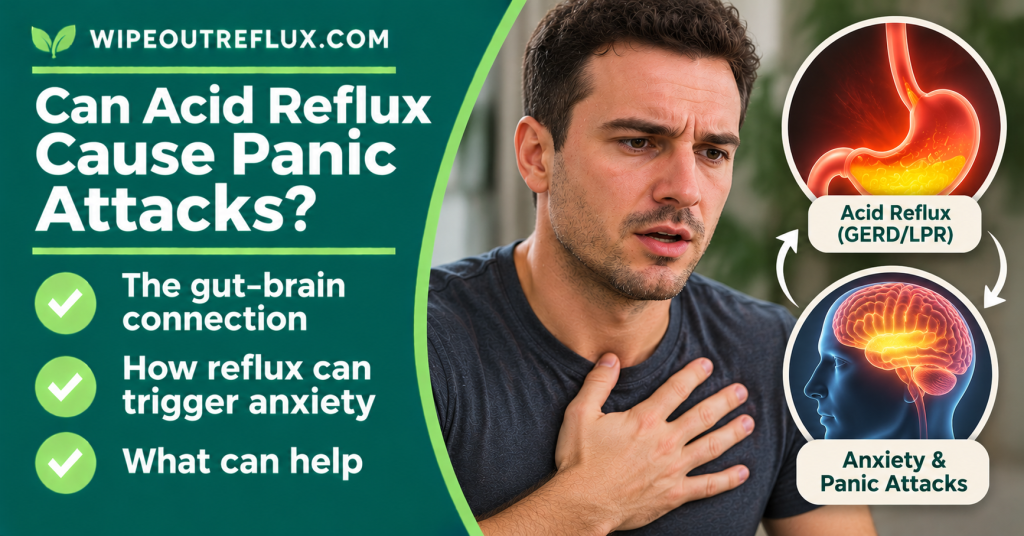
Acid reflux doesn’t directly cause panic attacks, but the two are closely linked and can set each other off. Reflux produces chest tightness, a racing heart, a choking or tight throat and shortness of breath, all of which feel alarmingly like the start of a panic attack. If you’re already prone to anxiety, those sensations can be enough to tip you into one. And anxiety in turn makes reflux symptoms feel stronger, so the two easily become a loop.
Research backs this up. A large meta-analysis found that roughly 1 in 3 people with GERD have anxiety symptoms, and that the relationship probably runs in both directions. The good news is that breaking the loop from either side helps: calming reflux removes the physical triggers, and calming the nervous system turns down how intensely you feel reflux. Chest pain should always be checked first, though, because neither reflux nor panic should be assumed.
Key Takeaways
- Reflux doesn’t directly cause panic attacks, but its symptoms can trigger one in people prone to anxiety.
- About 34% of people with GERD have anxiety symptoms, and they are around four times more likely to have anxiety than people without GERD.
- Stress makes the esophagus more sensitive: in a lab study, people with GERD felt acid sooner and more intensely during stress.
- Panic attacks can worsen reflux through rapid breathing, air swallowing, muscle tension and changes in eating habits.
- Night-time reflux can cause sudden choking awakenings that feel like nocturnal panic.
- Panic attacks usually peak within minutes and come with a sense of dread; reflux tends to track meals, lying down and bending.
- New chest pain, especially with exertion, sweating or arm or jaw pain, needs urgent medical assessment.
Reflux and Panic Attacks: Why the Symptoms Overlap
Panic attacks are sudden surges of intense fear that peak within minutes. They come with strong physical symptoms because the body’s fight-or-flight system switches on. Reflux happens for completely different reasons, but look at how much the symptoms share:
- Chest pain or tightness: common in both. Reflux can cause a burning or squeezing pain behind the breastbone.
- Racing or pounding heart: classic in panic, and many people with reflux report palpitations too. See acid reflux and heart palpitations.
- Tight throat or choking feeling: panic often causes a “lump” in the throat, and so does LPR.
- Shortness of breath: panic causes over-breathing, while reflux can irritate the airways. I cover this in silent reflux and shortness of breath.
- Nausea and an upset stomach: common in both.
- Lightheadedness: often from rapid breathing in panic.
That overlap is why so many people end up in the emergency room unsure whether they’re having a heart attack, a panic attack or a reflux flare. A Canadian study of 441 people attending an emergency department with chest pain found that around 25% met the criteria for panic disorder, and the vast majority of them weren’t recognized as such by the doctors treating them [Fleet et al., The American Journal of Medicine, 1996].
How Reflux Can Trigger a Panic Attack
Panic attacks often start with a physical sensation that the brain interprets as dangerous. Doctors call this “catastrophic misinterpretation”. For someone with reflux, the sequence might look like this:
- A reflux episode causes chest tightness or a squeezing throat.
- Your brain reads it as “something’s wrong with my heart” or “I can’t breathe”.
- Adrenaline surges, your heart races and your breathing speeds up.
- Those new sensations seem to confirm the danger, and fear escalates into a full panic attack.
This is particularly common with LPR, where the symptoms are in the throat and can feel like choking or the airway closing. A tight throat is frightening in a way that ordinary heartburn usually isn’t. I explain that sensation in throat feels tight.
Night-time reflux and nocturnal panic
Reflux at night can wake you suddenly with coughing, choking or a burning throat. Waking abruptly in that state, heart pounding, can feel identical to a nocturnal panic attack. If your “panic” episodes happen mostly in the early hours, a few hours after a late meal, or when you’ve been lying flat, reflux is worth considering as the trigger. See acid reflux at night.
How Anxiety and Panic Make Reflux Worse
The relationship runs the other way too, and this is the part that often gets missed.
1. Stress makes the esophagus more sensitive
In a well-designed lab study, people with GERD had acid dripped into the esophagus with and without a stressful noise playing. During stress, they noticed the acid sooner, rated it as more intense and became more sensitive overall. Healthy volunteers didn’t show this effect [Fass et al., Gastroenterology, 2008].
In other words, the same amount of acid hurts more when you’re anxious. That’s why reflux symptoms can spike during a stressful week even when nothing about your diet has changed.
2. Hypervigilance turns up the volume
Once you’ve had a frightening symptom, it’s natural to start scanning your body for it. Researchers call this esophageal hypervigilance, and studies show it’s linked with more severe esophageal symptoms, separate from what’s physically happening in the esophagus [Carlson et al., The American Journal of Gastroenterology, 2020]. The more closely you watch for a symptom, the more you notice it, and the more anxious you become.
3. Panic changes how you breathe and swallow
During panic, breathing becomes fast and shallow, and people often swallow air. Air in the stomach leads to belching, and every belch can carry a little acid and pepsin with it. Fast, chest-based breathing also doesn’t support the diaphragm, which forms part of the anti-reflux barrier. Slow belly breathing does the opposite, as I explain in breathing exercises for acid reflux.
4. Anxiety changes your habits
Anxious periods often mean more coffee, more alcohol, irregular meals, late-night snacking, poor sleep and comfort food. Every one of those is a reflux trigger in its own right.
What the Research Says About the Link
- A Norwegian population study of more than 43,000 adults found that people with anxiety had 3.2 times the odds of severe reflux symptoms compared with people without anxiety or depression [Jansson et al., Alimentary Pharmacology and Therapeutics, 2007].
- A 2023 meta-analysis of 36 studies found anxiety symptoms in 34.4% of people with GERD, who had about 4.5 times the odds of anxiety compared with healthy controls. Cohort and genetic studies pointed to a likely two-way causal relationship [Zamani et al., The American Journal of Gastroenterology, 2023].
- A genetic (Mendelian randomization) study found that GERD increased the risk of anxiety disorders by about 35%. In that study the reverse direction wasn’t confirmed, which suggests reflux itself may be a genuine contributor to anxiety [Zeng et al., Frontiers in Psychiatry, 2023].
None of these studies look specifically at panic attacks, which are a narrower thing than general anxiety. But they show clearly that reflux and anxiety travel together, and that living with chronic reflux symptoms takes a real psychological toll. For more on that side of things, see does silent reflux cause anxiety and can stress cause acid reflux.
Panic Attack or Acid Reflux? How to Tell the Difference
These patterns aren’t foolproof, but they can help:
More likely a panic attack if:
- It comes on suddenly and peaks within about 10 minutes
- There’s an intense feeling of dread, doom or losing control
- You have tingling in your hands or around your mouth, trembling or sweating
- It happens in a specific situation (crowds, driving, enclosed spaces) or out of the blue
- It eases within 20 to 30 minutes, often leaving you exhausted
More likely reflux if:
- Symptoms come after meals, especially large, fatty or late ones
- They’re worse when lying down, bending over or after alcohol or coffee
- You notice burning, a sour or bitter taste, regurgitation or burping
- Throat symptoms like hoarseness, throat clearing or postnasal drip are part of the picture
- An antacid or alginate brings relief
Possibly both if: a reflux symptom kicks off, you start to worry, and it snowballs into fear, a racing heart and rapid breathing. This is the pattern I hear about most often.
When Chest Symptoms Need Urgent Help
Don’t assume chest pain is reflux or panic until heart problems have been ruled out, especially if it’s new. Call emergency services if you have chest pain with any of the following:
- Pain that spreads to your arm, jaw, neck or back
- Pain that comes on with exertion
- Sweating, nausea or feeling faint
- Severe shortness of breath
- Risk factors like heart disease, diabetes, high blood pressure or smoking
I go through the differences in more detail in heartburn or heart attack.
How to Break the Reflux–Panic Loop
Calm the reflux side
- Get your evening routine right. Finish eating three hours before bed, keep dinner moderate in size, and raise the head of your bed if night-time symptoms wake you.
- Cut back on the big triggers. Coffee, alcohol, fizzy drinks and chocolate affect both reflux and anxiety, so reducing them helps twice.
- Use an alginate. Taking one after meals and before bed forms a barrier that reduces how much reaches the esophagus and throat. See alginates for acid reflux.
- Follow a structured plan. Knowing exactly what you can eat takes a lot of the guesswork and worry out of meals. That’s what the Wipeout Diet Plan is designed to do.
Calm the nervous system side
- Slow breathing. Breathing in through your nose for 4 seconds and out for 6 to 8 seconds, into your belly, signals safety to your nervous system and supports the diaphragm. I explain the link in the vagus nerve and acid reflux.
- Name the sensation. Telling yourself “this is reflux, it’s uncomfortable but not dangerous” can stop the escalation into panic, once a doctor has ruled out heart problems.
- Stop checking. Repeatedly swallowing to test your throat or pressing on your chest keeps hypervigilance going.
- Get proper support. Cognitive behavioral therapy (CBT) is a well-established treatment for panic disorder, and gut-directed approaches can help with esophageal hypervigilance too. Talk to your doctor if panic attacks are frequent.
Check your medications
Some medications can affect both reflux and anxiety. Stimulants, decongestants and high-dose caffeine can raise anxiety, while a few people report feeling anxious or restless on famotidine. If you’ve noticed a pattern, I discuss it in can famotidine cause anxiety. Don’t stop any medication without talking to your doctor first.
Conclusion
Acid reflux doesn’t directly cause panic attacks, but it can easily set one off. Chest tightness, a squeezing throat, palpitations and choking sensations from reflux are exactly the kind of physical signals that an anxious brain reads as danger. And once anxiety is in the mix, it turns up the volume on reflux: stress makes the esophagus more sensitive, hypervigilance amplifies symptoms, and panic itself changes breathing, swallowing and eating habits. The research shows anxiety and GERD go hand in hand, with good evidence that each can drive the other.
The way out is to work on both sides at once. Get any chest pain checked so you can trust that it isn’t your heart. Learn to recognize the patterns of your reflux. Use slow breathing and, if needed, proper psychological support to calm the alarm system. And reduce the physical triggers so there’s less for your brain to react to in the first place.
That last part is where diet makes the biggest difference. The Wipeout Diet Plan is my complete guide to calming reflux through food, meal timing and daily habits, so you spend less time on edge waiting for the next flare. I originally built it around silent reflux, which causes the throat tightness and choking feelings that so often trigger panic, but because it addresses the same root mechanisms, it works equally well for GERD and everyday heartburn.
Frequently Asked Questions
Can acid reflux feel like a panic attack?
Yes. Reflux can cause chest tightness, a racing heart, a tight or choking throat and shortness of breath, which overlap heavily with panic symptoms.
Can a panic attack cause acid reflux?
It can make reflux worse. Panic increases esophageal sensitivity, causes air swallowing and rapid breathing, and often leads to habits like more caffeine and irregular meals.
Why do I wake up at night choking and panicking?
Night-time reflux can wake you with a choking or burning sensation, which can feel just like a nocturnal panic attack. Late meals and lying flat make it more likely.
Can silent reflux cause anxiety attacks?
LPR symptoms like throat tightness and a lump-in-the-throat feeling are very distressing and can trigger anxiety or panic in people who are prone to it.
Can reflux cause heart palpitations and panic?
Many people with reflux report palpitations, possibly through irritation near the vagus nerve or simply through anxiety. Palpitations can then feed into panic. Get new palpitations checked by a doctor.
Will treating reflux stop my panic attacks?
If reflux symptoms are your main panic trigger, reducing them often helps a lot. If panic happens independently, it needs its own treatment, such as CBT.
How do I stop a reflux-triggered panic attack?
Sit upright, sip a little water, take an alginate if you use one, and breathe slowly into your belly with a longer out-breath. Remind yourself it’s reflux once your doctor has ruled out heart causes.
Research & References
- [Fleet et al., The American Journal of Medicine, 1996] — About 25% of 441 emergency department chest pain patients met criteria for panic disorder, and 98% of these weren’t recognized by attending cardiologists.
- [Fass et al., Gastroenterology, 2008] — Acute auditory stress made GERD patients perceive esophageal acid sooner and more intensely, an effect not seen in healthy controls.
- [Carlson et al., The American Journal of Gastroenterology, 2020] — Esophageal hypervigilance and visceral anxiety contributed to symptom severity in patients undergoing high-resolution esophageal manometry.
- [Jansson et al., Alimentary Pharmacology and Therapeutics, 2007] — In the Norwegian HUNT population, anxiety without depression was linked to a 3.2-fold increased risk of severe reflux symptoms.
- [Zamani et al., The American Journal of Gastroenterology, 2023] — Meta-analysis of 36 studies: anxiety symptoms in 34.4% of people with GERD (odds ratio 4.46 vs controls), with evidence for a bidirectional relationship.
- [Zeng et al., Frontiers in Psychiatry, 2023] — Bidirectional Mendelian randomization study finding GERD increased the risk of anxiety disorders (OR 1.35), while the reverse direction wasn’t supported.

David Gray
12 years living with LPR · Consultant & researcher
I've lived with LPR for twelve years — the misdiagnoses, the PPI courses that did nothing, the slow work of figuring out what actually helps. Wipeout Reflux is where I translate the research into plain terms for people stuck in the same place. Every claim here is sourced to peer-reviewed work, and I consult one-to-one with LPR sufferers.