
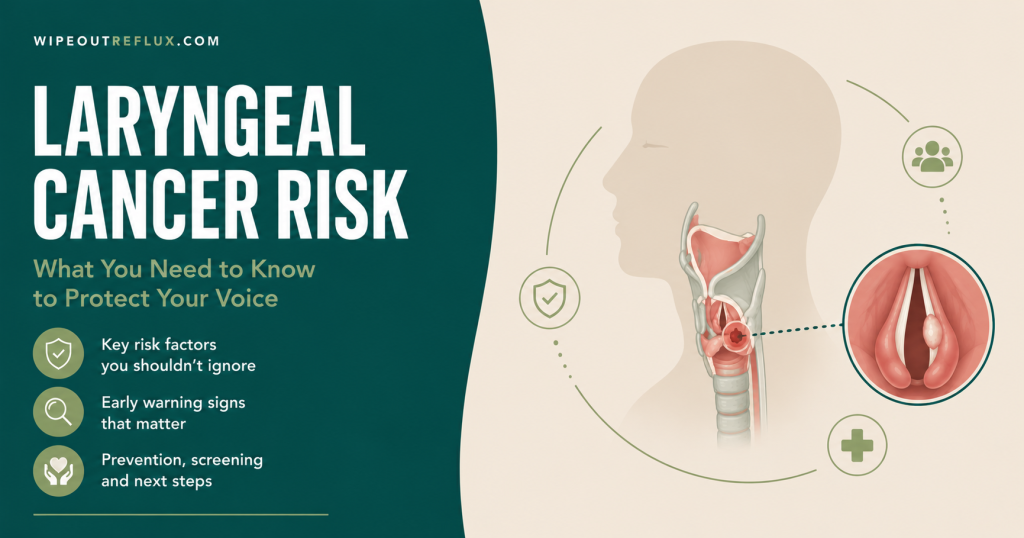
It’s a frightening question, so let’s answer it plainly: can acid reflux cause throat cancer? The honest answer is that reflux is linked to a modestly increased risk of cancer of the voice box (laryngeal cancer), but it is not a proven, strong cause — and the absolute risk for any individual with reflux remains low.
The most important thing to understand is proportion. Smoking and alcohol are responsible for the overwhelming majority of laryngeal cancers. Reflux, by comparison, appears to be a minor and still-uncertain contributor. So while the research does show an association — even in some people who don’t smoke or drink — this is a reason to control your reflux sensibly and to get persistent throat symptoms checked, not a reason to panic.
Here’s what the evidence actually says about reflux, LPR and laryngeal cancer risk, kept in proper perspective, along with the warning signs that genuinely warrant a doctor’s visit.
Key Takeaways
- Reflux is associated with a modestly higher risk of laryngeal (voice box) cancer, but association is not the same as proven cause, and the absolute risk stays low.
- Smoking and alcohol cause the large majority of laryngeal cancers — together they account for roughly 89% of cases — making them far more important than reflux.
- Studies suggest reflux may carry a small independent risk even in some non-smokers and non-drinkers, but the effect is modest.
- The clearer, better-established reflux-cancer link is in the esophagus (via Barrett’s oesophagus), not the throat.
- There’s no proof that treating reflux lowers cancer risk, but controlling it is worthwhile for your symptoms and as sensible risk reduction.
- Persistent hoarseness lasting more than three weeks, trouble swallowing, a neck lump, or unexplained weight loss should always be checked promptly — especially in smokers and drinkers.
- The biggest things you can do to protect yourself are not smoking, moderating alcohol, and keeping reflux under control.
What the evidence actually shows
Research does find a link. Pooling many studies together, people with gastroesophageal reflux have roughly double the relative risk of laryngeal cancer compared with people without reflux — on the order of a two-fold association across cohort and case-control data Wang et al., Cancers, 2025. That sounds alarming until you understand what “relative risk” means: it’s a multiplier on a baseline that is itself small. Doubling a low risk still leaves a low risk.
Some of that association may be independent of the usual culprits. When researchers specifically looked at people who don’t smoke or drink and adjusted for those factors, reflux still showed a modest positive association with laryngeal neoplasia (an adjusted odds ratio of about 1.29) Parsel et al., Otolaryngology–Head and Neck Surgery, 2020. That’s a small effect — a roughly one-third increase over a low baseline — not a dramatic one. The overall picture is of reflux as a plausible, minor contributor rather than a powerful driver.
Why smoking and alcohol matter far more
To keep reflux in perspective, look at what actually causes laryngeal cancer. Tobacco and alcohol are the dominant forces by a wide margin: in one large analysis, the two together accounted for around 89% of laryngeal cancer cases Hashibe et al., Cancer Epidemiology, Biomarkers & Prevention, 2009. That’s the headline. If you want to protect your throat from cancer, not smoking and moderating alcohol dwarf everything else you could do.
It’s also worth knowing that smoking and reflux aren’t unrelated — smoking worsens acid reflux too, so a smoker with reflux is stacking the two biggest and one of the smaller risk factors together. Tackling the smoking helps on both fronts at once.
How reflux could contribute
The mechanism people worry about is biologically plausible. In silent reflux (LPR), acid and the enzyme pepsin repeatedly reach the voice box and irritate its lining. Chronic inflammation of any tissue is, in general terms, thought to be able to contribute to cancer risk over long periods, and that’s the concern with years of untreated reflux irritating the larynx — the same irritation behind chronic reflux laryngitis and the broader picture of LPR symptoms. But plausible is not the same as proven. The evidence shows an association, and a mechanism that could explain it, but it hasn’t established that reflux directly causes laryngeal cancer, and untangling it from smoking and alcohol is genuinely difficult.
The clearer cancer link is in the esophagus, not the throat
Here’s an important distinction that often gets blurred. The best-established connection between reflux and cancer isn’t in the throat at all — it’s in the esophagus. Long-standing acid reflux can cause a change in the lining of the lower esophagus called Barrett’s oesophagus, which carries a raised risk of esophageal cancer. That pathway is far better understood than any throat link, and it’s why classic GERD is taken seriously. We cover it in depth in can acid reflux cause cancer and whether silent reflux can cause Barrett’s oesophagus. Keeping the two straight matters: the throat-cancer link is weaker and less certain than the esophageal one.
Reasons not to panic
If you have reflux and you’ve been worrying, hold on to these points. Laryngeal cancer is relatively uncommon to begin with, so even a doubled relative risk leaves the absolute chance small for any one person. Association does not prove causation, and much of the apparent link may trace back to shared risk factors like smoking. And crucially, having reflux — even silent reflux — does not mean you are on a path to cancer. For a fuller, measured look at the real risks of the condition, see whether silent reflux is dangerous. The sensible response to this evidence is steady management and awareness, not fear.
When to see a doctor
That said, some symptoms should never be brushed off — not because reflux is likely to be cancer, but because catching any throat problem early matters. See a doctor promptly if you have:
- Hoarseness or a voice change lasting more than three weeks — the most common early sign of a laryngeal problem, and one worth taking seriously, as our guide to reflux and hoarseness explains.
- Difficulty or pain swallowing, or a sensation of food sticking.
- A lump in the neck, unexplained weight loss, coughing up blood, or persistent ear pain on one side.
These matter most if you smoke or drink heavily, but they warrant a check regardless. Our guide on when to see a doctor for LPR covers the red flags in more detail. A persistent voice change is easy to attribute to reflux, but it deserves a proper look by a specialist to be sure.
What you can actually do
The practical takeaway is reassuring, because the most powerful protective steps are within your control. Don’t smoke — this is by far the biggest lever. Keep alcohol moderate. And bring your reflux under control, both to ease your symptoms now and as sensible, low-cost risk reduction over the long term. While there’s no proof that treating reflux lowers cancer risk specifically, reducing years of acid and pepsin exposure to your throat is a reasonable thing to do — and it’s the core of any silent reflux treatment, which comes down to what you eat and drink. That’s exactly where a structured plan like the Wipeout Diet Plan does the work.
Conclusion
So — can acid reflux cause throat cancer? Reflux is associated with a modestly higher risk of laryngeal cancer, and there may be a small independent effect, but it is not a proven strong cause, and the absolute risk for any individual stays low. The real drivers of laryngeal cancer are smoking and alcohol, which together account for the vast majority of cases. Reflux is, at most, a minor supporting player. The measured response is to control your reflux, avoid tobacco, moderate alcohol, and get any persistent throat symptom checked — not to live in fear of your heartburn.
Controlling reflux is the part of this picture you can most directly influence, and it comes down to what reaches your throat day after day — which is shaped by what you eat and drink. The Wipeout Diet Plan is the complete, step-by-step way to bring reflux down at its source, so acid and pepsin stop chronically irritating your voice box — worthwhile for your day-to-day symptoms and as sensible long-term care. It was built first and foremost around LPR and silent reflux, the throat-based form most relevant here, but because it targets the same underlying mechanisms it works just as well for classic GERD and heartburn. The Wipeout Food Reference Guide is the essential companion, showing at a glance which foods and drinks are safe with acid reflux and LPR and their pH values, so you can strip out the triggers keeping your throat inflamed. Take away the chronic irritation, look after the bigger risk factors, and you’re doing everything that’s genuinely in your power.
Frequently Asked Questions
Can acid reflux cause throat cancer?
Reflux is associated with a modestly increased risk of laryngeal (voice box) cancer, but it is not a proven strong cause, and the absolute risk for any individual remains low. Smoking and alcohol cause the large majority of laryngeal cancers. Reflux appears to be, at most, a minor and still-uncertain contributor.
Does silent reflux (LPR) increase cancer risk?
The evidence suggests a small association between reflux, including LPR, and laryngeal cancer — possibly a minor independent effect even in some non-smokers and non-drinkers. But the effect is modest, the absolute risk is low, and having silent reflux does not mean you’re likely to develop cancer. Controlling it is still worthwhile for symptoms and prudent long-term care.
How much does reflux raise laryngeal cancer risk compared with smoking?
Not remotely as much. Smoking and alcohol together account for roughly 89% of laryngeal cancers, whereas reflux is associated with a modest increase over a low baseline. If cancer risk is your concern, not smoking and moderating alcohol are far more important than any reflux measure.
Is the reflux-cancer link stronger in the throat or the esophagus?
The esophagus. The best-established reflux-cancer connection is through Barrett’s oesophagus, a change in the lower esophageal lining that raises esophageal cancer risk. The throat (laryngeal) link is weaker and less certain. That’s why long-standing classic GERD is monitored for esophageal changes.
What throat symptoms should make me see a doctor?
See a doctor promptly for hoarseness or a voice change lasting more than three weeks, difficulty or pain swallowing, a lump in the neck, unexplained weight loss, coughing up blood, or persistent one-sided ear pain. These deserve evaluation regardless of cause, and especially if you smoke or drink. Early assessment of any persistent throat symptom is always sensible.
Research & References
- Systematic review and meta-analysis finding that gastroesophageal reflux disease is associated with an increased risk of laryngeal cancer (pooled risk ratio around 2.2 in cohort studies and odds ratio around 2.0 in case-control studies), with the association only slightly attenuated after accounting for smoking and alcohol and present even among some non-smokers and non-drinkers Wang et al., Cancers, 2025.
- Study examining reflux and laryngeal neoplasia specifically in non-smokers and non-drinkers, finding a modest independent positive association after adjusting for smoking and alcohol (adjusted odds ratio approximately 1.29) Parsel et al., Otolaryngology–Head and Neck Surgery, 2020.
- Pooled analysis from the International Head and Neck Cancer Epidemiology Consortium estimating that tobacco and alcohol use together account for approximately 89% of laryngeal cancer cases, underscoring these as the dominant risk factors Hashibe et al., Cancer Epidemiology, Biomarkers & Prevention, 2009.

David Gray
12 years living with LPR · Consultant & researcher
I've lived with LPR for twelve years — the misdiagnoses, the PPI courses that did nothing, the slow work of figuring out what actually helps. Wipeout Reflux is where I translate the research into plain terms for people stuck in the same place. Every claim here is sourced to peer-reviewed work, and I consult one-to-one with LPR sufferers.