
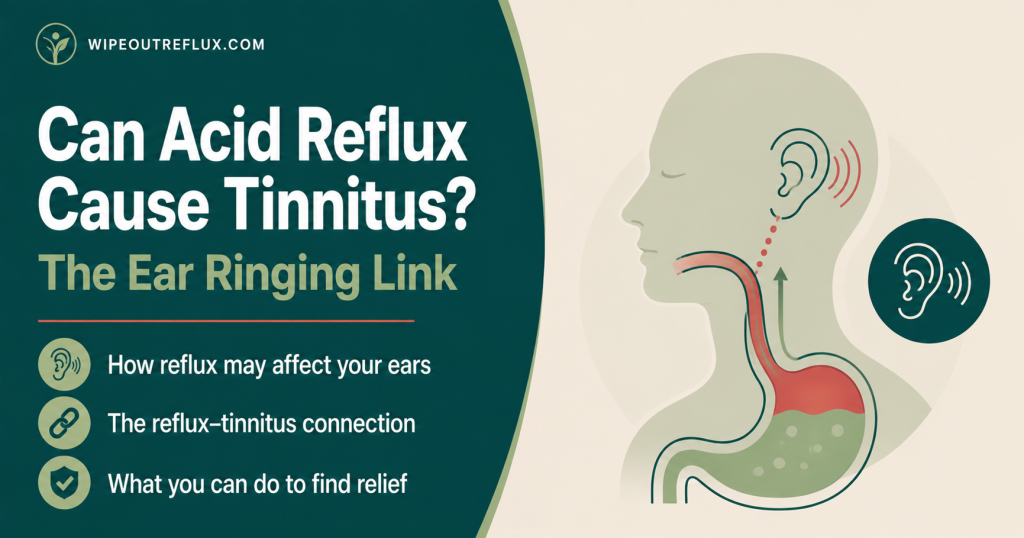
There’s a real association, and the evidence behind it has got noticeably stronger in the last couple of years. A nationwide cohort of 669,159 people found tinnitus incidence of 14.91 per 1,000 person-years in those with reflux disease versus 1.74 in those without. A separate genetic analysis found reflux disease raised the risk of tinnitus, Ménière’s disease, sensorineural hearing loss and vestibular dysfunction.
The route is anatomical. Your throat connects to your middle ear through the Eustachian tube, and reflux that reaches the back of the throat — particularly the pepsin in it — can inflame that tube. Pepsin has actually been detected in middle ear fluid, so this isn’t theoretical.
But I want to be straight about the limits here, because this topic attracts a lot of overclaiming. Association is not the same as your reflux being the cause of your ringing, and in that same large cohort, acid-suppressing medication did not significantly reduce tinnitus onset. Here’s what the picture actually looks like.
Key Takeaways
- A nationwide cohort of 669,159 people found substantially higher tinnitus incidence in people with reflux disease than without.
- A Mendelian randomisation study — a design that gets closer to causation — found reflux raised the risk of tinnitus, Ménière’s disease and hearing loss.
- The proposed route is the Eustachian tube, which links the back of the throat directly to the middle ear.
- Pepsin has been detected in middle ear fluid in around a third of children with chronic middle ear effusion, confirming refluxate can physically get there.
- LPR symptom scores are associated with impaired Eustachian tube function.
- PPI use did not significantly reduce tinnitus onset in the large cohort study — which fits what we know about pepsin surviving acid suppression.
- Reflux is one possible contributor among many; noise exposure, age-related hearing loss and medications remain far more common causes.
- New, one-sided, pulsatile or sudden tinnitus needs proper ENT assessment, not a reflux diet.
What the evidence actually shows
The large cohort study
In a retrospective cohort drawn from the Korean National Health Insurance Service sample (2012–2019), 669,159 people were followed for the development of tinnitus. Incidence was 14.91 cases per 1,000 person-years in the reflux group versus 1.74 in the non-reflux group, giving a crude hazard ratio of 8.32 — and notably, proton pump inhibitor use in the reflux group did not significantly reduce tinnitus onset Kang et al., Scientific Reports, 2024.
That’s a large, striking association. It’s also observational, which means people with reflux differ from people without it in many ways — body weight, medication use, stress, sleep quality, healthcare-seeking behaviour — and any of those could contribute.
The genetic evidence
This is what makes the topic more interesting than the usual correlation story. Mendelian randomisation uses genetic variants as natural randomisers, which sidesteps most confounding and reverse causation.
Applied to this question, the analysis indicated that reflux disease may elevate the risk of Ménière’s disease, sensorineural hearing loss, vestibular dysfunction and tinnitus — while Barrett’s oesophagus showed no such relationship. The authors proposed repeated stimulation of the middle or inner ear via the Eustachian tube as the likely mechanism Zhao et al., Journal of Multidisciplinary Healthcare, 2025.
Genetic studies have their own limitations, but they’re much harder to explain away as lifestyle confounding.
How reflux could reach your ear
The Eustachian tube route
Your Eustachian tube runs from the nasopharynx — the space right behind your nose and above your soft palate — to your middle ear. Its job is to equalise pressure and drain fluid. When it doesn’t open and close properly, you get pressure, fullness, muffled hearing and, for some people, ringing.
The opening of that tube sits exactly where refluxate arrives when it travels high enough. That’s the whole mechanism in one sentence.
The clinical evidence supports it. In a study of adults with otitis media with effusion, laryngopharyngeal reflux symptom scores were associated with Eustachian tube function, supporting reflux as a potential cause of Eustachian tube dysfunction Zhen et al., Frontiers in Neurology, 2022. I’ve covered this connection in more depth in acid reflux and Eustachian tube dysfunction.
Pepsin actually gets there
This is the finding that moves the argument from plausible to demonstrated. Pepsin — the stomach enzyme that only comes from the stomach — has been found in middle ear fluid.
Using the Peptest immunoassay in children aged 1–7 undergoing grommet insertion for chronic middle ear effusion, pepsin was detected in the middle ear of 14 of 44 children, and in 32.2% of middle ear specimens Formánek et al., International Journal of Pediatric Otorhinolaryngology, 2015.
Pepsin is not manufactured in your ear. If it’s there, it travelled. That matters enormously, because pepsin behaves differently from acid — it can sit in tissue and reactivate later when re-exposed to acid, causing ongoing inflammation long after the reflux event itself.
Inflammation, not corrosion
Nobody is suggesting stomach acid is burning your cochlea. The proposed sequence is subtler: refluxate irritates the nasopharynx and Eustachian tube opening, the tube swells and stops ventilating the middle ear properly, pressure and fluid build, and the auditory system responds to that altered input with tinnitus.
It’s the same mechanism behind reflux-related ear fullness and discomfort, covered in acid reflux and ear pain. If you also get post-nasal drip, sinus congestion or constant throat clearing, that’s consistent — it means material is reaching the upper airway.
The honest caveats
I’d be doing you a disservice if I stopped there, because there are three reasons not to assume reflux is your answer.
Tinnitus has many more common causes. Noise exposure, age-related hearing loss, earwax impaction, ear infections, jaw joint problems, blood pressure changes, and medications — particularly high-dose aspirin and other NSAIDs, some antibiotics and certain diuretics — account for the large majority of cases. Reflux is a plausible contributor, not the default explanation.
Treating the reflux may not fix it. In that 669,159-person cohort, PPI use didn’t significantly reduce tinnitus onset. There are several possible reasons: acid suppression doesn’t stop reflux events, only their acidity, and pepsin remains active and damaging regardless — which is exactly why PPIs underperform in LPR. It may also be that once tinnitus is established, the auditory system maintains it independently of the original trigger.
Confounding runs deep. Poor sleep worsens both reflux and tinnitus perception. So does stress and anxiety — see whether stress causes acid reflux. Sleep apnoea is associated with both. Untangling these in observational data is genuinely difficult.
Signs your tinnitus might be reflux-related
Reflux is more plausible as a contributor if:
- It comes with ear fullness, pressure, or a blocked sensation rather than existing alone
- It’s worse in the morning, after lying flat all night
- It fluctuates with your reflux symptoms — worse after big or late meals
- You also have throat clearing, hoarseness, post-nasal drip or a lump-in-throat sensation
- Your ears pop or crackle, or need frequent equalising
- Both ears are affected roughly equally
- You’ve had normal hearing tests and no obvious noise exposure history
Reflux is less likely if the tinnitus is in one ear only, pulses in time with your heartbeat, came on suddenly, or comes with genuine hearing loss or vertigo. Those patterns need investigating in their own right.
What to do about it
Get assessed properly first
See a doctor or audiologist for a hearing test and ear examination before assuming reflux is the cause. Seek prompt assessment for one-sided tinnitus, pulsatile tinnitus, sudden hearing loss, or tinnitus with vertigo — these can indicate conditions needing specific treatment.
It’s also worth reviewing your medications with your doctor. Several common drugs affect the ears at higher doses, and some — like NSAIDs — also worsen reflux, so you can end up chasing the wrong culprit.
Target the reflux reaching your throat
If the reflux link is plausible for you, the goal isn’t just less acid — it’s fewer reflux events reaching that high. That means:
- Smaller meals, eaten earlier. Volume drives how far reflux travels — see how long before bed to stop eating.
- Raise the head of your bed. Overnight is when material has the easiest route to the nasopharynx — see how to raise the head of your bed.
- Use an alginate at night. A raft barrier reduces the volume available to travel rather than just neutralising it — see alginates for acid reflux.
- Lower dietary acid. This matters specifically for pepsin, which reactivates on contact with acid in the tissue where it’s lodged.
- Address nasal and sinus inflammation if present, since it compounds Eustachian tube problems — see acid reflux and sinus congestion.
Set expectations sensibly
Give it eight to twelve weeks of genuine consistency before judging. If your ear fullness improves but the ringing doesn’t, that’s still useful information — it suggests reflux was affecting your Eustachian tube but that something else is generating the tinnitus.
And if reflux management doesn’t touch it, tinnitus retraining therapy, sound therapy and cognitive behavioural approaches have far better evidence for reducing distress from tinnitus than any dietary change does. That’s not a consolation prize; for most people it’s the more effective route.
Conclusion
Can acid reflux cause tinnitus? It can plausibly contribute, and the case is stronger than it was a few years ago. A cohort of nearly 670,000 people found markedly higher tinnitus incidence with reflux disease, a genetic analysis pointed the same way for tinnitus, hearing loss and Ménière’s disease, and pepsin has been physically detected in middle ear fluid — so refluxate demonstrably reaches the territory. The Eustachian tube provides an obvious anatomical route.
What I wouldn’t tell you is that treating your reflux will silence the ringing. Acid suppression didn’t reduce tinnitus onset in the large cohort, tinnitus has many commoner causes, and once established it often persists independently of whatever started it. The realistic position is that if you have reflux and tinnitus and ear fullness, controlling how far your reflux travels is worth doing — for your throat and ears both — while getting the tinnitus itself assessed properly.
If you’re going to attack the reflux side, the leverage is in reducing volume and acidity together so that less material reaches the top. Knowing which foods and drinks actually help there is the practical bottleneck, and it’s exactly what the Wipeout Food Reference Guide exists for — the essential reference for what’s safe with acid reflux and LPR, with pH values, so you’re not guessing. For the complete system rather than a food list, the Wipeout Diet Plan goes much deeper. It was built around LPR — the throat-based form, where reflux reaching high enough to affect the ears is precisely the problem — and because it works on the same underlying mechanisms it’s equally effective for GERD and everyday heartburn. It targets pepsin and volume together, which is the combination that determines whether refluxate ever gets near your Eustachian tube.
Frequently Asked Questions
Can acid reflux really cause ringing in the ears?
It’s associated with it, and there’s a credible mechanism via the Eustachian tube. A large cohort study found much higher tinnitus incidence in people with reflux, and a genetic study supported a causal direction. That said, reflux is one possible contributor among many, and most tinnitus has other causes.
How does reflux reach the ear?
Through the Eustachian tube, which connects the back of the throat to the middle ear. Refluxate arriving in the nasopharynx can inflame the tube opening, impairing ventilation and drainage. Pepsin from the stomach has been detected in middle ear fluid, confirming the material physically travels there.
Will treating my reflux stop the tinnitus?
Possibly, but don’t count on it. PPI use did not significantly reduce tinnitus onset in the large cohort study. Ear fullness and pressure are more likely to improve than the ringing itself, particularly if the tinnitus is long-standing.
Is it LPR rather than GERD that affects the ears?
Mechanistically, yes — reflux has to reach the throat and nasopharynx to affect the Eustachian tube, which is what LPR involves. Plenty of people have both, and you can have LPR without any heartburn at all.
Why is my tinnitus worse in the morning?
Lying flat removes gravity’s help, saliva production drops overnight, and swallowing becomes infrequent — so reflux travels further and sits longer. If your ears feel full or blocked on waking too, that pattern is consistent with an overnight reflux contribution.
Can omeprazole cause tinnitus?
Tinnitus is reported rarely as a side effect of PPIs, and long-term use can lower magnesium, which has its own effects — see omeprazole and low magnesium. If your ringing began shortly after starting a new medication, raise that specifically with your doctor rather than assuming it’s the reflux.
When should I see a doctor about tinnitus?
Promptly if it’s in one ear only, pulses with your heartbeat, started suddenly, or comes with hearing loss or vertigo. Otherwise, a baseline hearing test and ear examination are worth having before you attribute it to anything.
Research & References
- Retrospective cohort of 669,159 people from the Korean National Health Insurance Service sample (2012–2019) finding tinnitus incidence of 14.91 versus 1.74 cases per 1,000 person-years in those with and without gastroesophageal reflux disease (crude hazard ratio 8.32), with proton pump inhibitor use showing no significant reduction in tinnitus onset Kang et al., Scientific Reports, 2024.
- Mendelian randomisation analysis indicating that gastroesophageal reflux disease may elevate the risk of Ménière’s disease, sensorineural hearing loss, vestibular dysfunction and tinnitus, with no causal relationship found for Barrett’s oesophagus, and proposing repeated middle or inner ear stimulation via the Eustachian tube as the mechanism Zhao et al., Journal of Multidisciplinary Healthcare, 2025.
- Study of adults with otitis media with effusion finding laryngopharyngeal reflux-related symptoms associated with Eustachian tube function, supporting reflux as a potential cause of Eustachian tube dysfunction Zhen et al., Frontiers in Neurology, 2022.
- Peptest immunoassay study in children aged 1–7 with chronic otitis media with effusion undergoing ventilation tube insertion, detecting gastric pepsin in the middle ear of 14 of 44 children and in 32.2% of middle ear specimens Formánek et al., International Journal of Pediatric Otorhinolaryngology, 2015.

David Gray
12 years living with LPR · Consultant & researcher
I've lived with LPR for twelve years — the misdiagnoses, the PPI courses that did nothing, the slow work of figuring out what actually helps. Wipeout Reflux is where I translate the research into plain terms for people stuck in the same place. Every claim here is sourced to peer-reviewed work, and I consult one-to-one with LPR sufferers.