
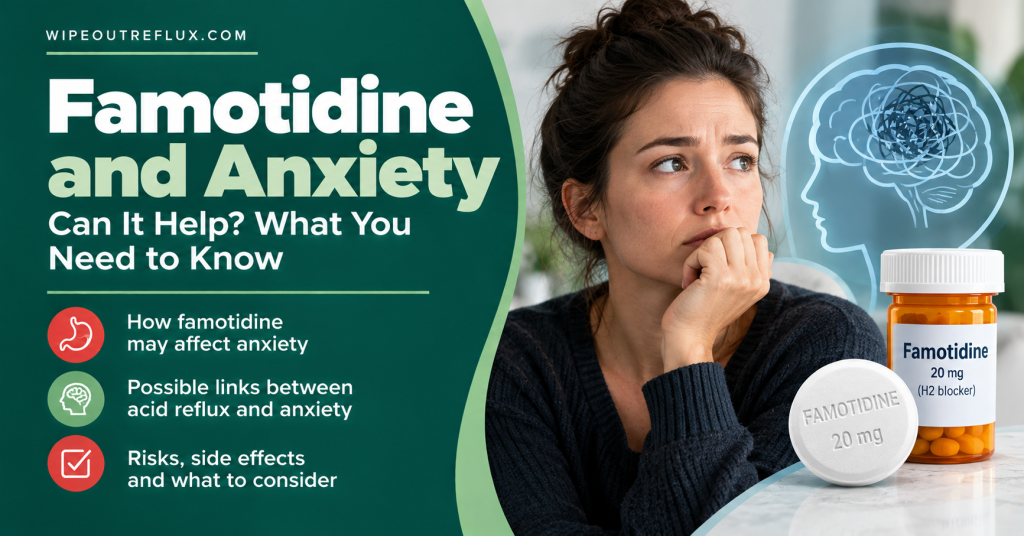
Yes, famotidine (Pepcid) can cause anxiety, but it’s uncommon. The FDA prescribing information lists anxiety among nervous system and psychiatric side effects reported in less than 1% of people in clinical trials, alongside insomnia, depression and hallucinations. Confusion and agitation have also been reported since the drug came to market [Famotidine Tablets Prescribing Information].
These effects are more likely in older adults and people with reduced kidney function. Famotidine is cleared mainly by the kidneys, so if they aren’t working fully, the drug builds up in the blood. Most reported reactions start within the first two weeks of treatment and settle within a few days of stopping [Gilless et al., Consultant, 2014].
There’s also a twist that matters if you have reflux. Reflux itself is strongly linked to anxiety, and some silent reflux symptoms feel a lot like anxiety. So it’s worth working out which one is actually driving how you feel.
Key Takeaways
- Anxiety is a listed but uncommon side effect of famotidine, reported in under 1% of people in trials.
- The label also lists insomnia, depression, hallucinations, confusion and agitation.
- Older adults and people with moderate to severe kidney impairment are at higher risk, because famotidine builds up when the kidneys clear it more slowly.
- Famotidine levels rise at least 2-fold in moderate and at least 5-fold in severe kidney impairment, which is why lower doses are recommended.
- Reactions usually appear within two weeks of starting and typically settle within a few days of stopping.
- Reflux itself is linked to anxiety, and LPR symptoms like throat tightness and a lump in the throat are often mistaken for anxiety.
- If you’re on prescribed famotidine, talk to your prescriber before stopping. Dose, timing and alternatives can all be adjusted.
What the Famotidine Label Says
The official prescribing information lists these nervous system and psychiatric reactions:
- In clinical trials (under 1% of patients): seizure, hallucinations, depression, anxiety, decreased libido, insomnia and somnolence (drowsiness).
- Reported after approval: confusion, agitation and paresthesia (pins and needles).
The label also carries a specific warning that CNS (central nervous system) adverse reactions, such as confusion and seizures, have been reported in elderly patients and in patients with moderate and severe kidney impairment [Famotidine Tablets Prescribing Information].
So anxiety is a recognized side effect. But it’s rare, and for most healthy adults taking a standard over-the-counter dose, it’s unlikely.
Why Kidney Function Matters
Famotidine is mainly removed from the body by the kidneys. In healthy people it has a half-life of about 2.5 to 3.5 hours. When kidney function drops, it hangs around much longer. According to the label, exposure to famotidine is at least twice as high in moderate kidney impairment and at least five times as high in severe impairment [Famotidine Tablets Prescribing Information].
That’s why the label recommends lower doses when creatinine clearance (a measure of kidney function) falls below 60 mL/min. Higher drug levels make CNS side effects more likely.
Kidney function also declines naturally with age, often without any symptoms. That’s one reason older adults are more prone to confusion and agitation on famotidine, even at doses that suit younger people. If you’re older or have kidney disease, check your dose with a doctor or pharmacist, especially if you’re buying it over the counter. I cover reflux in later life in acid reflux in older adults.
How Quickly Do Side Effects Appear and Go Away?
A clinical review of H2 blocker reactions notes that mental status changes such as confusion, agitation and hallucinations usually start within the first two weeks of treatment and typically resolve within three days of stopping. The review describes these reactions as relatively rare but well documented, and more likely in older and hospitalized patients [Gilless et al., Consultant, 2014].
That timing is a useful clue. If your anxiety started soon after you began famotidine, and you didn’t have it before, the drug is worth considering. If your anxiety came first, or has been around for months before you started, famotidine is less likely to be the cause.
What Readers Tell Me
In the years I’ve been running this site and doing consult calls, famotidine side effects come up now and then, but they’re rarely the dramatic ones. The things people mention most are trouble sleeping, feeling a bit wired or restless, headaches, and sometimes a vague low mood. In almost every case it’s been someone taking it every day, often twice a day, and things usually settled once they changed the timing or came off it with their doctor’s help. What I see far more often is the opposite: people who were anxious about their throat symptoms, and whose anxiety eased once their reflux was under control.
The Reverse Direction: Reflux Can Cause Anxiety
Before blaming famotidine, it’s worth knowing how closely reflux and anxiety are linked in their own right.
A meta-analysis found that around a third of people with reflux have anxiety symptoms, and that anxiety is far more common in people with reflux than in healthy controls. The authors concluded the relationship is likely to run both ways [Zamani et al., American Journal of Gastroenterology, 2023]. A genetic study went further, suggesting GERD may actually increase the risk of anxiety disorders [Zeng et al., Frontiers in Psychiatry, 2023].
Silent reflux is no different. People with LPR scored significantly higher on anxiety, depression and distress than healthy volunteers, and the researchers described it as a vicious cycle [Barillari et al., European Archives of Oto-Rhino-Laryngology, 2025].
I go into this in depth in does silent reflux cause anxiety and can LPR be caused by anxiety.
LPR symptoms that feel like anxiety
Many silent reflux symptoms overlap with the physical side of anxiety:
- A lump or tightness in the throat (globus)
- Feeling short of breath or unable to take a full breath
- Chest tightness
- Waking at night with a choking feeling
- A racing heart or palpitations
If you notice these and feel anxious, it’s easy to assume the medication is to blame, or that it’s “just anxiety.” Often it’s reflux, and the worry that comes with it. Paying close attention to throat sensations can also make them feel stronger, a pattern called esophageal hypervigilance, which I cover in health anxiety and acid reflux.
What to Do If You Think Famotidine Is Making You Anxious
- Don’t stop prescribed famotidine abruptly without talking to your prescriber. They can confirm whether it’s the likely cause and plan what comes next. If you bought it over the counter, stopping is generally fine, but speak to a pharmacist if your reflux is severe.
- Get urgent help for serious symptoms. Confusion, hallucinations, severe agitation or a seizure need prompt medical attention.
- Check your dose against your kidney function, especially if you’re over 65 or have kidney disease.
- Look at timing. If insomnia or restlessness is the issue, ask whether a different time of day would suit you better. Famotidine works for about 10 to 12 hours.
- Consider whether you need it daily. Famotidine also loses much of its effect with continuous use, so occasional use may suit you better anyway. I explain this in Pepcid (famotidine) for silent reflux.
- Ask about alternatives. Options include alginates, PPIs and other approaches. See alternatives to famotidine and famotidine vs omeprazole.
- Keep a simple diary of doses, sleep, anxiety and reflux symptoms. It makes it much easier for you and your doctor to see a pattern.
Conclusion
Famotidine can cause anxiety, but it isn’t common. It’s listed in the prescribing information alongside insomnia, depression, confusion and agitation, and these effects are most likely in older adults and people with reduced kidney function. If your anxiety started soon after you began famotidine, talk to your doctor or pharmacist about your dose, its timing or a switch.
Just don’t overlook the other side of the story. Reflux itself drives anxiety, and silent reflux symptoms can feel a lot like it. Getting the reflux under control often eases both.
That’s where diet comes in. The Wipeout Diet Plan is my complete, step-by-step plan for calming reflux down through what and when you eat, so you’re less reliant on medication and its side effects. I built it mainly for LPR, the throat-based reflux that’s so easily mistaken for anxiety, but it works on the same root causes as GERD and heartburn, so it helps those just as much.
For a lighter starting point, the Wipeout Food Reference Guide is the essential companion. It lists the foods and drinks that are safe for acid reflux and LPR, along with their pH values.
Frequently Asked Questions
Can Pepcid cause anxiety and panic attacks?
Anxiety is a listed but uncommon side effect of famotidine (Pepcid). Panic attacks aren’t specifically listed on the label. If you’re having them after starting famotidine, speak to your doctor. Reflux symptoms like throat tightness can also trigger panic-like feelings.
How long does famotidine anxiety last?
CNS reactions to H2 blockers usually resolve within about three days of stopping the medication. If anxiety continues well beyond that, another cause is more likely.
Can famotidine cause insomnia?
Yes, insomnia is listed as an uncommon side effect, as is drowsiness. If it affects your sleep, ask your doctor or pharmacist whether you could take it at a different time.
Is famotidine anxiety more common in older people?
Yes. Older adults are more likely to have reduced kidney function, which causes famotidine to build up. The label specifically warns about CNS reactions in elderly patients and people with moderate to severe kidney impairment.
Can famotidine cause depression?
Depression is listed among the uncommon side effects reported in clinical trials. Speak to your doctor if your mood changes after starting famotidine.
Should I stop taking famotidine if I feel anxious?
If it’s prescribed, talk to your prescriber first rather than stopping on your own. If it’s over the counter, you can stop, but get advice if your reflux is severe. Seek urgent help for confusion, hallucinations or seizures.
Is omeprazole less likely to cause anxiety than famotidine?
PPIs like omeprazole work differently and aren’t typically associated with the same CNS reactions, though they have their own side effects. See omeprazole side effects and discuss any switch with your doctor.
Research & References
- [Famotidine Tablets Prescribing Information] — FDA-approved labeling: lists anxiety, insomnia, depression, hallucinations and seizure in under 1% of trial patients; postmarketing reports of confusion and agitation; a warning on CNS reactions in elderly patients and those with moderate to severe kidney impairment; at least 2-fold and 5-fold higher exposure in moderate and severe impairment; and an elimination half-life of 2.5 to 3.5 hours.
- [Gilless et al., Consultant, 2014] — Clinical review of H2 blocker mental status changes: confusion, agitation, delirium and hallucinations are relatively rare but well documented, more likely in older and hospitalized patients, usually start within two weeks and typically resolve within three days of stopping.
- [Zamani et al., American Journal of Gastroenterology, 2023] — Meta-analysis finding anxiety symptoms in roughly a third of people with reflux, markedly more than in healthy controls, with a likely bidirectional relationship.
- [Zeng et al., Frontiers in Psychiatry, 2023] — Mendelian randomization study suggesting GERD causally increases the risk of anxiety disorders.
- [Barillari et al., European Archives of Oto-Rhino-Laryngology, 2025] — People with LPR scored significantly higher on anxiety, depression and distress than healthy volunteers.

David Gray
12 years living with LPR · Consultant & researcher
I've lived with LPR for twelve years — the misdiagnoses, the PPI courses that did nothing, the slow work of figuring out what actually helps. Wipeout Reflux is where I translate the research into plain terms for people stuck in the same place. Every claim here is sourced to peer-reviewed work, and I consult one-to-one with LPR sufferers.