
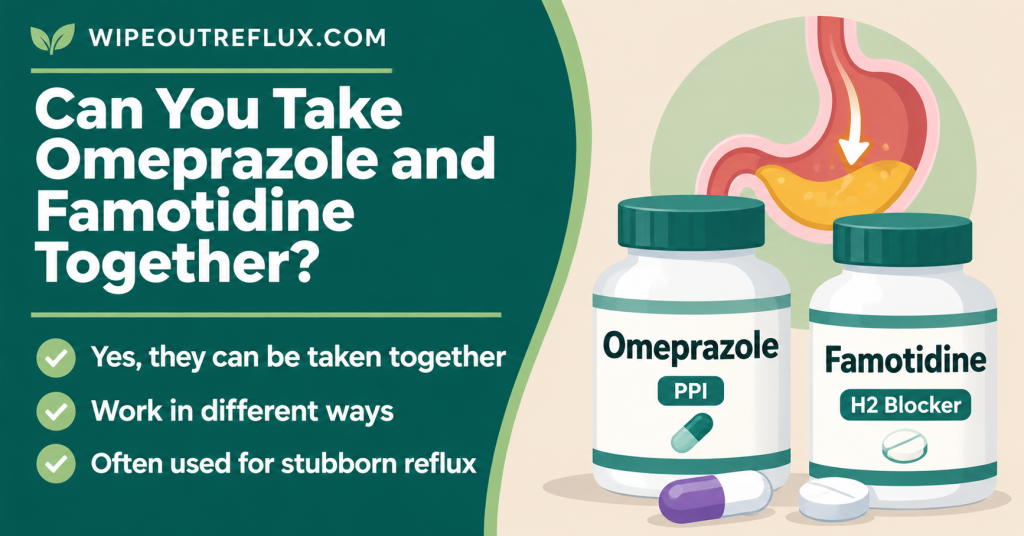
Yes, you can take omeprazole and famotidine together, and doctors prescribe the combination regularly. There’s no harmful interaction between them. The usual routine is omeprazole 30 to 60 minutes before breakfast (and before dinner if you take it twice a day), with famotidine at bedtime to cover acid that breaks through overnight.
The catch is that your body gets used to famotidine quickly. Taken every night, it can lose most of its extra benefit within about a week. So the combination tends to work best when famotidine is used strategically rather than automatically, and when you’re not relying on acid suppression alone to fix reflux.
Here’s how the two drugs work together, the timing that gets the most from them, and when the combination makes sense. As always, check with your doctor or pharmacist before combining medications, especially if you take anything else.
Key Takeaways
- Omeprazole (a PPI) and famotidine (an H2 blocker) reduce stomach acid in different ways, so they can complement each other.
- There’s no significant drug interaction between them, and they’re commonly prescribed together.
- The main reason to combine them is nighttime acid breakthrough, which affects many people even on twice-daily PPIs.
- A bedtime H2 blocker controls overnight acid far better than adding an extra PPI dose at bedtime.
- The old worry that famotidine stops omeprazole from working hasn’t held up in testing when the two are timed sensibly.
- Tolerance to nightly famotidine develops fast, often within a week, so on-demand or intermittent use usually works better.
- Neither drug stops reflux itself or neutralizes pepsin, so alginates, meal timing and diet still matter, especially for LPR.
- Don’t combine over-the-counter versions for more than 14 days without medical advice.
How Omeprazole and Famotidine Work Differently
Both drugs reduce stomach acid, but they act at different points in the same process.
The cells in your stomach lining that make acid, called parietal cells, are switched on by three signals: histamine, the hormone gastrin, and acetylcholine from the vagus nerve. Whatever the signal, acid is finally pumped out by a “proton pump” in the cell wall.
- Famotidine (Pepcid) blocks the histamine-2 receptor, so histamine can’t switch the cell on. It works within about an hour and lasts 10 to 12 hours, but it doesn’t block the gastrin or nerve signals.
- Omeprazole (Prilosec, Losec) switches off the proton pumps themselves, the final step. That makes it more powerful overall, but it only blocks pumps that are active when the drug is in your blood, so it needs to be taken before a meal and takes a few days to reach full effect.
Because they hit different targets, they can cover each other’s gaps. I compare the two in detail in famotidine vs omeprazole for acid reflux.
Is It Safe to Take Them Together?
For most people, yes. Famotidine doesn’t meaningfully affect the liver enzymes that break down omeprazole and many other drugs, unlike the older H2 blocker cimetidine. The two are widely prescribed together, and the AGA’s clinical practice update lists nighttime H2 blockers as an add-on option for nighttime reflux symptoms alongside PPI therapy [Yadlapati et al., Clinical Gastroenterology and Hepatology, 2022].
A few things are still worth checking with your doctor or pharmacist:
- Kidney function. Famotidine is cleared by the kidneys, so lower doses are needed if your kidneys aren’t working well. In older adults or people with kidney disease, it can occasionally cause confusion or agitation.
- Other medications. Omeprazole does interact with some drugs, notably clopidogrel, and both drugs can reduce the absorption of medicines that need stomach acid, such as some antifungals and HIV and cancer drugs. My guide to omeprazole drug interactions covers the main ones.
- Self-treating with OTC versions. Over-the-counter omeprazole and famotidine are both meant for up to 14 days without medical advice. If you need both, regularly, that’s a sign to get your reflux properly assessed.
Why Doctors Combine Them: Nocturnal Acid Breakthrough
The most common reason for the combination is a problem called nocturnal acid breakthrough. Even on twice-daily PPI therapy, many people have long stretches overnight where their stomach becomes strongly acidic again. Overnight, your stomach brings fresh proton pumps online, and acid secretion at night is driven largely by histamine.
So what’s the best fix? Researchers compared adding a third omeprazole dose at bedtime with adding an H2 blocker. In volunteers already on omeprazole twice daily, an extra bedtime omeprazole dose reduced the time stomach pH stayed below 4 from 48% to 31% of the night. A bedtime H2 blocker cut it to just 5 to 6% [Peghini et al., Gastroenterology, 1998].
In people with GERD on twice-daily PPIs, adding a bedtime H2 blocker raised the median time the stomach stayed above pH 4 overnight from 51% to 96% [Xue et al., Alimentary Pharmacology & Therapeutics, 2001].
That’s why famotidine at night is the classic partner for a daytime PPI. I go deeper into the overnight side of this in why take famotidine at night.
Does Famotidine Stop Omeprazole From Working?
You may have heard you shouldn’t take the two together because famotidine “switches off” the pumps that omeprazole needs to target. It’s a reasonable theory. PPIs only bind to active proton pumps, and an H2 blocker reduces how many pumps are active.
But when it was actually tested, it didn’t play out that way. In a randomized crossover study, volunteers took omeprazole and an H2 blocker together 30 minutes before breakfast. Rather than weakening the PPI, the combination kept stomach pH above 4 for longer and produced a higher median pH than omeprazole alone [Abdul-Hussein et al., Pharmacotherapy, 2015].
That said, the standard, most studied approach is still to separate them: omeprazole in the morning before food, famotidine in the evening or at bedtime. That way each drug covers the time of day it’s best at.
The Best Timing for Taking Them Together
- Omeprazole: 30 to 60 minutes before breakfast. If you take it twice a day, the second dose goes 30 to 60 minutes before your evening meal. Timing matters more for PPIs than people realize, which I explain in the best time of day to take omeprazole.
- Famotidine: at bedtime for nighttime symptoms, or 15 to 60 minutes before a meal you know will trigger heartburn.
- For breakthrough heartburn during the day: famotidine can be taken as needed on top of your PPI. It starts working within an hour, much faster than another PPI dose.
Famotidine can be taken with or without food. Always follow the doses on your own prescription or pack.
The Big Catch: Famotidine Tolerance
This is the part that changes how I’d use the combination.
Your body adapts to H2 blockers fast. When researchers added a bedtime H2 blocker to twice-daily omeprazole, it reduced overnight acid breakthrough on day one. But after a week of nightly use, there was no longer any difference compared with omeprazole alone [Fackler et al., Gastroenterology, 2002]. The American College of Gastroenterology’s earlier GERD guideline flagged the same issue, noting that a bedtime H2 blocker can be added for nighttime reflux but may lose its effect after several weeks [Katz et al., The American Journal of Gastroenterology, 2013].
So in practice, the most effective way to use the combination is usually:
- On demand. Keep famotidine for nights you know will be harder, like after a late or heavy meal, alcohol, or during a flare.
- Intermittently. Some doctors suggest weekday use with breaks, or short courses, to let the effect reset.
- Not as a permanent nightly add-on unless your doctor has a specific reason.
Tolerance is a big enough topic that I’ve written a separate piece on why famotidine stops working and what to do about it.
Omeprazole and Famotidine for Silent Reflux (LPR)
The combination is common in LPR treatment plans, often as a PPI twice daily plus famotidine at bedtime. It makes sense to reduce how acidic any reflux reaching your throat is, especially overnight when you swallow less and clear reflux poorly.
But with LPR, acid isn’t the whole story. The bigger problem is pepsin, a digestive enzyme that travels up with reflux, sticks to the delicate tissue in your throat, and gets reactivated by anything acidic. Omeprazole and famotidine reduce acid in the stomach. They don’t stop reflux happening, and they don’t remove pepsin that’s already in your throat. That’s a big part of why PPIs often don’t work for LPR, and doubling up on acid suppression doesn’t change it.
What does help is adding things that tackle the reflux itself and keep pepsin quiet:
- An alginate after meals and at bedtime. Alginates form a physical raft on top of your stomach contents and block reflux, acidic or not. They pair well with both drugs. More in alginates for acid reflux.
- Eating your last meal three hours before bed, and raising the head of your bed.
- A low-acid diet. Acidic foods and drinks reactivate pepsin in your throat regardless of which medication you take. That’s the foundation of the Wipeout Diet Plan.
If you’re on famotidine specifically for throat symptoms, my article on Pepcid (famotidine) for silent reflux is worth a read.
Side Effects of Taking Both
Taking both doesn’t create new side effects, but it does mean two sets of possible ones. Famotidine’s most common are headache, dizziness and constipation or diarrhea. Omeprazole can cause headache, stomach upset and, with long-term use, lower levels of vitamin B12 and magnesium. I cover these in omeprazole side effects.
The bigger consideration is that combining them suppresses acid more heavily. Stomach acid helps you absorb some nutrients and kill bacteria in food, so it’s worth using the lowest effective dose for the shortest time that works, and reviewing it regularly with your doctor.
Coming Off the Combination
If you’ve been on both for a while and want to reduce, it’s usually best to step down gradually rather than stopping everything at once. Stopping a PPI suddenly can trigger rebound acid, which feels like your reflux has come back worse. A common approach is to drop the nightly famotidine to as-needed first, then taper the PPI slowly. My guide to getting off PPIs and acid rebound walks through how to do this.
Conclusion
Omeprazole and famotidine can be taken together safely, and the combination is a well-established way to tackle acid that breaks through overnight. They work on different parts of the acid-making process, a bedtime H2 blocker controls night-time acid better than an extra PPI dose, and the fear that famotidine blocks omeprazole hasn’t held up in testing. The standard routine is omeprazole before breakfast (and dinner if twice daily) and famotidine at bedtime.
The two things to keep in mind are tolerance and the limits of acid suppression. Famotidine loses its edge within about a week of nightly use, so using it on harder nights tends to work better than taking it every night. And neither drug stops reflux or pepsin from reaching your throat, which is why so many people still have symptoms on both.
That’s the gap the Wipeout Diet Plan is designed to fill. I built it first and foremost for LPR, the throat-based reflux where medication so often falls short, but because it works on the same root causes it helps GERD and everyday heartburn just as well. It’s the in-depth guide to what to eat, what to avoid and how to time your meals, so medication becomes a backup rather than the whole plan.
Frequently Asked Questions
Can you take omeprazole and famotidine at the same time?
Yes. There’s no harmful interaction, and a randomized study found that taking a PPI and an H2 blocker together before breakfast actually improved acid control compared with the PPI alone. Most doctors still recommend omeprazole in the morning and famotidine at bedtime, so each covers the time of day it works best.
How far apart should I take omeprazole and famotidine?
Typically, omeprazole goes 30 to 60 minutes before breakfast and famotidine at bedtime, roughly 12 hours apart. If you take omeprazole twice daily, the second dose goes before your evening meal, with famotidine at bedtime.
Why would a doctor prescribe both omeprazole and famotidine?
Usually because of nighttime symptoms. Many people still have acid breakthrough overnight even on twice-daily PPIs, and a bedtime H2 blocker like famotidine is particularly effective at blocking the histamine-driven acid made at night. It’s also commonly used in LPR treatment plans.
Does famotidine make omeprazole less effective?
The theory is that it could, because PPIs only bind to active acid pumps. But testing has shown the combination improves acid control rather than reducing it. Taking famotidine at bedtime and omeprazole before breakfast avoids any overlap anyway.
Can I take Pepcid and Prilosec together?
Yes. Pepcid is famotidine and Prilosec is omeprazole, so the same advice applies. If you’re using the over-the-counter versions, don’t take them for more than 14 days without speaking to a doctor.
Does famotidine stop working if I take it every night with omeprazole?
It can. In one study, adding nightly famotidine-type H2 blockers to twice-daily omeprazole stopped making a difference after about a week because of tolerance. Using famotidine on demand, rather than every night, often keeps it effective.
Is it bad to take omeprazole and famotidine long term?
Not necessarily, if your doctor has a good reason. But because the combination suppresses acid heavily and famotidine’s benefit fades with nightly use, it’s worth reviewing regularly and using the lowest effective doses.
Research & References
- [Yadlapati et al., Clinical Gastroenterology and Hepatology, 2022] — AGA clinical practice update on personalized GERD management, listing alginates for breakthrough symptoms and nighttime H2 blockers for nocturnal symptoms as adjunctive options.
- [Peghini et al., Gastroenterology, 1998] — In volunteers on twice-daily omeprazole, a bedtime H2 blocker cut overnight time at pH below 4 to 5 to 6%, compared with 31% for an extra bedtime omeprazole dose.
- [Xue et al., Alimentary Pharmacology & Therapeutics, 2001] — In GERD patients on twice-daily PPIs, a bedtime H2 blocker raised overnight time with stomach pH above 4 from 51% to 96%.
- [Abdul-Hussein et al., Pharmacotherapy, 2015] — Randomized crossover study showing that a PPI and an H2 blocker taken together before breakfast improved gastric acid control rather than reducing the PPI’s effect.
- [Fackler et al., Gastroenterology, 2002] — Adding a bedtime H2 blocker to twice-daily omeprazole reduced nocturnal acid breakthrough initially, but tolerance removed the benefit after one week.
- [Katz et al., The American Journal of Gastroenterology, 2013] — ACG GERD guideline stating a bedtime H2 blocker can be added to daytime PPI therapy for nighttime reflux but may cause tachyphylaxis after several weeks.

David Gray
12 years living with LPR · Consultant & researcher
I've lived with LPR for twelve years — the misdiagnoses, the PPI courses that did nothing, the slow work of figuring out what actually helps. Wipeout Reflux is where I translate the research into plain terms for people stuck in the same place. Every claim here is sourced to peer-reviewed work, and I consult one-to-one with LPR sufferers.