
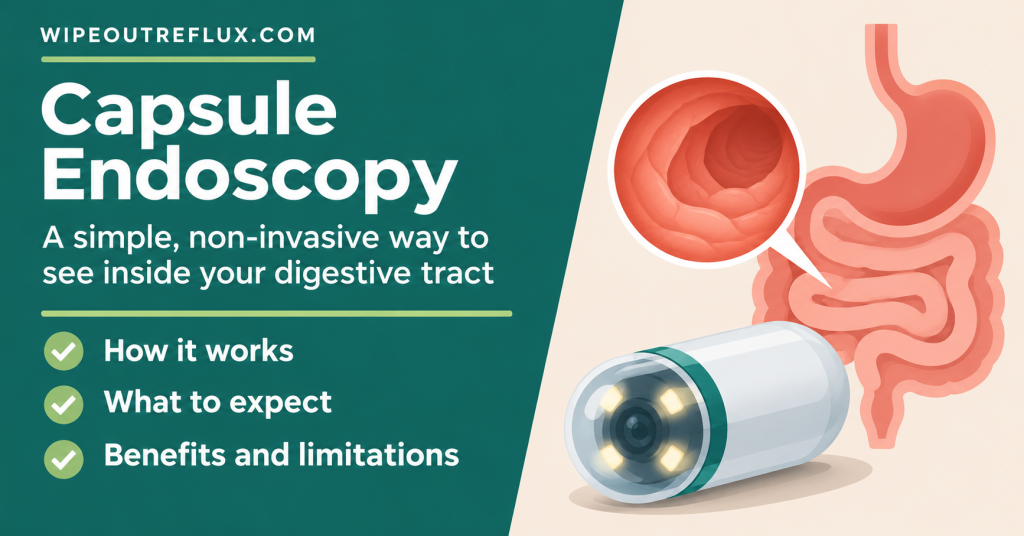
Capsule endoscopy means swallowing a vitamin-sized pill with a tiny camera inside. It takes thousands of photos as it travels through your digestive tract, sending them to a recorder you wear for the day, and then passes out naturally in your stool. It’s mainly used to look at the small intestine, which a standard endoscopy can’t reach. It’s not a replacement for an upper endoscopy when the question is reflux, because it can’t take biopsies, can’t treat anything, and is less accurate at spotting problems like Barrett’s esophagus.
Many people ask about the “PillCam” because it sounds like a way to avoid the tube down the throat. I understand why. But for reflux and silent reflux, a capsule usually isn’t the right test. Below I explain where it’s genuinely useful, what the day involves, the one real risk to know about, and why your gastroenterologist will probably still recommend a standard scope for reflux.
Key Takeaways
- Capsule endoscopy uses a swallowable pill camera that photographs your digestive tract and passes out naturally, usually within a day or two.
- Its main job is examining the small intestine, which conventional upper endoscopy and colonoscopy can’t fully reach. The most common reason for it is unexplained bleeding or anemia.
- For Barrett’s esophagus, esophageal capsules had a pooled sensitivity of 77% and specificity of 86%, which isn’t good enough to replace standard endoscopy.
- A capsule can’t take biopsies, so it can’t confirm H. pylori, Barrett’s esophagus or eosinophilic esophagitis.
- Magnetically steered capsules can examine the stomach well (about 90% sensitivity in one large study), but they’re only available in a few centers.
- The main risk is the capsule getting stuck. This happens in about 2% of people tested for bleeding and about 8% of people with established Crohn’s disease.
- A “patency capsule” that dissolves can be used first to check the capsule will pass safely.
- For reflux and LPR, the more useful tests are usually upper endoscopy, laryngoscopy and pH-impedance monitoring.
How Capsule Endoscopy Works
The capsule is about the size of a large vitamin pill. Inside are one or two tiny cameras, LED lights, a battery and a transmitter. You swallow it with water, and it moves through your gut by the same muscular contractions that move food. It takes several photos per second and sends them wirelessly to a recorder worn on a belt or in a pouch, often with sensor pads on your abdomen.
Over about 8 to 12 hours it records tens of thousands of images. A specialist then reviews them, often with software that flags suspicious frames, and writes a report. The capsule itself is single-use and comes out in your stool. Most people never notice it pass, and you don’t need to retrieve it.
The different types
- Small bowel capsule (the standard “PillCam”): by far the most common, used for the small intestine.
- Esophageal capsule: a dual-camera capsule designed to photograph the esophagus quickly as it passes. It was developed for reflux and Barrett’s screening but is rarely used for that now.
- Colon capsule: an alternative for some people who can’t have a colonoscopy.
- Magnetically controlled capsule: steered around the stomach with an external magnet. It’s used mainly in parts of Asia.
When Doctors Use Capsule Endoscopy
Capsule endoscopy fills one specific gap: the small intestine. This is roughly 20 feet of bowel between the reach of an upper endoscope and a colonoscope.
The most common reasons, according to European guidelines and a large systematic review, are:
- Unexplained GI bleeding or iron-deficiency anemia after a normal upper endoscopy and colonoscopy. This accounted for 66% of capsule studies across 22,840 procedures [Liao et al., Gastrointestinal Endoscopy, 2010].
- Suspected or known Crohn’s disease affecting the small bowel
- Suspected small bowel tumors or polyps, including in inherited polyp syndromes
- Celiac disease complications, in selected cases
The European Society of Gastrointestinal Endoscopy guideline sets these out as the main indications [Pennazio et al., Endoscopy, 2015].
Across those studies, the capsule found something relevant about 59% of the time, and it reached the end of the small intestine within the recording time in about 84% of cases [Liao et al., Gastrointestinal Endoscopy, 2010].
Can Capsule Endoscopy Check for Reflux Damage?
Technically yes, but not well enough to replace a standard scope.
A meta-analysis of 9 studies and 618 patients with GERD tested the esophageal capsule against standard endoscopy for detecting Barrett’s esophagus. The capsule had a pooled sensitivity of 77% and specificity of 86%. In other words, it missed nearly a quarter of cases. The authors concluded that standard upper endoscopy remains the test of choice [Bhardwaj et al., American Journal of Gastroenterology, 2009].
There are three bigger problems for reflux patients:
- No biopsies. Barrett’s esophagus, eosinophilic esophagitis and H. pylori gastritis all need tissue samples to confirm. A camera alone can’t diagnose them. See Barrett’s esophagus symptoms and eosinophilic esophagitis vs reflux.
- No treatment. A standard endoscopy can stretch a narrowing (dilation), stop bleeding or remove a polyp during the same procedure. A capsule can only take pictures.
- It doesn’t see the throat. For silent reflux (LPR), the action is in the larynx and pharynx. A capsule passes straight through. The relevant test is a laryngoscopy, often alongside pH-impedance testing.
Even a perfectly normal-looking esophagus doesn’t rule out reflux. Most people with reflux symptoms have no visible damage, which is why reflux is so often confirmed by measuring it rather than looking for it. See endoscopy for acid reflux.
What about the stomach?
A standard capsule tumbles through the stomach and misses large areas. Magnetically controlled capsules solve this by steering the camera around the stomach with an external magnet. In a blinded study of 350 patients in China, this method detected stomach lesions with 90.4% sensitivity and 94.7% specificity compared with conventional gastroscopy [Liao et al., Clinical Gastroenterology and Hepatology, 2016]. It’s promising, especially for people who can’t tolerate a scope, but it isn’t widely available in the US or UK, and it still can’t take biopsies.
Capsule Endoscopy vs Upper Endoscopy
| Capsule endoscopy | Upper endoscopy (EGD) | |
|---|---|---|
| How it’s done | Swallow a pill camera | Flexible tube through the mouth or nose |
| Sedation | None | Usually, though optional in some centers |
| Best at | Small intestine | Esophagus, stomach, duodenum |
| Biopsies | No | Yes |
| Treatment during test | No | Yes (dilation, stopping bleeding, removing polyps) |
| Esophagus accuracy | Moderate | Reference standard |
| Main risk | Capsule retention | Rare bleeding, perforation, sedation reactions |
| Time off | Normal activity during the day | Rest of the day if sedated |
If you’re nervous about a standard scope, ask whether your center offers unsedated transnasal endoscopy, which uses an ultra-thin scope through the nose, or simply discuss sedation options. My guide on how to prepare for an endoscopy covers both.
What to Expect on the Day
Preparation
- Fasting: typically clear liquids only the day before, and nothing for several hours before swallowing the capsule. Some centers also prescribe a bowel preparation to give clearer images.
- Medications: you may be asked to stop iron tablets a few days before, as they darken the bowel. Ask about your other medications.
- Clothing: wear a loose two-piece outfit so the sensor belt fits underneath.
During the test
- The sensor belt or patches and recorder are fitted, and you swallow the capsule with water.
- You can usually drink clear fluids after about 2 hours and have a light meal after about 4 hours. Follow your unit’s exact timings.
- You can go about normal, gentle activities. Avoid strenuous exercise and stay away from strong magnetic fields and MRI machines.
- After about 8 to 12 hours, you return the recorder or remove it as instructed.
Afterward
The capsule usually passes within 24 to 72 hours. Results typically take one to two weeks, because a specialist has to review a very large number of images.
The Main Risk: Capsule Retention
The only significant risk is the capsule getting stuck, usually at a narrowing in the small intestine. A meta-analysis found retention rates of:
- 2.1% for people tested for suspected small bowel bleeding
- 3.6% for suspected inflammatory bowel disease
- 8.2% for established inflammatory bowel disease
- 2.2% for people tested because of abdominal pain or diarrhea
[Rezapour et al., Gastrointestinal Endoscopy, 2017]
A retained capsule often causes no symptoms and is spotted on an X-ray. Some pass with medication, while others need removal by endoscopy or, rarely, surgery. If you have Crohn’s disease, previous bowel surgery, a known stricture, long-term NSAID use or symptoms of obstruction, your doctor may first give you a patency capsule. This is a dummy capsule of the same size that dissolves if it gets stuck, showing whether the real one will pass safely.
Capsules also aren’t usually used if you have swallowing difficulties, including significant dysphagia, because the capsule could lodge in the esophagus. They may also be avoided in pregnancy or with certain implanted devices.
Contact your doctor promptly if you develop abdominal pain, bloating, nausea or vomiting after a capsule study, or if you haven’t seen it pass and need an MRI.
Conclusion
Capsule endoscopy is very useful for the small intestine. It’s the go-to test for unexplained bleeding and anemia after a normal upper endoscopy and colonoscopy, and it’s valuable in Crohn’s disease. It’s simple, needs no sedation and is very safe, with retention as its main risk.
For reflux, though, it’s the wrong tool. It’s less accurate than a standard scope in the esophagus, it can’t take biopsies, and it can’t see the throat, where silent reflux does its damage. If you’re trying to get to the bottom of reflux or LPR, a standard (or transnasal) endoscopy, a laryngoscopy and pH-impedance testing will tell you far more.
While you’re working through tests, what you eat every day still matters most for how much reflux reaches your throat. The Wipeout Diet Plan gives you a structured, step-by-step way to reduce it. I designed it around LPR, the hardest form of reflux to control, and it works just as well for GERD and heartburn.
Frequently Asked Questions
Is capsule endoscopy better than a regular endoscopy?
Not for the esophagus or stomach. It’s better for the small intestine, which a regular endoscope can’t reach. For reflux, a standard endoscopy is more accurate and can take biopsies.
Does a capsule endoscopy hurt?
No. You swallow it like a large pill and normally feel nothing as it passes through. It doesn’t need sedation.
How long does it take to pass a capsule endoscopy?
Usually 24 to 72 hours. You don’t need to retrieve it. If you’re unsure whether it has passed and you need an MRI, tell your doctor, because an X-ray can confirm it.
Can a capsule endoscopy detect acid reflux?
It can show some visible damage such as esophagitis, but it can’t measure reflux, take biopsies or examine the throat. Most people with reflux have no visible damage, so it isn’t a useful test for diagnosing reflux.
Can I eat during a capsule endoscopy?
Usually you can have clear liquids about 2 hours after swallowing it and a light meal about 4 hours after. Always follow your unit’s instructions.
What happens if the capsule gets stuck?
It often causes no symptoms and is found on an X-ray. It may pass with medication, or it may need removal by endoscopy, or rarely surgery. The risk is around 2% for most people and higher in established Crohn’s disease.
Is capsule endoscopy covered by insurance?
It’s usually covered when there’s an accepted reason, such as unexplained bleeding or anemia after normal upper and lower endoscopies. Check with your insurer, as policies vary.
Research & References
- A systematic review of 227 studies and 22,840 small-bowel capsule procedures, finding that obscure GI bleeding was the most common indication (66%), with a pooled detection rate of about 59% and a completion rate of about 84% [Liao et al., Gastrointestinal Endoscopy, 2010].
- The European Society of Gastrointestinal Endoscopy guideline on small-bowel capsule endoscopy and device-assisted enteroscopy, setting out the main indications [Pennazio et al., Endoscopy, 2015].
- A meta-analysis of 9 studies (618 patients with GERD), finding that esophageal capsule endoscopy had a pooled sensitivity of 77% and specificity of 86% for Barrett’s esophagus, with upper endoscopy remaining the test of choice [Bhardwaj et al., American Journal of Gastroenterology, 2009].
- A blinded multicenter study of 350 patients, finding that magnetically controlled capsule endoscopy detected gastric lesions with 90.4% sensitivity and 94.7% specificity compared with gastroscopy [Liao et al., Clinical Gastroenterology and Hepatology, 2016].
- A meta-analysis of capsule retention rates by indication: 2.1% for suspected small-bowel bleeding, 3.6% for suspected IBD, 8.2% for established IBD and 2.2% for abdominal pain or diarrhea [Rezapour et al., Gastrointestinal Endoscopy, 2017].

David Gray
12 years living with LPR · Consultant & researcher
I've lived with LPR for twelve years — the misdiagnoses, the PPI courses that did nothing, the slow work of figuring out what actually helps. Wipeout Reflux is where I translate the research into plain terms for people stuck in the same place. Every claim here is sourced to peer-reviewed work, and I consult one-to-one with LPR sufferers.