
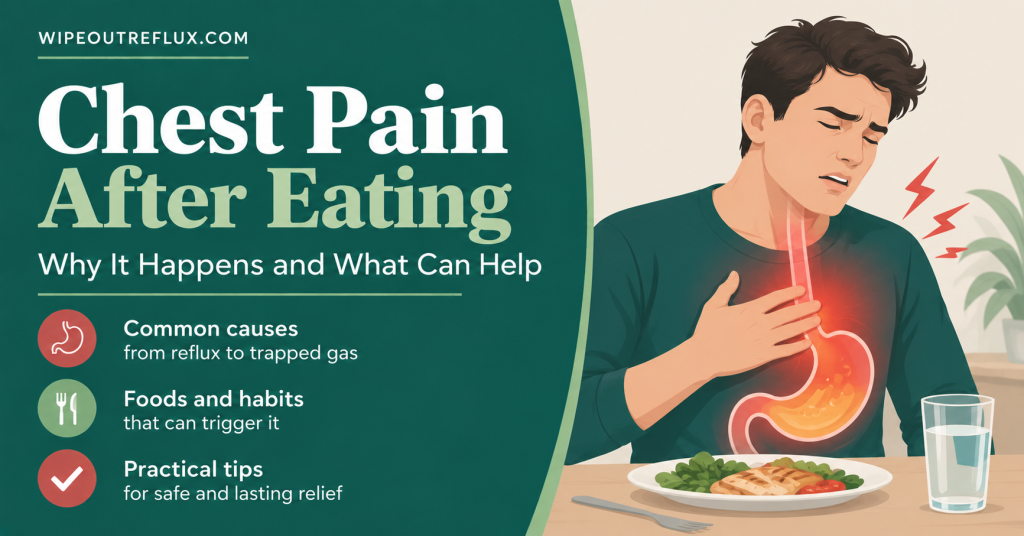
Chest pain after eating is most often caused by acid reflux. A meal stretches your stomach and makes the valve at the top of it open more often, so acid and stomach contents rise into the esophagus, which runs right behind your breastbone. That can feel like burning, pressure, tightness or even a sharp, stabbing pain. Other common digestive causes are esophageal spasm, trapped gas, a hiatal hernia, gallbladder pain after fatty meals, and ulcers or gastritis.
But chest pain after a meal can also be your heart. A large meal makes your heart work harder, and in people with narrowed coronary arteries that can bring on angina or even a heart attack. Reflux and heart pain can feel almost identical, so if you’re not sure, treat it as cardiac until a doctor tells you otherwise.
Call 911 (or your local emergency number) now if chest pain comes with: pressure, squeezing or heaviness; pain spreading to your arm, shoulder, neck, jaw or back; shortness of breath; sweating; nausea; or feeling faint. Don’t drive yourself.
Key Takeaways
- Rule out your heart first. Pain with pressure, sweating, breathlessness, or spreading to the arm, jaw or back is an emergency, even if it started after eating.
- Reflux is the most common cause of chest pain that turns out not to be the heart.
- Meals trigger reflux by stretching the stomach. Fatty, large and late meals are the worst.
- Reflux chest pain doesn’t always burn. It can feel like pressure, tightness or a sharp stab behind the breastbone.
- Esophageal spasm causes sudden, squeezing chest pain that can mimic a heart attack, often with trouble swallowing.
- Pain under the right ribs after a fatty meal, sometimes spreading to the chest or right shoulder, points to the gallbladder.
- Left-sided chest pain after eating is often reflux or gas, but it’s also where heart pain is felt, so get it checked if it’s new.
- Smaller, lower-fat meals, slower eating and staying upright for 2 to 3 hours after eating help most digestive causes.
First: When Chest Pain After Eating Is an Emergency
I’m putting this first because it matters most. Digestion diverts extra blood to your gut and makes your heart pump harder. If your coronary arteries are narrowed, a heavy meal can be enough to bring on chest pain from the heart, and the timing makes it very easy to blame your food.
The 2021 US chest pain guideline points out that heart pain isn’t always felt as “pain.” People describe it as pressure, tightness, squeezing, heaviness or even burning, and it can be felt in the shoulders, arms, neck or jaw rather than the chest. Women in particular often have nausea, palpitations or breathlessness along with it. The guideline also advises calling emergency services rather than getting yourself to hospital [Gulati et al., Journal of the American College of Cardiology, 2021].
Call emergency services if you have chest pain after eating with any of these:
- Pressure, squeezing, tightness or heaviness in the chest
- Pain spreading to one or both arms, the shoulder, neck, jaw or back
- Shortness of breath
- Sweating, nausea or vomiting
- Lightheadedness, dizziness or fainting
- A racing or irregular heartbeat
- Pain that comes on with exertion, such as walking after a meal, and eases with rest
- Pain lasting more than a few minutes, or that comes and goes and keeps returning
Your risk is higher if you smoke, have diabetes, high blood pressure or high cholesterol, are overweight, are over 45 (men) or 55 (women), or have a family history of early heart disease. Severe chest pain that starts after forceful vomiting or retching also needs emergency care, as it can rarely mean a tear in the esophagus.
Antacids easing the pain doesn’t prove it was reflux. Heart pain can come and go on its own. I compare the two in detail in heartburn or heart attack. If you’re ever in doubt, get checked. A normal ECG and blood tests let you treat the digestive cause with confidence.
Why Do I Have Chest Pain After Eating?
Once your heart has been ruled out, the cause is almost always in your esophagus, stomach or gallbladder. Your esophagus runs straight down behind your breastbone, so pain from it is felt in the middle of the chest, exactly where heart pain is felt. The esophagus and heart also share nerve pathways, which is why the brain struggles to tell them apart.
In people whose chest pain isn’t from the heart, reflux is the most common esophageal cause. A review of noncardiac chest pain found reflux symptoms in 53 to 90% of these patients and abnormal acid monitoring in 34 to 69%. Most of the rest have an oversensitive esophagus, and a smaller group have problems with how the esophagus squeezes (about 30% have abnormal muscle testing) [Fass and Achem, Journal of Neurogastroenterology and Motility, 2011].
The main causes of chest pain after eating are:
- Acid reflux (GERD): the most common cause by far.
- Esophageal spasm and motility problems: the esophagus squeezes too hard or out of sync.
- Trapped gas and bloating: pressure pushing up under the ribs.
- Hiatal hernia: part of the stomach sits above the diaphragm.
- Gallbladder pain: usually after fatty meals.
- Gastritis and stomach ulcers: upper abdominal pain that can rise into the chest.
- Food or pills getting stuck: including eosinophilic esophagitis and narrowing of the esophagus.
- Heart problems: covered above.
Acid Reflux: The Most Common Cause
Why meals set off reflux
The valve between your stomach and esophagus, the lower esophageal sphincter, doesn’t only leak when it’s weak. It also opens briefly in episodes called transient lower esophageal sphincter relaxations, and the main trigger for those is stretch in the upper stomach. Fill your stomach and you get more of them [Holloway et al., Gastroenterology, 1985]. That’s why reflux clusters in the hour or two after eating, and why big meals are worse than small ones. More in does overeating cause acid reflux.
Fat makes it worse. In a controlled comparison, a high-fat meal produced more acid exposure in the esophagus than a low-fat meal of the same size and calories [Becker et al., American Journal of Gastroenterology, 1989]. Fat slows stomach emptying and relaxes the valve, so the stomach stays fuller for longer with the door half open.
What reflux chest pain feels like
Classic heartburn is a burning feeling behind the breastbone that rises toward the throat, often with a sour taste or burping. But reflux chest pain doesn’t always burn. Many people describe:
- A tight, heavy or pressing feeling in the middle of the chest
- A sharp or stabbing pain behind the breastbone
- A gnawing ache that spreads to the back between the shoulder blades
- A feeling that food is sitting high in the chest
It usually starts 30 minutes to 2 hours after eating, gets worse when you lie down or bend over, and often eases when you sit up, burp or take an antacid. See acid reflux chest tightness for more.
Chest Pain After Eating but Not Heartburn
If your chest hurts after meals but it doesn’t burn, it can still be reflux, but it’s worth thinking about the other causes too.
Esophageal spasm
With esophageal spasm, the muscles of the esophagus contract too strongly or in an uncoordinated way. It causes sudden, intense, squeezing chest pain that can last from seconds to several minutes, and it’s one of the conditions most often mistaken for a heart attack. It’s commonly triggered by swallowing, especially very hot or very cold drinks, and often comes with trouble swallowing or a feeling of food getting stuck. Reflux can set off spasms, and the two often overlap. I explain how to tell them apart in esophageal spasm vs acid reflux and esophageal motility and acid reflux.
An oversensitive esophagus
Some people feel normal amounts of reflux, or even ordinary swallowing and stretching, as pain. This esophageal hypersensitivity explains much of the chest pain that isn’t heart-related or clearly reflux-related, according to the review above. It often responds to treatments that calm the nerves rather than just reducing acid.
Non-acid reflux
If acid-suppressing medication doesn’t help, reflux may still be happening. It’s just less acidic. Weakly acidic reflux and stomach contents that stretch the esophagus can still cause pain. See non-acid reflux.
Sharp Chest Pain After Eating
A sharp, stabbing pain after a meal is frightening, but it’s often digestive:
- Trapped gas: gas in the stomach or the bend of the colon under the left ribs can cause sharp, shifting pains that ease when you burp or pass wind. See acid reflux and gas and trapped gas in chest.
- Esophageal spasm: sudden, intense and squeezing, often when swallowing.
- Swallowing a large bite or a dry pill: food or a tablet stretching the esophagus can cause a sharp pain that lasts until it passes. Some pills, such as certain antibiotics, anti-inflammatories and iron, can also burn the esophagus lining if they get stuck. Take tablets with a full glass of water and stay upright afterward.
- Reflux esophagitis: an inflamed esophagus can make swallowing itself painful. See erosive esophagitis.
Sharp pain that’s worse when you breathe in, cough or lie flat, and isn’t linked to food, can come from the lungs or the lining around the heart and needs prompt medical assessment.
Left Side Chest Pain After Eating
The left side gets more searches than any other variation, and it’s easy to see why. It’s where people expect heart pain. In practice, left-sided pain after eating is often digestive. Your stomach sits under the left side of your diaphragm, and the bend of the colon called the splenic flexure sits just below the left ribs, where gas collects. A full stomach, trapped gas or a hiatal hernia can all cause pressure or aching on the left.
That said, heart pain can be felt on the left side of the chest and down the left arm. If left-sided chest pain is new, severe, comes with breathlessness, sweating or nausea, spreads to your arm, neck or jaw, or happens with exertion, treat it as an emergency. If it’s a familiar, mild ache that clearly follows big meals and eases with burping, gas or reflux is far more likely. Palpitations after meals can also be linked to reflux, which I cover in acid reflux and heart palpitations.
Middle and Upper Chest Pain After Eating
Pain in the middle of the chest, right behind the breastbone, is the classic location for esophageal pain from reflux, spasm or food sticking. It’s also the classic location for heart pain, so the same warning signs apply.
Pain high in the chest, near the throat or at the base of the neck, often comes with a feeling that food is stuck. That points to the esophagus, either reflux irritation, a narrowing, or eosinophilic esophagitis, an allergic inflammation that makes food stick. See food feels stuck in chest, eosinophilic esophagitis vs acid reflux and esophageal stricture.
Pain low in the chest, at the bottom of the breastbone or just below it, often comes from the stomach: gastritis, an ulcer or functional dyspepsia. See stomach ulcer or acid reflux and gastritis vs acid reflux.
Chest Pain After Eating Fatty Food
Fatty meals are a double trigger. They’re one of the strongest triggers for reflux, as above, and they’re also the classic trigger for gallbladder pain.
When you eat fat, your gallbladder contracts to release bile. If you have gallstones, that squeeze can push a stone against the gallbladder outlet and cause biliary colic: a steady, often severe pain under the right ribs or in the upper middle abdomen, which can spread to the lower chest, the back or the right shoulder blade. It usually starts within an hour or so of a fatty meal and can last for several hours. Unlike reflux, it doesn’t ease with antacids or by sitting up.
See a doctor if this sounds like you. Get urgent help if the pain comes with fever, yellowing of the skin or eyes, dark urine, or pain that lasts more than a few hours, as these can mean an infected gallbladder or pancreatitis. If you’ve already had your gallbladder removed and still get pain after fatty foods, see acid reflux after gallbladder removal.
Hiatal Hernia
With a hiatal hernia, part of your stomach pushes up through the diaphragm into the chest. Small hernias mainly make reflux easier. Larger ones can cause chest pressure, early fullness and breathlessness after meals as the herniated part of the stomach fills. If you also feel short of breath after eating, see shortness of breath after eating. More in hiatal hernia and reflux.
Foods That Cause Chest Pain After Eating
Certain foods come up again and again. Most work through reflux: they relax the valve, stay in the stomach longer, or add acid. A few cause spasm or gas instead.
- Fried foods: the fattiest trigger of all. They slow stomach emptying and relax the valve. See is fried food bad for acid reflux.
- Pizza: combines fat, cheese, tomato and usually a big portion late in the evening. See is pizza bad for acid reflux.
- Chocolate: in a pH-monitoring study, eating chocolate significantly increased acid exposure in the esophagus over the following hour [Murphy and Castell, American Journal of Gastroenterology, 1988]. See does chocolate cause heartburn or acid reflux.
- Spicy food: capsaicin can irritate an already inflamed esophagus and is often paired with fat and acid. See spicy food and acid reflux.
- Ice cream: high in fat and sugar, and very cold food and drinks can trigger esophageal spasm in some people. See is ice cream bad for acid reflux.
- Cheese: rich, aged and fatty cheeses are common triggers. See does cheese cause acid reflux.
- Peanut butter: high in fat, and thick spoonfuls can be hard to swallow. Most people tolerate a thin layer. See is peanut butter good for acid reflux.
- Bread: plain bread isn’t acidic, but dry, doughy bread can lodge in the esophagus, and big sandwiches with fatty fillings trigger reflux. See is bread good for acid reflux.
- Eggs: egg whites are usually fine, but yolks and fried eggs are fattier. See are eggs good for acid reflux.
- Bananas: usually one of the gentlest foods for reflux, so if a banana causes chest pain, think about eating too fast, food sticking or a sensitive esophagus. See are bananas acidic or alkaline.
- Coffee, alcohol, fizzy drinks, citrus and tomato: relax the valve, add acid or stretch the stomach with gas.
For a full list, see LPR foods to avoid and my food pH chart.
How to Stop Chest Pain After Eating
Once your heart has been ruled out, these steps help most digestive causes, especially reflux.
- Eat smaller meals. Less stretch means fewer valve openings. Four or five smaller meals are easier on reflux than two or three big ones.
- Cut back on fat. Fat is a trigger for both reflux and gallbladder pain. Grill, bake or steam instead of frying.
- Eat slowly and chew well. Big, poorly chewed bites can stretch the esophagus or get stuck. Put your fork down between bites.
- Sip, don’t gulp, and avoid very hot or ice-cold drinks if you get spasm-type pain.
- Stay upright for 2 to 3 hours after eating. A gentle walk helps. See does walking after meals help acid reflux.
- Stop eating 3 hours before bed. In a case-control study, going to bed within 3 hours of dinner was linked with much higher odds of reflux than waiting 4 hours or more [Fujiwara et al., American Journal of Gastroenterology, 2005]. See how long before bed you should stop eating.
- Lower the acid and triggers in your diet. Cutting acidic and fatty foods takes the pressure off an irritated esophagus. That’s the foundation of the Wipeout Diet Plan.
- Consider an alginate after meals. Alginates form a raft on top of the stomach contents that helps block reflux. See alginates for acid reflux.
- Take pills with a full glass of water and stay upright for at least 30 minutes afterward.
- Review your medications. Anti-inflammatory painkillers like ibuprofen can irritate the stomach and esophagus. See does ibuprofen cause acid reflux.
When to See a Doctor
Apart from the emergency signs at the top of this article, book an appointment if you have:
- Chest pain after eating that’s new, frequent or getting worse
- Pain or difficulty swallowing, or food sticking
- Vomiting, vomiting blood, or black, tarry stools
- Unexplained weight loss or loss of appetite
- Pain under the right ribs after fatty meals
- Symptoms that don’t improve after a few weeks of diet changes
- Risk factors for heart disease and any chest pain you haven’t had checked
Your doctor will usually check your heart first with an ECG and possibly blood tests or a stress test. If the heart is clear, the next steps may include a trial of reflux medication, an endoscopy, or tests of how your esophagus moves. See endoscopy for acid reflux and esophageal manometry.
Conclusion
Chest pain after eating is usually reflux. A meal stretches your stomach, the valve opens more often, and stomach contents irritate the esophagus right behind your breastbone. That can feel like burning, but just as often like pressure, tightness or a sharp stab. Esophageal spasm, trapped gas, a hiatal hernia and gallbladder pain after fatty meals are the other common culprits. But because the esophagus and heart sit side by side and share nerves, you can’t reliably tell them apart by feel. Pain with pressure, breathlessness, sweating or spreading to your arm, jaw or back always needs emergency care first.
Once your heart has been cleared, what you eat becomes the main lever. If you’d like a clear plan rather than trial and error, the Wipeout Diet Plan is where I’d start you. It’s my complete, step-by-step program for cutting the fat, acid and meal habits that drive reflux, so your esophagus can settle. It was originally built for silent reflux, the throat-based kind, but because it targets the same underlying causes, it works equally well for GERD, heartburn and reflux chest pain.
If you want something lighter to start with, the Wipeout Food Reference Guide is the essential companion. It lists the foods and drinks that are safe for acid reflux and LPR, with their pH values, so you can build meals that are much less likely to leave your chest aching.
Frequently Asked Questions
Why do I have chest pain after eating?
The most common cause is acid reflux, because a full stomach makes the valve at the top of the stomach open more often. Other causes include esophageal spasm, trapped gas, a hiatal hernia, gallbladder pain after fatty meals, and ulcers. Heart problems can also cause chest pain after meals, so get new or severe pain checked.
How do I know if chest pain after eating is my heart or reflux?
You can’t reliably tell by feel alone. Pain with pressure or squeezing, breathlessness, sweating, nausea, or spreading to your arm, jaw, neck or back should be treated as an emergency. Reflux pain is more often burning, linked to meals and lying down, and eased by sitting up or antacids, but only a doctor can rule out the heart.
Why does the left side of my chest hurt after eating?
Often it’s a full stomach, trapped gas under the left ribs, or reflux. But heart pain can also be felt on the left, so if the pain is new, severe, spreads to your arm or jaw, or comes with breathlessness or sweating, seek emergency care.
Can acid reflux cause sharp chest pain?
Yes. Reflux doesn’t always burn. It can cause sharp, stabbing or pressing pain behind the breastbone. Esophageal spasm and trapped gas also cause sharp pain after meals.
What does chest pain after eating fatty food mean?
Fatty food triggers both reflux and gallbladder contractions. Burning or pressure behind the breastbone suggests reflux. Steady pain under the right ribs that spreads to the back or right shoulder and lasts hours suggests gallstones and needs a doctor.
How long does chest pain from reflux last after eating?
Usually anywhere from a few minutes to a couple of hours, often starting 30 minutes to 2 hours after eating. It tends to ease when you sit up, burp or take an antacid. Pain lasting longer, or with warning signs, needs medical attention.
What helps chest pain after eating?
Sitting or standing upright, sipping water, loosening tight clothing, and taking an antacid or alginate help reflux pain. To prevent it, eat smaller, lower-fat meals, eat slowly, and leave 3 hours between dinner and bed. Always rule out the heart first.
Research & References
- [Gulati et al., Journal of the American College of Cardiology, 2021] — The 2021 AHA/ACC chest pain guideline notes that heart-related chest pain may be felt as pressure, tightness, squeezing, heaviness or burning, can spread to the shoulders, arms, neck or jaw, and advises calling emergency services for acute chest pain.
- [Fass and Achem, Journal of Neurogastroenterology and Motility, 2011] — Review identifying reflux as the most common esophageal cause of noncardiac chest pain, with esophageal hypersensitivity behind most non-reflux cases and abnormal motility in a minority.
- [Holloway et al., Gastroenterology, 1985] — Showed that stretching the stomach provokes transient lower esophageal sphincter relaxations, the main way reflux happens after meals.
- [Becker et al., American Journal of Gastroenterology, 1989] — High-fat meals increased esophageal acid exposure after eating compared with low-fat meals of equal size and calories.
- [Murphy and Castell, American Journal of Gastroenterology, 1988] — pH monitoring showed that eating chocolate significantly increased esophageal acid exposure in the following hour.
- [Fujiwara et al., American Journal of Gastroenterology, 2005] — Going to bed within 3 hours of dinner was associated with markedly higher odds of reflux than waiting 4 hours or more.

David Gray
12 years living with LPR · Consultant & researcher
I've lived with LPR for twelve years — the misdiagnoses, the PPI courses that did nothing, the slow work of figuring out what actually helps. Wipeout Reflux is where I translate the research into plain terms for people stuck in the same place. Every claim here is sourced to peer-reviewed work, and I consult one-to-one with LPR sufferers.