
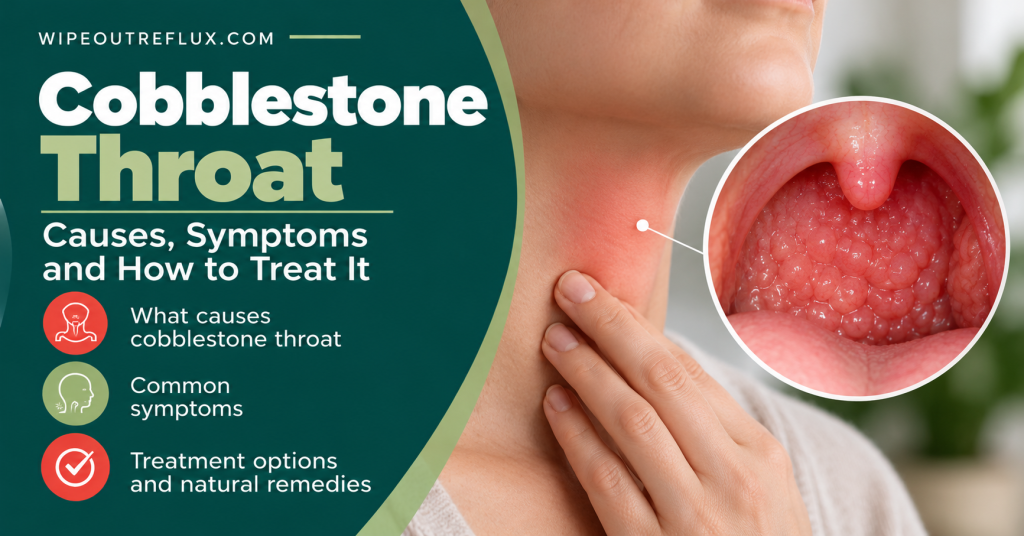
Cobblestone throat is a bumpy, pebbled look on the back wall of your throat. The bumps are small clusters of lymphoid tissue (the same kind of immune tissue as your tonsils) that have swollen because something is irritating the area. It looks alarming the first time you spot it in the mirror, but it’s almost always harmless.
The most common triggers are post-nasal drip from allergies, colds or sinus problems, a recent viral infection, and silent reflux (LPR), where stomach contents and the enzyme pepsin reach the throat. Dry air, mouth breathing, smoking and constant throat clearing can keep it going.
Cobblestone throat isn’t a disease in itself and it isn’t a sign of cancer. It’s a sign that your throat lining is reacting to an irritant. Find and calm the irritant, and the bumps usually flatten over a few weeks.
Key Takeaways
- Cobblestone throat means swollen lymphoid tissue on the back of the throat, giving a raised, bumpy “cobblestone” pattern.
- It’s a reaction to irritation, not a condition of its own, and it’s almost always benign.
- Post-nasal drip is the most common cause, followed by viral infections and silent reflux.
- Reflux-related cobblestoning often comes with throat clearing, mucus, a lump sensation or hoarseness, usually without heartburn.
- The bumps themselves rarely hurt. Any soreness usually comes from the irritation behind them.
- Treatment means treating the cause: nasal rinses and allergy control for drip, time for viruses, and diet and alginates for reflux.
- It usually settles within a few weeks once the trigger is controlled, though long-standing cases can take a couple of months.
- Get checked if you have a lump on one side, persistent one-sided pain, hoarseness for more than three weeks, or trouble swallowing.
What Is Cobblestone Throat?
The back wall of your throat (the posterior pharyngeal wall) is lined with a thin, moist membrane. Scattered underneath it are small islands of lymphoid tissue, part of a ring of immune tissue that also includes your tonsils and adenoids. Their job is to sample whatever you breathe and swallow and react to threats.
When that area is irritated for a while, those little islands swell and become more visible. Instead of a smooth, pink surface you see a pattern of raised, rounded bumps, often slightly redder or paler than the surrounding tissue, which is where the “cobblestone” name comes from. Doctors may call it posterior pharyngeal wall cobblestoning, lymphoid hyperplasia or granular pharyngitis.
The key point is that cobblestoning is a response. It tells you the throat has been irritated, but not what’s irritating it. That’s why the same appearance shows up with allergies, viruses and reflux.
What Does Cobblestone Throat Look Like?
If you shine a flashlight into your mouth and say “ahh,” you’ll see the back wall of the throat behind the uvula. Cobblestone throat typically looks like:
- Small, round, raised bumps spread across the back wall, a bit like goosebumps or tapioca pearls
- Bumps that are pink, red or slightly pale, sometimes with visible small blood vessels around them
- A sheen of mucus over the surface, especially if post-nasal drip is involved
- Both sides affected fairly evenly
A lot of people only notice it because they went looking after a sore throat, or because their throat feels “different.” Some degree of visible lymphoid tissue is normal, so a few bumps on their own aren’t a concern.
What Causes Cobblestone Throat?
1. Post-nasal drip
This is the most common cause. When the nose and sinuses make extra mucus, it drains down the back of the throat all day and night. That constant trickle irritates the lining and the lymphoid tissue swells in response. Post-nasal drip (now often called upper airway cough syndrome) is one of the most common causes of chronic cough and throat irritation in adults, and its signs on examination are notoriously nonspecific [Pratter, Chest, 2006].
Typical sources include hay fever and other allergies, non-allergic rhinitis, chronic sinusitis and the tail end of a cold. If you’re always aware of mucus at the back of your throat, you’ll find more in my guide to silent reflux and post-nasal drip.
2. Viral infections
Colds, flu and other viral throat infections commonly cause a temporary cobblestone appearance as the immune tissue ramps up. It has even been documented with the Omicron variant of COVID-19 [Inui et al., American Journal of Tropical Medicine and Hygiene, 2023]. This kind usually comes on with a sore throat, runny nose or cough and fades within one to three weeks.
3. Silent reflux (LPR)
Silent reflux is the cause that gets missed most often, because most people with it never get heartburn. Small amounts of stomach contents travel all the way up into the throat, often while you’re upright and going about your day, and irritate the lining. I’ll cover this in more detail below.
4. Allergies and environmental irritants
Even without much drip, allergens, dry heated air, air conditioning, dust and pollution can irritate the throat. Mouth breathing, especially at night with a blocked nose, dries the lining out and makes it more reactive.
5. Smoking, vaping and alcohol
Smoke and vapor directly irritate the throat lining, and both smoking and alcohol also make reflux worse. If you vape and have a lingering throat problem, see vaping and acid reflux.
6. Throat clearing and voice strain
Habitual throat clearing slams the tissues of the throat together, which irritates them and creates more mucus, which triggers more clearing. It’s a self-perpetuating loop. My guide on how to stop constant throat clearing explains how to break it.
Cobblestone Throat and Silent Reflux
If your cobblestone throat has been there for months, nothing infectious ever shows up, and antihistamines haven’t fixed it, reflux deserves a proper look. It’s one of the patterns I hear about most often from readers: a bumpy, irritated throat, constant mucus and throat clearing, and a doctor who says it’s “probably drip” when the drip never fully explains it.
How reflux irritates the back of the throat
The esophagus is built to cope with the occasional splash of stomach contents. The throat isn’t. In the research that first described laryngopharyngeal reflux, most patients had throat and voice symptoms while only a minority had heartburn [Koufman, The Laryngoscope, 1991].
The real troublemaker is pepsin, the stomach’s protein-digesting enzyme. Pepsin can stick to throat tissue and stay there long after a reflux episode, then switch back on whenever something acidic arrives, whether that’s another reflux event or an acidic drink [Johnston et al., The Laryngoscope, 2007]. That repeated low-grade irritation is exactly the kind of stimulus that makes lymphoid tissue swell. You can read more on this in how pepsin reactivates in the throat.
Reflux signs beyond the voice box
ENT doctors have traditionally judged reflux by looking at the voice box, but specialists increasingly recognize that reflux leaves signs elsewhere in the throat too. Researchers have pointed out that redness of the back wall of the throat and enlarged lymphoid tissue at the base of the tongue are reflux-related signs that the standard Reflux Finding Score doesn’t capture [Lechien et al., Indian Journal of Otolaryngology and Head & Neck Surgery, 2020]. Swelling of that tongue-base lymphoid tissue has also been linked to reflux in its own right [Sung et al., JAMA Otolaryngology–Head & Neck Surgery, 2013].
I want to be honest about the limits here, though. Throat appearance on its own is a poor way to diagnose reflux. In one study of healthy volunteers with no symptoms, 93% showed at least one so-called “reflux sign” on a scope [Milstein et al., The Laryngoscope, 2005]. Cobblestoning is a clue, not a diagnosis. What matters is the whole picture: the bumps plus your symptoms plus how they behave.
Reflux, drip, or both?
Reflux and post-nasal drip overlap far more than most people realize. Reflux can reach as high as the back of the nose, and people with reflux in that area report more post-nasal drip symptoms [Wise et al., American Journal of Rhinology, 2006]. In a randomized trial of people with chronic post-nasal drip and no sinus disease or allergy, 60% improved substantially on acid-suppressing medication compared with 24% on placebo [Vaezi et al., Gastroenterology, 2010].
So if you’ve been treating “drip” for months with limited success, reflux may be part or all of the story. My comparison of LPR vs allergies can help you tell them apart.
Signs your cobblestone throat may be reflux-related
- It has lasted weeks or months, with no fever or cold
- You clear your throat constantly or always feel mucus you can’t shift. See phlegm stuck in your throat from acid reflux
- You have a lump-in-the-throat feeling, hoarseness or a voice that tires easily
- It feels worse in the morning or after meals
- Coffee, alcohol, fizzy drinks, citrus, tomato, chocolate or late dinners make things worse
- Allergy treatment helped only a little, or not at all
If several of these fit, score yourself on the Reflux Symptom Index, the nine-question checklist ENT doctors use. A score above 13 suggests reflux is likely involved [Belafsky et al., Journal of Voice, 2002].
Is Cobblestone Throat a Sign of Cancer?
This is the question most people are really asking when they search for it, so I’ll answer it plainly: no. Cobblestoning is a benign, widespread reaction of normal immune tissue to irritation. It’s even and symmetrical, and it isn’t how throat cancer typically shows up.
What doctors do want to examine is anything that’s different from that pattern: a single lump or ulcer, a patch on one side only, a sore that doesn’t heal, or symptoms such as persistent one-sided pain, ear pain on one side, hoarseness for more than three weeks, coughing up blood, trouble swallowing or unexplained weight loss. If none of those apply, a bumpy throat on its own is very reassuring.
Is Cobblestone Throat Strep?
Usually not. Strep throat typically causes sudden, painful sore throat with fever, swollen tender glands in the neck, and often swollen tonsils with white patches, usually without a cough or runny nose. When a sore throat comes with cough, runny nose, hoarseness or mouth ulcers, a virus is much more likely, and guidelines advise that strep testing usually isn’t needed [Shulman et al., Clinical Infectious Diseases, 2012].
Cobblestoning tends to fit the viral, drip or reflux pattern far better than strep. If you have a high fever, very painful swallowing and pus on your tonsils, though, see a doctor for a quick strep test.
Does Cobblestone Throat Hurt?
The bumps themselves usually don’t. Most people with cobblestone throat describe a background of irritation rather than pain: scratchiness, rawness, a tickle, dryness, or the feeling that something is stuck. Any genuine soreness usually comes from what’s causing the cobblestoning, such as a virus, drip or reflux. If the soreness has lasted weeks, my guide to a sore throat that won’t go away walks through the likely culprits.
How to Get Rid of Cobblestone Throat
Because cobblestoning is a reaction, there’s no cream or spray that makes the bumps disappear directly. The approach is to remove the irritant and give the tissue time to settle.
Soothing steps for everyone
- Stay well hydrated. Sipping water through the day keeps the lining moist and mucus thinner.
- Warm salt water gargles. Half a teaspoon of salt in a glass of warm water, two or three times a day, can soothe the throat and loosen mucus.
- Humidify your bedroom if your air is dry, especially in winter.
- Breathe through your nose where you can, and treat a blocked nose so you’re not mouth breathing at night.
- Swap throat clearing for a hard swallow or a sip of water. It sounds small, but it breaks the irritation loop.
- Stop smoking or vaping if you do.
If it’s post-nasal drip
- Rinse your nose with saline once or twice a day
- Use a steroid nasal spray for a few weeks if allergies or rhinitis are involved
- Try a non-drowsy antihistamine if you have clear allergy symptoms like sneezing and itchy eyes
- Raise your head a little at night so mucus doesn’t pool
If it’s a virus
Rest, fluids, warm drinks and simple pain relief if needed. It should settle within a couple of weeks. If you developed throat symptoms after COVID that haven’t cleared, see can COVID cause silent reflux.
If it’s reflux
Throat tissue heals slowly, so reflux changes need a fair trial of at least four to six weeks before you judge them.
- Lower the acid in your diet. This is the step that matters most for throat reflux, because acidic food and drink reactivates pepsin that’s already sitting in the tissue. In people with stubborn LPR, a strict low-acid diet improved symptoms in 95% within two weeks [Koufman, Annals of Otology, Rhinology & Laryngology, 2011], and a mostly plant-based Mediterranean-style diet with alkaline water worked at least as well as acid-reducing medication in another study [Zalvan et al., JAMA Otolaryngology–Head & Neck Surgery, 2017]. My Wipeout Diet Plan sets out exactly what to eat and drink while your throat settles, then how to reintroduce foods safely. If you’d like to start with the basics, see LPR foods to avoid.
- Take an alginate after meals and at bedtime. Alginates form a protective raft on top of stomach contents. In a trial of 49 people with LPR, Gaviscon Advance improved both symptoms and throat appearance compared with no treatment [McGlashan et al., European Archives of Oto-Rhino-Laryngology, 2009]. More in alginates for acid reflux.
- Stop eating three hours before bed and raise the head of your bed if you wake with a worse throat.
- Cut back on the big triggers: coffee, alcohol, carbonated drinks, citrus, tomato, chocolate, mint and large fatty meals.
Acid-suppressing medication can help in some people, particularly when drip and reflux overlap. In a trial of people with LPR, eight weeks of a PPI plus diet counseling reduced post-nasal drip scores more than diet counseling alone [Lee et al., Journal of Rhinology, 2023]. It’s worth discussing with your doctor if diet and alginates alone aren’t enough.
How Long Does Cobblestone Throat Last?
It depends on the cause:
- Viral: usually one to three weeks
- Post-nasal drip: improves within a few weeks of treating the drip, but returns if the allergy or rhinitis flares again
- Reflux: symptoms often ease within four to six weeks of consistent changes, but the bumps themselves can take two to three months to flatten fully
It’s common for the throat to feel better well before it looks better, so don’t be discouraged if the mirror lags behind. For a realistic view of throat healing times, see how long a reflux sore throat takes to heal.
When to See a Doctor
Cobblestone throat on its own rarely needs medical attention. Book an appointment if:
- It hasn’t improved after four to six weeks of treating the likely cause
- You’ve been hoarse for more than three weeks
- You notice a lump in your neck that hasn’t gone down after two to three weeks
- One side of your throat looks or feels different from the other
- Swallowing is painful or food feels like it sticks
- You smoke or drink heavily and throat symptoms aren’t settling
Get seen urgently if you have difficulty breathing, can’t swallow your own saliva, cough up blood, or have a high fever with severe throat pain. My guide on when to see a doctor for LPR covers what to ask and what tests you might be offered.
Conclusion
Cobblestone throat looks dramatic, but it’s simply your throat’s immune tissue reacting to irritation. Post-nasal drip and viruses are the usual suspects. When the bumps hang around for months alongside mucus, throat clearing or a lump sensation, and allergy treatment hasn’t done the job, silent reflux is very often the missing piece. The good news is that once you calm the cause, the throat usually settles, even if the bumps take a little longer to flatten than the symptoms.
If reflux is part of your picture, the Wipeout Diet Plan is where I’d start. It’s my complete approach to calming reflux and taking away the acidic foods and drinks that keep reactivating pepsin in the throat, built from twelve years of managing this myself. It was designed first and foremost for silent reflux, the throat-based kind behind most cobblestoning, though the same approach works just as well for GERD and everyday heartburn.
Frequently Asked Questions
What is cobblestone throat?
It’s a bumpy, pebbled appearance on the back wall of the throat caused by small patches of lymphoid (immune) tissue swelling in response to irritation. It’s a reaction rather than a disease, and it’s almost always harmless.
Is cobblestone throat serious?
Usually not. It’s a common, benign response to post-nasal drip, viral infections or reflux. It’s worth getting checked if it comes with a lump on one side, hoarseness for more than three weeks, trouble swallowing, ear pain on one side or weight loss, mainly for peace of mind.
Can acid reflux cause cobblestone throat?
Yes. Silent reflux (LPR) brings stomach contents and pepsin up into the throat, often without heartburn, and that repeated irritation can make the lymphoid tissue swell. Reflux-related cobblestoning usually comes with throat clearing, mucus, a lump feeling or hoarseness.
How do I get rid of cobblestone throat?
Treat the cause. For post-nasal drip, use saline rinses and a steroid nasal spray. For a virus, give it a week or two. For reflux, lower the acid in your diet, avoid eating late and take an alginate after meals and at bedtime. Staying hydrated and cutting back on throat clearing help in every case.
Is cobblestone throat a sign of cancer?
No. Cobblestoning is a widespread, symmetrical reaction of normal immune tissue. Doctors look more closely at a single lump, an ulcer, a one-sided change or a sore that won’t heal, not at an even cobblestone pattern.
Can allergies cause cobblestone throat?
Yes. Allergies are one of the most common causes because they drive post-nasal drip, which constantly irritates the back of the throat. If antihistamines and nasal sprays only help partially, reflux may be contributing too.
How long does cobblestone throat take to go away?
Viral cobblestoning usually clears in one to three weeks. Drip-related cobblestoning improves within a few weeks of treatment. Reflux-related cobblestoning often feels better in four to six weeks but can take two to three months to flatten completely.
Research & References
- [Pratter, Chest, 2006] — ACCP guideline identifying post-nasal drip (upper airway cough syndrome) as the most common cause of chronic cough, noting its symptoms and examination signs are nonspecific and that GERD may mimic it.
- [Inui et al., American Journal of Tropical Medicine and Hygiene, 2023] — Clinical image report documenting cobblestone throat in a younger patient infected with the Omicron variant of SARS-CoV-2.
- [Koufman, The Laryngoscope, 1991] — Landmark study of 225 ear, nose and throat patients using 24-hour pH monitoring that established reflux as a common cause of laryngeal and voice disorders, often without heartburn.
- [Johnston et al., The Laryngoscope, 2007] — Showed pepsin stays stable at throat pH and can be reactivated by acid, explaining ongoing throat irritation between reflux episodes.
- [Lechien et al., Indian Journal of Otolaryngology and Head & Neck Surgery, 2020] — Review of screening for laryngopharyngeal reflux noting that oropharyngeal (back of throat) erythema and tongue-base lymphoid hypertrophy are reflux-related signs not captured by the Reflux Finding Score.
- [Sung et al., JAMA Otolaryngology–Head & Neck Surgery, 2013] — Study of adults with sleep-disordered breathing identifying obesity and laryngopharyngeal reflux as factors associated with lingual tonsil hypertrophy.
- [Milstein et al., The Laryngoscope, 2005] — In 52 healthy non-smoking volunteers, 93% showed at least one laryngeal “reflux sign” on flexible laryngoscopy, showing that scope findings alone are not specific for reflux.
- [Wise et al., American Journal of Rhinology, 2006] — Using pH probes in the nasopharynx and throat, found that people with reflux reaching these areas had significantly more post-nasal drip symptoms.
- [Vaezi et al., Gastroenterology, 2010] — Randomized placebo-controlled trial in 75 people with chronic post-nasal drip and no sinus disease or allergy; 60% on lansoprazole improved by more than half versus 24% on placebo.
- [Belafsky et al., Journal of Voice, 2002] — Developed and validated the Reflux Symptom Index, a nine-item questionnaire for laryngopharyngeal reflux, with scores above 13 considered abnormal.
- [Shulman et al., Clinical Infectious Diseases, 2012] — Infectious Diseases Society of America guideline on group A streptococcal pharyngitis, covering which clinical features suggest a viral cause and when strep testing and antibiotics are appropriate.
- [Koufman, Annals of Otology, Rhinology & Laryngology, 2011] — In 20 patients with PPI-resistant LPR, a strict diet eliminating foods and drinks below pH 5 for at least two weeks improved symptoms in 95%.
- [Zalvan et al., JAMA Otolaryngology–Head & Neck Surgery, 2017] — Found a plant-based Mediterranean diet with alkaline water was at least as effective as PPI treatment for improving laryngopharyngeal reflux symptoms.
- [McGlashan et al., European Archives of Oto-Rhino-Laryngology, 2009] — Randomized trial of Gaviscon Advance in 49 patients with laryngopharyngeal reflux; the treated group had significantly better Reflux Symptom Index and Reflux Finding Scores than untreated controls.
- [Lee et al., Journal of Rhinology, 2023] — Randomized trial in 80 people with LPR; eight weeks of a PPI plus diet counseling reduced post-nasal drip scores significantly more than diet counseling alone.

David Gray
12 years living with LPR · Consultant & researcher
I've lived with LPR for twelve years — the misdiagnoses, the PPI courses that did nothing, the slow work of figuring out what actually helps. Wipeout Reflux is where I translate the research into plain terms for people stuck in the same place. Every claim here is sourced to peer-reviewed work, and I consult one-to-one with LPR sufferers.