
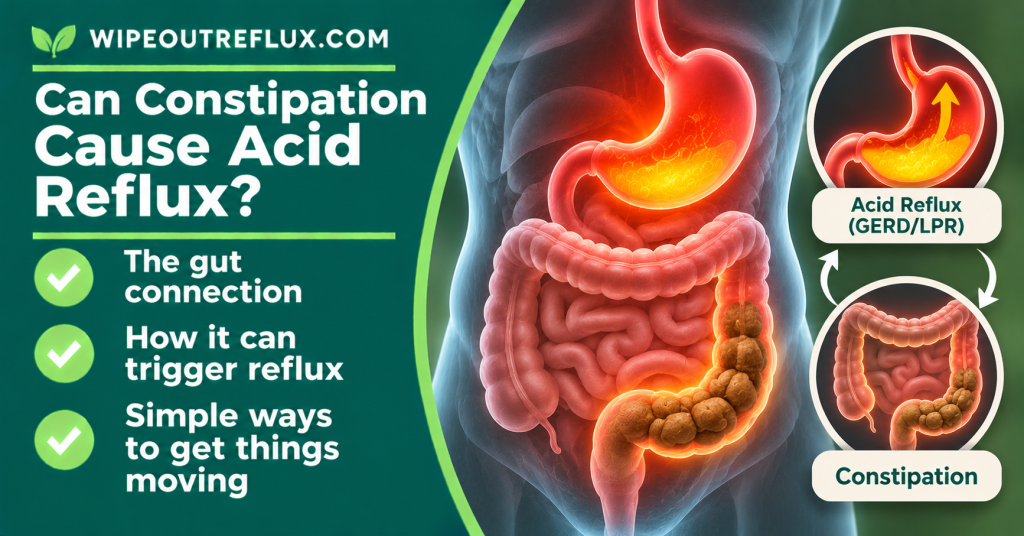
Constipation can contribute to acid reflux, and the two very often show up together. A backed-up bowel raises pressure inside the abdomen, especially when you strain, and that pressure pushes up on the stomach. A full rectum also sends signals that slow down stomach emptying, so food and acid sit in the stomach for longer. Both make it easier for stomach contents to escape up into the esophagus.
The research is still fairly limited, but it points in a consistent direction. Large population studies link constipation with GERD, and in a study of children with both problems, treating the constipation improved reflux on pH testing. The practical upshot is good news: the things that help constipation, like more fiber, more fluids and regular movement, tend to help reflux too.
Key Takeaways
- Constipation and acid reflux frequently occur together, and population studies show a strong association.
- Straining raises pressure inside the abdomen, which can push stomach contents up past the lower esophageal sphincter.
- A full rectum slows stomach emptying: in one study, rectal distension delayed gastric emptying by about 14 minutes.
- Bloating and gas from constipation add further upward pressure and can trigger belching and reflux.
- In children with constipation and reflux, treating the constipation improved both reflux symptoms and acid measurements.
- Fiber helps both: in a small study, psyllium reduced heartburn and the number of reflux episodes.
- Some reflux medications, supplements and painkillers can cause constipation, so the link can also run the other way.
Can Constipation Cause Acid Reflux?
Constipation isn’t usually the only cause of reflux, but it can be a genuine contributor, and for some people it’s a big one. Your digestive tract works as one connected system. When the far end gets backed up, it affects what happens further up.
Population studies show how often they overlap. A large Norwegian study of more than 43,000 adults found strong associations between severe reflux symptoms and other gut symptoms, including constipation [Jansson et al., Alimentary Pharmacology and Therapeutics, 2008]. A study from a Chinese gastroenterology clinic found chronic constipation in 14% of people with GERD versus 7.1% of those without it. The more severe the reflux, the more likely people were to have bowel problems too [Jiang et al., Chinese Journal of Internal Medicine, 2013].
An association doesn’t prove one causes the other. Both can share common causes, like a low-fiber diet, low activity, certain medications, pregnancy and IBS. But there are good mechanical reasons to think constipation can directly make reflux worse.
How Constipation Drives Reflux
1. Straining raises abdominal pressure
When you bear down on the toilet, you hold your breath and tighten your abdominal muscles. This sharply raises the pressure inside your abdomen, and that pressure squeezes the stomach. If your lower esophageal sphincter (LES) is already a bit weak, or you have a hiatal hernia, that squeeze can push acid and pepsin upward.
The same thing happens with heavy lifting, tight clothing and bending over. It’s why some people notice heartburn or a sour taste while straining. I explain the role of the valve in the lower esophageal sphincter and acid reflux, and the hernia link in hiatal hernia and reflux.
2. A full rectum slows the stomach
This is the mechanism most people have never heard of. Your gut has reflexes that coordinate the top and bottom. When the rectum is stretched, it signals the upper gut to slow down.
In a Belgian study of healthy young women, gently inflating a balloon in the rectum (to mimic a full bowel) slowed stomach emptying. The time it took for half a meal to leave the stomach rose from about 79 minutes to 92 minutes [Coremans et al., Neurogastroenterology and Motility, 2004]. The researchers also noted that people with slow-transit constipation often have delayed gastric emptying.
When the stomach empties slowly, food and acid sit there longer, the stomach stays more stretched, and there’s more opportunity for reflux. It’s the same principle as in gastroparesis and acid reflux, just milder.
3. Bloating and gas add pressure
When stool sits in the colon for longer, gut bacteria have more time to ferment it, producing gas. A bloated, distended belly pushes up on the stomach from below. Trapped gas also leads to more burping, and each belch can carry a little acid or pepsin up with it. See acid reflux and gas.
4. Shared underlying gut problems
Constipation and reflux often have a common root. IBS, SIBO, slow gut motility, low fiber intake and thyroid problems can all cause both. If you have constipation, bloating and reflux together, it’s worth reading IBS and acid reflux and SIBO and acid reflux.
Does Treating Constipation Help Reflux?
The best direct evidence comes from children. A Turkish study looked at 94 children with functional constipation. Of the 55 who had reflux symptoms and pH testing, 23 had abnormal acid reflux. After three months of standard constipation treatment, both their reflux symptoms and their acid reflux measurements improved significantly, as their bowel movements became more frequent [Baran et al., European Journal of Gastroenterology and Hepatology, 2017].
We don’t yet have a similar trial in adults, so I’d be careful about promising too much. But the mechanisms are the same, and in my experience many adults notice their reflux is worse during constipated spells and better when their bowels are regular.
Fiber: Good for Both Problems
Fiber is usually the first thing to try for constipation, and it turns out it may help reflux directly too.
In a small Russian study, 30 people with non-erosive reflux disease and low fiber intake took 5 g of psyllium three times a day for 10 days. The number with heartburn fell from 93% to 40%. Their LES resting pressure increased and the number of reflux episodes dropped from about 68 to 42 per day [Morozov et al., World Journal of Gastroenterology, 2018]. It was a short study without a control group, but the results are encouraging.
A few tips for using fiber with reflux:
- Increase it gradually over a couple of weeks. A sudden jump causes gas and bloating, which can temporarily make reflux worse.
- Drink more water as you add fiber, or it can make constipation worse.
- Soluble fiber is usually gentler. Oats, psyllium, bananas, carrots, sweet potato and chia seeds are good, reflux-friendly options.
- Be careful with high-FODMAP fiber (like onions, garlic, beans and wheat bran) if bloating is a problem.
For more detail, see fiber and acid reflux and psyllium husk for acid reflux.
When the Link Runs the Other Way
Sometimes the reflux side causes the constipation, mainly through medications and supplements:
- Antacids containing aluminum or calcium can be constipating, especially if used often.
- PPIs and H2 blockers can affect bowel habits in some people. I cover this in do acid reducers cause constipation.
- Iron supplements are a common cause of both constipation and heartburn. See do iron supplements cause heartburn.
- Opioid painkillers cause constipation and slow the whole gut, which can worsen reflux.
- A reflux diet that’s too restrictive can cut out fruit, vegetables and whole grains, leaving very little fiber.
That last one is something I see a lot. People cut out so many foods to avoid reflux that their diet becomes low in fiber and they end up constipated, which then makes reflux harder to control. A good reflux diet should include plenty of reflux-friendly fiber. That balance is built into the Wipeout Diet Plan, which is designed so you’re not left eating plain rice and chicken.
How to Ease Constipation and Reflux Together
- Add soluble fiber slowly. Aim to work up toward 25 to 30 g a day from food, with psyllium if needed.
- Drink enough water. Sip steadily through the day rather than drinking large amounts with meals, which can stretch the stomach.
- Walk after meals. Gentle movement helps both the stomach empty and the bowel move. See does walking after meals help acid reflux.
- Don’t strain. Use a footstool to raise your knees above your hips on the toilet, take your time, and breathe out gently rather than holding your breath and bearing down.
- Try reflux-friendly natural laxative foods. Prunes and kiwi fruit can help constipation, though both are mildly acidic, so start with small amounts. See are prunes good for acid reflux.
- Consider magnesium. Magnesium has a gentle laxative effect, and some forms are also used for reflux. Check with your doctor first if you have kidney problems. See magnesium for acid reflux.
- Use osmotic laxatives if needed. Polyethylene glycol (Miralax) is generally well tolerated and doesn’t cause the cramping of stimulant laxatives. Ask your pharmacist or doctor.
- Keep evening meals smaller and earlier so your stomach isn’t full when you lie down.
- Review your medications with your doctor if constipation started after a new prescription or supplement.
When to See a Doctor
Most constipation and reflux can be managed with diet and lifestyle changes. But see a doctor if you notice:
- Blood in your stool or black, tarry stools
- A change in bowel habits lasting more than a few weeks, especially if you’re over 50
- Unexplained weight loss
- Severe abdominal pain or a swollen, hard belly
- Vomiting, or being unable to pass gas or stool
- Difficulty swallowing, or food getting stuck
- Iron deficiency anemia
Conclusion
Constipation and acid reflux often go together, and constipation can genuinely make reflux worse. Straining raises abdominal pressure, a full rectum slows down stomach emptying, and the gas and bloating that come with constipation push up on the stomach from below. On top of that, both problems often share common roots like low fiber intake, inactivity, IBS and certain medications.
The encouraging part is that fixing one often helps the other. In children with both conditions, treating constipation improved reflux on pH testing, and in adults with reflux, adding psyllium fiber reduced heartburn and the number of reflux episodes. So rather than treating your gut as separate problems at the top and bottom, it’s worth treating it as one system.
That’s the approach I take in the Wipeout Diet Plan, my complete, in-depth guide to calming reflux through food, meal timing and daily habits, with plenty of reflux-friendly fiber built in so your bowels stay regular too. It was originally designed around silent reflux, but since it targets the same root causes, it works equally well if your symptoms are classic heartburn.
Frequently Asked Questions
Can constipation cause heartburn?
It can contribute. Straining raises abdominal pressure, and a backed-up bowel slows stomach emptying and causes bloating, all of which make heartburn more likely.
Can constipation cause acid reflux in the throat?
The same pressure and slow emptying that drive heartburn can push reflux higher, so it may contribute to throat symptoms in people with silent reflux.
Why does straining on the toilet give me heartburn?
Bearing down sharply increases pressure in your abdomen, which squeezes the stomach and can force acid past a weak lower esophageal sphincter or a hiatal hernia.
Does fiber help acid reflux?
It may. In a small study, psyllium fiber reduced heartburn and the number of reflux episodes and increased LES pressure. Increase fiber slowly to avoid bloating.
Can PPIs cause constipation?
Some people report constipation on acid reducers, though diarrhea is more often linked to PPIs. Calcium- and aluminum-based antacids are more commonly constipating.
What laxative is best if I have acid reflux?
Fiber, fluids and an osmotic laxative such as polyethylene glycol are usually well tolerated. Magnesium may also help. Check with your pharmacist or doctor, especially if you take other medications.
Can bloating cause acid reflux?
Yes. A distended belly pushes up on the stomach and increases burping, both of which can bring acid and pepsin up into the esophagus.
Research & References
- [Jansson et al., Alimentary Pharmacology and Therapeutics, 2008] — Norwegian population study (3,153 cases, 40,210 controls) finding strong associations between severe reflux symptoms and nausea, diarrhea and constipation.
- [Jiang et al., Chinese Journal of Internal Medicine, 2013] — In 1,074 gastroenterology outpatients, chronic constipation was more common with GERD (14.0% vs 7.1%), and GERD severity correlated with functional bowel disorders.
- [Coremans et al., Neurogastroenterology and Motility, 2004] — In 12 healthy women, rectal balloon distension increased gastric half-emptying time from 78.8 to 92.3 minutes compared with sham.
- [Baran et al., European Journal of Gastroenterology and Hepatology, 2017] — In children with functional constipation and abnormal acid reflux, three months of constipation treatment significantly improved reflux symptoms and the acid reflux index.
- [Morozov et al., World Journal of Gastroenterology, 2018] — Psyllium 5 g three times daily for 10 days in 30 NERD patients reduced heartburn (93% to 40%), raised minimal LES pressure and cut reflux episodes from about 68 to 42.

David Gray
12 years living with LPR · Consultant & researcher
I've lived with LPR for twelve years — the misdiagnoses, the PPI courses that did nothing, the slow work of figuring out what actually helps. Wipeout Reflux is where I translate the research into plain terms for people stuck in the same place. Every claim here is sourced to peer-reviewed work, and I consult one-to-one with LPR sufferers.