
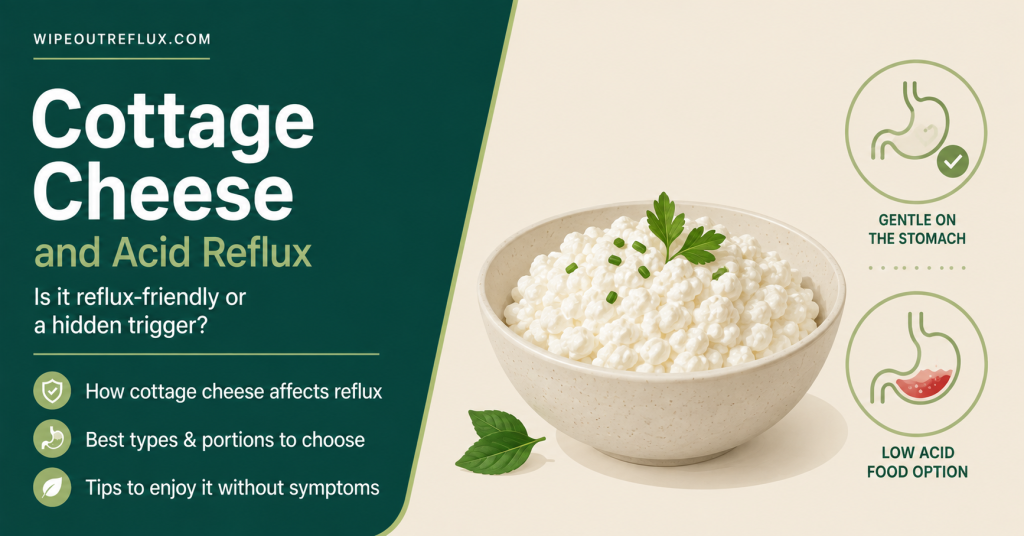
Good news if you like cottage cheese: it’s one of the more reflux-friendly cheeses you can eat. The reason is fat. Fat is the part of dairy most likely to aggravate reflux, and cottage cheese is naturally low in it — especially the 1% and 2% versions — while packing in a lot of protein. That combination makes it a far gentler choice than rich, aged cheeses like cheddar or brie.
It’s not completely off the hook, though. Cottage cheese is mildly acidic, full-fat (4%) versions carry more of the fat that can loosen the valve at the top of your stomach, and dairy simply doesn’t sit well with some people. Portion size matters too — a small bowl behaves very differently from a giant one.
So the honest answer is: for most people with reflux, low-fat cottage cheese in a sensible portion is a good, protein-rich option. Here’s how to get it right, what to watch for, and why it beats most other cheeses.
Key Takeaways
- Cottage cheese is one of the most reflux-friendly cheeses because it’s naturally low in fat and high in protein.
- Fat is the main dietary trigger in dairy — it can relax the lower oesophageal sphincter and slow stomach emptying — so low-fat cheeses win.
- Choose 1% or 2% cottage cheese over full-fat (4%) if reflux is a concern.
- Cottage cheese is mildly acidic (roughly pH 4.5–5) from the lactic acid of fermentation, but it’s not a strong acid trigger like citrus.
- Portion and calorie load matter as much as fat — a small bowl is far safer than a large one.
- Watch acidic add-ins like pineapple or tomato, which can turn a safe snack into a trigger.
- Some people are simply sensitive to dairy; if cottage cheese bothers you, that may be why.
Is cottage cheese good or bad for acid reflux?
For most people, it’s good — provided you pick a low-fat version and keep the portion reasonable. The thing that makes any cheese risky for reflux is its fat content, and here cottage cheese has a real advantage. A half-cup of 2% cottage cheese has only around 2.5 grams of fat but roughly 12 grams of protein. Compare that to hard cheeses, where a single ounce of cheddar carries about 9 grams of fat, and you can see why cottage cheese sits so much easier.
Why does fat matter? It can relax the lower oesophageal sphincter — the muscular valve that’s meant to keep stomach contents down — and it slows how quickly your stomach empties, giving acid more time and opportunity to travel back up. I explain that valve and its role in what to eat for reflux. A high-fat cheese leans into that mechanism; a low-fat one largely sidesteps it.
Why cottage cheese beats most other cheeses
If you’ve read that “cheese is bad for reflux,” that advice is really aimed at the fatty, aged cheeses — I cover the full picture in does cheese cause acid reflux. Cottage cheese is the exception that proves the rule, because it delivers cheese’s protein and calcium without the heavy fat load.
It’s worth knowing that fat’s role in reflux is real but often overstated, and portion size may matter just as much. In one study, increasing the fat content of a meal — without increasing its total calories — did not increase reflux or weaken the sphincter in the hours afterward Penagini et al., Gut, 1998. Other research points to the overall calorie density and size of a meal as key drivers of acid exposure Fox et al., Clinical Gastroenterology and Hepatology, 2007. The practical takeaway is reassuring: a modest bowl of low-fat cottage cheese ticks both boxes — low fat and low calorie load — which is exactly why it’s such a sensible pick.
The acidity question
Cottage cheese is mildly acidic, sitting at roughly pH 4.5 to 5. That’s because it’s made by curdling milk with an acid or a bacterial culture, which produces lactic acid and gives it that faint tang. So on the pH scale it counts as acidic — but nowhere near the level of genuine reflux troublemakers. Lemons and other citrus sit down near pH 2, more than a hundred times more acidic.
For most people that mild acidity isn’t the deciding factor; the fat content and portion matter more. If you have LPR (silent reflux), where the throat can be more acid-sensitive, it’s worth being a touch more cautious — more on that below. But cottage cheese doesn’t belong in the same category as the sharp, obviously acidic foods people usually need to avoid.
Low-fat vs full-fat cottage cheese
This is the single most useful choice you’ll make. Cottage cheese comes in nonfat, 1%, 2% and full-fat (4%) versions, and for reflux the lower-fat options are the safer bet. The difference isn’t huge per spoonful, but it adds up — and since fat is the main mechanism of concern, why not stack the odds in your favour?
My suggestion: 1% or 2% hits the sweet spot. Nonfat can taste thin and watery, which tempts people to add sugary or acidic toppings, while 4% brings more fat than you need. A 2% tub gives you creamy texture and plenty of protein without the fat penalty.
Watch-outs that can turn it into a trigger
Cottage cheese itself is gentle, but what you do with it can undo that:
- Acidic add-ins. Cottage cheese with pineapple is a classic combo, but pineapple is acidic — see is pineapple good for acid reflux — as are tomatoes and citrus. Pair with low-acid fruit like melon or banana instead.
- Big portions. Even a low-fat food can overload your stomach in large amounts, and volume is its own reflux trigger. Stick to a half-cup to one-cup serving.
- Full-fat versions eaten in quantity, which reintroduce the fat you were trying to avoid.
- Late-night snacking. Eating close to bed is a common trigger regardless of the food; give yourself a few hours before lying down.
How to eat cottage cheese with reflux
Put it all together and cottage cheese becomes an easy win:
- Choose 1% or 2% for the best fat-to-protein balance.
- Keep portions modest — a half-cup to a cup.
- Top it with low-acid foods like banana, melon, oats or a drizzle of honey rather than pineapple or berries if you’re sensitive.
- Use it as a daytime snack, not a bedtime one. It’s a great high-protein option on a reflux-friendly snack list.
- Try it in place of richer dairy — it’s a lower-fat stand-in for cream cheese or sour cream in many recipes, much like plain yoghurt or kefir.
Listen to your own reflux
Dairy is one of those foods where individual tolerance varies a lot. Some people digest cottage cheese without a flicker; others find any dairy sits heavily. If you have LPR — the silent, throat-based form of reflux — your tissues can react at acidity levels that wouldn’t bother a classic heartburn sufferer, so introduce cottage cheese cautiously and watch how your throat responds. (Not sure which type you have? My GERD vs LPR guide will help.)
The reliable test is a simple one: eat a small, low-fat portion when your symptoms are calm, then notice how you feel over the next few hours. Cottage cheese passes that test easily for most people — but you’re the only real judge of your own gut.
Conclusion
So, cottage cheese and acid reflux get along better than you might expect. Because it’s low in fat and high in protein, a modest bowl of 1% or 2% cottage cheese is one of the friendliest cheese choices out there — just mind the portion, skip the acidic toppings, and favour low-fat over full-fat. Its mild acidity is rarely the problem; fat and volume are the levers that matter, and cottage cheese keeps both low.
That’s the tricky thing about eating with reflux, though: every food comes with these little “yes, but” conditions, and holding them all in your head is exhausting. That’s exactly why I built the Wipeout Food Reference Guide — the essential reference for which foods and drinks are safe for acid reflux and LPR, with their pH values, so you can check cottage cheese (or anything else) at a glance instead of second-guessing every meal.
And if you want to stop managing reflux food by food and actually calm it at the source, the Wipeout Diet Plan is the complete, in-depth system. I built it first and foremost around LPR, the stubborn throat-based kind that’s hardest to shift, but because it works on the same underlying reflux mechanisms, it’s just as effective for GERD, heartburn and everyday acid reflux. Once the mechanism is calmed, gentle foods like cottage cheese stop being something you have to think twice about.
Frequently Asked Questions
Is cottage cheese good for acid reflux?
Generally yes, for most people. It’s low in fat and high in protein, which makes it one of the gentler cheeses for reflux. Choose 1% or 2%, keep the portion modest, and avoid acidic toppings, and it’s a solid protein-rich option.
Is cottage cheese acidic?
Mildly. It sits at around pH 4.5 to 5 because of the lactic acid produced when milk is cultured. That’s far less acidic than citrus or tomatoes, so for most people its acidity isn’t the main concern — fat content and portion size matter more.
Which cottage cheese is best for reflux — low-fat or full-fat?
Low-fat (1% or 2%). Since fat is the component most likely to trigger reflux by relaxing the lower oesophageal sphincter, the lower-fat versions are the safer choice while still giving you plenty of protein.
Can cottage cheese cause heartburn?
It can in some people, usually from full-fat versions, large portions, acidic add-ins like pineapple, eating it late at night, or a personal sensitivity to dairy. Low-fat cottage cheese in a small daytime portion is unlikely to trigger heartburn for most.
Is cottage cheese ok for silent reflux (LPR)?
Often yes, but test it carefully. LPR tissue can be more acid-sensitive, so start with a small, low-fat serving when your symptoms are calm and see how your throat responds. Its low fat content is a point in its favour for throat-based reflux.
Research & References
- In healthy subjects and reflux patients, increasing the fat content of a meal without increasing its total energy did not increase gastro-oesophageal reflux or weaken the lower oesophageal sphincter for at least three hours afterward, suggesting fat alone is not the sole driver Penagini et al., Gut, 1998.
- A controlled study of dietary fat and calorie density found that the overall calorie load of a meal was an important driver of esophageal acid exposure and reflux symptoms, underlining that portion size matters alongside fat content Fox et al., Clinical Gastroenterology and Hepatology, 2007.

David Gray
12 years living with LPR · Consultant & researcher
I've lived with LPR for twelve years — the misdiagnoses, the PPI courses that did nothing, the slow work of figuring out what actually helps. Wipeout Reflux is where I translate the research into plain terms for people stuck in the same place. Every claim here is sourced to peer-reviewed work, and I consult one-to-one with LPR sufferers.