
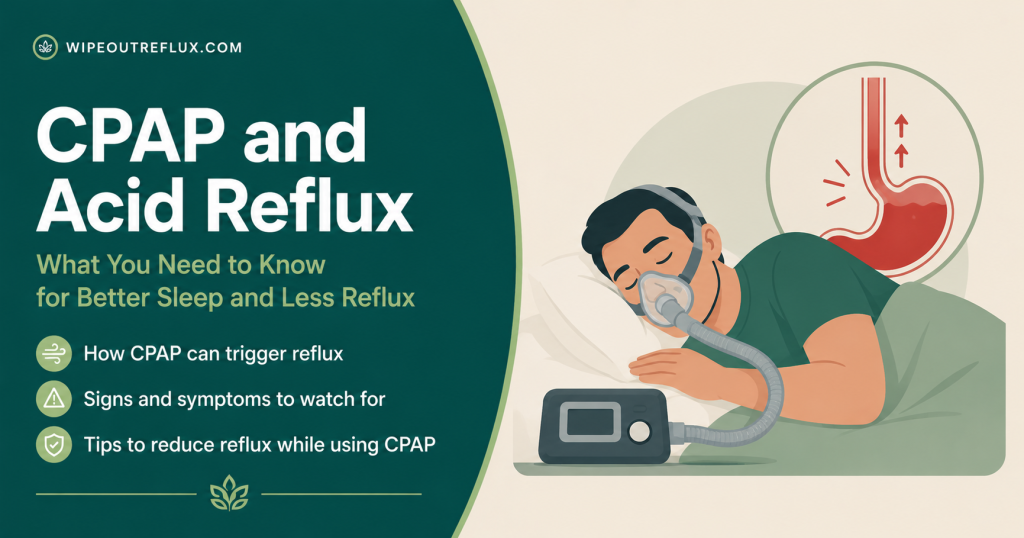
CPAP and acid reflux have a two-way relationship, and it surprises people. For most users, CPAP actually improves nighttime reflux — treating your sleep apnea calms the very pressure swings in your chest that pull acid upward all night. But for a meaningful minority, CPAP does the opposite and makes reflux noticeably worse. When that happens, the culprit almost always has a name: aerophagia, or swallowing air.
The mechanism is simple once you see it. CPAP delivers a steady stream of pressurised air to keep your airway open. Ideally, all of that air goes into your lungs — but some of it can end up going down the wrong tube, into your oesophagus and stomach. That trapped air inflates the stomach like a balloon, and a distended stomach pushes up on the valve that’s meant to keep acid down, triggering reflux, bloating and belching. The higher the pressure your machine runs, the more air there is to go astray, which is exactly why pressure can make reflux worse.
The good news is that CPAP-related reflux is usually very fixable — often without giving up the therapy that’s protecting your sleep and your heart. Let me explain both sides of the relationship, why pressure is so often the trigger, and the practical steps that fix it.
Key Takeaways
- CPAP more often helps reflux than harms it — treating sleep apnea reduces the nighttime reflux that apnea itself drives.
- When CPAP makes reflux worse, the usual cause is aerophagia: air from the machine going into the stomach instead of the lungs.
- A stomach inflated with swallowed air pushes acid up past the valve, causing reflux, bloating and belching.
- Higher machine pressure means more air available to be swallowed, which is why pressure is such a common trigger.
- Mask leaks, mouth breathing and nasal congestion all increase air swallowing — and are all fixable.
- Don’t just abandon CPAP: work with your sleep clinic on pressure settings, mask fit and humidification instead.
- Calming the underlying reflux — head-of-bed elevation, not eating late, and a low-acid diet — makes the whole system far more forgiving.
First, the good news: CPAP usually helps reflux
Before we get to the pressure problem, it’s worth understanding why CPAP is usually on your side. Sleep apnea and reflux are tightly linked. Every time an apnea blocks your airway, you strain to breathe against that blockage, and the effort creates a strong vacuum inside your chest — a negative pressure that literally helps suck stomach acid up into the oesophagus. So untreated apnea is itself a powerful engine for nighttime reflux, something I dig into in sleep apnea and acid reflux.
CPAP switches that engine off. When your airway stays open, those violent pressure swings stop, and reflux tends to settle with them. In one study, starting nasal CPAP produced a dramatic drop in overnight acid exposure in apnea patients — the percentage of night-time spent with a low oesophageal pH fell close to zero Kerr et al., Chest, 1992. More recently, apnea patients who stuck with CPAP saw their heartburn scores fall substantially, and the better their adherence, the bigger the improvement Tamanna et al., Journal of Clinical Sleep Medicine, 2016. So if CPAP is helping your reflux, that’s the expected result — and a good reason not to give it up lightly.
So why does CPAP make reflux worse for some people?
The answer is aerophagia. CPAP is designed to send air into your lungs, but the pressure doesn’t discriminate perfectly — if the pressure is high, or your airway is partly blocked, or you’re swallowing repeatedly, some of that air gets forced or swallowed down into the oesophagus and stomach instead. Over a night, that adds up to a stomach steadily inflating with gas.
And a gas-filled stomach is a reflux machine. Stretching the stomach with air triggers more of the transient valve relaxations that let acid escape upward — the same mechanism behind belching after a fizzy drink. It’s no coincidence, then, that aerophagia and reflux travel together in CPAP users. In one study, aerophagia symptoms were common among people on CPAP and were clearly linked to the presence of nighttime reflux Shepherd et al., Journal of Clinical Sleep Medicine, 2013, and a separate observation found a positive association between aerophagia and both reflux symptoms and reflux-medication use in CPAP patients Watson & Mystkowski, Journal of Clinical Sleep Medicine, 2008. The telltale signs are morning bloating, lots of belching, a gurgling stomach and gassiness that weren’t there before you started CPAP.
Why pressure is so often the trigger
Here’s the logical link the title points to: the more pressure your machine delivers, the more air is available to end up in the wrong place. At low pressures, the airway opens and almost everything goes to the lungs. As pressure climbs — whether because your apnea is severe or your machine is set high — the volume of air pushing against your throat rises, and more of it can be driven past the upper oesophagus into the stomach. That’s why aerophagia and CPAP-related reflux so often show up in people on higher settings.
It’s worth being honest that pressure isn’t the whole story — how well your own oesophageal valves and swallowing cope with that air matters too, which is why two people on the same setting can have completely different experiences. But pressure is the lever you can most often adjust, and bringing it down (safely, with your clinic) is frequently what solves the problem.
What makes the air-swallowing worse
A few everyday things pour fuel on aerophagia, and each one is fixable:
- Mouth breathing and mask leaks. If air is escaping or you’re breathing through your mouth, you tend to swallow more of it.
- Nasal congestion. A blocked nose makes the machine work harder against resistance and encourages mouth breathing.
- Pressure set too high for what you actually need on a given night.
- Lying flat and eating late, which prime the stomach to reflux any swallowed air straight upward.
The silent reflux angle
If your reflux is the throat-based kind — silent reflux (LPR), with hoarseness, throat-clearing or a lump-in-the-throat feeling — CPAP-driven reflux deserves extra attention. LPR damage is driven by an enzyme called pepsin that reactivates in the throat whenever acid reaches it, and lying down all night with an air-filled stomach gives acid every chance to travel that far. It’s also easy to confuse the two conditions, since nighttime throat symptoms can come from either — something I untangle in reflux laryngospasm at night versus sleep apnea. Calming that acid at the source is a big part of the fix, and a lower-acid, reflux-friendly approach like my Wipeout Diet Plan gives the whole system far less to throw back up in the first place.
How to fix CPAP-related reflux
The goal is to keep the therapy while stopping the air-swallowing. Most people manage both. Work through these — and please involve your sleep clinic before changing any machine settings:
- Review your pressure with your clinic. An auto-adjusting (APAP) machine can keep the average pressure lower than a fixed setting, and features like expiratory pressure relief ease the push on exhale. In some cases a bilevel (BiPAP) machine helps. Lowering the pressure to the minimum you truly need is often the single biggest fix — but it’s a clinical decision, not a DIY one.
- Stop the leaks and mouth breathing. A better-fitting or full-face mask, a chin strap, and a heated humidifier all cut down how much air you swallow. Treating nasal congestion helps too.
- Raise the head of your bed. Sleeping on an incline uses gravity to keep both acid and swallowed air down — see how to raise the head of your bed and the right sleeping position.
- Don’t eat close to bedtime. Going to bed on a full stomach makes any reflux worse; give yourself a few hours, as I explain in how long before bed you should stop eating.
- Calm the reflux itself. The less acid your stomach is producing and the less irritable your system is, the less any swallowed air will trouble you — which is where diet does the heavy lifting.
There’s strong evidence that tackling reflux through diet works: a plant-based, Mediterranean-style diet with alkaline water was about as effective as acid-suppressing medication for calming reflux symptoms Zalvan et al., JAMA Otolaryngology–Head & Neck Surgery, 2017. Fix the CPAP mechanics and calm the acid, and the two usually stop fighting each other.
Conclusion
So, does CPAP make acid reflux worse? It can — but usually only through aerophagia, when pressurised air ends up in your stomach and inflates it enough to push acid up. For most people CPAP actually improves nighttime reflux by treating the apnea that drives it, so the aim is almost never to stop therapy. It’s to stop the air-swallowing: dial in the right pressure with your clinic, seal up leaks and mouth breathing, sleep on an incline, and don’t head to bed on a full stomach. Do that, and you can usually keep the CPAP and lose the reflux.
The deepest fix, though, is to calm the reflux at its source so your stomach has far less to send back up in the first place. That’s exactly what my Wipeout Diet Plan is built to do — the complete, in-depth system for getting reflux under control for good, so a little swallowed air stops turning into a night of heartburn. I designed it first and foremost around LPR, the stubborn throat-based kind that’s hardest to treat, but because it works on the same underlying reflux mechanisms, it’s just as effective for GERD, heartburn and everyday acid reflux.
And for the day-to-day question of which foods and drinks calm your symptoms versus feed them, the Wipeout Food Reference Guide is the essential companion — it lays out the real pH values of foods and drinks for acid reflux and LPR, so you always know what’s helping and what’s hurting. Get the CPAP mechanics right, calm the acid, and your machine goes back to doing its real job: helping you sleep.
Frequently Asked Questions
Why does my CPAP give me acid reflux?
Almost always because of aerophagia — swallowing air from the machine. When pressurised air goes into your stomach instead of your lungs, it inflates the stomach and pushes acid up past the valve, causing reflux, bloating and belching. Higher pressures, mask leaks and mouth breathing all make it more likely.
Does CPAP help or hurt acid reflux?
For most people it helps. Treating sleep apnea removes the chest-pressure swings that drive nighttime reflux, and studies show CPAP reduces overnight acid exposure and heartburn, especially with good adherence. It only tends to worsen reflux in people who develop aerophagia — and that’s usually fixable.
Does lowering CPAP pressure reduce reflux and bloating?
Often, yes. The higher the pressure, the more air is available to be swallowed, so reducing it to the minimum you genuinely need frequently eases aerophagia and the reflux that comes with it. Auto-adjusting machines and expiratory pressure relief can help — but always change settings through your sleep clinic, not on your own.
How do I stop swallowing air on CPAP?
Reduce leaks and mouth breathing with a well-fitting or full-face mask and a chin strap, treat nasal congestion, use a heated humidifier, and review your pressure with your clinic. Sleeping on an incline and not eating late also help keep swallowed air and acid down.
Should I stop using CPAP if it causes reflux?
No — stopping CPAP leaves your sleep apnea untreated, which is bad for your heart and can worsen reflux in its own right. The better path is to fix the aerophagia through pressure adjustment, mask fit and positioning, and to calm the underlying reflux with diet and lifestyle. Talk to your sleep clinic before making changes.
Research & References
- In apnea patients, starting nasal CPAP produced a dramatic reduction in overnight gastroesophageal reflux, with the percentage of night-time spent at low oesophageal pH falling close to zero — showing CPAP typically improves reflux by treating the apnea that drives it Kerr et al., Chest, 1992.
- A study of apnea patients found that CPAP therapy reduced symptoms of nocturnal gastroesophageal reflux, with greater CPAP adherence predicting a larger fall in heartburn scores Tamanna et al., Journal of Clinical Sleep Medicine, 2016.
- A study of CPAP users found that symptoms of aerophagia (air swallowing) were common and were related to the presence of nighttime gastroesophageal reflux, linking swallowed air to reflux during therapy Shepherd et al., Journal of Clinical Sleep Medicine, 2013.
- A preliminary observation in CPAP patients reported a positive association between aerophagia and both gastroesophageal reflux symptoms and reflux-medication use — consistent with swallowed air worsening reflux in susceptible users Watson & Mystkowski, Journal of Clinical Sleep Medicine, 2008.
- A study of patients with laryngopharyngeal reflux found that a plant-based, Mediterranean-style diet with alkaline water was about as effective as proton pump inhibitor medication at reducing symptoms — underscoring the value of calming reflux at its source Zalvan et al., JAMA Otolaryngology–Head & Neck Surgery, 2017.

David Gray
12 years living with LPR · Consultant & researcher
I've lived with LPR for twelve years — the misdiagnoses, the PPI courses that did nothing, the slow work of figuring out what actually helps. Wipeout Reflux is where I translate the research into plain terms for people stuck in the same place. Every claim here is sourced to peer-reviewed work, and I consult one-to-one with LPR sufferers.