
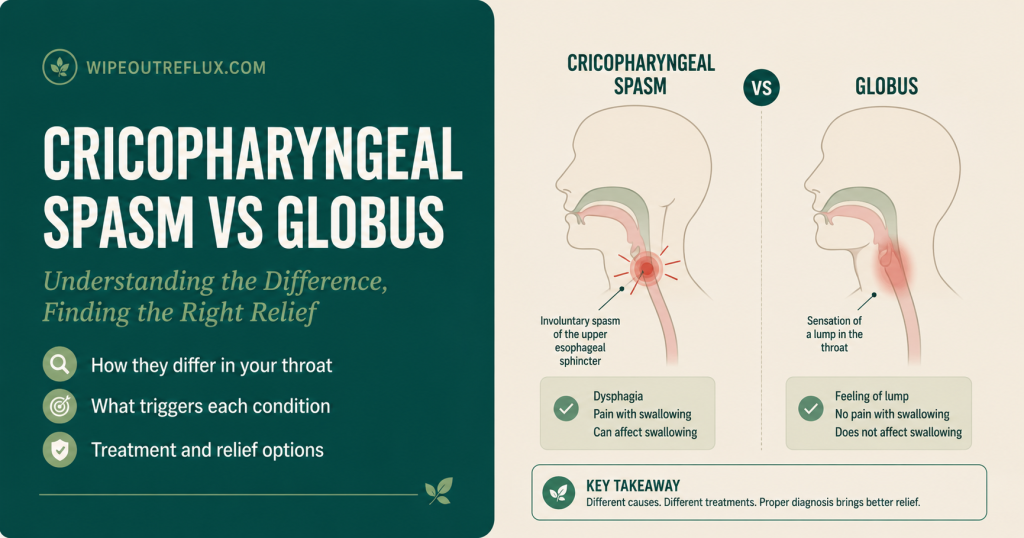
Cricopharyngeal spasm is a sustained, involuntary tightening of the cricopharyngeus — the ring of muscle that forms your upper esophageal sphincter, sitting right at the base of your throat. It feels like a lump, a band, or a hand squeezing your neck. It typically eases when you eat or drink and gets worse when you swallow nothing but your own saliva.
That last detail is the one that matters, and it’s the clue almost everyone misses. If your throat feels tighter on an empty swallow than it does on a mouthful of food, you’re dealing with muscle tension, not a blockage.
And in a large share of cases, the thing keeping that muscle switched on is reflux — specifically the silent, throat-based kind that never gives you heartburn to explain itself.
Key Takeaways
- Cricopharyngeal spasm is tightening of the upper esophageal sphincter (UES); “globus” is the medical term for the sensation it produces.
- The signature clue is that it feels worse swallowing saliva and better when eating — the opposite of a physical obstruction.
- The UES tightens as a protective reflex. In reflux, that reflex is being triggered repeatedly from below.
- Research has found measurable UES residual pressure in 66.7% of globus patients versus 9.5% of controls.
- Long-term acid exposure actually blunts the UES’s protective reflexes rather than sharpening them, which is why chronic cases behave differently from new ones.
- Anxiety is a genuine amplifier, but it is rarely the whole story — and being told it’s “just stress” is why so many people go years without treatment.
- Acid suppression alone often fails here, because pepsin and non-acid reflux still irritate the tissue.
- Speech therapy and targeted relaxation work have real trial evidence behind them.
What the cricopharyngeus actually does
Before we get to why it spasms, it’s worth understanding what this muscle is for — because that explains the whole picture.
The cricopharyngeus is the main component of your upper esophageal sphincter, the valve between your throat and your food pipe. Unlike most muscles, its resting state is contracted. It sits clamped shut all day, and only relaxes for a fraction of a second when you swallow, burp, or vomit.
Why? Because it’s the last barrier standing between your stomach contents and your airway. Everything below it — the esophagus, the lower valve — can tolerate acid to some degree. Everything above it — your voice box, your vocal cords, your lungs — cannot. The cricopharyngeus is the bouncer on the door of your airway.
So when this muscle grips harder than it should, it isn’t malfunctioning at random. It’s usually doing its job too enthusiastically, because something keeps setting it off.
Cricopharyngeal spasm vs globus: are they the same thing?
This confuses a lot of people, and honestly the medical world hasn’t helped by using the terms loosely.
Here’s the cleanest way to think about it:
- Globus is the symptom — the persistent sensation of a lump, ball, or tightness in the throat with nothing physically there. It’s what you feel.
- Cricopharyngeal spasm is one cause of that symptom — the specific mechanism where the UES muscle is hypertonic. It’s what’s happening.
You can have globus without cricopharyngeal spasm (post-nasal drip, thyroid enlargement, and inflamed throat tissue all produce it too). But you can’t really have cricopharyngeal spasm without feeling globus.
One practical note: search “cricopharyngeal spasm” in the medical literature and you’ll find surprisingly little. Search “globus pharyngeus” and there’s decades of research. The condition is well studied — it’s just filed under a different name than the one patients use. If your doctor doesn’t recognize the phrase, that’s why. Ask about globus instead.
How to tell them apart from something more serious
The distinction that actually matters clinically isn’t globus versus spasm — it’s globus versus dysphagia.
Globus is a sensation of tightness between swallows, and food goes down normally. Difficulty actually swallowing — food sticking, needing water to push it down, coughing on liquids — is a different symptom and needs proper investigation. So does throat tightness with weight loss, pain on swallowing, a neck lump you can feel, or symptoms on one side only. None of those are typical cricopharyngeal spasm and none should be waited out.
Why reflux makes the cricopharyngeus clamp down
This is the mechanism the generic “lump in throat” articles skip entirely, and it’s the part worth understanding properly.
Your esophagus has a built-in reflex called the esophago-UES contractile reflex. When it senses something coming back up, it tells the cricopharyngeus to squeeze tighter — slamming the door before anything reaches your larynx. It’s an airway protection reflex, and it’s meant to fire briefly.
In someone refluxing many times a day, that reflex is being pulled constantly. The muscle doesn’t get to stand down. It stays partly braced, and a partly braced sphincter is exactly what a lump in the throat feels like.
The manometry data supports this. Researchers examining upper esophageal sphincter function with high-resolution manometry found measurable UES residual pressure in 66.7% of globus patients, compared with just 9.5% of healthy controls, and identified it as an independent predictor of globus symptoms with an odds ratio of 6.33 [Peng et al., Journal of Clinical Gastroenterology, 2015]. In plain terms: in people with a lump in the throat, the sphincter measurably fails to fully let go after swallowing.
A broad review of globus concluded much the same — that reflux and hyperdynamic upper esophageal sphincter pressure are among the central mechanisms, and that the condition is multifactorial rather than psychological in origin [Järvenpää et al., European Archives of Oto-Rhino-Laryngology, 2018].
The twist: chronic reflux breaks the reflex
Here’s where it gets genuinely interesting, and where I think most explanations get it backwards.
You’d assume constant reflux means a constantly over-tight sphincter. Over the long run, the opposite happens. Work examining how acid exposure affects these reflexes found that sustained acidification decreased sensitivity to the UES contractile response — the protective squeeze became harder to trigger, not easier [Lang et al., American Journal of Physiology: Gastrointestinal and Liver Physiology, 2019].
And in humans, a study comparing patients with supraesophageal reflux — the throat-and-airway kind — against GERD patients and healthy controls found that significantly fewer of the supraesophageal group produced a UES contractile reflex in response to slow acid infusion, and only that group showed abnormal UES relaxation responses [Babaei et al., Gastroenterology, 2015].
So the picture across the arc of the condition is: early on, the sphincter over-reacts and you feel tight. Later, the reflex becomes worn down and unreliable, so more material reaches your throat — and the tightness you feel starts coming from the irritated tissue itself as much as from the muscle. That’s a big part of why silent reflux keeps coming back even after people think they’ve dealt with it.
Why it’s silent reflux, not heartburn, that usually does this
Most people with cricopharyngeal spasm from reflux have no heartburn at all. That’s not a contradiction — it’s what you’d predict from the anatomy.
Your esophagus has a thick, protective lining built to handle acid. Your throat and larynx have almost none. It takes a great deal of reflux to make an esophagus hurt, but only a tiny amount reaching the throat to cause trouble. So a person can be doing real damage at the top of the pipe while feeling nothing in the middle of it — which is exactly what separates LPR from classic GERD.
There’s also pepsin to account for. Pepsin is the stomach’s protein-digesting enzyme, and when it travels up with reflux it binds to throat tissue and stays there. It doesn’t wash away with the reflux episode. It sits in the tissue, dormant, and reactivates whenever anything acidic passes through — a glass of orange juice, a coffee, a fizzy drink. That’s why symptoms often spike hours after a meal with no obvious trigger in sight, and why a tight throat can persist through weeks of careful eating and then flare from one bad afternoon.
It’s also the reason acid-blocking medication so often disappoints here. PPIs lower acid production, but pepsin is still refluxing, and non-acid reflux is still mechanically triggering that protective squeeze. I’ve written separately about why PPIs underperform in LPR, and cricopharyngeal spasm is one of the clearest examples of it — people take omeprazole for three months, feel no different in the throat, and conclude reflux wasn’t the problem. Usually it was; the treatment just aimed at the wrong half of the mechanism.
Where anxiety genuinely fits in
I want to handle this carefully, because it cuts both ways.
Anxiety absolutely amplifies this symptom. Stress raises baseline muscle tone throughout the neck and throat, and a tight throat is frightening in a way that few other symptoms are — it sits right next to your airway. People check it. They swallow repeatedly to test it. Every test swallow is a dry swallow, which is the exact swallow that makes the sensation worse. The loop builds itself.
So yes, anxiety and reflux feed each other, and calming the nervous system genuinely helps.
But “it’s just anxiety” as a diagnosis is where a lot of people lose years. The measurable pressure abnormalities in globus patients are real and physical. Being anxious about a tight throat is a completely reasonable response to having a tight throat — it doesn’t demonstrate that anxiety caused it. If your throat tightness came first and the worry followed, treat the throat.
What actually helps
The immediate relief techniques
These break the spasm in the moment. None of them fix the cause, but when your throat feels gripped, they’re what you want.
- Sip and swallow something. Warm water works best. A wet swallow moves the muscle through a full relaxation cycle; a dry swallow doesn’t.
- Stop checking. The single most useful thing most people can do. Every anxious test-swallow reinforces the sensation. It’s uncomfortable to leave alone, and it works.
- Chew gum. Stimulates saliva, which is naturally alkaline, and keeps the throat moving without dry swallows.
- Yawn deliberately, or hum. Both release laryngeal tension — the technique singers use to unlock a tight throat.
- Slow your breathing out. Long exhales shift you out of the sympathetic state that’s holding the muscle braced. The breathing exercises I use for reflux apply directly here.
Treating the reflux underneath it
This is what actually ends it, and it’s slower than anyone wants.
Alginate rafts. Where medication is concerned, this is the one I’d prioritize for throat symptoms over acid suppression. Alginates form a physical barrier on top of the stomach contents rather than changing their chemistry — so they block pepsin and non-acid reflux, not just acid. Taken after meals and before bed, they address the mechanism that’s triggering the reflex.
Stop reactivating the pepsin. If pepsin is already bound in your throat tissue, every acidic drink switches it back on. Cutting acidic drinks and foods is not about the acid burning you — it’s about not handing a dormant enzyme its trigger. This is the core logic behind the Wipeout Diet Plan, and it’s why an ordinary “reflux diet” often does nothing for throat symptoms while a properly pH-aware one does.
Alkaline water and throat rinses. Water above pH 8 irreversibly denatures pepsin, and gargling to clear pepsin from the throat targets exactly the tissue that’s driving the muscle response.
Gravity, overnight. Reflux at night reaches the throat far more easily because you’re horizontal and swallowing less. Raising the head of the bed and leaving three hours between the last meal and lying down removes a large share of the nightly triggering.
Speech and voice therapy. This has better evidence than most people expect. A randomized controlled trial of 36 globus patients found significant improvement in symptom scores in the speech therapy group compared to both their pre-treatment scores and to controls given reassurance alone [Khalil et al., Revue de Laryngologie — Otologie — Rhinologie, 2003]. If your throat has been braced for months, the tension outlives the reflux that started it, and it needs unlearning. Voice therapy for silent reflux covers what that involves.
External UES support. The Reflux Band applies gentle external pressure over the cricoid at night to help the sphincter stay closed. It’s a niche device, but given that the whole problem here is UES behavior, it’s more mechanistically relevant to this symptom than to most.
How long it takes
Longer than you’d like. Throat tissue heals slowly, and the muscle habit outlasts the irritation. Most people see the first real change somewhere between four and eight weeks of consistent effort, with steady improvement after that. The LPR recovery timeline sets out realistic expectations — and the most common reason people fail here is stopping at week three because nothing has happened yet.
Conclusion
Cricopharyngeal spasm is not a mysterious condition and it is not usually “just stress.” It’s a protective muscle doing what it’s designed to do, too often, because reflux keeps triggering it from below — and once you see it that way, what to do about it becomes obvious. Calm the throat in the moment, and stop the reflux and pepsin that keep pulling the reflex.
The catch is that acid suppression on its own rarely gets you there, because pepsin and non-acid reflux carry on regardless. What changes this symptom is a systematic approach to what you eat and drink, when, and how you manage the hours around sleep. That’s what the Wipeout Diet Plan is built for. It’s the complete protocol — the pH thresholds that matter, the meal timing, the pepsin-reactivation traps that catch people out, and a structured plan to work through rather than a list of foods to avoid. It was designed first and foremost around LPR, the stubborn throat-based form of reflux that produces symptoms exactly like this one, but because it works on the same underlying mechanisms it’s equally effective for GERD and everyday heartburn.
If you want the lighter starting point, the Wipeout Food Reference Guide is the essential companion — the foods and drinks that are safe for acid reflux and LPR, with their pH values, so you can tell at a glance what’s likely to be reactivating pepsin in your throat. Between the two, the Diet Plan is where the real work happens; the guide is what you’ll keep open in the kitchen.
One last thing: this symptom frightens people more than almost any other, and fear tightens the very muscle causing it. Knowing what it is takes some of that away. A throat that feels tight but swallows food normally is a muscle problem, not a blockage — and muscle problems with a treatable cause are among the more fixable things I write about.
Frequently Asked Questions
Is cricopharyngeal spasm dangerous?
In itself, no. It’s uncomfortable and unsettling but not harmful, and it doesn’t obstruct your airway or your swallowing. What deserves attention is the reflux often driving it, since untreated silent reflux can irritate throat and laryngeal tissue over the long term. See a doctor if you have genuine difficulty swallowing, pain, weight loss, a lump you can feel, or symptoms on one side only.
Why does it feel worse when I swallow saliva than when I eat?
Because a dry swallow doesn’t move the sphincter through a complete relaxation cycle, while a bolus of food or liquid does. It’s also the most reliable sign that you’re dealing with muscle tension rather than a physical obstruction — a real blockage causes the opposite pattern.
Can cricopharyngeal spasm happen without any heartburn?
Yes, and that’s the usual presentation. The throat is far more sensitive to refluxed material than the esophagus is, so it’s entirely possible to have enough reflux to keep the sphincter braced without ever feeling burning in your chest. That’s the definition of silent reflux.
How long does a single episode last?
Anywhere from a few minutes to several hours. Individual episodes often ease after eating or drinking. If the tightness is constant for weeks rather than coming in waves, that points more toward ongoing tissue irritation than intermittent muscle spasm — which usually means the reflux needs addressing directly.
Will a PPI fix it?
Sometimes partially, often not. PPIs reduce acid but don’t stop reflux happening, and they do nothing about pepsin or non-acid reflux, both of which still trigger the protective reflex. Alginate barriers and dietary pH control tend to do more for this particular symptom.
Could it be my thyroid instead?
It can be, which is worth ruling out — an enlarged thyroid or a nodule produces a similar lump sensation. The distinguishing features are that thyroid-related globus tends to be more constant and doesn’t ease with eating, and there’s often something palpable. A simple ultrasound settles it.
Does Botox help cricopharyngeal spasm?
Botulinum toxin injection into the cricopharyngeus is used in genuine cricopharyngeal dysfunction with objectively demonstrated swallowing difficulty, and it can help there. It is not a standard treatment for globus sensation from reflux, and it doesn’t address the cause. It’s a specialist option after proper investigation, not a starting point.
Is it the same as laryngospasm?
No, and the difference matters. Laryngospasm is a sudden closure of the vocal cords that briefly stops you breathing — dramatic, terrifying, and over in under a minute. Cricopharyngeal spasm is a sustained tightness lower down that never affects your breathing at all. Both can be reflux-driven, but they feel nothing alike.
Research & References
- [Peng et al., Journal of Clinical Gastroenterology, 2015] — High-resolution manometry found recordable upper esophageal sphincter residual pressure in 66.7% of globus patients versus 9.5% of controls. Measurable residual pressure independently predicted globus symptoms with an odds ratio of 6.33.
- [Babaei et al., Gastroenterology, 2015] — Patients with supraesophageal reflux disease showed impaired upper esophageal sphincter and esophageal responses to simulated reflux events, with fewer UES contractile reflexes to slow acid infusion than controls or GERD patients.
- [Lang et al., American Journal of Physiology: Gastrointestinal and Liver Physiology, 2019] — Esophageal acid exposure reduced sensitivity to activation of the esophago-UES contractile reflex, suggesting chronic reflux degrades rather than sharpens the sphincter’s protective response.
- [Järvenpää et al., European Archives of Oto-Rhino-Laryngology, 2018] — Review of globus pharyngeus concluding the condition is multifactorial, with reflux and hyperdynamic upper esophageal sphincter pressure among the principal mechanisms rather than a purely psychological cause.
- [Khalil et al., Revue de Laryngologie — Otologie — Rhinologie, 2003] — Randomized controlled trial of 36 globus patients found significant improvement in symptom scores with speech therapy compared with both baseline and a reassurance-only control group.
- [Lee and Kim, World Journal of Gastroenterology, 2012] — Review of globus pharyngeus etiology, diagnosis and treatment, covering reflux, upper esophageal sphincter dysfunction and psychological contributors, and the diagnostic work-up used to exclude structural causes.

David Gray
12 years living with LPR · Consultant & researcher
I've lived with LPR for twelve years — the misdiagnoses, the PPI courses that did nothing, the slow work of figuring out what actually helps. Wipeout Reflux is where I translate the research into plain terms for people stuck in the same place. Every claim here is sourced to peer-reviewed work, and I consult one-to-one with LPR sufferers.