
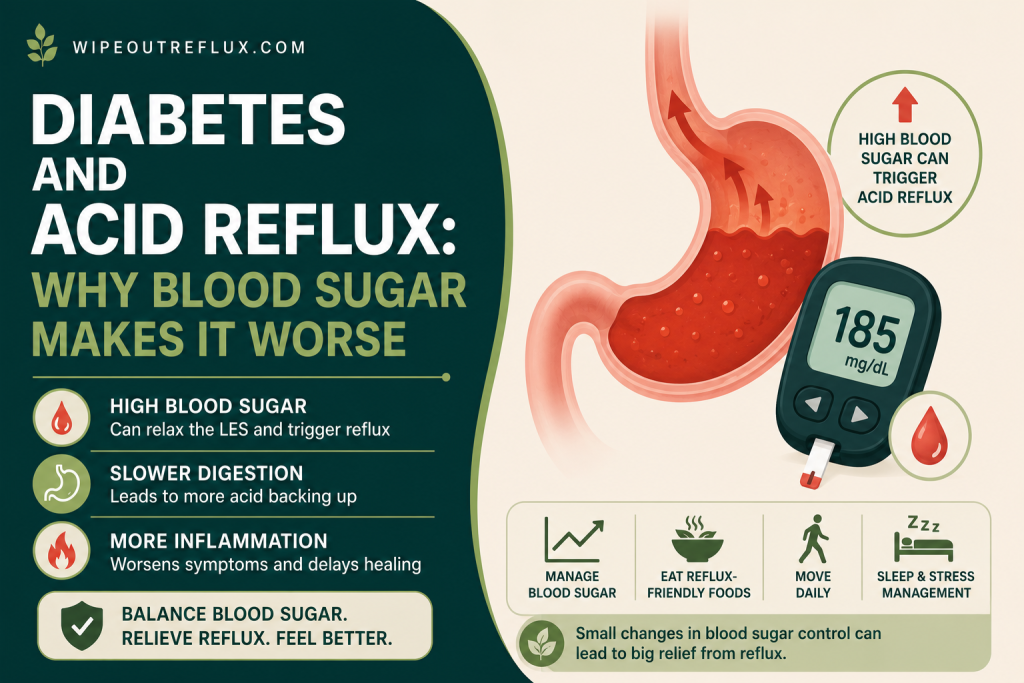
Diabetes raises your risk of reflux by around 60% — a meta-analysis of nine studies covering 9,067 people with reflux and 81,968 controls found an odds ratio of 1.61. But the more useful finding is how directly and immediately blood sugar itself is involved.
In a controlled study using an insulin-glucose clamp, researchers held blood glucose at either 4 mmol/L or 8 mmol/L — both within the normal after-meal range — and measured how fast a meal left the stomach. At 8 mmol/L, the time for half the liquid meal to empty was 57 minutes versus 32 minutes at 4 mmol/L. That’s nearly double, from a glucose difference most people wouldn’t consider high at all. And it happened in healthy volunteers as well as in people with diabetes.
So “blood sugar makes reflux worse” isn’t a vague wellness claim. Higher glucose slows your stomach down within the same meal, food and acid sit there longer, and the window for reflux widens.
There’s a second, harder problem too. Diabetic neuropathy damages the nerves controlling your gut — and it also dulls the nerves that report pain. In one study, people with diabetes and neuropathy had erosive oesophagitis at twice the rate of those without, while reporting typical reflux symptoms at exactly the same rate. Below: both mechanisms, and what actually helps.
This article is general information, not medical advice. Don’t change diabetes medication or targets without speaking to your diabetes team.
Key Takeaways
- Diabetes is associated with a 61% higher odds of reflux (OR 1.61, 95% CI 1.36–1.91) across nine studies and over 91,000 people.
- Raising blood glucose from 4 to 8 mmol/L slowed liquid gastric emptying from 32 to 57 minutes — in healthy subjects, not just diabetics.
- Solid food retention at 100 minutes rose from 36.7% to 55.2% over the same glucose range.
- Both figures sit inside the normal after-meal glucose range, so this isn’t only about poor control.
- Autonomic neuropathy causes gastroparesis, weakens oesophageal peristalsis, lowers sphincter pressure and reduces saliva.
- Neuropathy also blunts symptom perception — erosive oesophagitis was 66.7% with neuropathy vs 33.3% without, yet symptoms were identical.
- Asymptomatic erosive oesophagitis was four times more common in the neuropathy group (21.1% vs 5.3%).
- GLP-1 medications deliberately slow gastric emptying, which helps glucose but can worsen reflux.
- The meta-analysis was not adjusted for BMI, so shared obesity explains part — but not all — of the association.
- Metformin and PPIs both deplete vitamin B12, so taking them together warrants monitoring.
Why Blood Sugar Directly Slows Your Stomach
This is the mechanism that makes diabetes different from most reflux risk factors, because it operates meal by meal rather than over years.
Researchers took 8 healthy subjects and 9 people with insulin-dependent diabetes — deliberately choosing patients without gastrointestinal symptoms or evidence of neuropathy, so nerve damage couldn’t explain the results. Using an insulin-glucose clamp, they held blood glucose steady at 4 mmol/L on one day and 8 mmol/L on another, then measured gastric emptying of a mixed meal by scintigraphy.
The differences were substantial. In healthy subjects, solid food remaining in the stomach at 100 minutes was 55.2% at 8 mmol/L against 36.7% at 4 mmol/L. Time for half the liquid meal to empty was 57.0 minutes versus 32.2 minutes. The diabetic patients showed the same pattern, slightly less pronounced Schvarcz et al., Gastroenterology, 1997.
Three things about that deserve emphasis.
It happens in people without diabetes. This isn’t a diabetic complication — it’s normal physiology. Glucose regulates gastric emptying as part of a feedback loop that stops you absorbing sugar faster than you can handle it. Diabetes just means you spend far more time at the slow end of it.
The glucose levels were normal. Not 15 or 20 mmol/L. Eight millimoles per litre — roughly 144 mg/dL — is an unremarkable post-meal reading that many people with well-managed diabetes see routinely.
Slower emptying means a longer reflux window. While food sits in your stomach, there’s volume and pressure working against the valve at the top, and material available to reflux. Doubling that dwell time is a straightforward increase in exposure. It’s the same mechanism that makes fatty meals and large portions problematic, arriving by a different route. More on the general principle in gastroparesis and acid reflux.
There’s also a vicious circle here worth naming. Slow emptying makes post-meal glucose harder to predict, because carbohydrate arrives in the intestine at an irregular rate — which can cause both unexpected highs and hypos in people using insulin. Poorer glucose control then slows emptying further.
Neuropathy: The Long-Term Structural Damage
The acute glucose effect is reversible. Nerve damage largely isn’t, and it attacks the anti-reflux system at four separate points.
Diabetic autonomic neuropathy, particularly vagal nerve damage, is the accepted explanation for most gut dysfunction in diabetes. Oesophageal transit is delayed in around 35% of people with diabetes, and oesophageal dysfunction occurs frequently in those with autonomic neuropathy.
1. Gastroparesis. The vagus nerve drives the stomach’s grinding and pumping. Damage it and emptying slows chronically rather than just after a high-glucose meal. This is the acute effect made permanent.
2. Weakened oesophageal clearance. Once acid reaches the oesophagus, peristaltic waves are meant to sweep it back down. In diabetes, studies show reduced amplitude of contractions, fewer peristaltic waves and slower wave velocity. Acid that gets up stays up longer, so the same number of reflux episodes causes more damage. See oesophageal motility and acid reflux.
3. Lower sphincter pressure. Reduced resting lower oesophageal sphincter pressure has been documented in diabetes, so the barrier itself is weaker — background in the lower oesophageal sphincter and acid reflux.
4. Less saliva. Reduced salivary flow is common in diabetes, and it’s a genuinely underrated defence. Saliva is bicarbonate-rich and neutralises acid in the oesophagus and throat as you swallow. Less of it means slower neutralisation of whatever comes up. See saliva, bicarbonate and acid reflux and acid reflux and dry mouth.
Neuropathy typically appears 5 to 10 years after diabetes onset, and longer disease duration is associated with worse oesophageal function — so this is a reason for younger people with diabetes to take glucose control seriously now, not a fixed sentence. The vagal connection is explored further in the vagus nerve and acid reflux.
The Silent Damage Problem
This is the finding I’d most want anyone with long-standing diabetes to know, and it follows directly from the nerve damage.
Neuropathy damages afferent nerves — the ones carrying sensation from the gut — alongside the efferent nerves that control movement. So the same disease that increases reflux also reduces your ability to feel it.
In a study of type 2 diabetes patients who underwent electromyography for neuropathy, symptom interviews and endoscopy, typical reflux symptoms were reported at almost identical rates whether neuropathy was present or not — 23.6% versus 22.8%. But erosive oesophagitis was found in 66.7% of those with neuropathy against 33.3% without. Asymptomatic erosive oesophagitis was four times more common in the neuropathy group: 21.1% versus 5.3%. Peripheral neuropathy emerged as an independent risk factor for erosive oesophagitis while contributing nothing to typical symptoms Lee et al., Journal of Neurogastroenterology and Motility, 2011.
Read that carefully: twice the tissue damage, identical symptoms.
The practical implication is that heartburn is a poor guide to what’s happening in your oesophagus if you have diabetic neuropathy. “I don’t get reflux” carries less weight than it would otherwise. If you’ve had diabetes for a decade or more, have signs of neuropathy elsewhere — numbness or tingling in feet or hands — and have never had your upper gut looked at, that’s a reasonable thing to raise with your doctor. See endoscopy for acid reflux.
It also means atypical symptoms deserve more attention. Chronic cough, throat clearing, hoarseness and a lump-in-throat sensation can be reflux presenting without heartburn — and if pain perception is blunted, these may be the only clues you get. See GERD vs LPR.
What the Association Data Shows — and Its Limits
A meta-analysis pooled nine studies comprising 9,067 people with reflux and 81,968 controls, finding a significant association between diabetes and reflux risk (OR 1.61, 95% CI 1.36–1.91). The association was stronger in Asian populations (OR 1.71) than Western ones (OR 1.33), and stronger in people under 50 (OR 1.70). Sensitivity analysis was stable and there was no significant publication bias Sun et al., World Journal of Gastroenterology, 2015.
Two honest caveats, both acknowledged by the authors.
The data were not adjusted for BMI. That’s a significant limitation, because excess weight independently raises reflux risk and is also common in type 2 diabetes. Some of that 1.61 is almost certainly shared obesity rather than diabetes itself. The mechanistic evidence above is what convinces me there’s a real effect underneath — the glucose clamp study controlled for everything by using the same people at two glucose levels.
Most included studies were cross-sectional, so they establish association, not causation. Notably, none of the nine separated type 1 from type 2 diabetes, which would be worth knowing given how differently the two populations are distributed for weight.
My reading: the association is real but somewhat inflated by weight, and the direct glucose and neuropathy mechanisms are better evidence than the epidemiology.
Diabetes Medications That Can Make It Worse
GLP-1 receptor agonists — semaglutide, liraglutide, tirzepatide and others — slow gastric emptying deliberately. That’s part of how they work: food stays in the stomach longer, you feel full sooner, and glucose enters the bloodstream more gradually. It’s excellent for glycaemic control and weight, and it’s precisely the mechanism that worsens reflux.
This creates a genuine trade-off rather than a simple problem, because the weight loss these drugs produce reduces reflux risk substantially over time. Many people get worse before they get better. I’ve covered this in GLP-1 medications and silent reflux, does Ozempic cause heartburn, does Mounjaro cause acid reflux and the management question in omeprazole or famotidine with Ozempic and Mounjaro.
Metformin commonly causes nausea, bloating and abdominal discomfort, particularly when starting or increasing the dose. Slow-release formulations and taking it with food both help considerably, and most people adapt within a few weeks.
Other drug classes can contribute too — the wider list is in medications that make acid reflux worse.
What Actually Helps
Glucose control is reflux treatment
This is the point of the article. Given that moving from 4 to 8 mmol/L nearly doubled gastric emptying time, flattening your post-meal glucose spikes is not merely good diabetes management — it is directly reducing how long food sits in your stomach after every meal.
That reframes a lot of standard diabetes advice as reflux advice. Reducing rapidly absorbed carbohydrate, pairing carbohydrate with protein and fat, and eating meals in a consistent pattern all lower the peak your stomach has to work against. If you use continuous glucose monitoring, you already have the tool to see which meals produce the biggest spikes — and those are likely the meals that give you the worst reflux a couple of hours later.
Worth testing on yourself: note your reflux symptoms against your post-meal readings for a fortnight. The correlation is often clearer than people expect.
Smaller, more frequent meals
Doubly useful here. Smaller meals reduce both the glucose excursion and the gastric volume, addressing both mechanisms at once. If gastroparesis is established, this becomes essential rather than optional — along with reducing fat and insoluble fibre at individual meals, since both further slow emptying. See does overeating cause acid reflux.
Protect the evening especially carefully
If your stomach empties slowly, the standard three-hour gap before bed may not be enough. An evening meal that would clear comfortably in someone else may still be sitting there when you lie down. Consider making the evening meal the smallest and lightest of the day, and extend the gap where you can. See how long before bed you should stop eating and acid reflux at night. Raising the head of the bed matters more than usual for the same reason.
Medication for the reflux itself
PPIs remain the mainstay. An alginate is a useful addition because it works mechanically rather than chemically — see alginates for acid reflux and Gaviscon Advance.
Where diabetes differs is that prokinetics have a clearer rationale than in ordinary reflux, since delayed emptying is a documented part of the problem rather than a hypothesis. Domperidone and metoclopramide both have real side-effect profiles and are specialist decisions, but they’re worth asking about if gastroparesis is confirmed.
Watch the B12 double hit
A practical detail that’s easy to miss: metformin reduces vitamin B12 absorption, and so do PPIs. If you’re on both long-term — which is a very common combination in this group — you have two independent depleting influences. Ask about periodic B12 checks. See omeprazole and B12 deficiency, and omeprazole and low magnesium for the related issue.
Weight, where relevant
Since the meta-analysis wasn’t adjusted for BMI and excess weight independently drives reflux, weight reduction addresses both conditions. Guidelines specifically recommend it for reflux patients who are overweight Katz et al., The American Journal of Gastroenterology, 2022. Reflux-friendly forms of activity are covered in exercise and acid reflux.
When to See a Doctor
Seek medical advice if you have:
- Difficulty or pain on swallowing, or food sticking
- Vomiting undigested food from hours earlier — a classic gastroparesis sign
- Persistent vomiting, or unexplained nausea
- Vomiting blood, or black tarry stools
- Unintentional weight loss
- Increasingly unpredictable blood glucose, particularly unexplained post-meal hypos
- Reflux not responding to treatment
That penultimate one is worth flagging to your diabetes team specifically, since erratic glucose after meals can be the first sign of gastroparesis before any gut symptoms appear. And given the silent damage findings above, a low threshold for investigation is reasonable if you have long-standing diabetes with neuropathy. See when to see a doctor and can acid reflux make it hard to swallow.
Conclusion
Diabetes raises reflux risk by around 60%, and part of that is shared weight rather than diabetes itself — the meta-analysis wasn’t adjusted for BMI, and it would be dishonest not to say so. But two mechanisms make the link real regardless.
The first is immediate and, unusually for reflux, entirely within your influence. Blood glucose regulates gastric emptying directly, and the effect is large: moving from 4 to 8 mmol/L nearly doubled the time for a liquid meal to half-empty, in healthy people as well as diabetics. Every meal that spikes your glucose is a meal that sits in your stomach longer. That makes glucose control a reflux intervention, not just a diabetes one — and it’s why flattening post-meal peaks may do more for your heartburn than another antacid.
The second is slower and harder. Autonomic neuropathy weakens the stomach’s pump, the oesophagus’s clearing waves, the sphincter’s closing pressure and your saliva production — four defences at once. And because it damages sensory nerves too, it takes away your warning system. Twice the erosive oesophagitis, identical symptoms. If you have long-standing diabetes and no heartburn, that’s genuinely weaker reassurance than it sounds, and it’s the single most useful thing to take from this article.
Practically: treat your post-meal glucose curve as a reflux variable and watch what happens. Keep meals smaller and the evening one lightest. Extend your pre-bed gap beyond the usual three hours if emptying is slow. Ask about prokinetics if gastroparesis is confirmed, and about B12 if you’re on metformin and a PPI together. And if you’re starting a GLP-1, expect reflux to worsen before the weight loss starts helping.
Because meal size, composition and timing sit at the centre of both conditions, this is a situation where getting the eating right does double duty. Working out which foods need to go, which just need portioning or timing differently, and in what order to test them is most of the real work — and it’s what the Wipeout Diet Plan is structured around, as a way of reducing reflux episodes rather than a list of prohibitions. I built it first and foremost for LPR and silent reflux, the stubborn throat-based form that responds worst to medication, though because it targets the same underlying mechanisms it works just as well for GERD and everyday heartburn. Alongside it, the Wipeout Food Reference Guide is the practical companion — the full list of foods and drinks that are safe for acid reflux and LPR with their actual pH values, so you can build meals that suit your glucose and your oesophagus at the same time.
Frequently Asked Questions
Does high blood sugar cause acid reflux?
It contributes directly. Raising blood glucose from 4 to 8 mmol/L slowed liquid gastric emptying from 32 to 57 minutes in a controlled study — and that happened in healthy volunteers too, so it’s normal physiology rather than a diabetic complication. Food sitting longer means a longer window for reflux.
How much more likely is reflux if I have diabetes?
Around 61% higher odds (OR 1.61) across nine studies covering more than 91,000 people. The association was stronger in Asian populations and in people under 50. Worth noting the analysis wasn’t adjusted for body weight, so shared obesity explains part of it.
Can diabetes cause reflux without heartburn?
Yes, and this is the most important point in the article. In people with diabetic neuropathy, erosive oesophagitis was found in 66.7% versus 33.3% without neuropathy — while typical reflux symptoms were reported at identical rates. Asymptomatic erosive oesophagitis was four times more common. Nerve damage dulls the warning as well as causing the problem.
Will better blood sugar control improve my reflux?
It should help, particularly with the acute component, since the glucose effect on gastric emptying is immediate and reversible. Damage already done by neuropathy won’t reverse, but reducing post-meal spikes reduces how long each meal lingers. It’s worth tracking symptoms against your readings for a fortnight to see your own pattern.
Why does Ozempic or Mounjaro make my reflux worse?
Because slowing gastric emptying is part of how GLP-1 medications work — it’s the mechanism, not a side effect gone wrong. The trade-off is that the weight loss they produce reduces reflux risk substantially over time, so many people find it worsens before improving. Discuss it with your prescriber rather than stopping.
What is diabetic gastroparesis and how is it different from reflux?
Gastroparesis is delayed stomach emptying from vagus nerve damage. It’s a cause of reflux rather than the same thing. Distinctive signs include feeling full very quickly, nausea, vomiting food eaten hours earlier, and erratic post-meal glucose. Reflux is what happens downstream when the stomach doesn’t empty properly.
Does metformin cause acid reflux?
It commonly causes nausea, bloating and abdominal discomfort, particularly early on, though a specific reflux effect is less established. Slow-release formulations and taking it with food both help, and most people adapt within a few weeks. Don’t stop it without speaking to your diabetes team.
Should I take a PPI long-term if I have diabetes?
Often reasonable given the raised risk, but worth reviewing periodically. One specific thing to watch: metformin and PPIs both reduce vitamin B12 absorption, so if you take both long-term, ask about periodic B12 monitoring.
Does type 1 or type 2 diabetes carry more reflux risk?
Nobody knows properly — none of the nine studies in the meta-analysis separated them. Mechanistically, type 2 carries more weight-related risk while both carry neuropathy risk with duration. The glucose effect on gastric emptying applies to both, and was demonstrated in type 1 patients specifically.
Should I have an endoscopy if I have diabetes but no heartburn?
Not routinely, but the threshold should be lower than usual if you’ve had diabetes for a decade or more and have neuropathy elsewhere, given how poorly symptoms track damage in that group. It’s a conversation to have with your doctor rather than a blanket recommendation.
Research & References
- Schvarcz et al., Gastroenterology, 1997 — Study of 8 healthy subjects and 9 patients with insulin-dependent diabetes without gastrointestinal symptoms or evidence of neuropathy, in which gastric emptying of a mixed meal was measured by scintigraphy with blood glucose stabilised at 4 and 8 mmol/L on separate days using an insulin-glucose clamp. Intragastric retention of the solid meal at 100 minutes was 55.2% at 8 mmol/L versus 36.7% at 4 mmol/L (P = 0.004) in healthy subjects, and 44.2% versus 35.7% (P = 0.004) in diabetic patients. Time to 50% emptying of the liquid meal was 57.0 minutes versus 32.2 minutes (P = 0.002) in healthy subjects. The authors concluded that changes in blood glucose within the normal postprandial range have a significant impact on gastric emptying.
- Lee et al., Journal of Neurogastroenterology and Motility, 2011 — Study of 119 patients with type 2 diabetes enrolled in Korea, of whom 95 were finally analysed, undergoing electromyography for peripheral neuropathy, face-to-face symptom interviews and oesophagogastroduodenoscopy. Typical reflux symptoms were similar with and without neuropathy (23.6% vs 22.8%), but erosive oesophagitis was more frequent with neuropathy (66.7% vs 33.3%) and asymptomatic erosive oesophagitis significantly more frequent (21.1% vs 5.3%). Peripheral neuropathy was an independent risk factor for erosive oesophagitis without contributing to typical symptoms.
- Sun et al., World Journal of Gastroenterology, 2015 — Meta-analysis of nine observational studies comprising 9,067 individuals with gastro-oesophageal reflux disease and 81,968 controls. Diabetes was significantly associated with reflux risk (pooled OR 1.61, 95% CI 1.36–1.91, P = 0.003) using a random-effects model, with stronger associations in Asian populations (OR 1.71) than Western (OR 1.33) and in those under 50 (OR 1.70). No significant publication bias was found. The authors noted that most included studies were cross-sectional, that none separated type 1 from type 2 diabetes, and that the data were not adjusted for BMI.
- Katz et al., The American Journal of Gastroenterology, 2022 — ACG clinical guideline for the diagnosis and management of gastro-oesophageal reflux disease, which recommends weight loss for patients who are overweight, suggests avoiding meals within 2 to 3 hours of bedtime, and suggests avoiding individual trigger foods as a conditional recommendation on low-quality evidence.

David Gray
12 years living with LPR · Consultant & researcher
I've lived with LPR for twelve years — the misdiagnoses, the PPI courses that did nothing, the slow work of figuring out what actually helps. Wipeout Reflux is where I translate the research into plain terms for people stuck in the same place. Every claim here is sourced to peer-reviewed work, and I consult one-to-one with LPR sufferers.